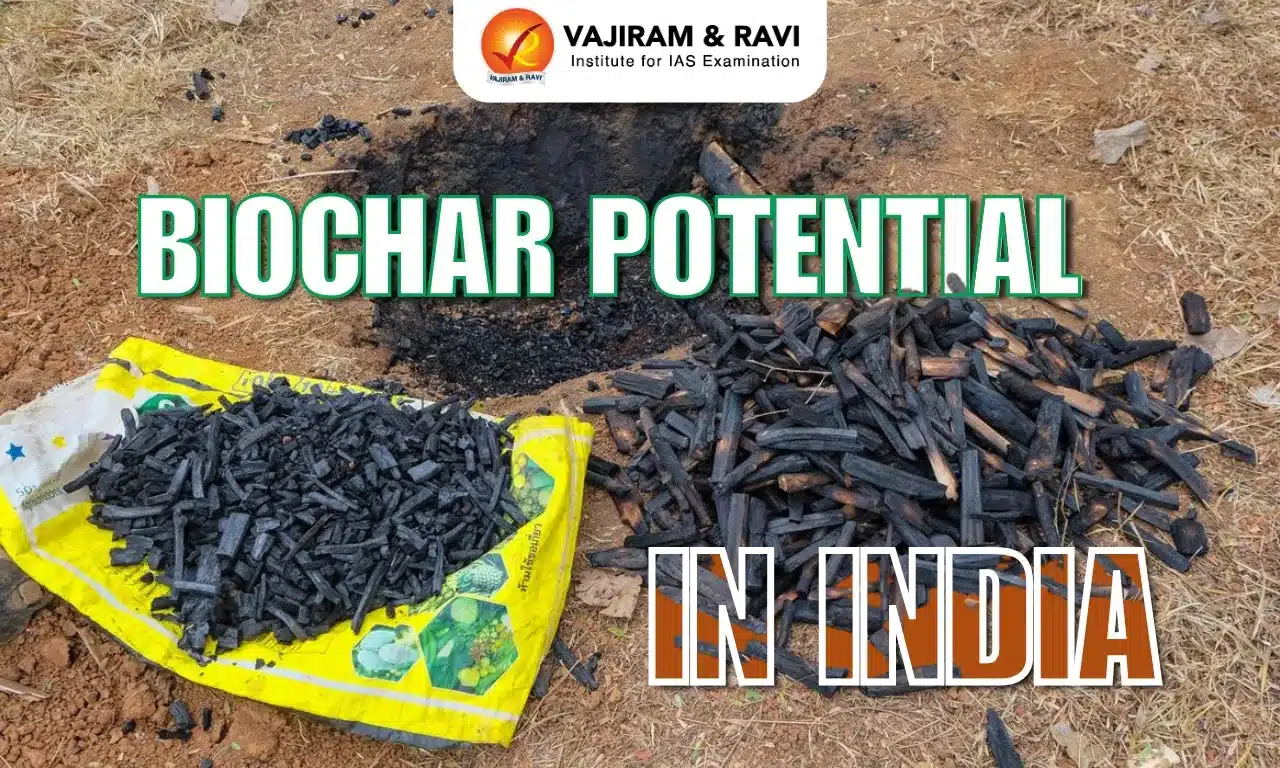
Unlocking Biochar’s Potential: India’s Green Solution for Carbon Removal

Biochar Potential in India

Biochar Potential in India Latest News

  • India’s upcoming carbon market, expected to launch in 2026, positions biochar as a key carbon dioxide removal (CDR) technology. 
  • Produced from agricultural residue and organic municipal waste, biochar is a carbon-rich charcoal that offers a dual advantage: sustainable waste management and long-term carbon sequestration. 
  • However, to transform biochar into a scalable and impactful solution for negative emissions, active involvement and coordinated support from various stakeholders across sectors is essential.

Unlocking Biochar’s Climate and Energy Potential in India

  • India produces over 600 million metric tonnes of agricultural residue and 60 million tonnes of municipal solid waste annually, much of which is either burnt or dumped, contributing to severe air pollution and greenhouse gas emissions. 
  • Harnessing just 30–50% of this surplus waste could yield 15–26 million tonnes of biochar annually, enabling the removal of approximately 0.1 gigatonnes of CO2-equivalent. 
  • Additionally, biochar production generates valuable byproducts like syngas and bio-oil. 
  • These can produce 8–13 TWh of electricity—about 0.5–0.7% of India’s total—and replace up to 0.7 million tonnes of coal each year. 
  • Bio-oil could also substitute 12–19 million tonnes of diesel or kerosene, lowering crude oil imports and cutting over 2% of fossil fuel-based emissions.

Biochar as a Versatile and Long-Term Carbon Sink

  • Biochar’s stable molecular structure enables it to sequester carbon in soil for 100 to 1,000 years, making it a highly effective and long-lasting carbon sink. 
  • Its applications across agriculture, industry, construction, and wastewater treatment offer scalable opportunities for reducing greenhouse gas emissions. 
  • In agriculture, biochar enhances water retention and can reduce nitrous oxide emissions—273 times more potent than CO₂—by 30–50%. 
  • It also improves soil organic carbon and aids in restoring degraded lands. 
  • In industrial carbon capture, specially modified biochar can absorb CO₂ from exhaust gases, though it currently has lower efficiency than conventional methods. 
  • In the construction sector, incorporating 2–5% biochar in concrete can strengthen the material, boost heat resistance by 20%, and capture up to 115 kg of CO₂ per cubic metre. 
  • Additionally, in wastewater treatment, one kilogram of biochar can treat 200–500 litres of water, unlocking a potential demand of 2.5–6.3 million tonnes annually in India, which produces over 70 billion litres of wastewater daily.

Barriers to Biochar Adoption 

  • Despite its immense potential as a carbon sink and its wide applicability across sectors, biochar’s adoption remains limited due to several systemic challenges. 
  • Key among them are the lack of standardised feedstock markets and uniform carbon accounting frameworks, which diminish investor confidence and hinder its recognition in carbon credit systems. 
  • Although research supports its technical feasibility, deployment is constrained by limited financial resources, evolving technologies, market uncertainties, and insufficient policy backing. 
  • The absence of viable business models and weak awareness among stakeholders further restrict market development. 
  • Additionally, the lack of robust monitoring, reporting, and verification (MRV) systems, coupled with poor coordination across agriculture, energy, and climate policies, slows progress. 

The Road Ahead

  • To overcome these hurdles, India must invest in region-specific R&D, integrate biochar into crop residue management and bioenergy programmes, and formally recognise it as a carbon removal pathway in its upcoming carbon market. 
  • This can not only unlock carbon credit revenue for farmers and investors but also generate over 5.2 lakh rural jobs. 
  • The added benefits of improved soil health, reduced fertilizer use (by 10–20%), and enhanced crop yields (by 10–25%) underscore the need to mainstream biochar in both policy and market frameworks. 

Conclusion

  • In sum, although biochar is not a silver bullet, it offers a science-backed multisectoral pathway for India to achieve its climate and development goals.

Source: TH

Biochar Potential in India FAQs

Q1: What is biochar and how is it produced?

Ans: Biochar is carbon-rich charcoal made from agri-residue and waste, offering carbon capture and waste management solutions.

Q2: How much CO₂ can biochar offset in India?

Ans: Biochar can potentially remove 0.1 gigatonnes of CO₂ annually if 30–50% of surplus waste is used.

Q3: What are biochar’s sectoral applications?

Ans: Biochar can be used in agriculture, construction, carbon capture, and wastewater treatment, offering wide climate benefits.

Q4: What are the main barriers to biochar adoption?

Ans: Lack of standardised carbon metrics, policy support, and viable business models limits large-scale biochar deployment.

Q5: How can India promote biochar adoption?

Ans: Through R&D, carbon credit recognition, and rural deployment, India can generate jobs and mainstream biochar as a green solution.

India’s Herbicide Boom: Changing Trends in Crop Protection

India’s Herbicide Market

India’s Herbicide Market Latest News

  • Crop protection chemicals, commonly referred to as pesticides, are substances applied to crops to safeguard them from damage caused by pests. 
  • These pests may harm crops directly by feeding on them or indirectly by spreading diseases. 
  • For instance, the white-backed plant hopper attacks rice crops both by feeding on them and by transmitting the Fiji virus, which leads to stunted plant growth—a problem currently affecting paddy farmers in Punjab and Haryana. 
  • While insecticides target such harmful insects, crop protection chemicals also include fungicides for fungal diseases like blast in rice and rust in wheat, and herbicides to control weeds that compete with crops for nutrients.
  • This article explores how rising labour shortages and evolving farming practices are driving a rapid shift in India’s pesticide market, especially towards herbicides, amid multinational dominance and Indian innovation.

Herbicides: The Fastest-Growing Segment in India’s Crop Protection Market

  • India’s organised crop protection chemicals market, valued at approximately ₹24,500 crore, is witnessing rapid growth in the herbicide segment. 
  • While insecticides lead the market at ₹10,700 crore, herbicides follow closely at ₹8,200 crore, growing at an annual rate of over 10%, the fastest among all segments. 

  • This space is largely dominated by multinational giants, many of which are backed by Chinese state-owned Sinochem Holdings. However, Indian companies are also making inroads. 

Labour Shortage Fuels Surge in Herbicide Use

  • Weeds indirectly harm crops by competing for essential resources like water, nutrients, and sunlight, and sometimes even hosting pests and pathogens. 
  • Traditionally, farmers controlled weeds through manual weeding or tools like khurpi, and in recent years, power weeders. 
  • However, manual weeding is labour-intensive and time-consuming—requiring 8–10 hours per acre—and needs to be repeated throughout the crop cycle. 
  • Though power weeders reduce this to 2–3 hours, they are not effective for all weed types, especially those with deep roots or growing in dense crop areas
  • Meanwhile, agricultural labour shortages have worsened, and wages have risen significantly—from ₹326.2 in 2019 to ₹447.6 in 2024. 
  • With fewer rural workers willing to engage in strenuous fieldwork, farmers increasingly rely on herbicides. 
  • Herbicides now function as labour-saving tools, much like tractors, addressing the twin challenges of time and workforce scarcity in Indian agriculture.

Shift Towards Preventive Herbicide Use in Indian Agriculture

  • Traditionally, farmers applied insecticides, fungicides, and herbicides only when pest or weed infestations visibly crossed economic threshold levels—when anticipated crop losses justified the cost of treatment. 
  • However, the herbicide market is evolving with a growing shift towards preventive strategies
  • Farmers are increasingly using pre-emergent herbicides—sprayed around or just after sowing—to prevent weed growth altogether and maintain clean fields from the outset. 
  • Others opt for early post-emergent herbicides to target weeds during the crop’s sensitive early stages. 
  • This proactive approach is gaining momentum, especially amid acute farm labour shortages. 
  • In the ₹1,500-crore paddy herbicide market, pre-emergent products make up about ₹550 crore, and roughly 20% of the ₹1,000-crore wheat herbicide market. 
  • These sub-segments are now the main drivers of growth in India's crop protection space, reflecting a broader shift from reactive to preventive weed management.

Multinational Monopoly and Indian Push in Herbicide Market

  • While India has a diverse base of public and private players in seeds and fertilisers, its crop protection chemicals industry remains dominated by multinational corporations, raising concerns of monopoly. 
  • Despite this, Indian firms are gradually making inroads. Crystal Crop Protection Ltd (CCPL), for example, is developing innovative products through international collaborations. 
  • In partnership with multinational corporations, CCPL introduced a new paddy herbicide called Sikosa, which combines two active ingredients—Bensulfuron-methyl and Pretilachlor—in a patented oil-dispersion formulation. 
  • This formulation allows efficient application within 0–3 days after transplanting, offering broad-spectrum weed control at a cost-effective price of ₹850–₹900 per acre—far cheaper than manual weeding. 
  • While such developments show promise, India still lacks a dominant global player like China’s Sinochem Holdings Corporation, reflecting the long road ahead for Indian companies in breaking the multinational stronghold.

Source: IE

India’s Herbicide Market FAQs

Q1: What is driving herbicide use in India?

Ans: Labour shortages and rising costs are driving Indian farmers to adopt herbicides as substitutes for manual weeding.

Q2: Which segment of pesticides is growing fastest?

Ans: Herbicides are the fastest-growing segment, expanding over 10% annually in India’s ₹24,500 crore crop protection chemicals market.

Q3: Why are pre-emergent herbicides gaining popularity?

Ans: Farmers now prefer pre-emergent herbicides for preventive weed control, especially amid worsening agricultural labour shortages.

Q4: Who dominates India’s herbicide market?

Ans: Multinational firms like Bayer, Syngenta, and Corteva dominate, though Indian firms like CCPL are gaining ground.

Q5: How are Indian firms innovating in this space?

Ans: Indian firms like CCPL are partnering globally to develop cost-effective, innovative herbicide formulations like Sikosa.

Merchant Shipping Bill – Modernising India’s Maritime Law

Merchant Shipping Bill

Maritime Law Latest News

  • Parliament has passed the Merchant Shipping Bill, 2024 and the Carriage of Goods by Sea Bill, 2025, to modernise India’s maritime laws and align them with global standards.

Introduction

  • In a significant move to overhaul India’s maritime legal infrastructure, Parliament has passed two landmark legislations: the Merchant Shipping Bill, 2024 and the Carriage of Goods by Sea Bill, 2025
  • These Bills aim to modernise outdated maritime laws, bring India in line with international maritime conventions, and support the country’s ambitions to become a leading player in global shipping and trade.

Modernisation of India’s Maritime Legal Framework

  • India’s maritime sector had long been governed by the Merchant Shipping Act of 1958 and the Indian Carriage of Goods by Sea Act, 1925, both of which had become outdated, fragmented, and inadequate for handling contemporary maritime challenges. 
  • The newly passed Bills represent a decisive departure from these colonial-era frameworks.
  • According to the Union Ministry of Ports, Shipping and Waterways, the reforms signal a “double endorsement” of the Centre’s push toward modern shipping infrastructure and legal clarity.

Merchant Shipping Bill, 2024

  • This Bill replaces the old 1958 Act with a comprehensive and future-ready legal structure. 
  • With 16 Parts and 325 clauses, it simplifies compliance, strengthens safety norms, and reflects India’s commitments under key International Maritime Organisation (IMO) conventions.
  • Key Features:
    • Seafarer Welfare: Prioritises working conditions, welfare, and protection of Indian and foreign seafarers operating under Indian jurisdiction.
    • Safety and Emergency Response: Strengthens frameworks for ship safety, emergency preparedness, and marine pollution control.
    • Environmental Protection: Integrates IMO protocols to safeguard marine ecosystems.
    • Tonnage Promotion: Encourages the registration of ships under the Indian flag to boost domestic tonnage.
    • Compliance Simplification: Consolidates fragmented provisions, thereby reducing red tape for maritime operators.
  • The Government stressed that the legislation not only updates India’s shipping law but also positions the country as a “globally respected maritime jurisdiction” ready for sustainable growth and investment.

The Carriage of Goods by Sea Bill, 2025

  • This Bill repeals the Indian Carriage of Goods by Sea Act, 1925 and brings in a modern legal structure to regulate cargo movement via sea. 
  • It is particularly significant for exporters, importers, shipping companies, and insurers.
  • Key Features:
    • Hague-Visby Rules Compliance: Aligns India’s cargo liability laws with globally accepted standards followed by countries like the UK, simplifying cross-border transactions.
    • Commercial Efficiency: The new rules enhance transparency in contracts and dispute resolution, helping to reduce litigation and boost investor confidence.
    • Trade Facilitation: It streamlines the legal process surrounding cargo shipping, making India more attractive to international shipping and logistics companies.

Strategic Significance for India’s Maritime Sector

  • Together, the two Bills lay the foundation for India’s blue economy by:
    • Promoting ease of doing business in maritime logistics.
    • Unlocking investment potential in ports, shipbuilding, and maritime technology.
    • Supporting India’s maritime security architecture through better legal and regulatory frameworks.
    • Creating opportunities for green maritime initiatives and sustainable coastal development.
  • The reforms are also expected to generate employment, especially in coastal states, and enhance India’s capability to compete with global maritime powers such as Singapore, China, and the UAE.

Source : TH

Merchant Shipping Bill FAQs

Q1: What is the Merchant Shipping Bill, 2024?

Ans: It is a modern maritime law replacing the outdated Merchant Shipping Act, 1958, to align with global conventions and improve seafarer welfare.

Q2: Why was the Carriage of Goods by Sea Bill, 2025 introduced?

Ans: It repeals the 1925 Act and adopts international standards to improve transparency and reduce legal disputes in maritime cargo transport.

Q3: How do the Bills benefit Indian seafarers and shipping companies?

Ans: They improve safety, simplify compliance, promote Indian-flagged ships, and enhance working conditions for seafarers.

Q4: What international standards do these Bills align with?

Ans: The Bills align with key conventions of the International Maritime Organization (IMO), including the Hague-Visby Rules.

Q5: What is the broader aim of these maritime reforms?

Ans: To position India as a globally respected maritime jurisdiction and facilitate growth in trade, investment, and sustainability.

Enquire Now