
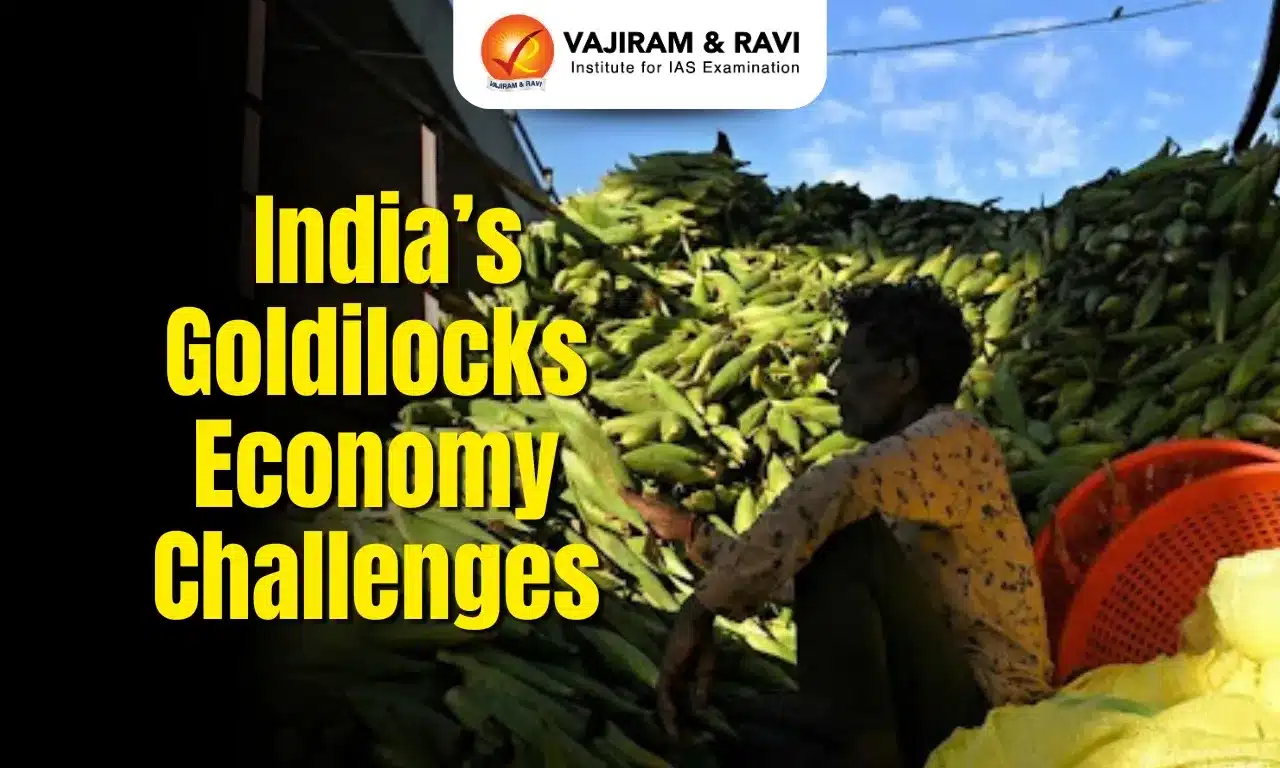
India’s Economic Equilibrium: Cracks in the Goldilocks Growth Story

India’s Goldilocks Economy Challenges

India’s Goldilocks Economy Challenges Latest News

  • India’s Finance Ministry recently hailed the economy’s “Goldilocks situation” — moderate growth, low inflation, and favourable monetary conditions — with analysts noting strong 7.6% GDP growth, peak interest rates, and steady corporate earnings. 
  • The country ended FY2024 as a $3.6 trillion economy, signalling optimism for 2025. 
  • However, seasoned economists caution that this rosy picture masks deeper structural imbalances, making the golden equilibrium more fragile than it appears.

Inflation and Stagnant Wage Growth: The Cracks in the “Goldilocks” Narrative

  • While headline CPI inflation eased from 4.8% in May 2024 to 2.82% by May 2025, food inflation told a harsher story. 
  • The Consumer Food Price Index (CFPI) often outpaced general inflation, peaking at 10.87% in October 2024 against CPI’s 6.21%. 
  • Even in moderate months, the gap persisted, disproportionately hurting lower-income households, for whom food constitutes nearly half the consumption basket. 
  • This volatility, driven by weather disruptions, supply chain issues, and global commodity swings, eroded real incomes and destabilised household budgets, undermining the perception of price stability.

Erosion of Real Wages

  • The wage data further challenges the “Goldilocks” image. In 2023, an average nominal salary hike of 9.2% translated to only 2.5% real wage growth. 
  • In 2020, real wages even turned negative (-0.4%) despite nominal growth of 4.4%. 
  • For 2025, projected real wage growth of 4% against an 8.8% nominal rise means inflation still halves the gain. 
  • This persistent erosion squeezes household savings, curtails discretionary spending, and increases debt dependence — particularly in sectors with modest pay hikes like IT services, manufacturing, engineering, and consumer industries.

The Silent Squeeze on Households

  • A salary hike loses its promise when inflation eats away its value — a 9% raise feels like just 2% in purchasing power if prices rise 7%. 
  • For many families, this silent squeeze means compromising on quality of life, reducing essential and discretionary consumption, and struggling with financial uncertainty, exposing the fragility beneath India’s supposed macroeconomic equilibrium.

Income Inequality and Fiscal Pressures: Questioning the “Goldilocks” Claim

  • India’s headline GDP growth masks deep-seated structural issues of inequality and fiscal strain. 
  • While the Gini coefficient for taxable income has declined from 0.489 in AY13 to a projected 0.402 in AY23, this improvement is limited to the formal sector and excludes the vast informal workforce
  • The post-pandemic recovery has been K-shaped, benefiting affluent segments and specific industries, while real wages for low-income groups have stagnated. 
  • This persistent disparity risks weakening social cohesion, restricting access to quality education and healthcare, and constraining long-term inclusive growth.
  • On the fiscal front, the government is committed to reducing the fiscal deficit from 6.4% in 2022-23 to 4.4% in 2025-26, with similar declines in revenue and primary deficits. 
  • However, these deficits remain high, necessitating large-scale borrowing that could crowd out private investment, slow job creation, and curb economic expansion. 
    • With public debt-to-GDP at around 81%—well above the FRBM target of 60%—a significant share of future revenues will be consumed by debt servicing, limiting funds for social sector spending and potentially leading to higher taxes. 
  • Together, entrenched inequality and fiscal vulnerabilities challenge the sustainability of India’s so-called “Goldilocks” economy.

Beyond the “Goldilocks” Illusion: India’s Underlying Economic Fragilities

  • India’s so-called “Goldilocks” economy—marked by strong GDP growth, low inflation, and stable macro indicators—conceals deeper structural weaknesses. 
  • Volatile food inflation, stagnant real wages, persistent income inequality, and constrained fiscal space undermine the perception of a universally shared macroeconomic sweet spot. 
  • While headline numbers project stability, the benefits of growth remain concentrated among a select few, leaving large sections of the population struggling with eroded purchasing power and limited economic opportunity. 
  • True equilibrium lies not in surface-level metrics but in inclusive growth that boosts real incomes, narrows inequality, and strengthens fiscal resilience. 
  • Without addressing these systemic challenges, the notion of a “just right” economy risks remaining an illusion for millions of Indians.

Source: TH

India’s Goldilocks Economy Challenges FAQs

Q1: What is India’s “Goldilocks” economy?

Ans: It refers to a phase of moderate growth, low inflation, and stable macroeconomic conditions without overheating.

Q2: Why is food inflation a concern?

Ans: Volatile food prices disproportionately hurt lower-income households, eroding purchasing power and destabilising budgets.

Q3: How are wages impacting growth?

Ans: Stagnant real wages limit household savings, cut spending, and increase debt dependence.

Q4: What role does inequality play?

Ans: Persistent disparities risk weakening social cohesion and limiting inclusive economic growth.

Q5: Why is fiscal pressure a threat?

Ans: High deficits and public debt crowd out private investment, reducing funds for social spending.
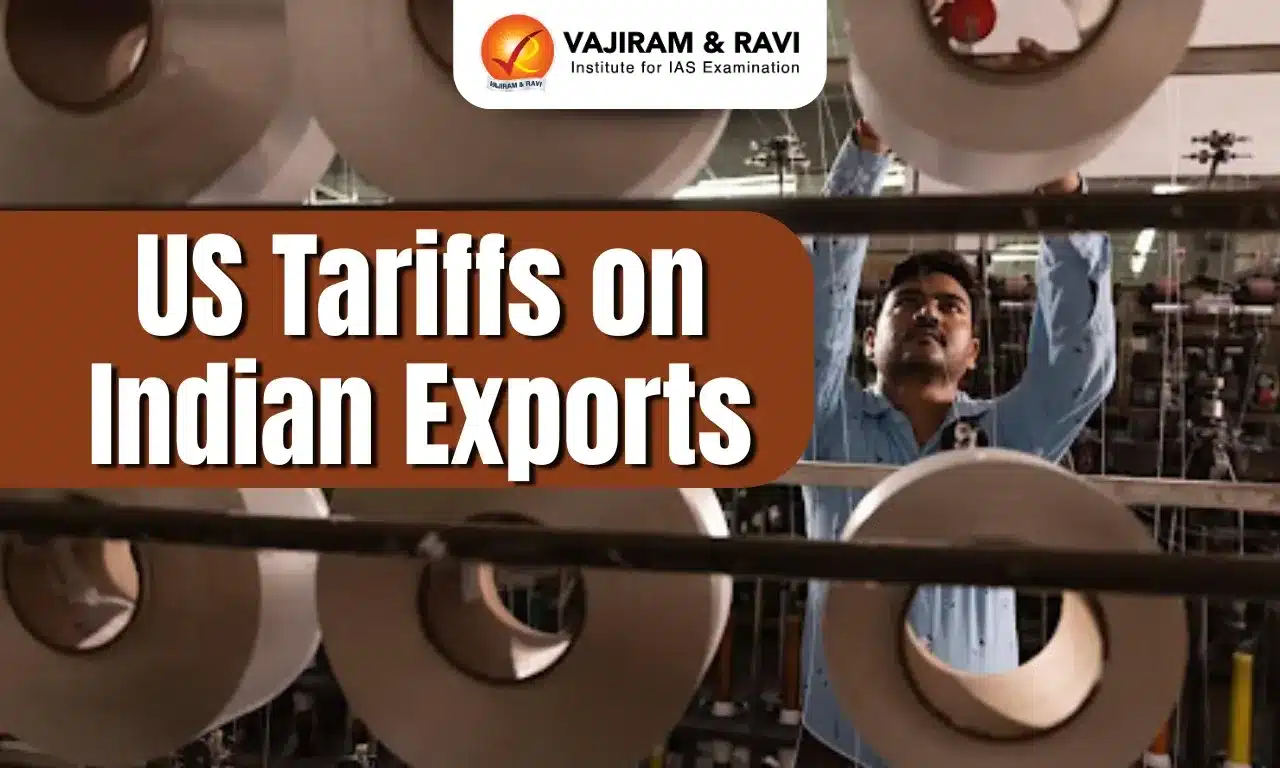
Trump’s 50% Tariff on India: Economic Impact, Trade Tensions, and Strategic Response

US Tariffs on Indian Exports

US Tariffs on Indian Exports Latest News

  • The US has imposed an additional 25% tariff on Indian imports, citing India’s Russian energy purchases, raising total tariffs to 50%—the highest for any nation. 
  • India condemned the move as “unfair, unjustified and unreasonable.” Experts warn it could reduce India’s annual GDP by over 0.5 percentage points.

Trump’s Reasons for Targeting India with Higher Tariffs

  • While officially citing India’s energy imports from Russia, the additional tariffs appear aimed at pressuring India into signing a US-favourable trade deal. 
  • Trump has long labelled India as one of the most protectionist nations, with high trade and non-trade barriers limiting foreign market access. 
  • He argues these barriers enable India to maintain a trade surplus with the US, meaning India exports more to the US than it imports. 
  • Trump’s broader goal is to reduce this trade deficit and establish what he considers balanced trade relations.
    • Trump’s notion is not rooted in promoting free trade but in achieving “balanced trade,” meaning zero trade deficit.
    • However, balanced trade between two countries rarely occurs naturally, as nations typically have deficits with some partners and surpluses with others
    • What truly matters is avoiding an overall trade deficit that becomes unsustainable, where imports significantly exceed a country’s capacity to pay.

Impact of Tariffs on Reducing Trade Deficit

  • A tariff acts as a tax on imported goods, making them costlier for domestic consumers. 
  • With a 50% tariff on Indian imports, US buyers will find these products significantly more expensive, leading to reduced demand. 
  • They may switch to cheaper alternatives from other countries or avoid purchasing the product altogether. 
  • As imports from India decline—while US exports to India remain unchanged—the US trade deficit with India will narrow and could eventually be eliminated.

Tariffs as a Tool to Push for a Trade Deal

  • Beyond reducing imports, tariffs are being used to pressure India into a trade deal aimed at eliminating the trade deficit. 
  • This could be achieved by compelling India to open its domestic markets to more US goods, thereby boosting US exports, or by urging the Indian government and related entities to purchase more American products—such as defence equipment or crude oil—directly contributing to narrowing the deficit.

Why Retaliatory Tariffs May Backfire for India

  • Imposing tariffs on US imports would hurt Indian consumers by raising costs and reducing imports from the US. 
  • This could widen India’s trade deficit, prompting further US tariffs since Trump’s primary goal is to eliminate the deficit.

Impact of US Tariffs on Indian Economy and Jobs

  • While tariffs are imposed between governments, their real effect hits companies and workers by disrupting supply chains. 
  • Indian exporters, especially in labour-intensive sectors like textiles, carpets, and food products, may lose contracts to competitors in un-tariffed countries, causing job losses and livelihood disruptions. 
  • The deeper impact lies less in GDP decline and more in employment devastation.

Overall Economic Exposure

  • Only around 20% of India’s goods exports — about 2% of GDP — are US-bound, limiting the direct macroeconomic hit. 
  • However, certain sectors are disproportionately dependent on US trade, making them more vulnerable. 
  • Experts estimate that $8 billion worth of exports, including gems and jewellery, apparel, textiles, and chemicals, could be most at risk.

Sectoral Impact

  • Vulnerable Sectors: Gems and jewellery, textiles, apparel, and chemicals are expected to bear the brunt, potentially prompting targeted government support measures.
  • Less Affected Sectors: IT services are not targeted, shielding much of the equity market. Pharmaceutical exports to the US are also expected to remain unaffected.
  • Excluded Goods: Steel, aluminium (taxed separately), semiconductors, and derived electronic products are exempt. Apple’s large-scale Indian manufacturing is unlikely to be impacted.

India’s Strategic Response to US Tariffs

  • In the short term, India must focus on minimising losses through trade negotiations
  • Over the long term, it needs urgent domestic reforms to boost manufacturing, skill development, infrastructure quality, logistics efficiency, and ease of doing business
  • Tax relief, a national human resource policy, and leveraging its young population are essential. 
  • Global trade rewards strength, and India must address structural weaknesses to avoid economic exploitation and punitive measures.

Source: IE | CNBC | IE

US Tariffs on Indian Exports FAQs

Q1: Why did Trump raise tariffs on India?

Ans: To pressure India over Russian energy imports and negotiate a US-favourable trade deal.

Q2: How do tariffs reduce trade deficit?

Ans: Higher import costs reduce US demand for Indian goods, lowering imports and narrowing the deficit.

Q3: Which sectors are most vulnerable?

Ans: Gems, jewellery, textiles, apparel, and chemicals face the highest risk.

Q4: Why avoid retaliatory tariffs?

Ans: They hurt Indian consumers, widen the deficit, and may trigger further US measures.

Q5: What’s India’s long-term solution?

Ans: Boost manufacturing, skills, infrastructure, and competitiveness through structural reforms.

Groundwater Contamination – A Public Health Emergency

Groundwater Contamination

Groundwater Contamination Latest News

  • India’s worsening groundwater contamination crisis has emerged as a major public health threat, with toxic pollutants linked to chronic illnesses across several states.

Introduction

  • Groundwater is the lifeline of India, meeting over 85% of rural drinking water and 65% of irrigation needs. 
  • Once considered pure, it is now increasingly tainted by nitrates, heavy metals, industrial pollutants, and pathogenic microbes. 
  • The 2024 Annual Groundwater Quality Report by the Central Ground Water Board (CGWB) has revealed alarming contamination levels across the country, underscoring the urgent need for systemic reform. 
  • This crisis is no longer limited to environmental concerns; it is a nationwide public health emergency.

Scale and Nature of Groundwater Contamination

  • Groundwater samples from over 440 districts show dangerous levels of contaminants:
    • Nitrates: Found in more than 20% of samples, mainly due to excessive fertiliser use and septic tank leakage.
    • Fluoride: Excess levels in over 9% of samples, causing dental and skeletal fluorosis in states like Rajasthan, Andhra Pradesh, and Telangana.
    • Arsenic: Detected at unsafe levels in parts of Punjab, Bihar, and the Gangetic belt, posing severe cancer and neurological risks.
    • Uranium: Recorded above 100 ppb in districts of Punjab, Andhra Pradesh, and Rajasthan, linked to phosphate fertilisers and over-extraction.
    • Iron and Heavy Metals: Over 13% of samples exceeded safe iron limits; lead, cadmium, and mercury have been traced to industrial discharges.

Documented Health Impacts

  • The health effects of groundwater contamination are severe and widespread:
    • Fluorosis: Affecting over 66 million people in 230 districts; leads to joint pain, deformities, and stunted growth in children.
    • Arsenicosis: Causes skin lesions, cancers, gangrene, and respiratory illnesses; prevalent in West Bengal, Bihar, and Uttar Pradesh.
    • Nitrate Poisoning: Responsible for “blue baby syndrome” in infants; 56% of districts exceed safe nitrate limits.
    • Uranium Toxicity: Causes chronic organ damage and kidney disorders; children are particularly at risk.
    • Waterborne Diseases: Outbreaks of cholera, dysentery, and hepatitis due to sewage infiltration into aquifers.

Case Studies of Groundwater “Death Zones”

  • Baghpat, Uttar Pradesh: 13 deaths in two weeks from kidney failure linked to industrial effluents in borewells.
  • Jalaun, Uttar Pradesh: Petroleum-like fluids found in handpumps due to suspected underground fuel leaks.
  • Paikarapur, Bhubaneswar: Hundreds fell ill from sewage-contaminated groundwater due to a faulty treatment plant.

Root Causes of the Crisis

  • Fragmented Governance: Multiple agencies like CGWB, CPCB, SPCBs, and the Ministry of Jal Shakti work in silos, reducing policy coherence.
  • Weak Legal Framework: The Water Act, 1974 barely addresses groundwater; enforcement is lax.
  • Inadequate Monitoring: Lack of real-time, public data prevents early detection.
  • Over-Extraction: Falling water tables concentrate pollutants and mobilise geogenic toxins.
  • Industrial Negligence: Minimal oversight allows illegal discharges and untreated effluent disposal.

Pathways to Reform

  • To safeguard groundwater, a multi-pronged approach is essential:
    • National Groundwater Pollution Control Framework: Assign clear responsibilities and empower CGWB with enforcement powers.
    • Technology-Driven Monitoring: Real-time sensors, satellite imaging, and public data access.
    • Health-Centric Interventions: Community-based defluoridation and arsenic removal units, piped safe water supply.
    • Zero Liquid Discharge Mandates: Strict regulation for industrial effluent and landfill leachate.
    • Agrochemical Management: Shift towards organic and balanced fertilisation practices.
    • Citizen Participation: Empower panchayats, schools, and local monitoring groups to test and report water quality.

Source: TH

Groundwater Contamination FAQs

Q1: How much of India’s drinking water comes from groundwater?

Ans: Over 85% of rural drinking water and 65% of irrigation water in India comes from groundwater.

Q2: What are the main contaminants found in India’s groundwater?

Ans: Nitrates, fluoride, arsenic, uranium, heavy metals, industrial toxins, and pathogenic microbes.

Q3: Which regions are worst affected by arsenic contamination?

Ans: The Gangetic belt, including West Bengal, Bihar, Uttar Pradesh, Jharkhand, and Assam.

Q4: What health problems are caused by fluoride in groundwater?

Ans: Fluoride contamination can cause dental and skeletal fluorosis, joint pain, bone deformities, and stunted growth.

Q5: What measures are recommended to tackle groundwater contamination?

Ans: Stronger regulation, real-time monitoring, safe water access, industrial waste control, and citizen-led water governance.

Enquire Now