
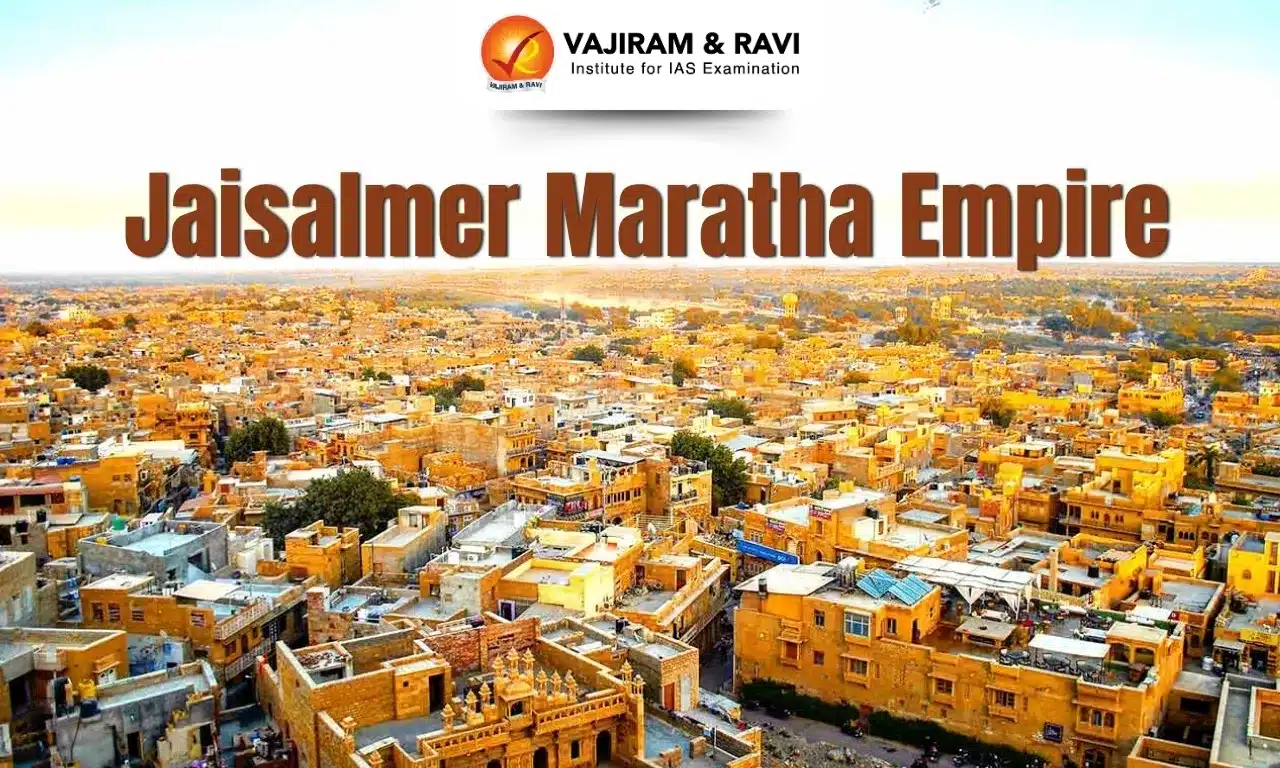
Jaisalmer and the Maratha Empire Controversy: What History Reveals

Jaisalmer Maratha Empire

Jaisalmer Maratha Empire Latest News

  • A controversy has erupted over a map in the new NCERT Class 8 social science textbook showing Jaisalmer as part of the Maratha empire in 1759.

  • Relatives of the former Jaisalmer royal family, called the depiction “historically misleading” and “factually baseless,”. 
  • They stated that no authentic records indicate Maratha control, invasion, taxation, or authority over Jaisalmer, and that royal archives confirm the Marathas never interfered in the princely state’s affairs. 
  • Responding to the objection, the chairperson of NCERT’s curricular area group for social science, said further research is underway to verify the map’s accuracy, and if errors are found, a corrected version will be prepared for future editions.

Northern Expansion of the Marathas: Economic Tribute vs. Political Control

  • In the early 18th century, as the Mughal empire fragmented, Peshwa Baji Rao I led Maratha expansion into northern regions, including parts of Rajasthan, Delhi, Punjab, Bundelkhand, Orissa, Bengal, and Bihar, consolidating control over Malwa after the Battle of Bhopal. 
  • Historians state that the Marathas often allowed local rulers to remain in power, securing agreements with zamindars to collect tribute rather than replacing them. 
  • They clarified that while the Marathas collected chauth and sardeshmukhi from Rajput territories and other regions, this did not always translate into political dominance, as many states paid tribute without recognizing the Peshwa as their sovereign.

Historians Confirm Jaisalmer Was Never Part of the Maratha Empire

  • Historians agree that while the Marathas expanded northwards after consolidating power in the Deccan, annexing regions like Malwa and Orissa and extracting tribute from several Rajput states, Jaisalmer was never under their control. 
  • According to them, the Marathas entered Rajasthan—often at the invitation of Rajput chiefs to resolve succession disputes—and confined most raids to Jaipur and Jodhpur, never targeting Jaisalmer or Bikaner. 
  • There is no historical evidence of Jaisalmer being a tributary state. Maratha expeditions in Rajasthan to claim tribute, but with no lasting administration, as local rulers often expelled Maratha agents once the armies left. 
  • Even prominent states like Amber-Jaipur failed to pay tribute regularly, and there is no record of Jaisalmer making such payments, reinforcing that it was never part of the Maratha empire.

Maratha Empire: Patchy Control and Varied Authority

  • Historians note that Maratha rule in the 18th century was far from uniform.
  • They described it as “patchy and irregular” between the 1730s and 1750s—ranging from fully administered territories to areas only loosely controlled, where resistant zamindars defied authority. 
  • Historians observed that the Maratha polity has often been framed as a regional awakening, a Hindu reaction to Muslim rule, or an effort to reform Hindu society.
  • They argued that it should instead be seen as one of many contemporary polities, not a proto-nationalist crusade. 
  • While the Marathas claimed sovereignty over large parts of India, their actual control varied greatly, and the more important question is understanding how authority was established rather than glorifying dynastic territorial claims.

NCERT Responds to Map Controversy, Open to Revisions

  • NCERT clarified that the new Class 8 social science chapter on the Marathas was prepared with expert consultation and based on earlier published maps, with no prior objections. 
  • The map includes areas under direct Maratha control as well as tributary states or regions under temporary agreements. 
  • NCERT acknowledged that a disclaimer on approximate borders, present in the Grade 7 book, should also have been included in Grade 8. 
  • Experts suggested using different shades on maps to distinguish direct control, tributary states, short-term conquests, and areas of influence, as a single colour oversimplifies history.

Source: IE | ToI | IT

Jaisalmer Maratha Empire FAQs

Q1: Was Jaisalmer ever part of the Maratha Empire?

Ans: No, historians confirm Jaisalmer was never under Maratha control or tribute, contrary to NCERT’s controversial textbook map.

Q2: What regions did the Marathas control in the north?

Ans: They expanded into Rajasthan, Delhi, Punjab, Bundelkhand, Orissa, Bengal, and Bihar, but often left local rulers in place.

Q3: Did the Marathas control Rajput states politically?

Ans: Not always. Many states paid chauth or sardeshmukhi but did not recognize Maratha political authority over them.

Q4: What is NCERT’s stance on the Jaisalmer map issue?

Ans: NCERT says the map was based on earlier sources, open to correction, and may revise it in future editions.

Q5: What improvements do experts suggest for historical maps?

Ans: Use colour shades to differentiate direct control, tributary states, temporary conquests, and influence, avoiding oversimplification of history.
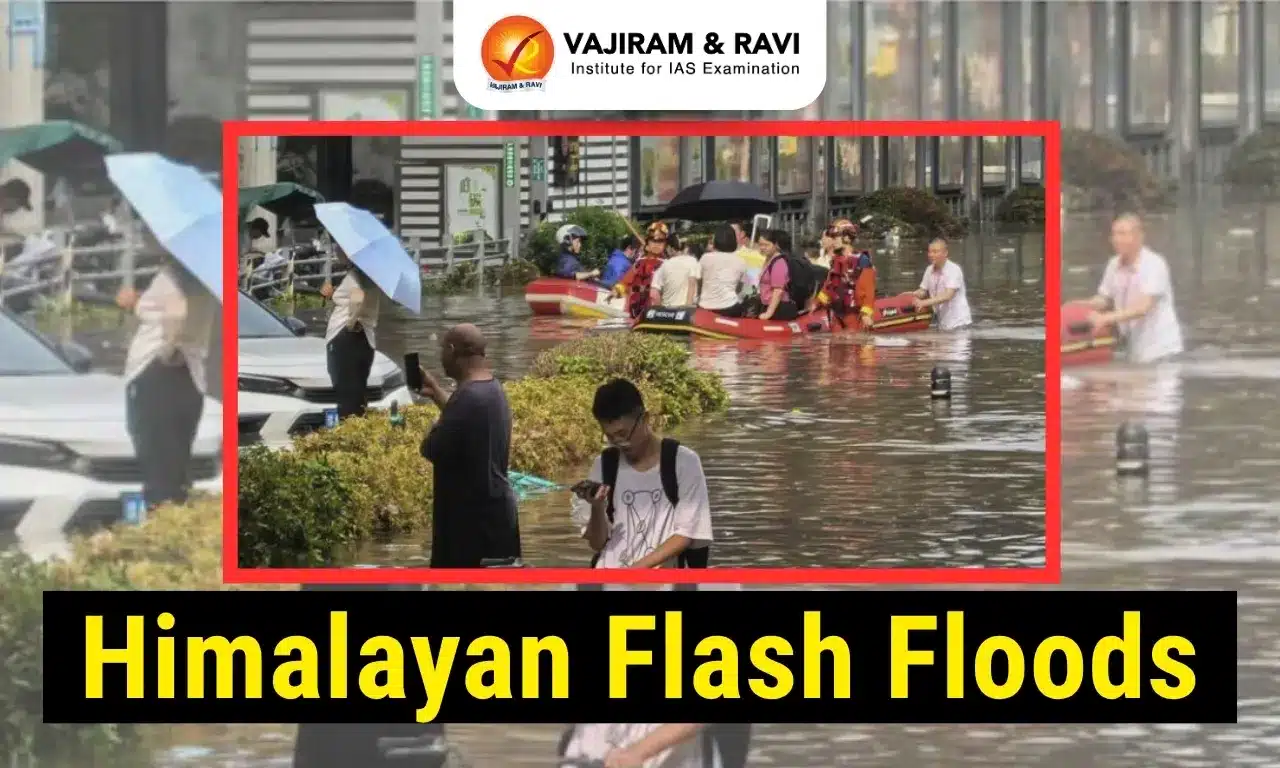
Rain, Landslides, and Flash Floods in the Himalayas: Causes, Risks, and Mitigation

Himalayan Flash Floods

Himalayan Flash Floods Latest News

  • A flash flood in Dharali, Uttarkashi on August 5 killed at least four, left many missing, and caused widespread destruction. 
  • Hundreds were displaced, and similar extreme weather events in Himachal Pradesh last month killed dozens and affected thousands.

Unclear Cause of Dharali Flash Flood Highlights Rising Risks

  • Flash floods, often triggered by extreme rainfall causing landslides or mudslides, sweep debris into rivers, destroying everything in their path. 
  • The exact cause of the August 5 Dharali flood remains uncertain, though a glacial lake breach is a possibility yet to be confirmed. 
  • Despite normal monsoon levels in the area, the incident underscores growing disaster risks in ecologically fragile regions and the increasing difficulty of establishing effective early warning and mitigation systems.

Understanding Rainfall Patterns and Cloudburst Concerns in Uttarkashi

  • Despite heavy and continuous rainfall across Uttarakhand this month, Uttarkashi district experienced relatively low precipitation before the recent flash flood. 
  • On August 3 and 4, when Haridwar and Udham Singh Nagar saw very heavy rains, Uttarkashi received below-normal rainfall. 
  • According to IMD data, on August 5 — the flood day — Uttarkashi recorded 32 mm of rain, double the daily normal but far from an extreme rainfall event. 
  • Cloudbursts, defined by IMD as at least 100 mm of rain in about an hour over a 10×10 km area, are highly localised and often go unrecorded if measuring instruments are absent in the affected zone. 
  • Such intense, short-duration rain can trigger landslides and flash floods, as seen in Himachal Pradesh recently. 
  • However, in Uttarkashi’s case, there is no evidence of a cloudburst or cloudburst-like event, even in remote areas.

Multiple Triggers Behind Flash Floods in the Himalayas

  • Flash floods in the Himalayas are rarely caused by a single factor and do not always result directly from heavy rainfall or cloudbursts. 
  • Such events typically require a combination of conditions, such as 
    • intense rain leading to landslides 
    • or mudslides that channel debris into rivers, steep slopes that facilitate rapid water flow, 
    • or sudden glacial breaks releasing large volumes of water, as seen in Chamoli in 2021. 
  • In fragile terrains with eroding slopes and saturated soil, even low-intensity rainfall can trigger landslides or floods. 
  • The Himalayas, being young, geologically weak, and earthquake-prone, are inherently more vulnerable compared to older ranges like the Aravalis. 
  • Added to this natural fragility, large-scale construction and heavy vehicular traffic further heighten the risk during extreme rainfall events.

Early Warning Limitations and Mitigation for Flash Floods

  • The Dharali incident highlights the challenge of predicting flash floods, as even moderate rainfall can trigger them. 
  • While heavy rain forecasts and improving landslide predictions exist, determining whether such events will cause flash floods remains highly uncertain. 
  • Mitigation measures can help reduce risks, including: 
    • restricting construction near riverbanks, 
    • relocating vulnerable settlements away from rivers, and 
  • managing large boulders and construction debris to prevent them from being swept into waterways during high-flow events.

Source: IE

Himalayan Flash Floods FAQs

Q1: What caused the Dharali flash flood in Uttarkashi?

Ans: The exact cause is unclear, but possibilities include a glacial lake breach, highlighting complex triggers of Himalayan flash floods.

Q2: What is a cloudburst according to IMD?

Ans: A cloudburst is 100 mm or more rainfall in one hour over 10×10 km, often triggering landslides and flash floods.

Q3: Can low-intensity rainfall trigger flash floods?

Ans: Yes, in fragile Himalayan terrains with saturated soils and erosion, even small rain can cause landslides or flash floods.

Q4: Why are the Himalayas more vulnerable to flash floods?

Ans: They are young, geologically weak, earthquake-prone mountains, with added risks from construction, deforestation, and heavy traffic during extreme rainfall.

Q5: What mitigation measures can reduce Himalayan flash flood risks?

Ans: Avoid riverbank construction, relocate vulnerable settlements, and manage debris to prevent it being swept into rivers during high flow.

EV Policy Shift – For a Cleaner Transport Future

EV Policy

EV Policy Latest News

  • India has shifted its EV policy focus from cars to trucks, launching a Rs. 500-crore PM E-DRIVE subsidy for 5,600 heavy-duty e-trucks to curb transport emissions.

Introduction

  • India’s electric mobility strategy is undergoing a significant pivot. While earlier policy efforts focused on promoting electric cars, the government is now prioritising the electrification of trucks. 
  • This change aims to tackle the disproportionate share of emissions from heavy-duty vehicles, which make up just 3% of India’s vehicle fleet but contribute over a third of transport-related carbon emissions. 
  • The new focus is backed by a Rs. 500-crore subsidy to support 5,600 electric trucks under the PM E-DRIVE scheme.

Background - From Electric Cars to Electric Trucks

  • The turning point came in September 2024 when the PM E-DRIVE scheme was launched without subsidies for electric four-wheelers, unlike the earlier FAME programme
  • In August 2025, NITI Aayog reinforced this shift, noting that measuring India’s EV progress solely through car adoption is not suitable for a country where two-wheelers dominate and cars constitute only 13% of the vehicle fleet.
  • While EV adoption in the two-wheeler segment has reached 6%, electric cars accounted for just 2% of total four-wheeler sales in 2024. 
  • This figure lags far behind global leaders such as China (47%), Europe (23%), and the US (10%).

Challenges with Electric Car Adoption

  • Despite government incentives, tax waivers, falling battery costs, and supply chain development under the PLI scheme, electric car sales in India remain sluggish. 
  • High upfront costs, range anxiety, and low daily usage patterns for personal cars have limited adoption. 
  • Large cars over Rs. 10 lakh make up just 2% of the fleet, reducing the environmental impact of their electrification.
  • The government launched the Scheme to Promote Manufacturing of Electric Passenger Cars in 2024 to attract global automakers. However, uptake has been limited, with Tesla declining to set up manufacturing in India.

The Case for Electrifying Trucks

  • Heavy-duty trucks are the backbone of India’s road transport system, but are also major polluters. 
  • They emit 34% of the transport sector’s CO₂ emissions and over half of particulate pollution, despite being only a small fraction of the fleet. 
  • Long-haul trucks, in particular, have been identified as critical for achieving significant reductions in greenhouse gases.
  • Electric truck penetration is currently negligible, just 0.7% in 2024. 
  • Of the 8.34 lakh trucks sold that year, only 6,220 were electric, and just 280 had capacities above 3.5 tonnes.

Policy Measures and Incentives

  • Under the PM E-DRIVE scheme, the Ministry of Heavy Industries is offering incentives of up to Rs. 9.6 lakh per heavy-duty e-truck to offset high capital costs. 
  • A special allocation is being made for 1,100 trucks registered in Delhi to address severe air pollution.
  • In May 2025, the Office of the Principal Scientific Adviser identified 10 high-potential zero-emission trucking routes, including:
    • Chandigarh-Delhi-Jaipur
    • Dhanbad-Kolkata-Haldia
    • Bengaluru-Chennai-Villupuram
    • Salem-Coimbatore-Kochi

Global Context - Learning from China

  • China’s experience demonstrates the potential of electrifying freight. With 9% of heavy-duty trucks now electric, it is displacing over 1 million barrels of oil demand per day. 
  • India aims to replicate such impact, reducing both oil imports and urban air pollution.

Future Outlook - Building EV Infrastructure for Freight

  • The success of India’s truck electrification drive will depend on:
    • Rapid deployment of high-capacity charging stations along industrial corridors
    • Financial incentives for fleet operators to transition
    • Strengthening domestic manufacturing of e-trucks and batteries
    • Policy support for green freight logistics under public-private partnerships
  • If implemented effectively, this shift could position India as a leader in sustainable freight transport, delivering significant climate, health, and energy security benefits.

Source : IE

EV Policy FAQs

Q1: Why is India prioritising electric trucks over electric cars?

Ans: Trucks contribute over one-third of transport CO₂ emissions despite being just 3% of the fleet, making them a high-impact target for electrification.

Q2: What is the PM E-DRIVE scheme?

Ans: It is a government programme providing subsidies for electric vehicles, now focusing on e-trucks instead of electric cars.

Q3: How many e-trucks will be supported under the new policy?

Ans: The government plans to support 5,600 heavy-duty e-trucks with incentives up to ₹9.6 lakh per vehicle.

Q4: Why are electric car sales low in India?

Ans: High upfront costs, range anxiety, and low daily usage patterns have limited adoption despite subsidies and tax waivers.

Q5: Which countries have higher electric car penetration than India?

Ans: China, Europe, the US, and Vietnam have significantly higher EV penetration rates compared to India’s 2% in four-wheeler sales.

Enquire Now