Gaza War Stalls IMEC: Challenges and Future Prospects

India-Middle East-Europe Economic Corridor

India-Middle East-Europe Economic Corridor Latest News

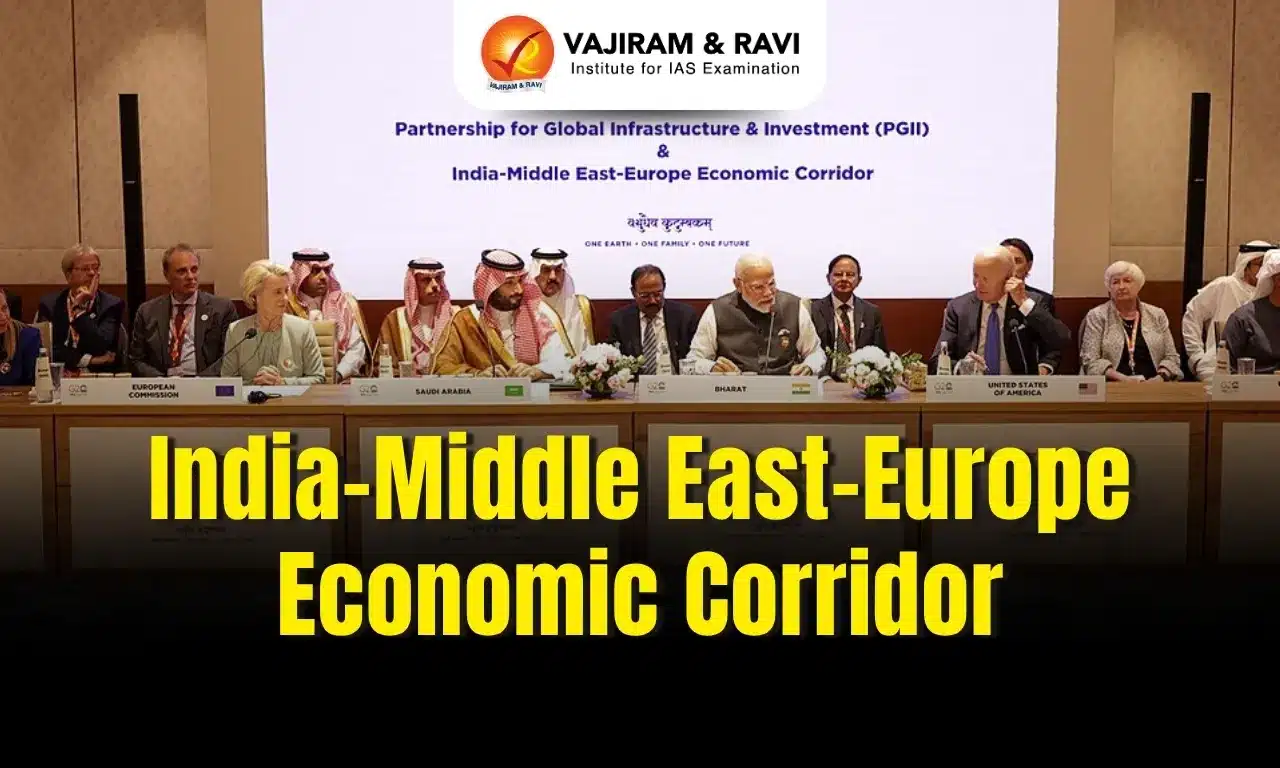
  • India’s National Security Council Secretariat recently hosted officials from the U.S., UAE, Saudi Arabia, France, Italy, Germany, Israel, Jordan, and the EU to review progress on the India-Middle East-Europe Economic Corridor (IMEC). 
  • This article deals with the corridor’s ambitions, challenges, and future prospects.

About India-Middle East-Europe Economic Corridor (IMEC)
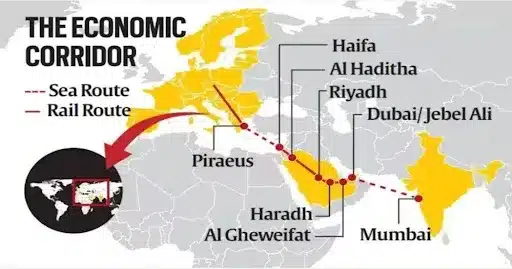
  • Announced at the 2023 G20 Summit in New Delhi, the IMEC aims to boost economic development through enhanced connectivity between Asia, the Arabian Gulf, and Europe. 
  • It consists of two segments:
    • the India-Gulf corridor, linking India’s western ports to the UAE and then via high-speed freight rail through Saudi Arabia and Jordan to Haifa, Israel; and 
    • the Gulf-Europe corridor, connecting Haifa to Greece and Italy by sea, followed by onward transport through Europe’s rail networks. 
  • Expected to reduce India-Europe shipping times by about 40% compared to the Red Sea route, the project has seen limited progress since its launch.

IMEC’s Promise and the Geopolitical Opening That Enabled It

  • The IMEC was conceived during India’s G20 Presidency in September 2023, at a rare moment of Middle East stability following years of regional rivalries. 
  • Arab normalisation with Israel, which Saudi Arabia was poised to join, created conditions for India, Middle Eastern states, the U.S., and Europe to envision a corridor connecting India to Europe. 
  • The economic case was strong — the EU is India’s largest trading partner, with FY 2023-24 bilateral trade at $137.41 billion, and non-oil trade with the UAE and Saudi Arabia rising significantly
  • Planned as more than a trade route, IMEC aimed to integrate electricity and digital connectivity cables, clean hydrogen pipelines, and measures to boost efficiency, reduce costs, create jobs, and cut emissions. 
  • It sought to address persistent trade challenges, including lack of tariff standardisation, low financial integration, limited corridor-wide insurance, and varying port capacities, while building a cross-Saudi/UAE railway to link its sea legs. 
  • Although these were considered manageable through investment and cooperation, the project stalled when, less than a month later, the region was plunged into ongoing conflict, preventing the first stakeholder meeting from taking place.

Gaza War Turns IMEC’s Challenges into Fundamental Obstacles

  • While the IMEC’s economic rationale remains strong, its hurdles have shifted from manageable to fundamental due to Israel’s ongoing war on Gaza, which has strained regional ties. 
  • The corridor’s key Middle East-Europe link depends on Jordan-Israel cooperation, now at a low point amid tensions over Palestinian displacement. 
  • Prospects for Saudi-Israel normalisation have also diminished, with Riyadh demanding Palestinian concessions that Israel is unwilling to make. 
  • The war’s expansion into Lebanon, Yemen, Syria, Iraq, and tensions with Iran heightens insurance costs for regional trade, further complicating implementation. 
  • Ironically, despite hindering progress, Israel sees the IMEC as crucial to deepening its economic integration with the Arab world, excluding Palestine.
    •  Prime Minister Netanyahu has termed framed of the project as a geopolitical blessing for participating states.

IMEC’s Future Hinges on Middle East Stability and Conflict Resolution

  • While the IMEC’s western leg faces uncertainty, India’s strong strategic and economic ties with the UAE and Saudi Arabia keep prospects for its eastern leg alive. 
  • Initiatives like UPI integration enhance digital connectivity potential, but intra-Gulf economic rivalries, such as Saudi measures to counter Emirati dominance, hinder unified corridor planning. 
  • For the IMEC to match its 2023 vision, the regional stability that enabled its conception must be restored — a goal tied to resolving the Palestinian statehood issue. 
  • Growing global recognition of the need to end Israel’s Gaza war, reflected in actions like Germany halting certain arms shipments to Israel, underscores this reality. 
  • Until lasting peace is achieved, IMEC remains a “day-after” project, with current efforts limited to planning and trade facilitation.

Source: IE

India-Middle East-Europe Economic Corridor FAQs

Q1: What is the IMEC?

Ans: A trade and connectivity corridor linking India, the Gulf, and Europe through sea and rail routes.

Q2: When was IMEC announced?

Ans: During the G20 Summit in New Delhi in September 2023.

Q3: How much can IMEC reduce shipping time?

Ans: By about 40% compared to the Red Sea route.

Q4: What halted IMEC’s progress?

Ans: The outbreak of the Gaza war less than a month after its launch.

Q5: Which countries are key IMEC partners?

Ans: India, UAE, Saudi Arabia, Jordan, Israel, Greece, and Italy.
India’s Agricultural Exports Surge Amid Global Trade Challenges

India Farm Exports

India Farm Exports Latest News

  • While overall merchandise export growth remains flat and unlikely to exceed the 2022-23 peak of $451.1 billion, agricultural exports are driving India’s export momentum, showing resilience and record-breaking potential.

India’s Export Performance in 2024-25

  • In 2024-25, India’s merchandise exports stood at $437.4 billion, just 0.1% higher than the $437.1 billion in 2023-24. 
  • During April-June 2025, exports rose to $112 billion, a 1.7% increase from $110.1 billion in the same period last year. 
  • Union govt expressed confidence that exports this fiscal would surpass last year’s levels, despite potential disruptions from U.S. President Donald Trump’s tariff measures, including a 50% duty on Indian goods.

Agricultural Exports: Strong Upward Trend

  • Agricultural exports recorded robust growth of 6.4%, increasing from $48.8 billion in 2023-24 to $51.9 billion in 2024-25. 
  • The first quarter of 2025-26 posted a further 5.8% year-on-year rise.
  • If current trends continue, farm exports could reach $55 billion in 2025-26, surpassing the previous record of $53.2 billion in 2022-23.
  • India’s agricultural exports to the U.S. have been particularly strong, growing by 24.1% during January-June 2025 compared to the same period in 2024.

Drivers and Risks for India’s Farm Exports

  • India’s farm exports surged from $7.5 billion in 2003-04 to $43.3 billion in 2013-14, later peaking at $53.2 billion in 2022-23 due to a global agri-commodity price boom
  • The FAO food price index rose from 96.4 (2019-20) to 140.6 (2022-23).
  • The 2023-24 decline was driven by drought and government curbs on wheat, rice, sugar, and onion exports to control food inflation
  • These restrictions eased in 2024-25 as monsoon-aided farm output improved, with a second consecutive above-normal monsoon likely allowing sugar export resumption. 
    • Sugar net exports fell sharply from $5.5 billion (2022-23) to $771.3 million (2024-25).
  • In Q1 2025-26, major items like marine products, non-basmati rice, buffalo meat, coffee, tobacco, and fruits & vegetables posted strong growth. 
  • Coffee exports benefited from low global stocks due to poor harvests in Brazil and Vietnam, while tobacco shipments rose following output shortfalls in Brazil and Zimbabwe.
    • Brazil and Vietnam are the world’s biggest producers of arabica and robusta varieties respectively. 
    • India mostly exports robusta beans and powder used in instant coffee and espresso blends.

Tariff Risks and Competitive Pressures

  • From August 27, 2025, U.S. tariffs of 50% on Indian goods could hit marine products hardest, with the U.S. taking 35% of India’s exports in this category. 
  • Frozen shrimps and prawns alone sent $1.9 billion of the $4.5 billion total to the U.S
  • Similar tariffs on Brazilian goods may divert their coffee surplus to other markets, potentially lowering prices and hurting Indian exports.

India’s Agricultural Import Trends and Growing Dependence

  • India maintained a $13.4 billion agricultural trade surplus in 2024-25, with farm exports ($51.9 billion) exceeding imports ($38.5 billion), even as the surplus has fallen sharply from $27.7 billion in 2013-14 due to faster import growth. 
  • Agricultural imports remain concentrated in a few commodities, with over two-thirds coming from vegetable oils, pulses, and fresh fruits
  • Fresh fruit imports — worth $1.7 billion, largely from the U.S. — include almonds, pistachios, walnuts, apples, grapes, kiwis, figs, pears, and dates. 
  • Pulses imports hit a record 7.3 million tonnes ($5.5 billion) in 2024-25 after duty cuts following the 2023-24 El Niño drought, though they have reduced this year with a bumper harvest. 
  • Vegetable oil imports (palm, soyabean, sunflower) continue rising as domestic production lags demand.
  • Cotton and natural rubber imports have also grown due to declining domestic output since their peaks in 2013-14 and 2012-13, respectively.

Agriculture Emerges as a Sticking Point in India–US Trade Talks

  • PM Modi’s recent statement that India will never compromise the interests of its farmers, livestock rearers, and fisherfolk underscores the government’s firm stance in stalled trade negotiations with the US. 
  • The key point of contention is opening India’s market to US farm produce — including GM maize, soyabean, fuel ethanol, and dairy products — which New Delhi now wants excluded from any deal. 
  • This hardened position is shaped by domestic political sensitivities and US President Donald Trump’s tariff measures, including a 50% duty on Indian imports, part of which penalises oil purchases from Russia. 

Source: IE | IE

India Farm Exports FAQs

Q1: What was India’s agricultural export value in 2024-25?

Ans: $51.9 billion, up 6.4% from the previous year.

Q2: Which products saw strong export growth in Q1 2025-26?

Ans: Marine products, non-basmati rice, buffalo meat, coffee, tobacco, fruits, and vegetables.

Q3: What factors boosted coffee exports?

Ans: Poor harvests in Brazil and Vietnam reducing global stock levels.

Q4: What is India’s agricultural trade surplus in 2024-25?

Ans: $13.4 billion, with exports exceeding imports.

Q5: Why is agriculture a sticking point in India–US trade talks?

Ans: India refuses to open its market to US farm products like GM maize and soyabean.

Tamil Nadu’s State Education Policy 2025

State Education Policy

State Education Policy Latest News

  • Tamil Nadu has launched its State Education Policy 2025 as an alternative to the NEP, emphasising state-specific priorities in school and higher education.

Introduction

  • Tamil Nadu has introduced its long-awaited State Education Policy (SEP) 2025, offering a distinct alternative to the Centre’s National Education Policy 2020
  • The policy aims to uphold the state’s historical emphasis on equitable education, social justice, and linguistic diversity while addressing future challenges in skill development, higher education, and technology integration.
  • The decision comes amid ongoing differences between the Tamil Nadu government and the Union government over language policy, entrance examinations, and federal autonomy in education.

Historical Context of Education Policy in Tamil Nadu

  • Tamil Nadu has historically pursued progressive education policies that prioritise accessibility and social equity. 
  • Since the introduction of free noon meals in schools in the mid-20th century and the expansion of state-run institutions, the state has consistently worked to reduce dropouts and bridge socio-economic divides.
  • In recent decades, Tamil Nadu has:
    • Resisted the three-language formula, opting instead for a two-language policy prioritising Tamil and English.
    • Opposed NEET (National Eligibility-cum-Entrance Test) for medical admissions, arguing it disadvantages rural and socially backward students.
    • Maintained higher-than-national-average Gross Enrolment Ratios (GER) in both school and higher education.

About the State Education Policy 2025

  • The SEP 2025 was drafted by a high-level expert committee chaired by retired Chief Justice of the Delhi High Court, Justice D. Murugesan, after extensive consultations with educators, students, civil society, and subject experts.
  • Key Principles:
    • Equity and Inclusivity: Ensuring access to quality education regardless of caste, gender, language, or socio-economic status.
    • State Autonomy: Crafting education strategies that align with Tamil Nadu’s socio-cultural and economic needs rather than following a uniform national template.
    • Employment-Readiness: Integrating skill development and vocational training from the school level.

School Education Reforms

  • Two-Language Policy: Tamil and English will remain the medium of instruction, rejecting the NEP’s three-language recommendation.
  • Foundational Literacy and Numeracy: Strengthened focus on early learning in Classes 1-3, with continuous assessment instead of high-stakes exams.
  • Digital Infrastructure: Expansion of smart classrooms, ICT tools, and teacher training in digital pedagogy.
  • Social Justice Measures: Continuation and strengthening of welfare schemes such as free textbooks, uniforms, and the noon-meal programme.

Higher Education Framework

  • Autonomous Curriculum Design: State universities will have greater flexibility in designing syllabi suited to local industries and employment needs.
  • Multiple Entry-Exit System: Students will have the option to pause and resume studies without losing academic credits, similar to NEP’s flexibility but tailored for Tamil Nadu’s academic calendar.
  • Research and Innovation Hubs: Investment in domain-specific research centres, especially in agriculture, renewable energy, and healthcare.
  • Opposition to Common Entrance Tests: Admissions to professional courses will continue to follow the state’s reservation policies and entrance examination exemptions where applicable.

Vocational and Skill Development Focus

  • Collaboration with industries to update vocational curricula in polytechnic and ITI institutions.
  • Introduction of skill-based courses in secondary schools covering AI, robotics, agritech, and entrepreneurship.
  • Partnerships with MSMEs to offer internships and apprenticeships for final-year students.

Teacher Training and Capacity Building

  • Revised Teacher Education Modules integrating technology and inclusive pedagogy.
  • Continuous Professional Development (CPD) programmes for educators in both school and higher education.
  • Creation of an online teacher resource portal in Tamil and English.

Differences with the NEP 2020

The following table list downs the key differences between NEP 2020 and Tamil Nadu's SEP 2025:

Differences-between-SEP-NEP

Significance of the SEP 2025

  • The SEP 2025 underscores Tamil Nadu’s federal stance that education should remain a Concurrent List subject with adequate space for states to address their unique contexts. 
  • By resisting uniformity, the policy strengthens the state’s identity and commitment to social justice while aligning with global education trends in flexibility and skills-based learning.

Future Outlook

  • The success of the SEP 2025 will depend on its implementation, funding allocation, and coordination between the state education department, universities, and private institutions. 
  • As Tamil Nadu seeks to position itself as an education hub, the policy could also serve as a model for other states asserting autonomy over education governance.

Source: IE | TH

State Education Policy FAQs

Q1: What is the Tamil Nadu State Education Policy 2025?

Ans: It is the state’s comprehensive education framework designed as an alternative to the National Education Policy, focusing on equity, inclusivity, and local needs.

Q2: Who headed the committee for drafting the SEP 2025?

Ans: The policy was prepared by a panel chaired by Justice D. Murugesan, former Chief Justice of the Delhi High Court.

Q3: How does the SEP differ from the NEP in language policy?

Ans: The SEP retains Tamil and English as the two languages of instruction, rejecting the NEP’s three-language formula.

Q4: What is Tamil Nadu’s stance on NEET under the SEP?

Ans: The policy opposes NEET, maintaining state-based admission systems for professional courses.

Q5: What is the focus of vocational education under the SEP?

Ans: It prioritises skill-based courses in emerging sectors like AI, agritech, and renewable energy, in partnership with industries.

Enquire Now