
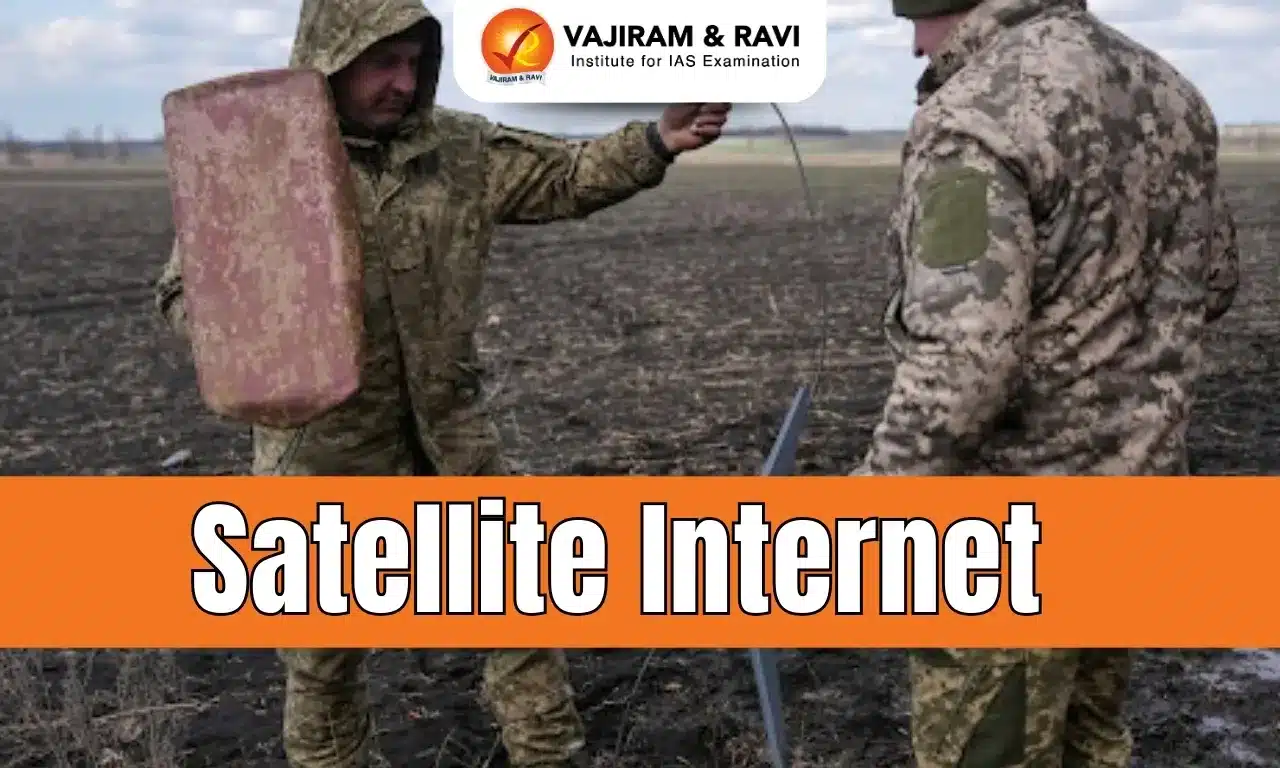
Satellite Internet in India

Satellite Internet

Satellite Internet Latest News

  • Starlink’s upcoming launch in India has renewed focus on how satellite internet works, its applications, and regulatory challenges.

Introduction

  • Satellite internet is emerging as a transformative solution in global connectivity, especially for remote and underserved areas. 
  • With Elon Musk’s Starlink set to debut in India, the country’s internet infrastructure is poised for a significant upgrade. 
  • Unlike traditional ground-based networks dependent on cables and towers, satellite internet can offer high-speed access in areas where physical infrastructure is unviable, ensuring resilience during disasters and operational continuity for both civilian and military applications.

Significance of Satellite Internet

  • Ground-based broadband, while efficient in urban hubs, struggles in sparsely populated or disaster-prone regions due to high infrastructure costs and vulnerability to physical damage. 
  • Satellite internet overcomes these constraints by providing coverage irrespective of terrain, rapidly deploying during emergencies, and servicing mobile or remote operations such as on ships, aircraft, or oil rigs. 
  • This makes it not just a backup but a potential primary connectivity mode in specific scenarios.

Key Features and Dual-Use Nature

  • The arrival of satellite mega-constellations like Starlink marks a new era. These networks, consisting of thousands of satellites, have applications across:
    • Civilian sectors: healthcare, agriculture, transportation, education, and disaster response.
    • Military sectors: secure communications, battlefield coordination, and navigation in remote conflict zones.
  • Global examples highlight its importance. Viasat enabled disaster relief during Hurricane Harvey, while Starlink has been crucial to Ukrainian defence in the Russia-Ukraine conflict. 
  • In India, the Army has utilised satellite internet in strategic locations like the Siachen Glacier. However, its borderless nature also poses risks, as seen in cases of smuggled terminals being used by insurgent groups.

Working of Satellite Internet

  • A satellite internet network comprises:
    • Space Segment: Satellites in orbit, carrying communication payloads with a service life of 5-20 years.
    • Ground Segment: Terminals and antennas that connect users to the satellites.
  • The orbital altitude determines coverage and latency, with three main categories:
    • Geostationary Earth Orbit (GEO) - 35,786 km altitude; large coverage but high latency; unsuitable for real-time applications. Example: Viasat’s Global Xpress.
    • Medium Earth Orbit (MEO) - 2,000-35,786 km altitude; lower latency than GEO but still requiring multiple satellites for coverage. Example: O3b constellation.
    • Low Earth Orbit (LEO) - below 2,000 km; very low latency and smaller, cheaper satellites, but requiring large mega-constellations for global coverage. Example: Starlink with over 7,000 satellites.

LEO Mega-Constellations and Innovations

  • LEO constellations mitigate their limited coverage by using vast numbers of satellites with onboard processing capabilities. 
  • Optical inter-satellite links allow direct satellite-to-satellite communication, reducing dependency on ground stations and improving efficiency.
  • These systems employ steerable antennas to ensure uninterrupted service as satellites move rapidly across the sky, handing off connections seamlessly between satellites.

Applications Across Sectors

  • Communications: Internet access in remote regions, support for IoT networks.
  • Transportation: Enhanced navigation, self-driving vehicle support, and real-time logistics.
  • Disaster Management: Early warnings, emergency coordination, and resilient communication lines.
  • Healthcare: Telemedicine, diagnostics, and remote monitoring.
  • Agriculture: Precision farming and crop analytics.
  • Defence: Secure communications, surveillance, and operational readiness in remote zones.
  • Environmental Monitoring & Energy: Tracking natural resources, supporting renewable energy operations.
  • Future innovations like direct-to-smartphone satellite connectivity could eliminate the need for dedicated terminals, integrating satellite capabilities directly into consumer devices.

Challenges and Strategic Importance

  • While costs remain higher than terrestrial broadband (approx. $500 for hardware and $50/month for service), the benefits in remote connectivity and strategic resilience justify the investment. 
  • However, its dual-use nature raises regulatory and security concerns, making governance critical.
  • For India, satellite internet offers the opportunity to:
    • Bridge the digital divide.
    • Strengthen disaster resilience.
    • Enhance national security capabilities.
    • Play a role in shaping the international governance of satellite networks.

Source : TH

Satellite Internet FAQs

Q1: What is satellite internet?

Ans: Satellite internet is a communication technology that provides internet access using satellites in orbit instead of terrestrial cables and towers.

Q2: Which orbits are used for satellite internet?

Ans: Satellite internet uses Geostationary (GEO), Medium Earth Orbit (MEO), and Low Earth Orbit (LEO) satellites, each with different coverage and latency characteristics.

Q3: Why is LEO preferred for modern satellite internet?

Ans: LEO satellites offer very low latency and can be deployed in large constellations for near-global coverage, making them ideal for real-time applications.

Q4: What are the key applications of satellite internet?

Ans: It is used in defence, disaster management, healthcare, agriculture, transportation, environmental monitoring, and remote communications.

Q5: What challenges does satellite internet pose?

Ans: High costs, regulatory hurdles, security risks from dual-use potential, and governance of mega-constellations are the main challenges.
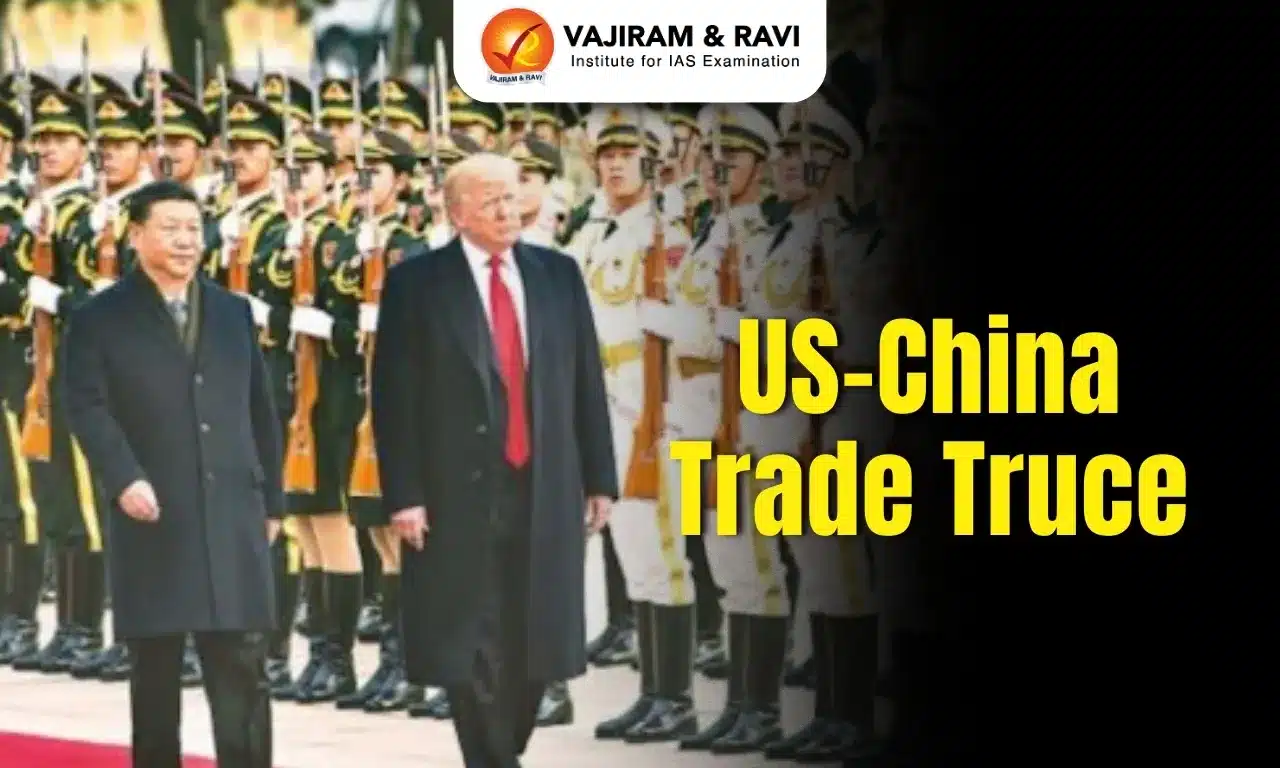
Behind US-China Trade Truce: Tariffs, Agriculture & Rare Earths in Play

US-China Trade Truce

US-China Trade Truce Latest News

  • US President Donald Trump has extended his trade truce with China until November 10, 2025, delaying the imposition of a 145% tariff on Chinese goods and maintaining it at 30% as per a previous order. 
  • This pause follows Beijing’s countermeasures, which included initially imposing a 125% tariff on US imports (later reduced to 10%) and restricting exports of rare-earth metals crucial for US industries like automotive, aerospace, defence, and semiconductors. 
  • China has also leveraged its agricultural imports, drastically reducing purchases of US farm produce — from $13.1 billion in January–June 2024 to $6.4 billion in the same period of 2025, continuing a multi-year decline from a peak of $40.7 billion in 2022.

Background to the Extension

  • The United States and China have agreed to prolong their trade truce for another 90 days, just hours before mutual tariff hikes were set to take effect. 
  • This pause kept US tariffs on Chinese imports at 30%, while China maintained a 10% duty on US goods. 
  • Earlier in the year, both sides had threatened triple-digit tariffs, with Washington planning levies up to 145% and Beijing up to 125%, before scaling back during May talks in Geneva.

Objectives of the Extension

  • According to the White House, the delay allows more time to address trade imbalances, unfair trade practices, and national security issues. 
  • The US cited a $300 billion trade deficit with China in 2024. 
  • Negotiations will focus on increasing market access for US exporters, lifting trade restrictions, and stabilising the global semiconductor supply chain.

Key Trade Issues

  • Ongoing discussions cover access to China’s rare earths, purchases of Russian oil, and US technology export curbs
  • Recently, Trump allowed companies like AMD and Nvidia to resume certain chip sales to China in exchange for 15% of revenues — a move criticised as a “shakedown.” 
  • Additionally, the US is pressing for TikTok’s separation from Chinese parent ByteDance, a step opposed by Beijing.

China’s Agricultural Import Leverage in US-China Trade Dispute

  • China has strategically slashed its agricultural imports from the US, especially soyabeans, which fell to just $2.5 billion in January–June 2025 from $17.9 billion in 2022. 
  • Other US exports hit include corn, barley, cotton, beef, pork, poultry, tree nuts, and forest products. 
  • As the world’s top importer of key agri-commodities, China now sources much of its soyabean, barley, and corn from Brazil, Argentina, Canada, and others, bypassing US suppliers. 
  • This shift impacts American farmers across the “corn belt” and livestock producers in states like Texas, Oklahoma, and California. 
  • Alongside its dominance in rare-earth elements, China’s buying power in the global agri-market is a potent tool to pressure the US administration into maintaining trade talks and avoiding tariff escalation.

India–US Agricultural Trade Surges Amid US–China Decline

  • While US farm exports to China plunged 51.3% in January–June 2025 compared to the same period in 2024, shipments to India rose by 49.1%. 
  • Bilateral agricultural trade between India and the US is thriving, with US exports to India expected to exceed $3.5 billion and Indian exports to the US likely to top $7.5 billion this year
  • India has overtaken China as the largest market for US tree nuts, importing over $1.1 billion worth in 2024 and $759.6 million in just the first half of 2025. 
  • The US also holds a 35% share in India’s seafood exports, especially frozen shrimps and prawns worth $1.9 billion in 2024–25. 
  • Despite this robust exchange, the Trump administration has doubled tariffs on Indian imports to 50% from August 27, including a 25% penalty for purchasing Russian oil — a move not applied to China despite similar purchases.

Source: TH | BBC

US-China Trade Truce FAQs

Q1: What did the recent US-China trade truce achieve?

Ans: It extended tariff pauses until November 10, allowing negotiations on trade imbalances, market access, and key economic and security concerns.

Q2: How has China leveraged agriculture in the trade war?

Ans: China cut US farm imports, especially soybeans, replacing them with purchases from Brazil, Argentina, and other suppliers.

Q3: Why are rare earths central to the US-China trade dispute?

Ans: China controls global rare earth supply, impacting industries like defense, electronics, and EVs, using it as leverage in negotiations.

Q4: How have US exports to China changed in early 2025?

Ans: US exports to China dropped by about 20% in the first six months of 2025 compared to 2024.

Q5: What is Trump’s demand regarding soybean imports?

Ans: Trump urged China to quadruple its soybean imports from the US, aiming to aid American farmers hit by the trade war.

Sports Governance Bill Passes, Keeps BCCI Outside RTI Scope

BCCI RTI Exemption

BCCI RTI Exemption Latest News

  • The Rajya Sabha passed the National Sports Governance Bill, 2025, a day after its clearance in the Lok Sabha. 
  • Opposition leaders criticised the legislation, calling it an “extreme centralisation of sports administration”. 
  • They highlight that the bill grants the Board of Control for Cricket in India (BCCI) most favoured treatment by keeping it outside the scope of national laws like the Right to Information (RTI) Act.
  • The Bill specifies that only sports bodies receiving direct financial assistance from the government are deemed “public authorities” under the RTI Act. Since the BCCI does not get such funding, it will remain excluded. 
  • Over the years, the BCCI has resisted inclusion under the RTI despite recommendations from the Supreme Court, the Law Commission of India, and the Central Information Commission to bring it under the transparency law.

RTI Exemption for BCCI in National Sports Governance Bill

  • The National Sports Governance Bill seeks to recognise and regulate national sports bodies, aligning them with Olympic and Paralympic Charters and global best practices to improve transparency, accountability, and international collaboration opportunities. 
  • Initially, Clause 15(2) of the Bill defined a recognised sports organisation as a “public authority” under the RTI Act, making its operations — including team selection and contract awards — open to public scrutiny. 
  • This broad definition would have included the Board of Control for Cricket in India (BCCI).
  • However, a later amendment narrowed the definition to only cover organisations receiving government grants or financial assistance, and even then, solely regarding the utilisation of those funds
  • This change excluded the BCCI — which does not take direct government funding — from RTI obligations, despite cricket’s impending inclusion in the Olympics and calls for greater transparency in the sport’s administration.

BCCI’s Stance and RTI Debate

  • BCCI maintains that it is a private, autonomous body registered under the Tamil Nadu Societies Registration Act, 1975, and not a “public authority” under the RTI Act. 
  • It does not receive direct government funding, and is not classified as a sports federation under the Union Sports Ministry.

Judicial and Commission Recommendations

  • Multiple judicial and quasi-judicial bodies have challenged BCCI’s stance. 
  • The Law Commission of India’s 275th Report (2018) recommended classifying the BCCI as a public authority.
  • It cited indirect financial benefits such as tax exemptions exceeding ₹2,100 crore (1997–2007) and subsidised land allotments by state governments.

Supreme Court Observations

  • In 2015, the Supreme Court observed that BCCI performs “public functions” — including selecting India’s national teams, using national symbols, and monopolising cricket with government concurrence. 
  • The Justice R.M. Lodha Committee called BCCI’s functioning a “closed door and back-room affair” and urged legislative inclusion under the RTI Act.

CIC’s Landmark Order and Legal Challenge

  • In 2018, the Central Information Commission declared BCCI a “public authority” and directed it to create an RTI query mechanism. 
  • The BCCI challenged this order in the Madras High Court, which stayed its implementation, leaving the matter unresolved.

Implications of Bringing BCCI Under RTI

  • If the BCCI were brought under the RTI Act, citizens could request comprehensive information about its operations — from team selection criteria and broadcasting contract details to infrastructure tenders, official appointments, and meeting minutes. 
  • This transparency would compel the board to justify decisions to the public, rather than only to its internal members.
  • The Supreme Court, in its 2015 ruling, clarified that while BCCI is not a state body, it is subject to writ jurisdiction under Article 226 of the Constitution because it performs public functions. 
  • This empowers High Courts to intervene when the board’s actions are arbitrary or against public interest.

Source: IE | FP

BCCI RTI Exemption FAQs

Q1: What does the National Sports Governance Bill aim to achieve?

Ans: It seeks to regulate sports bodies, align governance with global standards, and enhance transparency and accountability in national sports administration.

Q2: Why is the BCCI excluded from RTI under the Bill?

Ans: The Bill limits RTI coverage to bodies receiving direct government funding, which the BCCI does not take.

Q3: What has the Supreme Court said about BCCI’s role?

Ans: The Court held BCCI performs public functions like team selection and should ensure transparency despite being a private body.

Q4: What did the CIC rule in 2018 about BCCI?

Ans: The CIC declared BCCI a public authority under RTI and ordered it to create an RTI mechanism, which was later stayed.

Q5: What would BCCI under RTI mean for the public?

Ans: Citizens could request details on team selection, contracts, infrastructure tenders, and internal decision-making processes.

Enquire Now