
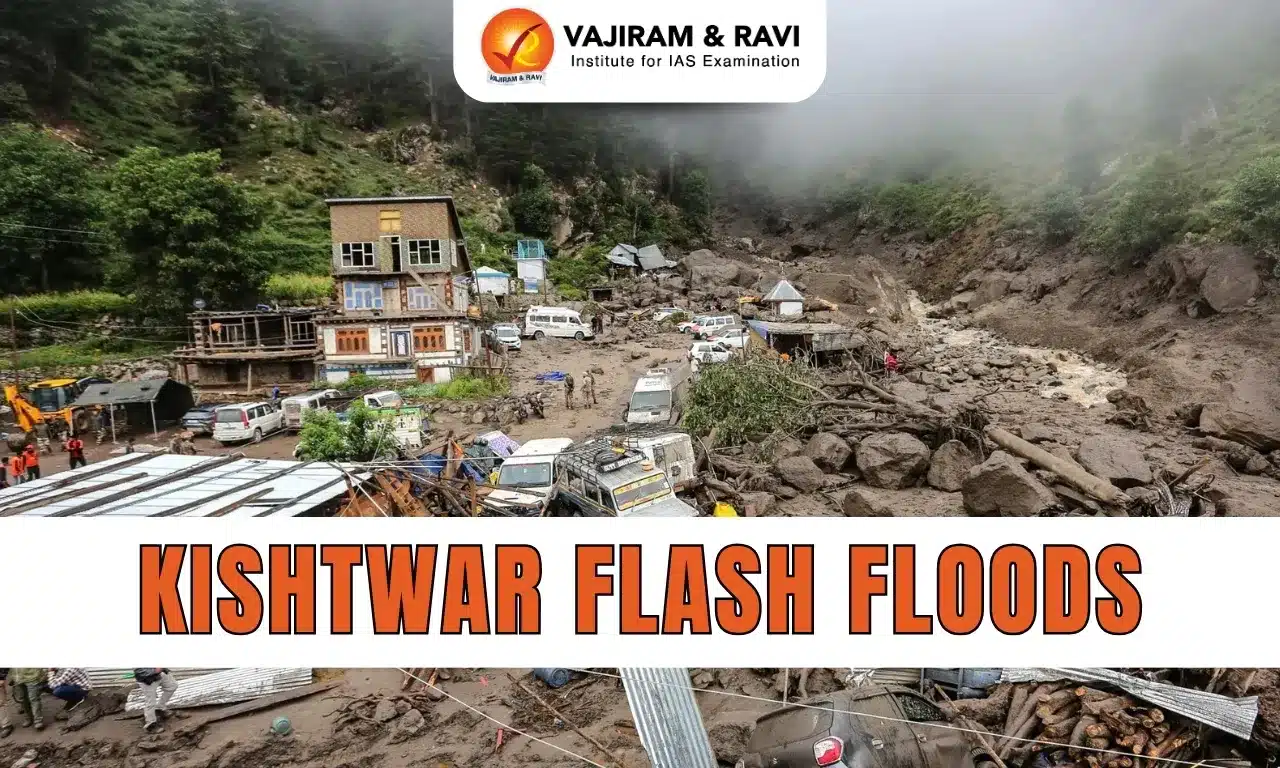
Kishtwar Flash Floods: Climate Change and Extreme Weather in Jammu & Kashmir

Kishtwar Flash Floods

Kishtwar Flash Floods Latest News

  • At least 65 people died and over 50 remain missing after a flash flood triggered by torrential rain hit Chasoti village in Kishtwar, Jammu & Kashmir. The disaster struck near the route to the Machail Mata temple.
  • While scientists caution against linking any single extreme event directly to climate change, they note that rising global temperatures and shifting weather patterns have made such incidents — including flash floods and wildfires — more frequent and severe.
  • In Jammu & Kashmir, as elsewhere in India, the increasing frequency of extreme weather events driven by climate change has already caused the deaths of thousands in recent years.

Extreme Weather Events in Jammu & Kashmir (2010–2022)

  • Between 2010 and 2022, Jammu & Kashmir experienced 2,863 extreme weather events that claimed 552 lives, according to a 2024 study published in Mausam by IMD scientists.
  • The most frequent occurrences were thunderstorms (1,942 incidents) and heavy rain (409 incidents), while flash floods (168 incidents) and landslides (186 incidents) also posed significant threats. 
  • Although heavy snow was less frequent (42 incidents), it caused the highest fatalities — 182 deaths — making it the deadliest weather phenomenon during this period.
  • The study also highlighted that Kishtwar, Anantnag, Ganderbal, and Doda districts recorded the highest number of deaths from flash floods.
  • Overall, the research concluded that while heavy rain and heavy snow remain the primary weather-related killers, other hazards such as flash floods, thunderstorms, and windstorms are increasingly emerging as major threats in Jammu & Kashmir.

Key Drivers of Extreme Weather Events in J&K

  • Although several factors contribute to the occurrence of extreme weather events in J&K, the three significant drivers behind these events are rising temperatures, the changing pattern of Western Disturbances, and the region’s topography.

Rising Temperatures and Their Impact on J&K

  • The western Himalayas, where Jammu & Kashmir lies, have warmed at twice the rate of the Indian subcontinent since 2000. 
  • This sharp rise in temperature has intensified both mean and extreme precipitation. 
  • A warmer atmosphere can hold more moisture — about 7% extra water vapour for every 1°C rise — resulting in heavier and more frequent rainfall events that often trigger severe flooding.
  • Higher temperatures have also accelerated glacial shrinkage, increasing the number of unstable glacial lakes
    • These lakes, being relatively young, have fragile edges prone to erosion, melting, and sudden breaches. 
    • When heavy rainfall occurs, they overflow, releasing slush and sediment that cause catastrophic downstream floods.
  • As per climate experts, these unstable lakes make the region particularly vulnerable. 
  • Intense rain not only swells rivers but also destabilises glacial lakes, compounding the risk of flash floods and large-scale destruction.

Changing Nature of Western Disturbances

  • Western Disturbances (WDs) are east-moving rain-bearing wind systems that originate beyond Afghanistan and Iran, gathering moisture from the Mediterranean, Black, Caspian, and Arabian Seas. 
  • Traditionally active in winter months (December–March), they are now increasingly affecting weather outside the winter season.
  • This increases the risk of floods and heavy rainfall in India’s Himalayan states, including Jammu & Kashmir.
  • Climate change has altered their behaviour. The rapid warming of the Arabian Sea releases more moisture into these systems. 
  • When WDs extend into the North Arabian Sea, they absorb this excess moisture, intensifying rainfall over the hills.
  • This shift means that global warming is strengthening and prolonging the influence of WDs, making extreme rainfall and flash floods more frequent in the region.

Topography and Vulnerability of J&K

  • Jammu & Kashmir’s hilly and mountainous terrain amplifies its exposure to extreme weather events. 
  • The Himalayas consist of diverse ranges that significantly influence local weather systems.
  • One of the key processes is orographic rainfall
    • As moist air is forced to ascend over the mountains, it cools and condenses, resulting in heavy precipitation. 
    • This process makes the region more prone to sudden and intense rain, often triggering flash floods, landslides, and cloudbursts.
  • The unique Himalayan topography acts as a natural trigger for extreme events, meaning that climate change impacts — like warming temperatures and shifting Western Disturbances — are magnified by the terrain.

Source: IE | ToI | KV

Kishtwar Flash Floods FAQs

Q1: What caused the Kishtwar flash floods?

Ans: Torrential rains triggered flash floods, intensified by climate change and fragile Himalayan terrain.

Q2: How has climate change impacted J&K?

Ans: Rising temperatures, shifting western disturbances, and shrinking glaciers increased extreme rainfall and flooding.

Q3: Which events are frequent in J&K?

Ans: Thunderstorms, heavy rain, landslides, flash floods, and heavy snowfall dominate extreme weather events.

Q4: Why is J&K more vulnerable?

Ans: Its mountainous topography amplifies orographic rainfall and unstable glacial lakes, making it disaster-prone.

Q5: What did IMD studies reveal?

Ans: Between 2010–2022, J&K saw 2,863 extreme events, causing 552 deaths, with heavy snow deadliest.
PM Modi on Energy Independence: Nuclear Expansion, Critical Minerals, and Defence Self-Reliance

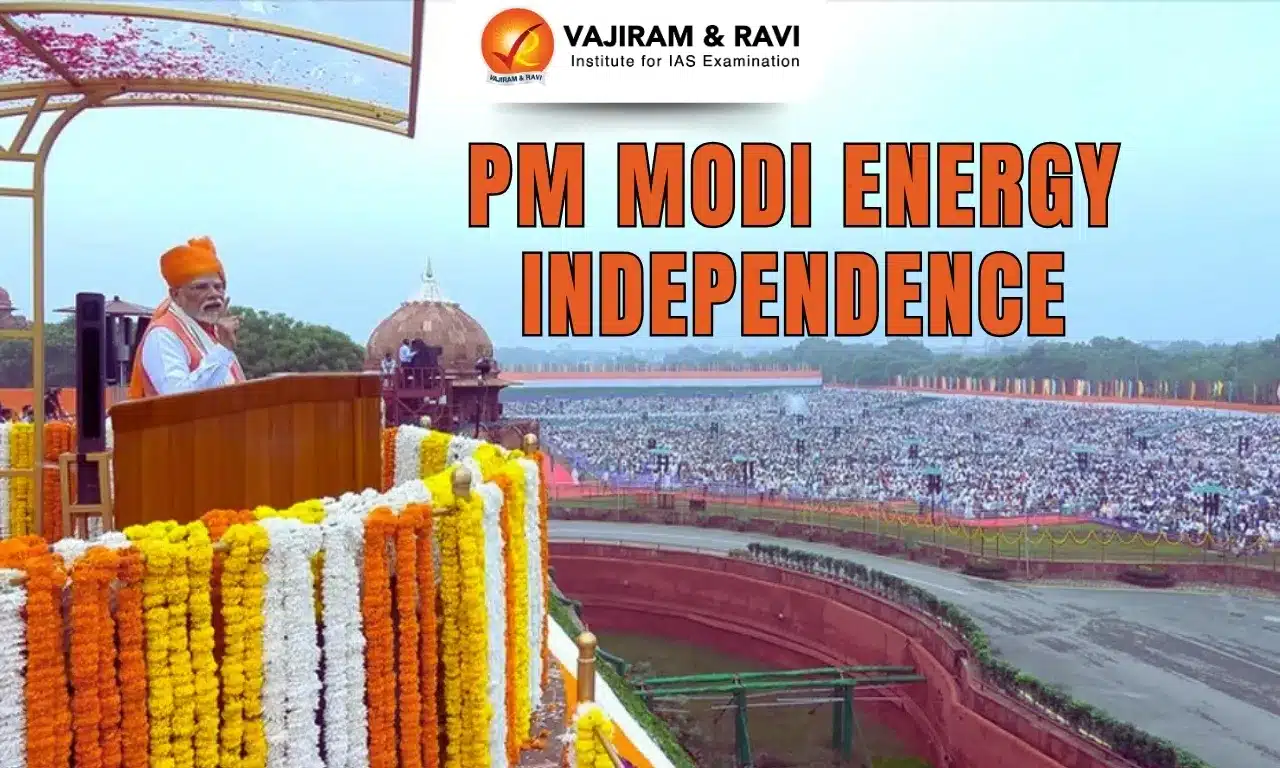
PM Modi Energy Independence

PM Modi Energy Independence Latest News

  • In his Independence Day address from the Red Fort, PM Modi emphasized the urgent need for India to achieve self-reliance in energy and critical minerals. 
  • He linked this to the country’s large petroleum import bill, highlighting how dependency drains resources that could otherwise support development, agriculture, and poverty alleviation.
  • PM Modi announced a landmark policy shift by declaring that the government has “opened the doors” of nuclear energy to private participation. 
  • The aim is to expand India’s nuclear power generation capacity tenfold by 2047, positioning nuclear energy as a major pillar of the country’s clean energy future.

India’s Heavy Energy Import Dependence

  • Currently, India remains heavily dependent on imported fossil fuels:
    • Crude oil imports (2024–25): $137 billion
    • Petroleum products: $24 billion
    • Liquefied Natural Gas (LNG): $15 billion
  • Together, energy imports constituted 22.3% of total imports in 2024–25, compared to 23% in 2023–24, according to data from the Petroleum Planning and Analysis Cell (PPAC).
  • The lakhs of crores spent on energy imports could have been invested in India’s long-term growth — building infrastructure, supporting farmers, and fighting poverty. 
  • By reducing dependency through self-reliance and clean energy expansion, India could redirect critical resources toward domestic priorities.

India’s Push for Critical Mineral Self-Reliance

  • PM Modi underlined the importance of critical minerals in powering key technologies across energy, industrial, and defence sectors.
  • He announced that exploration is underway at over 1,200 sites under the National Critical Mineral Mission (NCMM)
  • So far, the Ministry of Mines has auctioned 24 blocks and plans to auction 100 more by 2030
  • However, experts caution that operationalising these blocks could take years due to regulatory bottlenecks.
  • To fast-track progress, the government has set up a Project Monitoring Unit (PMU) to streamline approvals and expedite mine development. 
  • At the same time, India is diversifying its strategy by pursuing overseas exploration and acquisitions.
  • This is supported by recent amendments to the Mines and Minerals (Development & Regulation) Act, which now allows the National Mineral Exploration Trust (NMET) to fund international projects.

India’s Nuclear Energy Expansion and Private Sector Entry

  • In his Independence Day address, PM Modi also announced plans to increase India’s nuclear energy capacity tenfold by 2047
  • Currently, the country’s installed nuclear capacity stands at 8.8 GW, contributing just under 2% to total electricity generation
  • Ten nuclear reactors are operational, with further expansion underway.
  • The government has also opened the nuclear sector to private participation. 
  • In the 2024-25 Budget, provisions were made for partnerships with private companies to finance and build Bharat Small Reactors (BSRs) for captive use, though operation will remain with NPCIL. 
  • Full-scale private involvement, however, will require amendments to the Atomic Energy Act and the Civil Liability for Nuclear Damage Act, with a task force examining issues such as fuel procurement, waste management, and safeguards.
  • PM Modi also highlighted India’s climate achievements, noting that the country has met its target of 50% non-fossil fuel electricity capacity five years ahead of schedule
  • This marks a significant rise from 30% in 2015 and 38% in 2020, driven largely by growth in solar and wind power, along with nuclear and large hydro projects.

Operation Sindoor and Mission Sudarshan Chakra: India’s Defence Self-Reliance Drive

  • Operation Sindoor showcased India’s growing defence self-reliance, with terror networks and Pakistan-based infrastructure dismantled using Made-in-India weapons. 
  • The operation signalled that India would no longer accept nuclear blackmail or external pressure, reinforcing its strategic autonomy.
  • Building on this momentum, India announced Mission Sudarshan Chakra, inspired by Lord Krishna’s legendary weapon. 
  • The initiative is aimed at neutralising enemy infiltrations and enhancing offensive and deterrent capabilities with rapid, precise, and powerful responses.
  • The government emphasised that indigenous innovation is key to future security, urging Indian youth to develop advanced technologies such as jet engines within India. By 2035, India also plans to expand a nationwide security shield across all public places, highlighting its vision of comprehensive protection backed by self-reliant defence systems.

Source: IE | PIB

PM Modi Energy Independence FAQs

Q1: What did PM Modi stress on Independence Day?

Ans: He urged energy independence, critical minerals self-reliance, and defence autonomy for India’s growth.

Q2: What is India’s energy import bill?

Ans: In 2024–25, imports cost $176 billion, making up 22.3% of total imports.

Q3: What is the National Critical Mineral Mission?

Ans: Exploration at 1,200 sites, 24 blocks auctioned, with 100 more targeted by 2030.

Q4: How will nuclear power expand?

Ans: India plans a tenfold nuclear boost by 2047, with private sector entry enabled.

Q5: What is Mission Sudarshan Chakra?

Ans: A defence initiative to neutralise threats with precision, inspired by Lord Krishna’s Sudarshan Chakra.

PM Modi’s Independence Day 2025 Speech Highlights

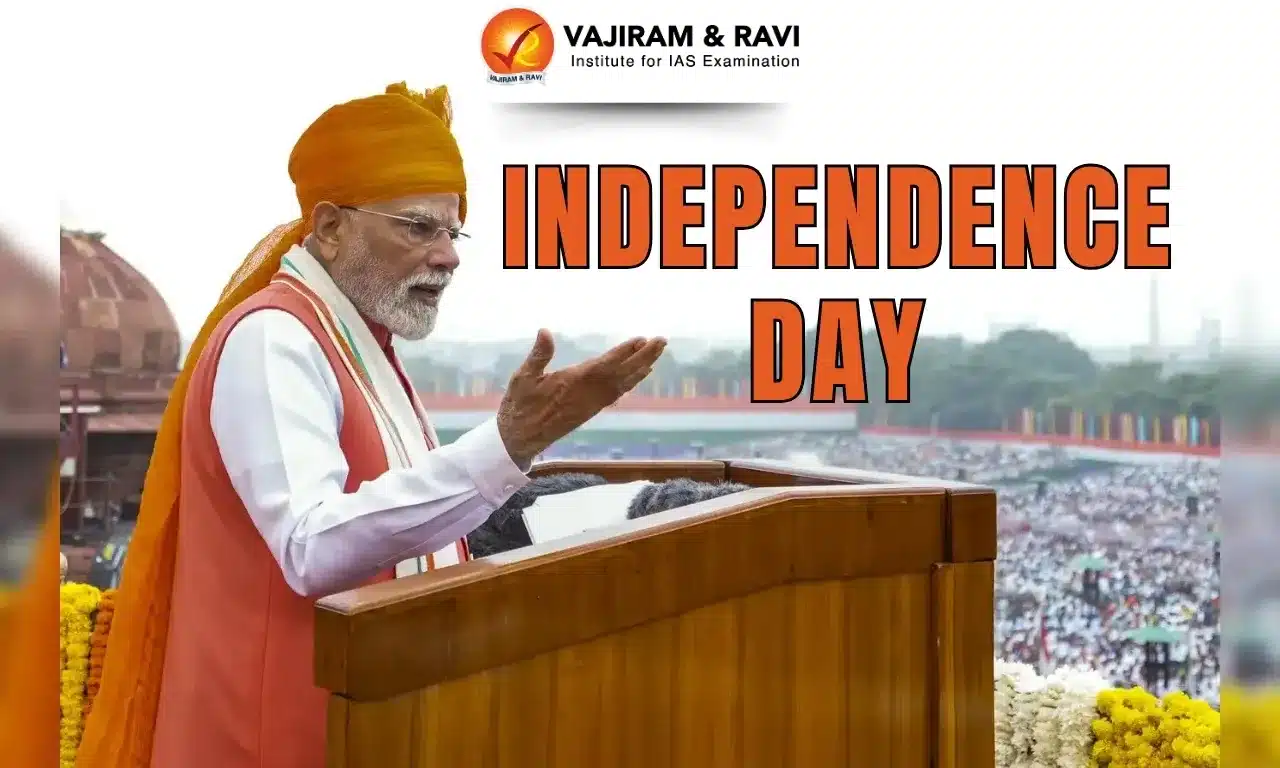
Independence Day

Independence Day Latest News

  • PM Modi’s 2025 Independence Day speech announced sweeping reforms, including GST rationalisation, a Rs. 1 lakh crore jobs scheme, a Demography Mission, and a push for semiconductor and tech innovation.

Introduction

  • Prime Minister Narendra Modi delivered his 12th Independence Day address on August 15, 2025, marking his longest-ever speech at 103 minutes. 
  • The address outlined sweeping economic and governance reforms, highlighted security concerns, and underscored self-reliance as the foundation of a developed India by 2047. 
  • Central to his message were new initiatives, including the High-Powered Demography Mission, second-generation GST reforms, and a corpus for job creation. 
  • The speech combined political messaging, policy announcements, and appeals to youth, farmers, and entrepreneurs, setting the stage for India’s long-term growth trajectory.

Key Announcements and Policy Reforms

  • Next-Generation Economic Reforms
    • PM Modi announced the setting up of a high-powered task force to undertake next-generation reforms by reviewing outdated rules, laws, and policies. 
    • The task force will focus on reducing compliance burdens, especially for MSMEs, startups, and cottage industries, thereby boosting entrepreneurship and global competitiveness. 
    • Reforms in logistics and export systems are also expected to strengthen India’s trade performance.
  • GST Rationalisation and Relief to Citizens
    • After eight years of GST implementation, PM Modi declared that “second-generation GST reforms” would be rolled out. 
    • These reforms aim to simplify the tax regime, reduce compliance costs, and make essential goods cheaper. 
    • PM Modi linked the reforms to a “Diwali gift,” promising substantial tax relief for citizens, especially benefiting small businesses and everyday consumers.
  • Employment and Economic Empowerment
    • The Prime Minister launched the Pradhan Mantri Viksit Bharat Rozgar Yojana, a Rs. 1 lakh crore corpus designed to boost job creation
    • Under this scheme, first-time private sector employees will receive a one-time grant of Rs. 15,000, while private employers will be incentivised to generate jobs. 
    • By supporting both employees and businesses, the government seeks to address youth unemployment and encourage entrepreneurship.
  • Protecting Farmers, Fishermen, and Dairy Interests
    • With trade negotiations with the US putting pressure on India to open its markets for agricultural and dairy imports, PM Modi firmly declared that India would not compromise the interests of farmers, livestock rearers, and fishermen. 
    • Positioning himself as a “wall” safeguarding these communities, he assured citizens that their livelihoods would remain a top priority in policymaking.

National Security and Demographic Concerns

  • High-Powered Demography Mission
    • In one of the most politically significant announcements, PM Modi launched a High-Powered Demography Mission to address concerns about infiltration and demographic changes, especially in border regions. 
    • He warned of a “deliberate conspiracy” to alter India’s demographic balance, claiming that infiltrators were threatening livelihoods, targeting women, and misleading tribal communities. 
    • By framing demographic change as a national security issue, the government aims to implement time-bound measures under this mission.
  • Internal Security and Counter-Terror Operations
    • The Prime Minister praised anti-Naxal operations, particularly in Chhattisgarh, where “terror corridors have turned into green corridors.” 
    • He positioned these successes as evidence of India’s stronger internal security framework, while reiterating that unchecked demographic shifts could pose fresh threats to national unity and security.

Technology and Innovation Push

  • PM Modi emphasised technology as the backbone of future growth. 
  • Key highlights included the announcement that Made-in-India semiconductor chips would enter the market by the end of 2025, with six plants already operational and four more in progress. 
  • He urged Indian youth to innovate in AI, cyber security, deep-tech, and operating systems, envisioning India as a global technology leader. 
  • The focus on indigenous chip manufacturing is particularly significant amid global supply chain disruptions and India’s ambition to reduce dependence on foreign technology.

Source: TH | IE

Independence Day FAQs

Q1: What was the major economic announcement in PM Modi’s Independence Day 2025 speech?

Ans: The announcement of second-generation GST reforms to simplify taxes and reduce costs was a major highlight.

Q2: What is the Pradhan Mantri Viksit Bharat Rozgar Yojana?

Ans: It is a Rs. 1 lakh crore scheme offering incentives for job creation, including a Rs. 15,000 grant for first-time private employees.

Q3: What is the High-Powered Demography Mission?

Ans: A government initiative to address demographic changes and infiltration threats, especially in border areas.

Q4: How did PM Modi address the concerns of farmers and fishermen?

Ans: He assured that India would not compromise their interests in trade negotiations, particularly against US demands.

Q5: What role did technology feature in the speech?

Ans: Modi announced India’s first Made-in-India semiconductor chips by 2025 and pushed for innovation in AI, cyber security, and deep-tech.

Enquire Now