US-Russia Alaska Summit – Fallout and Strategic Concerns

US-Russia Alaska Summit

US-Russia Alaska Summit Latest News

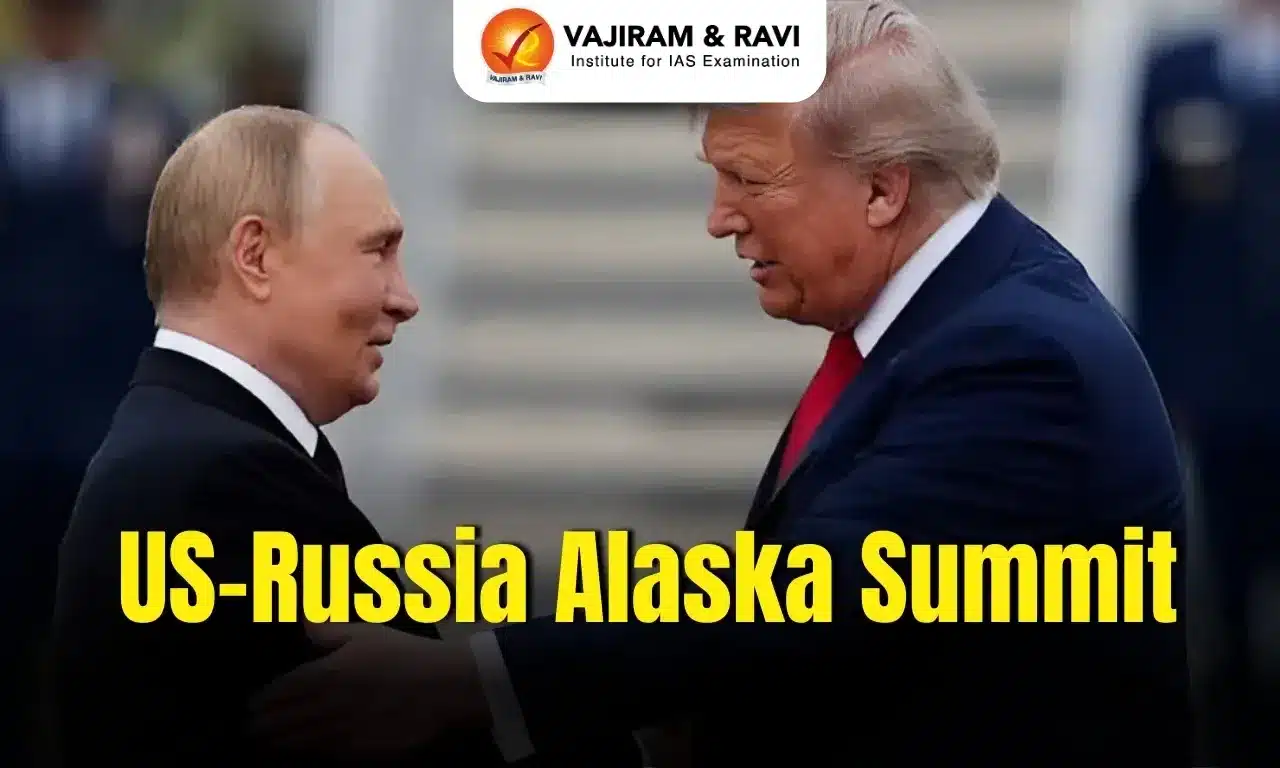
  • US President Donald Trump rated his summit with Russian President Vladimir Putin a “10 out of 10,” describing it as a warm and productive meeting.
  • The US-Russia Alaska Summit, aimed at exploring ways to end the ongoing war in Ukraine, involves two leading nuclear powers, with implications for global security, NATO relations, and the Ukraine conflict.

Key Highlights of the US-Russia Alaska Summit

  • Productive engagement but no agreement:
    • Trump described discussions as “extremely productive”, while noting that a final deal is yet to be reached.
    • Both leaders acknowledged progress on many issues (specifics were not disclosed), and highlighted a possible trilateral meeting (US-Russia-Ukraine) under discussion.
  • Nuclear powers and geopolitics:
    • Trump emphasized the importance of US-Russia relations as the world’s top two nuclear powers.
    • The summit reflects an effort to reduce hostilities and explore a peace settlement in Ukraine.
  • Trump’s position on Ukraine war:
    • Trump claimed that the war would not have occurred if he had remained US President after 2020.
    • He suggested that Ukrainian President Volodymyr Zelenskyy should “make a deal” with Russia, reflecting a move beyond a ceasefire to discussions of a comprehensive peace agreement.
  • Putin’s statement:
    • Putin agreed with Trump’s assertion that the Ukraine war could have been avoided under Trump’s leadership.
    • He expressed willingness to move forward on dialogue to resolve the crisis, and emphasized improving US-Russia relations and potential cooperation in high technology, Arctic, and outer space.

India’s Strategic Dilemma Amid US-Russia Alaska Summit

  • Trade tariffs and sanctions:
    • The 25% tariff on Indian exports is part of Trump’s pressure strategy on Russia.
    • US Treasury warned of harsher sanctions, with a proposed Bill authorizing up to 500% tariffs on states aiding Moscow’s war economy.
    • India’s refined petroleum exports to Europe (sourced from Russian crude) are also under scrutiny.
    • Trump claimed Russia “lost India as an oil client” due to tariffs—though Indian refiners deny US measures affect their buying decisions.
  • Energy security vs. geopolitics:
    • Since 2022, India has become a major buyer of discounted Russian crude (Russia now accounts for 35-40% of India’s total oil imports by volume), ensuring energy security but drawing criticism from the West.
    • The US tariffs have indirectly tied India to the geopolitics of the Ukraine war.
    • If tariffs are enforced, India may face a trade-off between cheap energy and export competitiveness.

Strategic Significance of the US-Russia Alaska Summit

  • For India:
    • Demonstrates how secondary powers like India get affected by great power bargaining.
    • Highlights the energy security vs. foreign policy autonomy dilemma.
    • Shows how India’s refusal to align fully with Western sanctions complicates ties with Washington.
  • For global politics:
    • Reinforces the role of great power politics in conflict resolution.
    • Though Trump briefed Zelenskyy and European leaders, the potential for a broader Western consensus remains uncertain.
    • Highlights US-Russia engagement despite strained relations under NATO’s Ukraine stance.
    • Could influence future NATO-Ukraine strategy and Europe’s security architecture.
    • Signals a possible recalibration of US-Russia relations with ripple effects for Europe, China, and India.

Way Forward for India

  • Diplomatic tightrope: Balancing ties with Russia (defense, energy) and the US (strategic partnership, Indo-Pacific).
  • Growing partnership: With the US and Europe (trade, technology, etc).
  • Ray of hope: The Indian government hopes Trump will delay or discard tariffs, pending Ukraine peace talks.

Conclusion

  • The US-Russia Alaska Summit represents a tentative but crucial step toward peace negotiations in Ukraine. 
  • While progress was acknowledged, the lack of concrete details highlights the fragility of diplomacy in conflict resolution. 
  • The summit may have given Putin symbolic legitimacy, but left India in a zone of strategic and economic uncertainty
  • New Delhi must navigate the dual challenge of securing energy supplies from Russia while mitigating the risks of US secondary tariffs, all against the backdrop of a shifting global order shaped by the Ukraine conflict.

Source: IE| IE |IE

US-Russia Alaska Summit FAQs

Q1: How do the recent US-Russia Alaska summit talks reflect the changing dynamics of great power politics?

Ans: The summit highlighted Russia’s diplomatic resilience and the US’s willingness to explore a peace deal, underscoring how great power rivalries shape global conflict resolution.

Q2: What are the implications of the US’s secondary tariffs on India for its foreign policy and trade strategy?

Ans: Tied to Russian oil imports, it exposes the vulnerability of India’s trade to geopolitical shifts and pressures India’s balancing act between strategic autonomy and economic security.

Q3: How India’s energy security considerations intersect with its external relations in the context of the Ukraine crisis?

Ans: India’s reliance on discounted Russian crude ensures energy stability but complicates ties with the US and Europe, linking domestic economic needs to global geopolitical tensions.

Q4: What strategic opportunities and challenges does a potential US-Russia rapprochement present for India?

Ans: It could stabilize global energy markets, and realign great power equations, forcing India to recalibrate its partnerships with Washington, Moscow, and Beijing.

Q5: Why is India’s position in the Ukraine conflict seen as an example of strategic autonomy?

Ans: By continuing Russian oil imports despite Western criticism, India demonstrates strategic autonomy, but risks punitive trade measures and strained relations with the US-led West.
New Income Tax Bill 2025 Passed | Key Changes & Concerns

New Income Tax Bill 2025

New Income Tax Bill 2025 Latest News

  • Parliament has passed the Income Tax Bill 2025, designed to modernise and replace the decades-old Income Tax Act of 1961. 
  • The new legislation is notably shorter, more streamlined, and clearer in its drafting. 
  • Yet, it also introduces several new provisions that may pose challenges or raise concerns, depending on their implications and implementation.

Need for a New Income Tax Law

  • The Income Tax Act, 1961 had become outdated after decades of numerous amendments, making the legislation complex, lengthy, and difficult for citizens to understand.
  • Its vague provisions gave tax officials significant discretion, often leading to harassment of taxpayers.
  • The Income Tax Bill, 2025 addresses these issues by streamlining and simplifying the law
  • It reduces the number of chapters from 47 to 23 and sections from 819 to 536, cutting down on redundancy and confusion. 
  • To ensure clarity, the Bill expands the use of tables (57 vs. 18 earlier) and formulae (46 vs. six earlier).
  • Most importantly, the language has been simplified, removing legal jargon and including practical examples where necessary, making tax law far more accessible to ordinary citizens.

Need for a Second Version of the Income Tax Bill

  • The first version of the Income Tax Bill 2025, introduced in February, was ambitious but required deeper scrutiny due to its importance. 
  • To ensure fairness and robustness, it was referred to a Select Committee comprising MPs from across parties.
  • The Committee submitted a comprehensive report in July, which retained much of the Bill’s simplified language but also recommended several changes. 
  • To avoid confusion between multiple versions, the government decided to withdraw the original Bill, and incorporate all suggested changes into a single, updated draft.

Key Changes in the New Income Tax Bill 2025

  • The primary objective of the new Income Tax Bill is simplification and rationalisation, not altering tax rates or slabs, which continue to be adjusted separately through the Union Budget.
  • Provisions for Minimum Alternate Tax (MAT) and Alternate Minimum Tax (AMT) have now been separated into two distinct sub-sections, improving clarity.
  • Taxpayers now have the option to update their returns up to four years from the end of the relevant assessment year, allowing mistakes to be corrected without penalty or extra tax liability.
  • Additionally, the period for which assessments can be reopened has been reduced to five years, ensuring greater certainty for taxpayers and preventing long-drawn scrutiny.

Introduction of “Tax Year”

  • A new concept of “tax year”, defined as April 1 to March 31, has been introduced.
  • The law has been significantly streamlined:
    • Sections reduced from 819 (1961 Act) to 536.
    • Chapters reduced from 47 to 23.
    • Word count halved from 5.12 lakh to 2.6 lakh.
    • Tables and formulae increased to provide clarity (57 tables, 46 formulae).

Digital Provisions and Virtual Space

  • The Bill retains the definition of “virtual digital space”, giving tax authorities powers during searches and seizures.
  • This includes email servers, social media accounts, online investments, cloud servers, and digital applications.
  • Finance Minister assured that SOPs will be issued to safeguard personal digital data seized during searches.

Concerns Over Expanded Search Powers

  • While the new Income Tax Bill 2025 aims to simplify tax compliance, it also introduces provisions that raise serious privacy concerns.
  • Under the old Income Tax Act, 1961, officials could inspect electronic documents and physically break locks if access was denied. 
  • The new law goes much further:
    • Taxpayers in control of electronic documents are now legally required to provide “reasonable technical and other assistance”, including sharing passwords of their systems.
  • Since the law does not restrict what kind of electronic information can be accessed, this could extend to personal emails, social media accounts, and private data.
  • If the taxpayer refuses to share passwords, tax officials are empowered to override access codes to any computer system directly.
  • These expanded powers have triggered concerns that they could be misused, undermining citizens’ right to digital privacy and creating scope for overreach by authorities.
  • However, govt contends this was necessary as in today’s financial ecosystem, significant financial information is no longer confined to physical records or formal documents
  • Instead, it is often shared over messaging platforms, stored in personal emails, or maintained on digital accounts.

Source: TH | IE

New Income Tax Bill 2025 FAQs

Q1: What is the New Income Tax Bill 2025?

Ans: The New Income Tax Bill 2025 replaces the 1961 Act, simplifying provisions, reducing sections, and modernising tax compliance for citizens.

Q2: Why was a new income tax law needed?

Ans: The 1961 Act became outdated after many amendments, making it confusing. The 2025 Bill streamlines language and reduces complexity.

Q3: What are key taxpayer-friendly features in the new Bill?

Ans: Taxpayers can update returns within four years, reopen assessments only for five years, and obtain nil-TDS certificates without penalties.

Q4: What are concerns about expanded search powers?

Ans: The Bill requires taxpayers to share passwords and lets officials override access codes, sparking privacy concerns over personal data.

Q5: What does “tax year” mean in the new Bill?

Ans: The new Bill introduces “tax year” as April 1 to March 31, aligning with financial year for clarity.

Health Hazards of Plastic Pollution Explained | Human & Environmental Impact

Health Hazards of Plastic Pollution

Health Hazards of Plastic Pollution Latest News

  • Negotiations among nearly 180 countries in Geneva failed to yield consensus on a binding international treaty to curb plastic pollution. 
  • While the United Nations Environment Programme (UNEP) has already adopted a resolution recognising the urgency of the issue, only a legally binding pact would compel nations to act. 
  • However, deep divisions persist: some countries argue that the treaty should focus narrowly on plastic waste management, while others insist it must also tackle plastic production itself. 
  • Another key dispute lies in whether developed countries should provide financial support to developing nations for implementing plastic curbs. 
  • The most contentious point, however, is the recognition of plastics’ role in human health — a divide that has stalled meaningful progress on drafting the agreement.

Increased Use of Plastic

  • Plastic has become the ultimate symbol of the industrialised, consumption-driven economy due to its versatility, durability, and low production cost. 
  • Derived largely from fossil fuels, plastic can be moulded into a vast array of products — from essential items such as aircraft and medical equipment to disposable packaging and cosmetic decorations. 
  • Its affordability compared to alternatives like glass or aluminium has accelerated its global spread. 

Challenges from Plastic

  • Ubiquitous nature of plastic has turned it into the primary source of litter, exposing weaknesses in waste management systems worldwide.
  • A major challenge arises from plastic’s persistence in the environment. Plastics are complex mixtures of polymers, monomers, and chemical additives, with more than 16,000 chemicals potentially present in various plastic products. 
  • Alarmingly, little is known about the health or environmental impacts of over 10,000 of these substances. 
  • Studies have found that over 4,000 hazardous chemicals exist in major plastic types such as PVC, PET, polyethylene, and polyurethanes. 
  • Being synthetic and non-biodegradable, these chemicals are nearly indestructible and can migrate into ecosystems — contaminating rivers, oceans, soil, and ultimately entering the human body.
  • Thus, while public debates often focus on recycling or waste management, the deeper concern lies in the toxic chemical load plastics carry. 
  • Their resilience and indestructibility make them long-term threats to human health and environmental safety, posing challenges that go far beyond visible waste.

Evidence That Plastic Harms Health

  • Plastics are made from petrochemical derivatives such as ethylene, propylene, and styrene. 
  • Common variants include polypropylene (PP), polyethylene (LDPE, LLDPE, HDPE), and polyethylene terephthalate (PET). 
  • To manufacture these, several other chemicals are used — including bisphenols, phthalates, PCBs, PBDEs, and PFAS. 
  • These substances are widely present in everyday items such as food containers, drink bottles, toys, polyester fabrics, cosmetics, paints, adhesives, medical bags, and electronic components.

Health Risks Identified by Studies

  • Over the years, medical researchers have investigated the effects of exposure to these chemicals through daily-use products. 
  • These studies have linked plastic-related chemical exposure to:
    • Thyroid dysfunction
    • Hypertension
    • Kidney and testicular cancer
    • Gestational diabetes
  • Most of these studies were conducted in developed countries, highlighting the need for wider global research.

Microplastics and Human Health

  • Microplastics are plastic fragments smaller than five millimetres, originating either as breakdown products of larger plastic items or as additives in manufactured goods. 
  • They are widely present in the environment due to the pervasive use of plastics.
  • With recent advances in detection technology, microplastics have been discovered in several critical parts of the human body, including: Blood; Breast milk; Placenta; Bone marrow.
  • This shows that microplastics are not just environmental pollutants but can penetrate and circulate within human biological systems.

Impact on Human Health

  • Although the exact health consequences of microplastics are still under investigation, early evidence suggests links to a wide range of disorders. 
  • Their persistence and potential to carry toxic chemicals raise concerns about long-term risks to human health, especially in sensitive stages such as pregnancy and early development.

India’s Approach to Plastic Management

  • Production and use of single-use plastics are banned in nearly 20 States, as these items are the least reusable and most difficult to recycle. 
  • To address the waste management challenge, the government has also put in place administrative mechanisms requiring companies to collect back a share of the plastics they use. 
  • However, these measures have had limited success due to weak enforcement. 
  • Importantly, India does not yet recognise the health risks posed by plastics and associated chemicals, treating the issue largely as a waste management problem
  • In global negotiations on a plastics treaty, India — along with some other countries — has opposed including health impacts in the agreement, instead suggesting that such concerns should be addressed by the World Health Organization (WHO).

Source: TH | CIEL

Health Hazards of Plastic Pollution FAQs

Q1: What are health hazards of plastic pollution?

Ans: Plastic pollution exposes humans to toxic chemicals and microplastics, linked to cancer, hormonal changes, organ damage, and metabolic disorders.

Q2: Why are plastics harmful to human health?

Ans: Plastics contain thousands of chemicals, including phthalates and bisphenols, many untested, that can disrupt hormones and cause serious diseases.

Q3: What is the impact of microplastics on humans?

Ans: Microplastics enter blood, placenta, and breast milk, raising concerns about unknown long-term effects on immunity, reproduction, and organ health.

Q4: How does plastic pollution affect the environment?

Ans: Non-biodegradable plastics persist in soil, rivers, and oceans, harming ecosystems, marine life, and contaminating food chains with toxic chemicals.

Q5: What is India’s response to plastic pollution?

Ans: India bans single-use plastics in many states, but policies focus on waste management rather than addressing plastics’ health impacts.

Challenges Confronting the Election Commission of India

Election Commission

Election Commission Latest News

  • The Election Commission of India is in the news over the Bihar Special Intensive Revision exercise, which led to mass voter deletions and Supreme Court scrutiny on electoral roll transparency.

Introduction

  • The Election Commission of India (ECI), one of the most vital constitutional bodies safeguarding India’s democracy, is under increasing scrutiny. 
  • Allegations of electoral roll discrepancies, the controversial Special Intensive Revision (SIR) in Bihar, and political criticism have placed the Commission in the spotlight. 
  • Recent interventions by the Supreme Court (SC) and protests by the Opposition have intensified debates around the ECI’s role, autonomy, and credibility.

Constitutional Mandate of the Election Commission

  • The Election Commission of India is a permanent constitutional body entrusted with the superintendence, direction, and control of elections to Parliament, state legislatures, and the offices of the President and Vice-President. 
  • Initially headed only by a Chief Election Commissioner (CEC), it now comprises two additional Election Commissioners, forming a three-member body. 
  • Its mandate is to ensure free, fair, and impartial elections, the cornerstone of Indian democracy.

The Appointment Controversy

  • The Chief Election Commissioner and Other Election Commissioners (Appointment, Conditions of Service and Term of Office) Act, 2023 reshaped the appointment process. 
  • The selection committee now includes the Prime Minister, a Union Minister, and the Leader of the Opposition
  • Opposition parties argue this structure compromises independence, as the government side holds a 2:1 majority, raising fears of bias in appointments.

Allegations of Voter Roll Manipulation

  • The EC has faced repeated accusations from Opposition parties:
    • Maharashtra (2019-20): Allegations of lakhs of voters being added between Lok Sabha and Assembly polls.
    • Haryana and Delhi: Similar claims of manipulated voter lists before the Assembly elections.
    • Karnataka (2024 Lok Sabha): INC alleged large-scale discrepancies in the Mahadevapura constituency, including duplicate and bulk registrations.
  • These allegations have renewed calls for machine-readable voter rolls, which the EC has resisted, citing cybersecurity concerns, a stance earlier upheld by the SC.

The Bihar SIR and Supreme Court Intervention

  • The EC’s Special Intensive Revision in Bihar, announced in June 2025 ahead of Assembly polls, mandated voters to submit proof of birth and citizenship. 
  • This led to the deletion of 65 lakh names from the electoral rolls, reducing Bihar’s voter base from 7.89 crore to 7.24 crore.
  • The SC, in an interim order, directed the EC to:
    • Publish booth-wise lists of deleted names.
    • Provide reasons for deletion (death, migration, duplication, etc.).
    • Accept Aadhaar as valid proof of identity.

Challenges of Migrant Voters

  • India’s internal migrant population continues to face barriers in exercising voting rights. 
  • Migrants must travel back to their registered constituencies, which imposes costs and reduces turnout. 
  • Experts stress the need for a cheap, transparent, and secure system, tailored to the realities of poor migrants, unlike models in advanced economies.

Political Fallout and Growing Protests

  • The controversy has escalated politically:
    • INC’s press conference on voter roll manipulation spurred the Opposition to demand accountability.
    • Protests outside the EC office led to the arrests of opposition MPs.
    • Parliament’s Monsoon Session has faced repeated disruptions over the Bihar SIR issue.

Broader Concerns for Electoral Integrity

  • The unfolding events raise critical challenges for the EC:
    • Ensuring Transparency - Addressing claims of voter roll manipulation.
    • Protecting Voter Rights - Preventing mass exclusions while maintaining accuracy.
    • Balancing Cybersecurity and Accessibility - Providing machine-readable rolls without compromising data safety.
    • Safeguarding Institutional Independence - Resisting political influence in appointments and decision-making.

Source : TH

Election Commission FAQs

Q1: What is the role of the Election Commission of India?

Ans: It supervises, directs, and controls elections to Parliament, State legislatures, and the offices of the President and Vice-President.

Q2: Why is the EC facing criticism over electoral rolls?

Ans: Allegations of duplicate, bulk, and manipulated voter entries have raised concerns of bias and irregularities.

Q3: What is the Special Intensive Revision (SIR) in Bihar?

Ans: It is a voter roll clean-up exercise that led to the deletion of 65 lakh names ahead of Assembly elections.

Q4: What has the Supreme Court directed the EC to do in Bihar?

Ans: The SC ordered the EC to publish a booth-wise list of deleted names with reasons and to accept Aadhaar as proof.

Q5: Why are migrant voters a major challenge for Indian elections?

Ans: Migrants often cannot vote easily as they must travel back to their constituencies, lowering turnout.

Enquire Now