
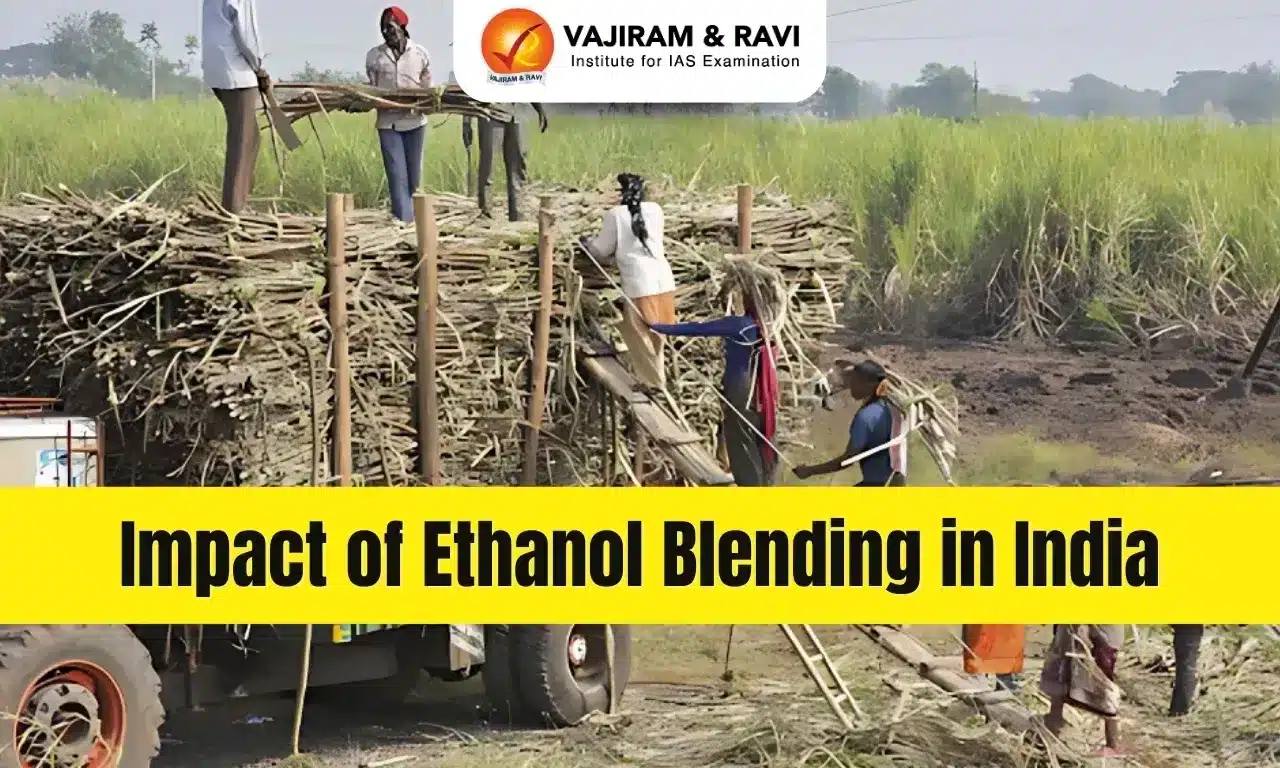
Explained – Impact of Ethanol Blending in India

Impact of Ethanol Blending in India

Ethanol Blending Latest News

  • India has achieved 20% Ethanol blending in petrol five years ahead of schedule, raising debates on its economic, environmental, and EV transition impacts.

Introduction

  • India has achieved its ambitious target of blending 20% ethanol with petrol (E20) five years ahead of schedule, marking a major milestone in its clean energy transition. 
  • Ethanol blending, part of the National Policy on Biofuels, has grown from just 1.5% in 2014 to 20% in 2025, driven by strong government incentives. 
  • While hailed as a step toward energy security, reduced oil imports, and farmer welfare, it has also sparked debates over its impact on vehicle performance, groundwater sustainability, and India’s long-term transition to electric mobility.

Ethanol Blending and Vehicle Owners

  • From April 2023, vehicles in India have carried E20 compatibility stickers. However, acceptance among consumers has been limited.
    • A LocalCircles survey covering 36,000 respondents found that two in three petrol vehicle owners opposed the E20 mandate, citing reduced mileage and higher maintenance costs.
    • Automakers such as Hero MotoCorp have acknowledged the need for new materials (rubbers, elastomers, plastics) to make engines E20-compatible.
    • The Union government admits to a “marginal drop” in fuel efficiency but argues that improved engine tuning will offset losses.
  • Despite these assurances, NITI Aayog has recommended tax incentives on E10 and E20 fuels to compensate consumers for efficiency loss.

Economic and Fiscal Impacts

  • One of the key justifications for ethanol blending has been its role in reducing India’s oil import bill:
  • Since 2014-15, ethanol substitution has saved Rs. 1.40 lakh crore in foreign exchange.
  • However, benefits to consumers have been limited. While oil PSUs (IOC, BPCL) saw a 255% rise in dividend payouts since 2022-23 due to falling crude prices, petrol prices fell only by 2%, raising questions on whether gains are being equitably shared.

Impact on Agriculture and Environment

  • Ethanol blending has opened a steady revenue stream for farmers, especially sugarcane growers:
    • Ethanol production grew from 40 crore litres in FY14 to nearly 670 crore litres in FY24, with about 9% of sugar output diverted to fuel.
    • The Centre says it has paid Rs. 1.20 lakh crore to farmers since FY15.
  • However, concerns persist about the environmental cost:
    • Sugarcane cultivation requires 60-70 tonnes of water per tonne of crop, leading to excessive groundwater extraction, especially in drought-prone Maharashtra.
    • Nearly 30% of India’s land is already degraded, and water-intensive cropping patterns worsen desertification risks.
  • The government is now diversifying ethanol sources:
    • Food Corporation of India allocated 5.2 million tonnes of rice for ethanol in 2024-25.
    • 34% of corn output was diverted, forcing a surge in corn imports (9.7 lakh tonnes in 2024-25).
    • Despite diversification, sugarcane acreage remains stable at ~57 lakh hectares, driven by assured Fair and Remunerative Pricing (FRP).

Global Trade and U.S. Concerns

  • India’s booming ethanol sector has attracted international scrutiny.
  • The U.S. has pushed India to relax ethanol import restrictions, calling current policies a “trade barrier.”
  • The Indian Sugar Mills Association warns that import liberalisation could undermine domestic capacity building and hurt farmers.

Ethanol Blending and the EV Transition

  • While ethanol blending has reduced carbon dioxide emissions by 700 lakh tonnes, experts argue that a faster shift to electric vehicles (EVs) would deliver greater climate gains.
    • India lags global peers, with EVs making up only 7.6% of vehicle sales in 2024. To meet its 2030 target of 30% EV sales, growth must accelerate by over 22% in the next five years.
    • EV adoption is constrained by rare earth element (REE) shortages, as India relies heavily on Chinese supplies for components like magnets and batteries.
    • Carmakers such as Maruti Suzuki have cut production targets for EVs due to supply chain disruptions.
  • The government is engaged in diplomatic talks with Beijing to ensure REE supply stability, highlighting the intersection between energy security and geopolitics.

Future Outlook

  • While the Petroleum Ministry has indicated plans to pursue blending beyond 20%, the Union government clarified in March 2025 that no formal decision has been taken. Policymakers face a delicate balance between:
    • Supporting farmers and energy independence through ethanol.
    • Addressing the environmental costs of water-intensive sugarcane.
    • Accelerating the shift to EVs for deeper decarbonisation.
  • India’s ethanol success is undeniable, but the challenge lies in ensuring that its gains are not offset by ecological and consumer costs.

Source : TH

Ethanol Blending FAQs

Q1: What is India’s current ethanol blending level in petrol?

Ans: India has achieved 20% ethanol blending in petrol (E20) five years ahead of schedule.

Q2: How has ethanol blending benefited the Indian economy?

Ans: It has saved over ₹1.40 lakh crore in oil import costs since 2014-15 and boosted farmer incomes.

Q3: What environmental concerns are linked to ethanol blending?

Ans: Heavy reliance on water-intensive sugarcane strains groundwater reserves and accelerates land degradation.

Q4: How are Indian consumers reacting to E20 petrol?

Ans: Most vehicle owners oppose it due to reduced mileage and higher maintenance costs.

Q5: Will ethanol blending affect India’s EV transition?

Ans: Ethanol blending aids decarbonisation, but rapid EV adoption offers greater long-term emission reductions.


India’s First Sustainable Aviation Fuel Plant to Begin Production in 2025

Sustainable Aviation Fuel India

Sustainable Aviation Fuel India Latest News

  • Indian Oil Corporation (IOC), India’s largest refiner and fuel retailer, is set to begin commercial production of Sustainable Aviation Fuel (SAF) at its Panipat refinery by December 2025. The facility recently received international certification to manufacture biofuel from used cooking oil (UCO).
  • By year-end, IOC will achieve a production capacity of 35,000 tonnes of SAF annually, with raw material sourced from large hotel chains, restaurants, and food companies, which typically discard cooking oil after one-time use.
  • This development marks a significant step in India’s green aviation push, contributing to cleaner energy transition and reducing dependence on conventional jet fuel.

About Sustainable Aviation Fuel (SAF)

  • SAF is a bio-based alternative to conventional jet fuel, produced from renewable feedstocks such as used cooking oil, agricultural residues, forestry waste, and non-edible crops.
  • SAF is a “drop-in fuel,” meaning it can be blended with existing jet fuel and used in current aircraft engines without modification.
  • International aviation bodies certify blending limits (usually up to 50%) to ensure safety and performance.

Benefits of Sustainable Aviation Fuel (SAF)

  • Engine and infrastructure compatibility - SAF blended with conventional Jet A can be used in existing aircraft and infrastructure.
  • Fewer emissions - Compared with conventional jet fuel, 100% SAF has the potential to reduce greenhouse gas emissions by up to 94% depending on feedstock and technology pathway.
  • More flexibility - SAF is a replacement for conventional jet fuel, allowing for multiple products from various feedstocks and production technologies.
  • Energy Security – It reduces dependence on imported crude oil.
  • Economic Opportunities – It Creates new markets for farmers (through non-edible crops and residues) and waste collectors (used cooking oil, biomass).
  • Exports: With Europe already enforcing SAF blending mandates, European airlines are seen as the first major buyers of IOC’s SAF when they land in India. IOC also plans to tap into global export markets as demand rises.

IOC’s First Commercial SAF Plant

  • Indian Oil Corporation (IOC), the country’s largest refiner, will begin commercial production of Sustainable Aviation Fuel (SAF) at its Panipat refinery by December 2025
  • The plant is certified under ISCC CORSIA standards.
    • IOC is the first Indian company to receive ISCC CORSIA certification, a requirement under the Carbon Offsetting and Reduction Scheme for International Aviation (CORSIA). 
    • From 2027, airlines worldwide must offset emissions beyond 2020 levels, and using SAF blends will be a key compliance pathway.
  • It will produce 35,000 tonnes of SAF annually using used cooking oil (UCO).
    • UCO refers to edible oils and fats that have been used for frying, cooking, or food preparation in both commercial and household settings. 
    • It is essentially leftover oil from cooking processes. 
    • While UCO can be a sustainable feedstock for biodiesel and other products, its improper disposal can lead to environmental and health issues.

Meeting India’s SAF Targets

  • The initial production capacity will be sufficient to meet India’s 1% SAF blending target for international flights by 2027.
  • The National Biofuel Coordination Committee (NBCC) has set indicative targets of 1% blending in 2027 and 2% in 2028.
  • SAF blending for domestic flights is expected to follow, but only after international targets are in place.

Challenges Ahead

  • Collection bottlenecks: While UCO collection from big hotel chains is easy, creating systems to collect oil from small eateries and households remains difficult.
  • High cost: SAF is currently about three times more expensive than conventional jet fuel, raising concerns for airlines about higher operating costs.
  • Feedstock Availability: Large-scale production requires a steady supply of sustainable feedstocks (used cooking oil, residues, waste).
  • Policy roadmap: Although the government had earlier considered early SAF mandates, cost concerns have pushed implementation to 2027 onwards.

Future Pathways

  • While IOC has started with the used cooking oil route, it is also working on alcohol-to-jet (ATJ) technology, which uses ethanol as feedstock. 
  • Other Indian companies are exploring similar SAF technologies, but all pathways require international certification before commercial rollout.

Source: IE | BS | AFDC

Sustainable Aviation Fuel India FAQs

Q1: What is SAF?

Ans: Sustainable Aviation Fuel (SAF) is eco-friendly jet fuel made from renewable feedstocks like used cooking oil.

Q2: Who is producing SAF in India?

Ans: Indian Oil Corporation (IOC) will produce SAF commercially at its Panipat refinery by December 2025.

Q3: What is IOC’s SAF production capacity?

Ans: IOC’s Panipat refinery will produce 35,000 tonnes of sustainable aviation fuel annually from used cooking oil.

Q4: Why is SAF important for aviation?

Ans: SAF reduces aviation carbon emissions and supports global decarbonisation targets under CORSIA guidelines.

Q5: What challenges exist in SAF adoption?

Ans: The main challenges are high production costs and difficulty collecting used cooking oil from small users.

India’s S&P Credit Rating Upgrade Explained: Drivers and Future Outlook

India S&P Credit Rating

India S&P Credit Rating Latest News

  • Recently, S&P Global Ratings upgraded India’s sovereign rating to BBB from BBB-, the country’s first upgrade in nearly two decades. 
  • The move is significant not only because of the long gap but also due to its far-reaching implications for India’s economic standing, investor confidence, and global credibility.

About S&P Global

  • S&P Global, also known as Standard & Poor’s Global, is a prominent international credit rating agency. 
  • It assesses the creditworthiness of governments, corporations, and financial instruments, offering investors independent evaluations of financial risk.

Why Credit Ratings Matter

  • Credit ratings assess a country’s creditworthiness — its ability and willingness to repay borrowed money. 
  • Just as timely loan repayments improve an individual’s credit score, sound financial management enhances a nation’s rating. 
  • Since most governments, including India, borrow annually to cover fiscal deficits (₹15.69 lakh crore in 2025-26), a higher rating lowers borrowing costs by signaling reliability to lenders.
  • For India, S&P’s recent upgrade means reduced interest rates on debt and easier access to global capital markets
  • The upgrade can unlock new global funding pools and reduce borrowing costs not only for the government but also for Indian corporates, especially those raising money abroad.

India’s Persistent Push for a Ratings Upgrade

  • For years, the Indian government has actively lobbied global rating agencies — S&P, Moody’s, and Fitch — for higher credit ratings, arguing that their assessments understate India’s economic strength. 
  • New Delhi has often criticised the methodologies as biased against emerging economies.
  • It even highlighted the issue in the 2020-21 Economic Survey with a dedicated chapter titled “Does India’s Sovereign Credit Rating Reflect its Fundamentals? No!”

Steady Gains in India’s Economic Fundamentals

  • India’s recent rating upgrade by S&P is rooted in two key improvements — fiscal discipline and economic growth
  • After years of missing fiscal deficit targets under the Fiscal Responsibility and Budget Management Act (2003), the government has shown aggressive consolidation since the pandemic. 
  • The deficit has been cut from 9.2% of GDP in 2020-21 to a projected 4.4% in 2025-26, with plans to bring debt-to-GDP down from 57.1% to 49–51% by 2030-31.
  • On growth, despite slowing to 6.5% in 2024-25, India remains among the world’s fastest-growing large economies, with robust nominal GDP supporting a declining debt ratio. 
  • S&P has also praised India’s inflation management, as the headline inflation rate fell to 1.55% in July 2025, the lowest since 2017
  • Low, stable inflation boosts investor confidence by protecting returns, supporting currency stability, and reducing social risks. 
  • Together, these factors highlight India’s fiscal resilience, growth strength, and credibility in economic management, justifying the long-awaited upgrade.

Understanding India’s Position on the Rating Scale

  • India’s credit rating with S&P has improved within the same category, moving from BBB- (the lowest in investment grade) to BBB, which is more stable but still the entry-level of investment-grade ratings.
  • Credit ratings are broadly divided into two classes: investment grade (safer for investors) and speculative grade (riskier, with repayment less predictable). 
  • Within investment grade, BBB is the lowest rung. According to S&P, a BBB rating reflects an “adequate capacity to meet financial commitments, but more vulnerable to adverse economic conditions.”
  • The next levels are BBB+, followed by the A, AA, and AAA categories, with AAA denoting the strongest capacity to meet financial obligations. 
  • Thus, while India’s upgrade signals improved financial credibility, it still has ground to cover before reaching stronger rating tiers.

India’s Place Among Global Peers

  • India shares its BBB rating with countries such as Greece, Mexico, and Indonesia.
  • At the very top, with the AAA rating, are advanced economies including Australia, Canada, Denmark, and Germany.
  • However, the wealthiest countries do not always retain the highest ratings. 
  • For example, the United States was downgraded to AA+ by S&P in 2011, breaking its AAA streak due to rising debt concerns. 

What Lies Ahead for India’s Credit Rating

  • The upgrade brings immediate benefits, notably lower borrowing costs for the government, reflected in falling bond yields and a stronger rupee. 
  • However, the next step toward a higher rating will not be easy.
  • S&P has indicated that a further upgrade depends on reducing the combined fiscal deficit of the Centre and states below 6% of GDP on a structural basis
  • This is challenging, as S&P projects the deficit to narrow only to 6.6% by 2028-29, down from 7.8% in 2024-25. 

Source: IE | PIB | MC

India S&P Credit Rating FAQs

Q1: What rating did India get from S&P?

Ans: India’s sovereign rating was upgraded from BBB- to BBB by S&P Global Ratings.

Q2: Why do credit ratings matter?

Ans: Higher ratings reduce borrowing costs, improve investor confidence, and open global funding opportunities.

Q3: What drove India’s upgrade?

Ans: Improved fiscal deficit control, strong GDP growth, and stable inflation management drove the upgrade.

Q4: Where does India stand globally?

Ans: India shares BBB rating with Greece, Mexico, and Indonesia, below AAA-rated countries like Germany and Australia.

Q5: What’s needed for the next upgrade?

Ans: India must reduce combined Centre-State fiscal deficit below 6% of GDP, a challenging target.

Enquire Now

