Election Commission vs States: Who Controls Election Officials in India

Election Commission vs States

Election Commission vs States Latest News

  • The Election Commission of India (ECI) and the West Bengal government are locked in a dispute over disciplinary authority on election officials. 
  • The state has refused to act against four officers accused of tampering with the electoral roll, arguing that no elections have been announced and the Model Code of Conduct is not in force. 
  • This clash has reignited the long-standing debate on the extent of the ECI’s disciplinary control once state officials are deputed to election duty.

Constitutional Vision for the Election Commission

  • During the Constituent Assembly debates, Dr. B. R. Ambedkar emphasized that the Chief Election Commissioner should enjoy the same protection as a Supreme Court judge to ensure independence from the executive. 
  • On staffing, he rejected the idea of creating a parallel permanent bureaucracy for the Commission, noting it would be costly and unnecessary since electoral work fluctuates in intensity. 
  • Instead, he proposed that officials be deputed from provincial governments, remaining under the Commission’s authority during elections
  • Thus, the framers envisioned an Election Commission without its own permanent staff but with full control over officials temporarily assigned to it.

1988 Amendments: Strengthening ECI’s Authority over Election Officials

  • In 1988, Parliament gave legal backing to the Constituent Assembly’s vision by amending both the Representation of the People Acts of 1950 and 1951
  • These changes placed election officials formally under the Election Commission’s control.
  • Under Section 13CC of the 1950 Act, officials such as Chief Electoral Officers, District Election Officers, and Electoral Registration Officers were deemed to be on deputation to the Commission while handling electoral rolls, making them subject to its supervision and discipline.
  • Similarly, Section 28A of the 1951 Act extended this authority to returning officers, presiding and polling officers, and even police personnel on election duty. 
  • Their accountability to the Commission lasted from the notification of elections until the final declaration of results.
  • Together, these amendments institutionalised the Commission’s power over both administrative and enforcement staff during elections, ensuring independence and uniformity in the conduct of polls.

The Continuing Tussle: T N Seshan vs. the Government

  • Even after the 1988 amendments gave the Election Commission clear authority over election officials, disputes with governments persisted. 
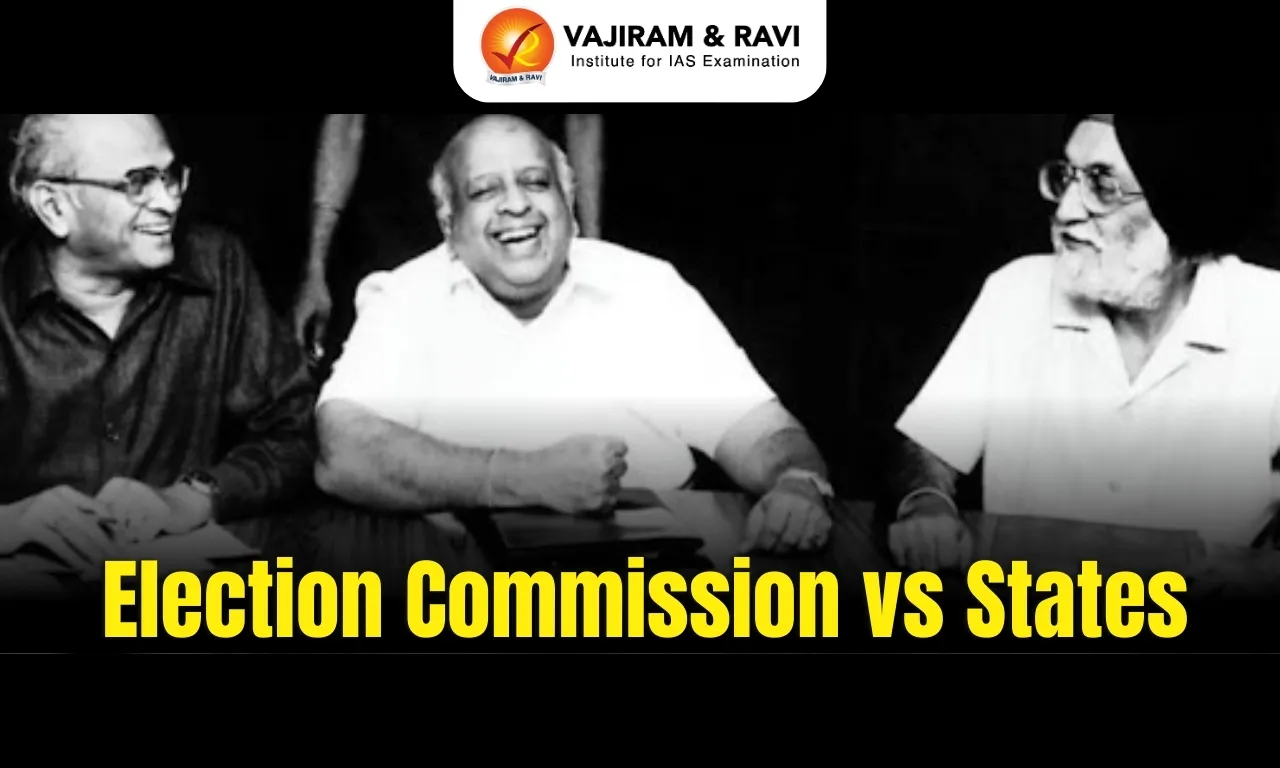
  • The fiercest clash came during the tenure of T N Seshan (1990–96), the combative Chief Election Commissioner known for his strict enforcement of electoral discipline.
    • He declared that once drafted, these officials would answer solely to the ECI. 
    • He also claimed powers to discipline, suspend, or transfer errant officers — a stance the government refused to accept.

The Ranipet Flashpoint

  • The conflict peaked during the 1993 Ranipet by-election in Tamil Nadu. 
  • To conduct this election smoothly, the then CEC sought deployment of central forces. However, the government bluntly told him that he lacked the authority to demand central forces.
  • In retaliation, T N Seshan postponed 31 elections — to Lok Sabha, Rajya Sabha, state councils, and assemblies — until the deadlock was resolved. 

Judicial Intervention and Aftermath

  • The ECI then approached the Supreme Court, which gave interim relief by affirming its authority over officers on election duty. 
  • However, the litigation dragged on even after Seshan retired in 1996. 
  • Finally, in 2000, under Chief Election Commissioner M S Gill, a negotiated settlement was reached, and the case was closed.

The 2000 Agreement: Formalising ECI’s Disciplinary Powers

  • The tussle over the ECI’s authority was finally settled in 2000 through a negotiated agreement recorded by the Supreme Court. 
  • For the first time, the Commission’s disciplinary powers over officials on election duty were formally spelt out.

Scope of Powers

  • The ECI was empowered to:
    • Suspend officers for dereliction of duty.
    • Replace errant officials and send them back to their original cadres with a detailed conduct report.
    • Recommend disciplinary action to the competent authority, which was bound to act within six months and report back to the Commission.
  • This settlement marked a turning point: for the first time, the ECI’s disciplinary authority was codified on paper, strengthening its ability to act against officials who compromised free and fair elections. 
  • It also established a clear chain of accountability between the ECI, the Centre, and the states.

West Bengal Standoff: Options Before the ECI

  • The ongoing clash between the ECI and the West Bengal government shows that the 2000 settlement has not fully resolved tensions over disciplinary control of election officials. 
  • Over the years, states have sometimes resisted ECI directives or diluted them by accepting explanations from officers instead of enforcing strict action.
  • In the present case, if West Bengal continues to resist, the ECI has three escalation options:
    • Summoning the Chief Secretary — already exercised, with a week’s compliance deadline set.
    • Involving the Centre — urging it to remind the state of the binding nature of the 2000 framework.
    • Approaching the Courts — as a final recourse, invoking its authority under the Representation of the People Acts, 1950 and 1951, to ensure enforcement.
  • This episode highlights how the ECI’s authority, though legally backed, still faces practical challenges when state governments push back against its disciplinary powers.

Source: IE | IE

Election Commission vs States FAQs

Q1: What was Ambedkar’s view on staffing the Election Commission?

Ans: Dr. Ambedkar opposed a separate bureaucracy and preferred borrowing officials from states, making them answerable to the Election Commission while on deputation.

Q2: When did the ECI get formal power over election officials?

Ans: In 1988, amendments to the Representation of the People Acts granted the ECI authority over officers on election duty, ensuring control and discipline.

Q3: How did T.N. Seshan expand ECI’s powers?

Ans: As CEC (1990–96), T.N. Seshan asserted disciplinary authority over officials, clashed with the Centre, and even postponed elections, prompting a Supreme Court battle.

Q4: What did the 2000 agreement establish?

Ans: It allowed ECI to suspend, substitute, or return errant officers and mandated competent authorities to act on its recommendations within six months.

Q5: What are ECI’s options in the West Bengal case?

Ans: ECI can summon the Chief Secretary, involve the Centre to enforce compliance, or approach courts under the Representation of the People Acts.
India’s Two-Tier GST Reform: Long-Term Revenue Gains Ahead

GST Reform in India

GST Reform in India Latest News

  • S&P Global Ratings noted that the proposed two-tier GST structure could reduce the effective taxation rate while boosting long-term fiscal revenues.
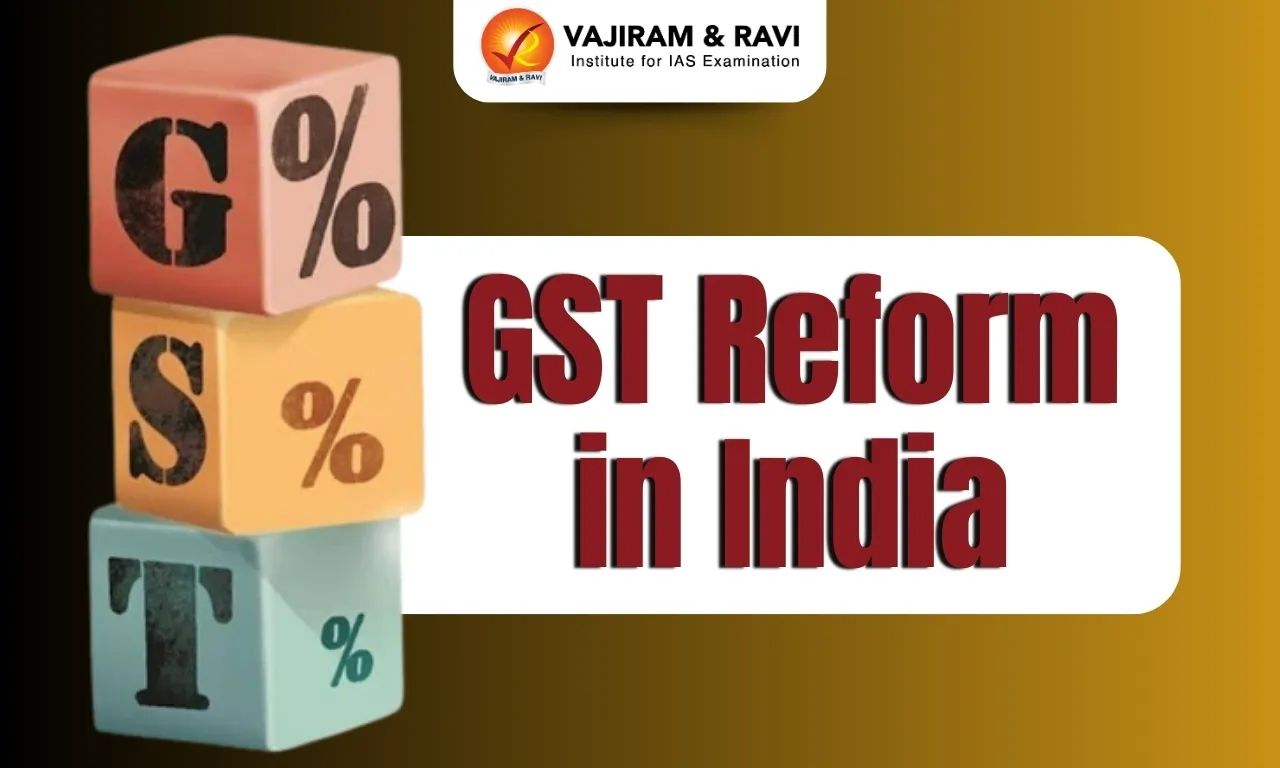
  • The Centre’s proposal, to be discussed with states in an upcoming meeting, aims to simplify GST by reducing the slabs to just 5% and 18%, along with a special 40% rate for select luxury or sin goods.
  • This reform is expected to streamline compliance, reduce complexity, and potentially increase government revenues over time, though its short-term impact on collections and affordability remains to be seen.

The Proposed Two-Slab GST System

  • The central government plans to move from the current four-rate GST structure to two slabs of 5% and 18%, with an additional 40% rate for sin and demerit goods
    • Currently, there are 4 slabs under GST -- 5, 12, 18 and 28 per cent and the taxation system has been an important component of the government's revenues.
  • This reform is expected by the end of 2025 and aims to simplify compliance while reducing distortions in the indirect tax regime.
  • The changes will reduce classification disputes, scope for litigation and evasion as well as remove duty inversion.

Declining Effective GST Rates

  • Since its launch in 2017, GST rates have been gradually reduced. 
  • An RBI study in 2019 found that the weighted average GST rate had dropped from 14.4% to 11.6%, achieved through base broadening and removing distortions. 
  • This trend is expected to continue under the new structure.

S&P’s Position on GST Reform

  • S&P Global Ratings has dismissed concerns that the Centre’s proposal to reform the Goods and Services Tax (GST) regime will harm fiscal revenues. 
  • Director of the organisation explained that while tax rates may appear lower under the proposed two-slab system, simplified implementation and transparent accounting could actually improve revenue collection in the long run.
  • It highlighted that GST has been a key driver of fiscal revenues over the past five to six years. 
  • S&P believes reforms will continue strengthening government finances rather than weakening them, even if short-term adjustments create some pressure.

Debt and Fiscal Targets

  • S&P forecasts the combined central and state fiscal deficit at 7.3% of GDP in 2025–26, narrowing to 6.6% by 2028–29
  • Interest servicing remains a heavy burden but should ease gradually due to stronger revenues and cheaper financing.
  • India’s debt-to-GDP ratio is projected to fall from 83% in 2024–25 to 78% by 2028–29, with the Centre targeting 49–51% by 2030–31.

Rating Upgrade and Long-Term Outlook

  • S&P upgraded India’s rating to BBB from BBB-, citing its robust economic performance.
  • The agency stressed that India’s reforms, including GST rationalisation, support long-term fiscal sustainability despite short-term uncertainties.
  • It upgraded India’s rating to BBB from BBB- citing:
    • Strong and resilient economic expansion.
    • Political commitment to fiscal discipline.
    • Improved quality of government spending through higher capital expenditure.
    • A credible monetary policy framework ensuring controlled inflation.

Economists’ Perspective on Fiscal Impact

  • Economists note that state governments could face revenue losses estimated at ₹7,000–9,000 crore annually
  • However, these may be offset by stronger GDP growth, which boosts both direct and indirect tax collection. 
  • For 2025–26, the central government’s fiscal deficit impact is expected to be less than 0.1% of GDP.

Source: IE | ET | BS

GST Reform in India FAQ

Q1: What is the proposed GST reform in India?

Ans: The Centre proposes replacing four slabs with two—5% and 18%—plus a 40% special rate for luxury or sin goods to simplify compliance.

Q2: How does S&P view GST reforms?

Ans: S&P believes reforms will simplify the tax system, improve transparency, and strengthen government revenue in the long term despite initial concerns.

Q3: Will GST reforms reduce government revenue?

Ans: While rates may seem lower, streamlined compliance and broader tax base are expected to increase overall fiscal revenue over time.

Q4: What are the fiscal implications for states?

Ans: Economists project states may lose ₹7,000–9,000 crore annually, but faster GDP growth could offset this by raising direct and indirect tax collections.

Q5: Why did S&P upgrade India’s rating?

Ans: Due to strong economic performance, fiscal discipline, higher capital expenditure, and credible monetary policy managing inflation.

Rajya Sabha Clears Bill Allowing Mining of Critical Minerals

Election Commission vs States

Critical Minerals Latest News

  • The Rajya Sabha has passed the Mines and Minerals Amendment Bill, 2025, allowing leaseholders to mine critical minerals like lithium, cobalt, and nickel without paying additional royalty.

Introduction

  • India has taken a decisive step towards securing its Critical Mineral supply chain by passing the Mines and Minerals (Development and Regulation) Amendment Bill, 2025
  • The legislation, cleared by the Rajya Sabha after its passage in the Lok Sabha on August 12, empowers mining leaseholders to extract rare and critical minerals such as lithium, cobalt, and nickel without paying additional royalty. 
  • This reform is positioned as a cornerstone for India’s ambitions in clean energy, technology, and strategic industries.

About the Mines and Minerals Amendment Bill, 2025

  • The Bill amends the Mines and Minerals (Development and Regulation) Act, 1957. 
  • Its key provision allows existing leaseholders to diversify operations by adding critical minerals to their portfolio. 
  • These minerals are essential inputs for advanced technologies, including electric vehicles, semiconductors, renewable energy storage, and aerospace applications.
  • Additionally, the Bill strengthens the Union government’s powers to promote the development of mineral markets through the creation of mineral exchanges, ensuring transparency and efficient trading.

Significance of the Reform

  • Strengthening Resource Security - Lithium, cobalt, and nickel are indispensable for batteries, electronics, and green technologies, making domestic mining critical to reduce import dependence.
  • Boost to Clean Energy Transition - Access to critical minerals underpins India’s EV revolution, solar manufacturing, and renewable integration.
  • Support for Strategic Sectors - From smartphones to fighter jets, these minerals are essential for India’s industrial and defence ecosystems.
  • Ease of Doing Business - By removing the burden of additional royalty, the Bill incentivises companies to invest in exploration and development.

The National Critical Mineral Mission

  • The Union Coal and Mines Ministry highlighted that the government has identified 24 critical and strategic minerals
  • To support this effort, the National Critical Mineral Mission has been launched with an outlay of Rs. 34,000 crore, focusing on boosting domestic exploration and production, including offshore reserves.
  • The National Mineral Exploration Trust has also been renamed as the National Mineral Exploration and Development Trust, signalling a stronger emphasis on both exploration and industrial development.

Challenges Ahead

  • Environmental Risks - Critical mineral mining could impact fragile ecosystems and water resources.
  • Global Competition - India must match international players already dominating the mineral supply chains.
  • Technological Capacity - Scaling up exploration and refining requires cutting-edge technologies and significant investment.
  • Geopolitical Sensitivities - Securing critical minerals is tied to global strategic competition, especially with China’s dominance in rare earth processing.

Future Outlook

  • The passage of the Bill is expected to transform India’s mining sector into a strategic pillar for economic growth and self-reliance
  • By linking resource extraction with the goals of energy transition, Make in India, and national security, India is positioning itself as a serious player in the global critical minerals market.
  • However, the success of the initiative will depend on balancing industrial ambitions with environmental safeguards, building domestic refining capacities, and ensuring equitable revenue sharing with states and local communities.

Source: TH

Critical Minerals FAQs

Q1: What is the Mines and Minerals Amendment Bill, 2025?

Ans: It is a law allowing mining leaseholders to extract critical minerals like lithium, cobalt, and nickel without paying additional royalty.

Q2: Why are critical minerals important for India?

Ans: They are essential for EV batteries, renewable energy, defence, electronics, and aerospace industries.

Q3: What is the National Critical Mineral Mission?

Ans: A government initiative with a Rs. 34,000 crore outlay to boost exploration and domestic production of 24 critical minerals.

Q4: How does the Bill promote transparency?

Ans: It empowers the government to set up mineral exchanges for transparent trading and market development.

Q5: What challenges does India face in critical mineral mining?

Ans: Environmental risks, technological gaps, global competition, and geopolitical challenges remain major hurdles.

Constitution (130th Amendment) Bill, 2025 – Removal of Ministers Facing Serious Criminal Charges

_Constitution (130th Amendment) Bill, 2025

Constitution (130th Amendment) Bill, 2025 Latest News

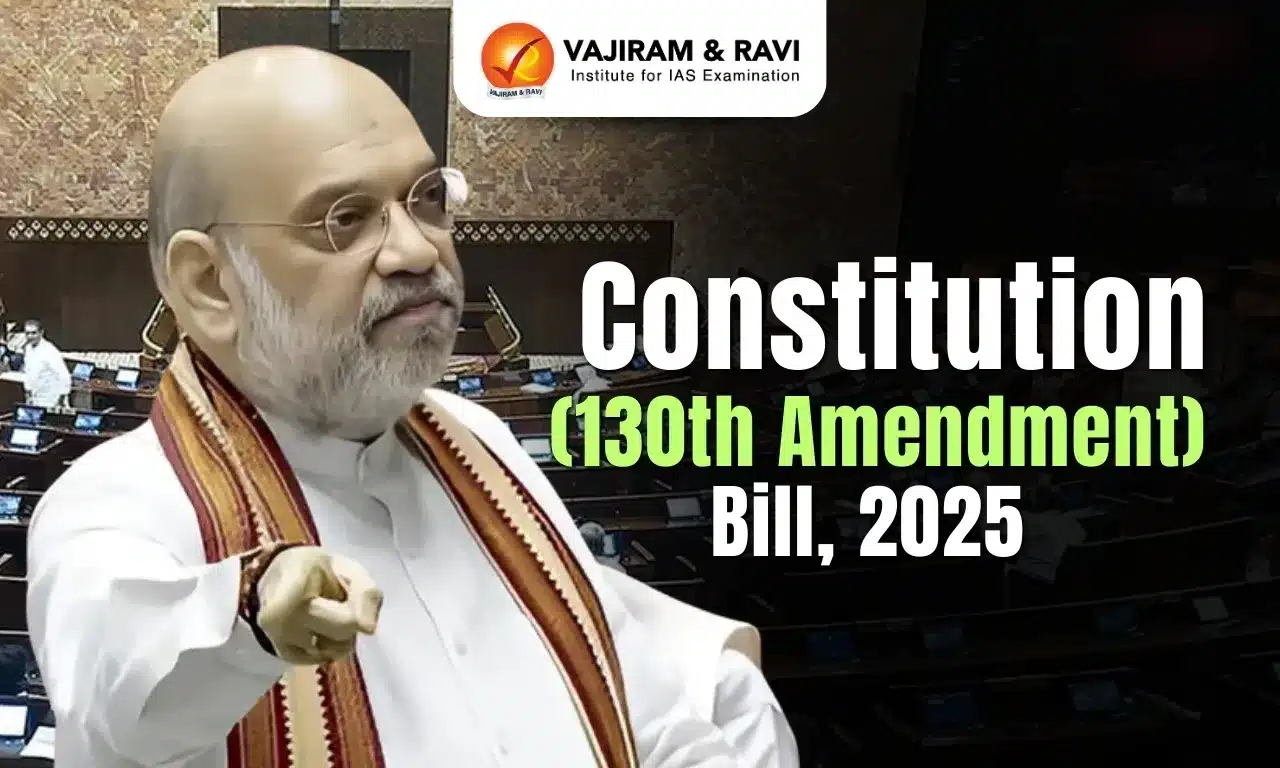
  • Union Home Minister Amit Shah is expected to introduce the Constitution (130th Amendment) Bill, 2025 in the Lok Sabha.
  • The bill aims to address the gap in the Constitution regarding removal of Ministers (PM, CMs, Union/State Ministers) facing serious criminal allegations and detained for 30 consecutive days.
  • The move comes against the backdrop of the controversy that surrounded the arrest in 2023 of V Senthil Balaji, a minister in Tamil Nadu’s DMK government.

Key Provisions of the Constitution (130th Amendment) Bill, 2025

  • Constitutional amendments:
    • The Bill will amend Articles 75, 164 and 239AA.
    • Article 75 of the Constitution primarily deals with the appointment and responsibilities of the Council of Ministers, including the Prime Minister.
    • Article 164 of the Constitution outlines the provisions related to the CoMs in a state.
    • Article 239AA of the Constitution outlines special provisions for the NCT of Delhi.
  • Removal clause: If a Minister (PM/CM/Minister) is arrested and detained for 30 consecutive days on charges punishable with five years or more imprisonment, then:
    • President (on advice of PM/directly) removes Union Ministers/PM.
    • Governor (on CM’s advice) removes State Ministers.
    • Governor (directly) removes Chief Minister of State.
    • UT-specific amendments cover CMs/Ministers in UTs and J&K.
  • Reappointment: Ministers can be reappointed upon release.

Justification and Rationale Behind the Constitution (130th Amendment) Bill, 2025

  • Good governance and constitutional morality: Ministers facing criminal charges undermine public trust and principles of responsible government.
  • Character beyond suspicion: Elected representatives must rise above political interests to uphold the welfare of people.
  • Constitutional gap: No explicit removal provision existed earlier; courts interpreted “pleasure of Governor/President” but bound by aid and advice doctrine.

Political and Legal Background

  • Case reference:
    • Arrest of V. Senthil Balaji (DMK Minister, 2023) sparked controversy.
    • Governor R.N. Ravi dismissed him → CM M.K. Stalin reinstated after bail → later reshuffle removed Balaji after SC’s concerns.
  • Judicial doctrine: Governors’ powers under Article 164 are not absolute, subject to aid and advice of the Council of Ministers.

Related Legislative Measures

  • Constitution (130th Amendment) Bill, 2025 – For union and states.
  • Government of Union Territories (Amendment) Bill, 2025 – Amends the Government of Union Territories Act, 1963 and covers UTs like Puducherry and Delhi.
  • J&K Reorganisation (Amendment) Bill, 2025 – Amends section 54 in the 2019 reorganisation act (the act turned J&K from a state to a UT).
  • All bills are likely to be referred to a Joint Committee of Parliament.

Procedural Issues in Parliament

  • Rule 19A and 19B of Lok Sabha Rules: Require prior notice and circulation of bills to MPs before introduction.
  • Government request: Sought leniency in procedural rules due to time constraints (Monsoon Session ending August 21, 2025).

Constitutional and Administrative Implications

  • Strengthens executive accountability: Explicit mechanism for removal of tainted Ministers.
  • Centre–State–UT differentiation: Separate but aligned amendments to maintain federal balance.
  • Checks criminalisation of politics: Legislative attempt to safeguard public trust in governance.
  • Risk of political misuse: 
    • Analysts criticized the Bill as a tool to destabilize opposition-ruled states.
    • Warning of misuse by central agencies to arrest opposition leaders, while ruling party leaders remain untouched.
    • There have been recent cases when incumbent CMs — such as Arvind Kejriwal in Delhi and Hemant Soren in Jharkhand — spent several weeks in jail on corruption allegations.
  • May cause logjam in the session of Parliament: The government's likely move comes when the Opposition has been making headlines with “vote theft” allegations, and holding protests against the SIR of the electoral rolls in Bihar. 

Conclusion

  • In the coming years, if the Constitution (130th Amendment) Bill, 2025 is enacted, India may witness a paradigm shift towards greater constitutional accountability and ethical governance.
  • It will ensure that public offices remain free from the shadow of serious criminal allegations. 
  • However, the true test of these reforms will lie in safeguarding them from political misuse, thereby balancing the ideals of constitutional morality with the principles of natural justice.

Source: TH | IE | HT

Constitution (130th Amendment) Bill, 2025 FAQs

Q1: What is the significance of the Constitution (130th Amendment) Bill, 2025?

Ans: The Bill introduces a legal framework for automatic removal of PM, CMs, and Ministers detained on serious criminal charges.

Q2: How does the proposed amendment to Articles 75, 164, and 239AA enhance the principles of constitutional morality?

Ans: By ensuring that Ministers facing grave criminal allegations cannot continue in office, aiming to strengthen accountability and reduce criminalisation of politics.

Q3: What are the federal implications of empowering the Centre to remove Chief Ministers and Ministers of States?

Ans: There are concerns about potential overreach of central authority and political misuse against opposition-ruled states.

Q4: What lessons can be drawn from the controversies surrounding the arrests of V. Senthil Balaji, Arvind Kejriwal, and Hemant Soren?

Ans: These cases highlighted gaps in constitutional provisions regarding arrested Ministers and influenced the move to avoid political and judicial conflicts.

Q5: What are the procedural and legislative challenges to the Constitution (130th Amendment) Bill, 2025?

Ans: The Bill requires a two-thirds majority for passage, faces opposition concerns over misuse, and must navigate procedural hurdles.

Enquire Now