
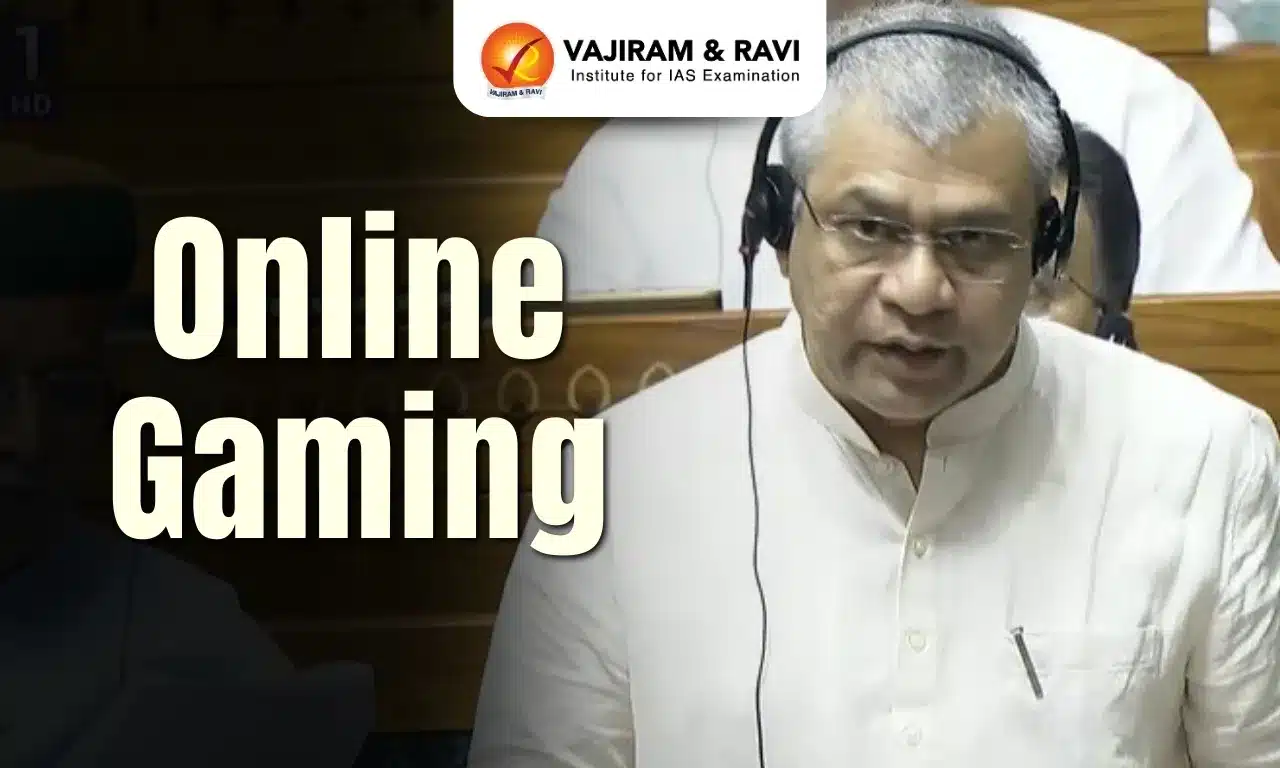
Online Gaming Bill 2025 – Ban on Real Money Games and Push for E-Sports

Online Gaming

Online Gaming Latest News

  • The Lok Sabha has passed the Online Gaming Bill 2025, banning harmful real money gaming while promoting e-sports and social gaming under a new regulatory framework.

Introduction

  • The Parliament has passed the Promotion and Regulation of Online Gaming Bill, 2025, marking a decisive shift in the governance of the country’s booming digital gaming sector. 
  • The Bill introduces a complete ban on real money gaming, citing its social, financial, and psychological harms, while simultaneously creating an enabling framework for e-sports and online social games. 
  • With this move, the government seeks to protect vulnerable sections of society, promote responsible gaming, and support the growth of India’s digital innovation ecosystem.

Key Provisions of the Online Gaming Bill 2025

  • The legislation is structured around three key segments of gaming:
    • E-Sports - Recognised as a creative and recreational industry with strong growth potential, the Bill supports e-sports development as a mainstream sector.
    • Online Social Games - Encouraged as safe entertainment options that do not involve financial risks or addictive gambling mechanisms.
    • Online Money Games - Completely prohibited, covering activities such as fantasy sports, poker, rummy, and other real money-based platforms where players deposit funds with monetary return expectations.
  • Violations of the ban will attract strict penalties, including:
    • Imprisonment of up to three years and fines up to Rs. 1 crore for first-time offenders.
    • Enhanced penalties for repeat offenders, including imprisonment between three to five years and fines up to Rs. 2 crore.

Establishment of an Online Gaming Authority

  • A major highlight of the Bill is the creation of a statutory Online Gaming Authority tasked with:
    • Coordinating policy support for the sector.
    • Regulating and supervising gaming platforms.
    • Supporting e-sports and legitimate online social gaming enterprises.
    • Curbing harmful practices such as money laundering, addictive algorithms, and fraudulent gaming models.
  • The Authority will function as a central regulator, providing uniform legal oversight and ensuring that the sector evolves in a safe and sustainable manner.

Rationale Behind the Legislation

  • The government emphasised the urgent need for regulatory intervention, highlighting alarming statistics and trends:
    • 32 suicides in the past 31 months linked to online money gaming addiction.
    • Rising financial distress among families due to compulsive gambling behaviour.
    • Reports of real money games being used for money laundering and terror financing.
    • Psychological disorders and exploitation caused by predatory gaming algorithms.
  • Lok Sabha Speaker termed the Bill a “national interest” legislation, citing its role in saving families from financial and emotional collapse. 
  • Union Information & Technology Minister underlined that while India must embrace digital innovation, it cannot allow harmful practices to threaten public welfare.

Industry Response and Potential Challenges

  • The Bill has sent shockwaves through India’s multi-billion-dollar real money gaming industry, which had long sought central regulation rather than prohibition. 
  • Industry experts have already hinted at a possible constitutional challenge on grounds of trade restrictions and legislative competence.
  • Legal experts, however, argue that the Bill is drafted in a manner that can withstand judicial scrutiny, given its strong grounding in public interest and national security considerations.

Significance for India’s Digital Future

  • The Online Gaming Bill 2025 balances the dual objectives of promoting innovation while safeguarding citizens:
    • For Youth - It shields young players from harmful addiction and financial ruin.
    • For Industry - It provides clarity and legitimacy to e-sports and social gaming start-ups.
    • For Society - It addresses rising concerns around fraud, money laundering, and mental health.
    • For Governance - It establishes a uniform, national-level framework that was long overdue in the fragmented regulatory space.
  • By encouraging e-sports, the Bill also aligns with India’s ambition to emerge as a global player in digital entertainment, especially as the country prepares to host world-class sporting events like the proposed 2036 Olympics.

Online Gaming FAQs

Q1: What is the key feature of the Online Gaming Bill 2025?

Ans: It bans harmful real money gaming while promoting e-sports and online social games.

Q2: What penalties does the Bill impose for violations?

Ans: Offenders face imprisonment up to three years and fines up to ₹1 crore, with harsher penalties for repeat offences.

Q3: What is the role of the Online Gaming Authority?

Ans: It will regulate the sector, support e-sports, and curb harmful gaming practices.

Q4: Why did the government ban real money gaming?

Ans: Due to rising suicides, financial distress, fraud, and links to money laundering and terror financing.

Q5: How does the Bill impact India’s digital innovation sector?

Ans: It provides regulatory clarity, safeguards citizens, and promotes e-sports as a growth industry.

House Panel Raises Alarm on India’s Air Safety – Key Findings & Reforms

India Aviation Safety

India Aviation Safety Latest News

  • The Standing Committee on Transport, Tourism and Culture tabled its 380th report on Overall Review of Safety in the Civil Aviation Sector in both Houses of Parliament. 
  • The report has issued a strong warning about the state of India’s aviation safety system.
  • The panel’s sharp observations highlight serious systemic lapses in India’s aviation safety architecture and stress the urgent need for reforms to prevent future tragedies.

Context and Trigger of the Report

  • In the backdrop of the AI 171 crash in Ahmedabad (2025), the Parliamentary Standing Committee on Transport, Tourism and Culture has raised serious alarms over systemic lapses in India’s civil aviation safety architecture. 
  • The committee’s 380th report highlights regulatory weaknesses, operational stress, and governance failures that could escalate into future disasters if unaddressed.
  • The Committee also summoned officials from the Aircraft Accident Investigation Bureau (AAIB) to question them on delays in accident investigations and coordination failures.
  • While the report does not directly mention the AI 171 crash, members of the committee extensively discussed it during deliberations.

Parliamentary Panel on Aviation Safety: Key Findings and Concerns

  • Aviation Safety at Risk
    • The committee observes that India’s rapidly expanding aviation sector has stretched infrastructure and regulation to their limits.
    • With passenger traffic expected to cross 300 million annually by 2030, unchecked fleet growth, workforce fatigue, and outdated infrastructure could create conditions ripe for catastrophic accidents.
  • DGCA Autonomy Crisis
    • The Directorate General of Civil Aviation (DGCA) is grossly understaffed — only 553 of 1,063 sanctioned posts are filled.
    • Nearly 45% of technical staff are on deputation, leading to high attrition and loss of institutional memory.
    • India’s International Civil Aviation Organisation (ICAO) audit placed it below the global average in safety oversight.
    • Without urgent reforms, India risks international restrictions on airline operations.
    • The committee demands full administrative and financial autonomy for DGCA and recruitment independence from UPSC to attract technical experts.
  • Air Traffic Controllers: Overworked and Fatigued
    • Air Traffic Control Officers (ATCOs) at major airports like Delhi, Mumbai, Bengaluru, and Hyderabad are working prolonged, fatiguing shifts.
    • Due to staff shortages, many airports merge control sectors at night, increasing risks.
    • The committee calls this “institutionalised overwork” and demands:
      • A Fatigue Risk Management System (FRMS).
      • An end to exemptions from duty-time rules.
      • A staffing audit and expansion of ATC training capacity.
  • Unresolved Safety Deficiencies
    • As of April 2025, 3,747 safety deficiencies remain unresolved, including 37 critical risks.
    • DGCA’s enforcement is termed a “procedural formality”, lacking real deterrence.
    • Recommendations include:
      • Time-bound closure of deficiencies (72 hours for critical cases).
      • Strict penalties, suspension, or licence cancellation for non-compliance.
      • Independent audits of DGCA’s enforcement system.
  • Helicopter Operations: Weak Oversight
    • Since 2021, India has seen 23 helicopter incidents, including four during the 2025 Char Dham Yatra.
    • Oversight is fragmented, with state agencies like Uttarakhand Civil Aviation Development Authority (UCADA) managing operations with limited DGCA involvement.
    • The committee calls for:
      • A uniform national framework for helicopter operations.
      • Terrain-specific training for mountain pilots.
      • A DGCA helicopter oversight cell for continuous monitoring.
  • Recurring Operational Risks
    • Runway incursions rose to 14.12 per million movements in 2024, exceeding the target of 9.78.
    • Similar overshoots were noted for loss-of-situational-awareness events and near mid-air collision (AIRPROX) incidents.
    • The panel recommends:
      • Root-cause analysis of each incident.
      • Focused safety programmes at high-risk airports.
      • Faster deployment of fog navigation and Instrument Landing Systems (ILS) systems.
  • Regulatory Culture and Whistleblower Protection
    • A punitive culture discourages reporting of safety lapses.
    • Instances cited where ATCOs were fined up to ₹25 lakh.
    • The committee urges:
      • Adoption of a “just culture” approach that distinguishes errors from negligence.
      • A legally backed whistleblower protection system ensuring anonymity and preventing victimisation.
  • Maintenance, Repair and Overhaul (MRO) Dependence and Strategic Vulnerabilities
    • India depends 85% on foreign MRO facilities, spending ₹15,000 crore annually overseas.
    • This creates strategic vulnerabilities in case of geopolitical shocks.
    • Recommendations include:
      • Rationalising GST and customs duties on aviation spares.
      • Incentivising domestic MRO hubs.
      • Launching a national aviation skill mission.
  • Governance Gaps in Airports Authority of India (AAI)
    • AAI lacks a Member (ATC) on its Board despite repeated recommendations since 2006.
    • The committee calls this a serious governance failure, undermining systemic safety planning.

Conclusion

  • The committee’s report is a roadmap for urgent reforms, stressing that without stronger regulation, staffing reforms, and governance changes, India risks facing future aviation disasters and international restrictions.

Source: IE | NDTV

India Aviation Safety FAQs

Q1: What triggered the aviation safety alarm in India?

Ans: The AI 171 crash in Ahmedabad (2025) led the Parliamentary Standing Committee to highlight systemic lapses in India’s aviation safety framework.

Q2: What are the key concerns raised by the panel?

Ans: The panel flagged DGCA understaffing, ATC fatigue, unresolved safety deficiencies, poor MRO dependence, and governance gaps as critical threats.

Q3: Why is DGCA autonomy important for aviation safety?

Ans: DGCA lacks independence and staffing; granting full autonomy and recruitment freedom is essential for building regulatory capacity and global credibility.

Q4: How does ATC fatigue affect aviation safety?

Ans: Overworked air traffic controllers face fatigue and stress, increasing risks of runway incursions, near misses, and operational errors at major airports.

Q5: What reforms did the panel recommend?

Ans: Reforms include fatigue risk management, strict safety compliance, whistleblower protection, domestic MRO hubs, and stronger governance in aviation institutions.

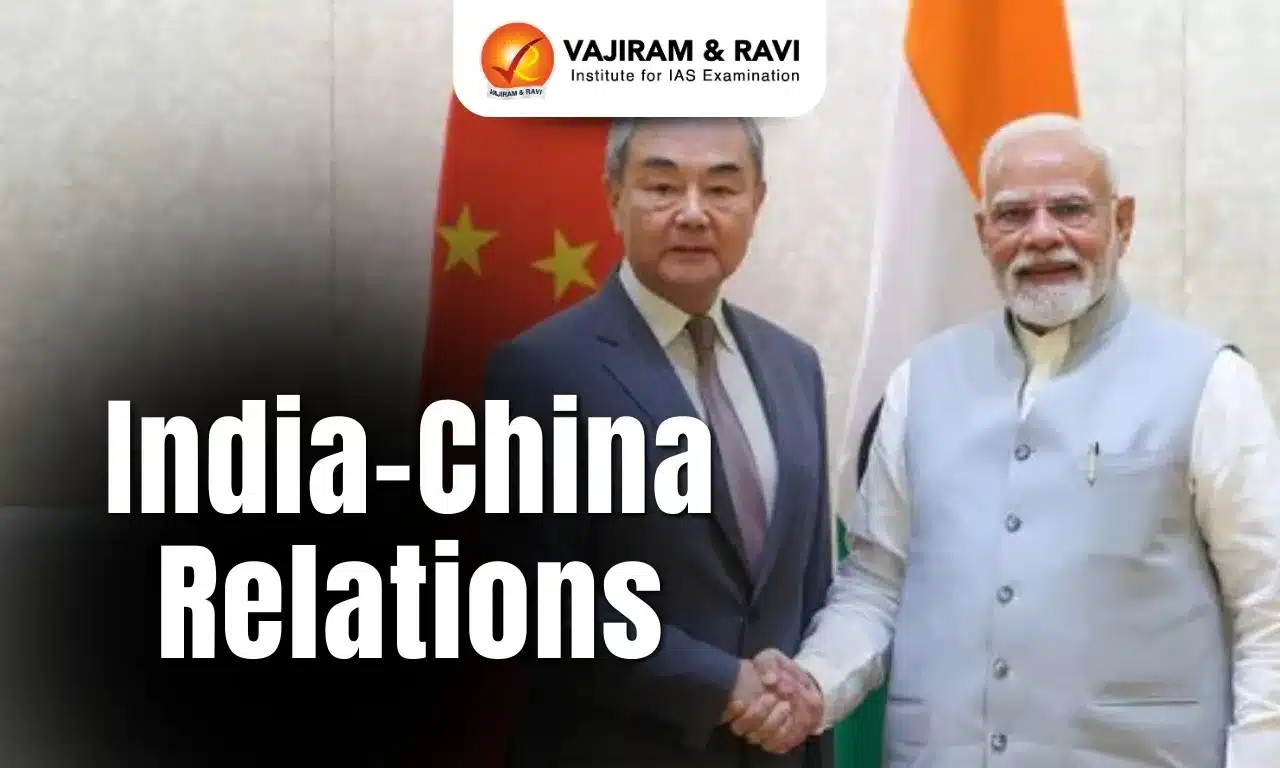
India–China Relations 2025: Border Challenges, Trust Deficit & Renewed Engagement

India–China Relations

India–China Relations Latest News

  • Chinese Foreign Minister Wang Yi’s visit to New Delhi marks the first ministerial-level engagement from China since the two countries agreed in October 2024 to disengage at the border.
  • During his meeting with PM Modi, Wang acknowledged that India–China relations have seen “ups and downs”, stressing that the lessons learned from past experiences are worth remembering. 
  • His remarks suggest a cautious attempt at resetting ties while keeping in mind the sensitivities arising from recent border tensions.

India–China Ties: From Mahabalipuram to Re-engagement

  • In October 2019, PM Modi and President Xi Jinping held their second informal summit at Mahabalipuram, symbolising optimism and warmth in bilateral ties. 
  • However, this optimism quickly faded. By June 2020, the violent Galwan Valley clash in Ladakh marked the worst military confrontation in decades, leading to the death of 20 Indian soldiers and at least four Chinese soldiers. 
  • This triggered a deep rupture in relations, with both sides amassing 50,000–60,000 troops along the Line of Actual Control (LAC), and engaging in frequent confrontations while building infrastructure to consolidate their positions.
  • Despite multiple rounds of military and diplomatic negotiations, disengagement remained partial, keeping relations strained. 
  • Progress began only in 2024, when both sides agreed to complete disengagement in the remaining flashpoints of Depsang and Demchok
  • This paved the way for a significant thaw, reinforced by a Modi–Xi meeting in Kazan in October 24, where both leaders decided to mend ties.
  • Since then, there has been a renewed diplomatic momentum. 

Wang Yi’s Visit Amid Global Shifts and Renewed Outreach

  • In the wake of Donald Trump’s election as U.S. President, China braced for potential hostilities, signalling readiness for both friendship or confrontation. 
  • As Washington imposed tariffs on China — and later on India — Beijing sought to strengthen ties with New Delhi. 
  • This thaw led to the revival of the Kailash Mansarovar Yatra and resumption of visa issuance to Chinese nationals
  • Against this backdrop, Chinese Foreign Minister Wang Yi visited India, marking a significant gesture of outreach before PM Modi’s upcoming visit to Tianjin for the Shanghai Cooperation Organisation (SCO) summit
  • Unlike in 2022, Wang secured a meeting with PM Modi during this trip, signalling improved diplomatic engagement between the two Asian giants.

Twin-Track Movement in India–China Relations

  • India and China have agreed to simultaneously advance border-related discussions and bilateral cooperation without allowing one issue to obstruct the other. 
  • This twin-track approach, first adopted after Rajiv Gandhi’s 1988 visit, had been followed until 2020 and is now being revived.

Border-Related Mechanisms

  • Expert Group on Boundary Delimitation - An “Expert Group” under the Working Mechanism for Consultation and Coordination on India-China Border Affairs (WMCC) will explore early harvest options in boundary delimitation.
  • Working Group on Border Management - A new Working Group under WMCC will focus on effective border management, ensuring peace and stability in border areas.
  • Expanded General-Level Mechanisms - General-level mechanisms will be expanded to include Eastern and Middle sectors in addition to the existing Western sector, with early meetings planned.
  • Both sides acknowledged the need for a political perspective to achieve a fair, reasonable, and mutually acceptable framework for boundary settlement
  • India emphasised that the border situation directly influences overall bilateral ties.

Bilateral Engagements

  • Connectivity and Trade
    • Agreement to resume direct flight connectivity at the earliest.
    • Facilitation of visas for tourists, businesses, media, and visitors.
    • Re-opening of border trade through designated points: Lipulekh Pass, Shipki La Pass, and Nathu La Pass.
    • Promotion of trade and investment flows through concrete steps.
  • Trans-Border Rivers Cooperation
    • China agreed to share hydrological information during emergencies on humanitarian grounds, enhancing cooperation on shared water resources.

Addressing the Trust Deficit in India–China Relations

  • The trust deficit between India and China remains a major obstacle despite recent efforts at engagement.
  • Border Tensions - Repeated Chinese incursions — Depsang (2013), Chumar (2014), Doklam (2017), and the ongoing Ladakh standoff — have eroded confidence. 
    • Over 50,000 troops remain deployed in eastern Ladakh, making a time-bound roadmap for de-escalation and de-induction essential.
  • China–Pakistan Nexus - China’s military cooperation with Pakistan, including weapons supply and live intelligence during Operation Sindoor, has deepened Indian security concerns.
  • Water Security Risks - China’s construction of a mega dam on the Yarlung Tsangpo (Brahmaputra) threatens downstream states, raising alarm for India as a lower riparian country.
  • Terrorism Concerns - India reiterated its strong opposition to cross-border terrorism, recalling that combating terrorism was a core objective of the SCO.
  • Economic Vulnerabilities - China’s export restrictions on rare earths, tunnel boring machines, and fertilisers directly impact India’s industrial growth and food security.

Source: IE | BBC

India–China Relations FAQs

Q1: Why is Wang Yi’s 2025 India visit significant?

Ans: It marks the first ministerial-level engagement since the 2024 disengagement, signalling a cautious reset in India–China relations.

Q2: What is the twin-track approach in India–China ties?

Ans: It means progressing on border issues and bilateral cooperation simultaneously, without letting one obstruct the other.

Q3: What are the main trust issues between India and China?

Ans: Border incursions, China–Pakistan military ties, water disputes, and economic restrictions have eroded mutual confidence.

Q4: How are India and China improving connectivity?

Ans: Both agreed to resume direct flights, reopen border trade routes, ease visas, and boost investment and tourism exchanges.

Q5: What role do rivers play in India–China relations?

Ans: China agreed to share emergency hydrological data on the Yarlung Tsangpo (Brahmaputra), but India fears risks from Chinese mega dam projects.

Enquire Now