

Haryana’s New Forest Definition Raises Environmental Concerns

Haryana Forest Definition

Haryana Forest Definition Latest News

  • Recently, the Haryana government officially defined the “dictionary meaning of forest.” Officials stated that the definition draws on Supreme Court precedents and aligns with judicial expectations.
  • However, environmentalists have raised strong concerns, arguing that the definition is too narrow and could exclude the Aravalli ridge, an ecologically fragile region. 
  • Such exclusion may leave it vulnerable to unchecked urbanisation, illegal mining, and real estate encroachments, threatening biodiversity and groundwater recharge in one of North India’s most critical ecosystems.

Haryana’s Definition of Forests
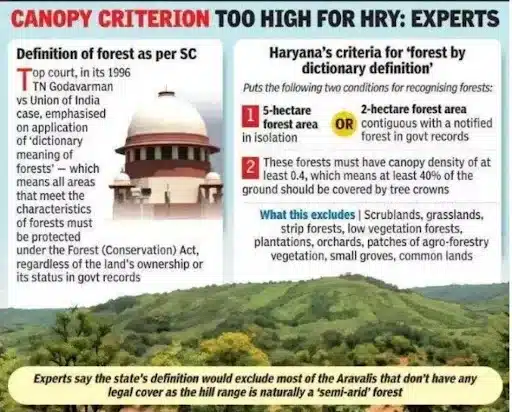
  • Recently, Haryana’s Environment, Forest and Wildlife Department issued a notification officially defining forests under the “dictionary meaning.”
  • According to the notification:
    • A patch of land will qualify as a forest if it has:
    • A minimum area of five hectares in isolation, or
    • A minimum area of two hectares if contiguous with government-notified forests.
    • It must also have a canopy density of at least 0.4 (40%).

Exclusions from Definition

  • The notification excludes the following from being treated as forests:
    • Linear, compact, or agro-forestry plantations.
    • Orchards outside government-notified forests.
  • These exclusions cover tree plantations along roads, canals, and railway tracks, which, though ecologically beneficial, will not be classified as forests under this definition.

Supreme Court’s Directives on Forest Definition

  • In its March 2025 ruling, the Supreme Court directed all States and Union Territories to formally define what constitutes a forest and begin comprehensive surveys to identify forest areas within their jurisdictions.

Key Instructions from the Court

  • Expert Committees: Each State/UT was required to set up a committee within one month to identify: Forest-like areas; Unclassified Forest lands; Community Forest lands.
  • Survey and Mapping: The committees must map forest lands and submit their reports to the Centre within six months.
  • Use of 2011 Guidelines: The process must strictly follow the 2011 Lafarge Umiam Mining guidelines, which mandate:
    • GIS-based decision-support database.
    • District-wise mapping of plots that may qualify as forests under the Forest (Conservation) Act, 1980 (FCA).
    • Inclusion of core, buffer, and eco-sensitive zones of protected areas.
    • Identification of wildlife corridors, lands diverted from forest use, and supporting maps such as TOPO-sheets and Forest Survey of India maps
  • The Court made it clear that Chief Secretaries of States and Administrators of UTs would be held personally accountable for non-compliance with its directives.

Godavarman Case, FCA and the 2023 Amendment

  • At the centre of the current Supreme Court hearings on the 2023 amendment to the Forest (Conservation) Act (FCA), 1980 lies the core question: “What constitutes a forest?”

FCA, 1980 – Original Scope

  • The FCA of 1980 restricted the dereservation of forests or the use of forest land for non-forest purposes. 
  • No diversion of forest land was permitted without prior approval from the Centre.

Godavarman Ruling, 1996

  • In a landmark judgment (T N Godavarman Thirumulpad v Union of India), the Supreme Court expanded the meaning of ‘forest’. 
  • It held that the term must be understood in its dictionary meaning, covering all statutorily recognised forests — whether reserved, protected, or otherwise. 
  • This effectively meant that any forested parcel of land, regardless of size, ownership, or official classification, could fall under the FCA.

The 2023 Amendment and Subsequent Legal Battle

  • According to the government, the wide applicability of the FCA following Godavarman was restraining development and utility-related works, even minor projects like building toilets in tribal schools. 
  • To address this, the 2023 amendment restricted FCA applicability only to:
    • Notified forests, and
    • Lands identified as forests in government records.
    • Challenge to the Amendment
  • Retired IFS officers and NGOs such as Vanashakti and Goa Foundation challenged the amendment, arguing that it substantially diluted protections under the FCA.
  • In February 2024, the Supreme Court directed all States and UTs to continue following Godavarman’s broader definition of forests while it considered the case (Ashok Kumar Sharma, IFS (Retd) & Ors. vs. Union of India).

Court’s March 2025 Directives

  • The Court then issued detailed instructions requiring States/UTs to define forests, conduct surveys, and submit reports to the Centre, aligning with 2011 Lafarge Umiam Mining guidelines.
  • The matter is ongoing, with the next Supreme Court hearing scheduled in September 2025.

Reactions to Haryana’s Forest Definition

  • Environmentalists have strongly criticised the definition, calling it too restrictive. 
  • Forest analysts argue that the minimum canopy cover threshold of 40% is unrealistic for the Aravalli region, which is naturally arid, with low rainfall and rocky terrain. 
  • The region’s vegetation — thorny, dry deciduous vegetation due to low rainfall and rocky terrain. 
  • According to them, this narrow definition contradicts the 1996 Supreme Court Godavarman judgment, which required a broader, dictionary-based interpretation of forests.
  • They further pointed out that the minimum area requirement of 2 to 5 hectares is unreasonably high for a dry state like Haryana. 
  • In their view, a more practical threshold would have been 1 to 2 hectares, ensuring that smaller but ecologically vital forest patches are not left unprotected.

Source: IE | ToI

Haryana Forest Definition FAQs

Q1: What is Haryana’s new forest definition?

Ans: A forest must have at least 5 hectares in isolation or 2 hectares if contiguous, with a 40% canopy density.

Q2: What areas are excluded from Haryana’s forest definition?

Ans: Plantations along roads, canals, railway tracks, orchards, and agro-forestry plantations outside notified forests are excluded.

Q3: Why are environmentalists critical of Haryana’s definition?

Ans: They argue the high canopy and area thresholds will exclude the ecologically fragile Aravalli region, risking biodiversity and water recharge.

Q4: What did the Supreme Court direct states about forest definition?

Ans: In 2025, the Court ordered states to define forests, map them using GIS, and submit reports, following the Lafarge Umiam guidelines.

Q5: How does Haryana’s definition differ from the Godavarman ruling?

Ans: The Godavarman judgment used a broader dictionary meaning of forests, while Haryana’s definition applies restrictive thresholds.

RBI Cautions Against Raising India’s 4% Inflation Target

RBI Inflation Target

RBI Inflation Target Latest News

  • The RBI, in its new discussion paper on the monetary policy framework, cautioned that raising India’s 4% inflation target now would undermine the credibility of the framework and risk reversing the macroeconomic stability gains achieved over the past decade.

RBI’s Discussion Paper on Monetary Policy

  • The Reserve Bank of India (RBI) has released its long-awaited discussion paper on the country’s monetary policy framework. 
  • It warns that raising the current 4% inflation target could undermine the credibility of the framework and undo the policy and institutional gains achieved over the last decade.

Key Questions for Feedback

  • The central bank has invited public feedback on four crucial issues:
    • Whether monetary policy should target headline or core inflation.
    • If the 4% inflation target remains optimal for balancing growth and stability.
    • Whether the 2–6% tolerance band needs revision or removal.
    • Whether the explicit 4% target should be dropped in favour of only a range.

Risks of Raising or Lowering the Target

  • The paper highlights that raising the target in today’s environment of global geopolitical and economic uncertainty could be interpreted as a dilution of the inflation targeting framework, weakening investor confidence. 
  • Conversely, lowering the target below 4% would not suit India’s current economic conditions.
  • Recently, S&P Global Ratings upgraded India’s rating to BBB, praising the RBI’s strong record in inflation management. 
  • Stable inflation within the 2–6% range has been crucial for investor confidence, growth prospects, and currency stability.

Background

  • India adopted the flexible inflation targeting framework in 2016, with a medium-term CPI target of 4% and a tolerance band of 2–6%. 
  • The present target is valid till March 2026, after which it must be reset for the next five years.

Headline vs. Core Inflation in Monetary Policy

  • The Economic Survey 2023-24 suggested that India’s inflation targeting framework should consider focusing on core inflation (excluding food and fuel).
    • Core inflation - A measure of inflation that excludes highly volatile components, typically food and energy prices. 
    • Headline inflation - The total inflation rate in an economy, encompassing the prices of all goods and services within the representative basket. 
  • This was due to the fact that the food prices in India often rise due to supply shocks rather than demand pressures—making them less responsive to monetary policy tools.
  • The RBI, under former Governor Shaktikanta Das, rejected this idea, stressing that food prices cannot be ignored
  • In its latest discussion paper, the RBI reiterated that nearly all inflation-targeting countries, regardless of their development stage, target headline CPI inflation
    • Uganda is the only exception, focusing on core inflation.

Spillover Effects of Food Prices

  • The RBI highlighted that persistent food inflation eventually spills over into core inflation through higher wages, rents, and business markups. 
  • Empirical evidence from India shows that while core prices remain stable, non-core (food and fuel) prices tend to converge with them over the long run
  • Hence, ignoring food inflation could weaken monetary policy effectiveness.

Recent Trends

  • In July 2024, headline CPI inflation fell to 1.55%, an eight-year low, while core inflation stood at 4.1%. 
  • Historically, headline inflation has fluctuated widely between 1.5% and 8.6% since 2014 due to food price swings, whereas core inflation has been more stable.
  • The RBI concluded that monetary policy must ensure both credibility and certainty, especially during global uncertainty. 
  • Therefore, it emphasised the importance of continuing with headline CPI as the target, since it better reflects the inflation experienced by households and investors.

Source: IE | BS

RBI Inflation Target FAQs

Q1: What did the RBI caution in its discussion paper?

Ans: RBI warned that raising the 4% inflation target could erode policy credibility and undo macroeconomic gains achieved over the last decade.

Q2: What key issues is the RBI seeking feedback on?

Ans: Feedback is invited on headline vs. core inflation, 4% target validity, the 2–6% tolerance band, and whether to keep a fixed target or range.

Q3: Why is raising the inflation target risky now?

Ans: Global uncertainties and investor sentiment could see it as weakening the inflation targeting framework, reducing credibility and stability.

Q4: What has been India’s inflation targeting framework?

Ans: Adopted in 2016, it set a CPI target of 4% with a tolerance band of 2–6%, valid until March 2026.

Q5: What is RBI’s stance on headline vs. core inflation?

Ans: RBI supports targeting headline CPI, noting that persistent food inflation spills over into core prices, affecting wages, rents, and markups.

NTCA Restricts Tiger Corridors to Minimal Pathways

Tiger Corridors

Tiger Corridors Latest News

  • The NTCA has restricted tiger corridors to only the 32 least cost pathways, easing project clearances but raising ecological concerns.

Introduction

  • In a major policy shift, the National Tiger Conservation Authority (NTCA) has restricted the identification of tiger corridors to only the 32 “least cost pathways” listed in its 2014 report. 
  • This decision comes less than a month after the NTCA affirmed before the Bombay High Court that tiger corridors should reflect multiple scientific studies and ecological benchmarks. 
  • While the move simplifies clearances for development projects, it has sparked debate among conservationists, as corridors are essential for tiger movement, genetic diversity, and long-term survival.

Importance of Tiger Corridors

  • Tiger corridors are natural linkages connecting tiger reserves and protected areas, allowing safe movement of tigers and other wildlife across fragmented landscapes. 
  • They help maintain genetic diversity, reduce human-wildlife conflict, and ensure the ecological stability of tiger populations. 
  • Under the Wildlife Protection Act, 1972, projects in or around corridors require approval from the Standing Committee of the National Board for Wildlife (SC-NBWL).

NTCA’s Policy Reversal

  • In July 2025, NTCA told the Bombay High Court that tiger corridors must be defined using:
    • Protected Areas occupied by tigers.
    • Least cost pathways identified in 2014.
    • Corridors in Tiger Conservation Plans (TCPs).
    • Wildlife Institute of India (WII) studies (2016, 2021).
    • Quadrennial All-India Tiger Estimation (AITE) data.
  • However, in August 2025, NTCA issued a clarification narrowing corridors only to:
    • The 2014 least cost pathways.
    • Corridors listed in reserve-specific TCPs.
  • This rollback excluded more robust WII studies and AITE-based refinements, surprising experts since NTCA’s 2014 report itself had called these corridors a “minimal requirement.”

Legal and Judicial Context

  • The Bombay High Court is hearing a petition challenging the Maharashtra State Board for Wildlife’s April 2025 decision to forward only projects within the least cost pathways for SC-NBWL approval. 
  • NTCA’s sudden clarification, submitted during hearings, has reshaped the case. The Environment Ministry has indicated that further refinement of corridors, based on AITE data, may be delayed until the High Court delivers its ruling.

Scientific Perspectives

  • Contemporary research highlights that limiting corridors to the least cost pathways underestimates the complex movement of tigers
  • A July 2025 study by Nagpur’s LRC Foundation identified 192 potential corridors across 10 central Indian states, connecting 30 tiger reserves and around 150 protected areas. 
  • This dense network demonstrates that multiple pathways, not just the shortest routes, are critical for tiger survival.

Concerns and Criticism

  • Conservationists fear that the NTCA’s narrowed definition weakens tiger protection at a time when India’s tiger population is recovering but facing increasing habitat fragmentation. 
  • By disregarding updated scientific studies and broad ecological benchmarks, the decision risks undermining the long-term connectivity essential for sustaining viable tiger populations. 
  • Critics argue that this approach prioritises short-term project clearances over India’s global conservation commitments.

Future Outlook

  • The issue is likely to remain under judicial scrutiny in the coming months. Conservation scientists are pressing for the incorporation of advanced modelling, telemetry data, and AITE-based evidence in corridor planning. 
  • With India home to nearly 3,000 tigers, over 70% of the global wild population, the protection of ecological corridors will be crucial to maintaining its conservation success story.

Source: IE

Tiger Corridors FAQs

Q1: What are tiger corridors?

Ans: Tiger corridors are natural linkages connecting habitats to allow safe movement, gene flow, and long-term survival of tigers.

Q2: What change has NTCA made to corridor identification?

Ans: NTCA has restricted corridors to the 32 least cost pathways from 2014 and reserve-level Tiger Conservation Plans.

Q3: Which projects benefit from the new definition?

Ans: Projects like Western Coalfields’ Durgapur mines and Lloyds Metals’ Surajgarh iron ore mines in Maharashtra.

Q4: Why are conservationists concerned?

Ans: Excluding recent WII studies and AITE data weakens scientific rigor and risks habitat fragmentation.

Q5: What did recent research suggest about tiger movement?

Ans: A 2025 Circuitscape study identified 192 potential corridors across central India, far more than NTCA’s minimal list.

Enquire Now