
Amartya Sen: Migration Integral to Globalisation and Human Progress

Migration and Globalisation

Migration and Globalisation Latest News

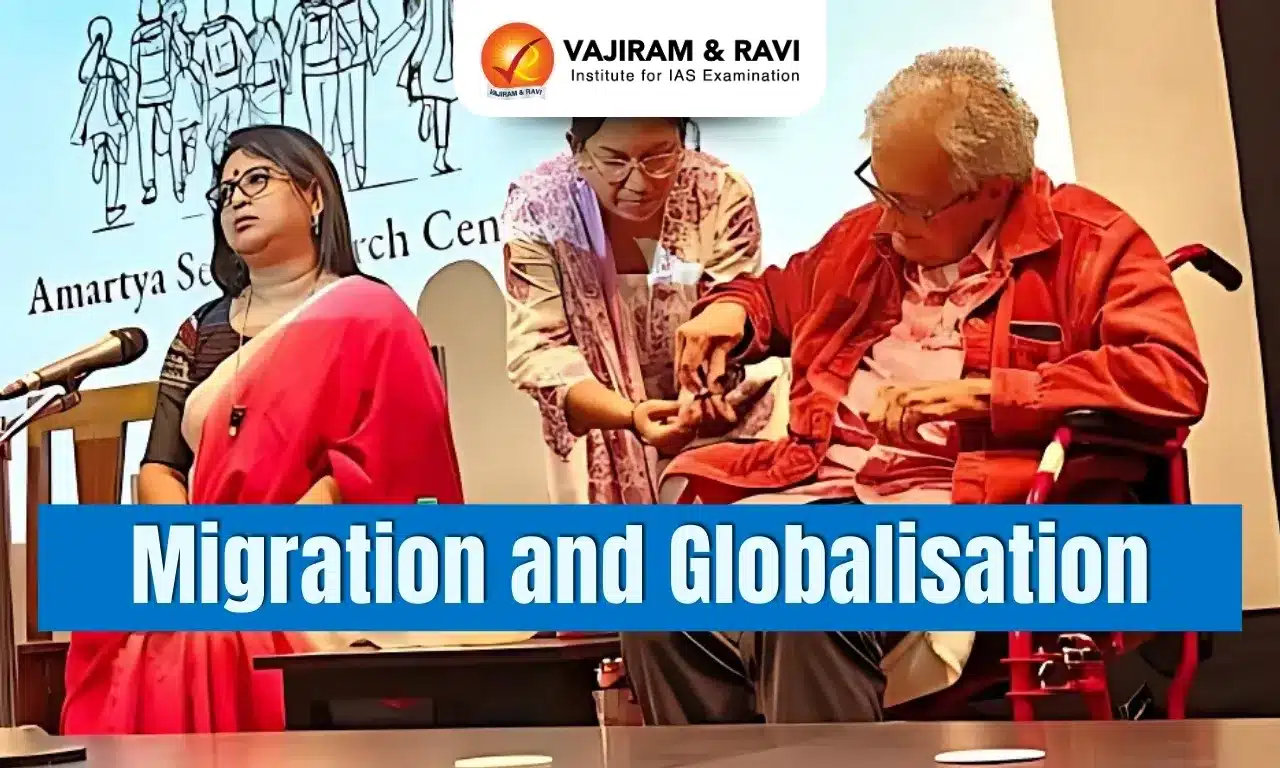
  • Nobel laureate Amartya Sen, during an interaction with students in Kolkata on August 22, 2025, highlighted that migration is essential to globalisation and has historically driven human progress. 
  • He further stressed that diversity is the foundation of Indian society, fostering genuine growth and development for the nation and its people.

Linkages Between Migration and Globalisation

  • Migration is both a cause and consequence of globalisation. It represents the mobility of people across and within borders in search of opportunities shaped by global economic changes.
  • While often portrayed as problematic, migration contributes significantly to sustainable development. 
  • In poorer regions, remittances improve household security and support local economies, while in ageing industrial societies, migrant workers fill labour shortages and sustain welfare systems.

Migration and Global Economic Changes

  • International Migration: Driven by global restructuring of labour markets, especially demand for semi-skilled and unskilled workers in developed countries. 
    • Migrants often find employment in informal sectors such as textiles, construction, and agriculture.
  • Internal Migration: Linked to relocation of industries and tourism growth in the Global South, where rural workers, especially women, migrate for low-paying but vital jobs. 
    • Migration is also a path for youth to gain independence and exposure.

Contributions of Migrants

  • Economic Support: Remittances are critical for household survival, investment in agriculture, housing, and local enterprises.
  • Skill Transfer: Returning migrants bring new skills and open non-farm opportunities if adequate infrastructure exists.
  • Social Impact: Migration fosters cultural exchange and reshapes community expectations, especially for women and youth seeking autonomy.

Key Challenges

  • Restrictive Policies: Immigration controls often strengthen illegal smuggling networks and exploitative employers, rather than addressing underlying labour market needs.
  • Exclusion from Urban Services: Internal migrants face difficulties in accessing housing, healthcare, and education due to restrictive policies.
  • Informal Labour Exploitation: Many undocumented migrants work under poor conditions with limited rights and protections.
  • Unequal Benefits: Skilled migrants earn more and invest productively, while unskilled migrants face lower incomes and limited capacity to send remittances.
  • Gender Disparities: Women migrants often face social pressures but can be strong agents of change where they have access to land and resources.

Policy Imperatives

  • The report stresses that migration should be recognised as both a choice and a contributor to development, not merely a problem to be controlled. 
  • Policies must:
    • Protect migrants’ rights and improve working conditions.
    • Support productive use of remittances through training and infrastructure.
    • Ensure equitable access to resources, especially for women.
    • Reduce structural constraints that force people into migration as the only survival strategy.

Amartya Sen on Migration and Diversity

  • During an interaction with students in Kolkata, Nobel laureate Amartya Sen underscored that migration is fundamental to globalisation and has historically driven human progress
  • He explained that cultural, linguistic, scientific, and artistic advancements—such as the repeated Arabic translations of Brahmagupta’s mathematical works—reflect migration’s role in collaboration and knowledge-sharing. 
  • Stressing that “almost nothing would happen” without the movement of people, Sen noted that migration enriches societies through food, music, culture, and ideas. 
  • He also highlighted that diversity forms the bedrock of Indian society, enabling true growth of the nation and its people. 
  • His remarks come amid recent attacks on migrants from West Bengal in other states, which have caused livelihood losses.

Conclusion

  • Migration is deeply linked with globalisation and has long been central to human survival and progress. 
  • Its contributions to economic growth, cultural exchange, and sustainable development are undeniable. 
  • However, without supportive policies, migrants remain vulnerable to exploitation, exclusion, and inequality. 
  • Recognising their role and safeguarding their rights is essential to harness migration as a force for inclusive global development.

Source: TH | IIED

Migration and Globalisation FAQs

Q1: What did Amartya Sen say about migration and globalisation?

Ans: He said migration has been a major source of global progress and is essential for cultural and economic advancement.

Q2: Why does Sen emphasise migration’s importance?

Ans: He argued that without migration, “almost nothing would happen,” as it fosters collaboration in culture, knowledge, food, and music.

Q3: What role does diversity play according to Sen?

Ans: He stated that diversity is the bedrock of Indian society and crucial for the nation’s genuine growth and development.

Q4: What historical example did Sen cite?

Ans: He mentioned that Brahmagupta’s mathematics book was translated six times into Arabic, showing migration’s role in knowledge exchange.

Q5: What is the contemporary context of his remarks?

Ans: His comments come amid rising attacks on Bengali migrants in other states, causing livelihood losses and political controversy.
NITI Aayog Proposes Model Homestay Policy to Boost Tourism Growth

NITI Aayog Homestay Policy

NITI Aayog Homestay Policy Latest News

  • NITI Aayog has released a report titled Rethinking Homestays: Navigating Policy Pathways
  • The report provides a framework for States to harmonise regulations and build an inclusive homestay ecosystem. 
  • It highlights the vast economic potential of alternative accommodations like homestays and Bed and Breakfast (BnB) in driving sustainable tourism growth. 
  • It also presents a strategic roadmap to unlock opportunities in this sector, aiming to boost local incomes, diversify India’s tourism offerings, and strengthen community-based tourism.

State of Travel and Tourism in India

  • India’s travel and tourism sector has shown remarkable post-pandemic recovery, driven largely by domestic tourism. 
  • According to WTTC’s 2024 Economic Impact Research, the sector contributed ₹21.15 lakh crore to the economy in 2024, marking a 21% rise from 2019, and is projected to reach ₹43.25 lakh crore by 2034, accounting for 7.6% of GDP
  • It currently employs 4.325 crore people—one in every eleven jobs in India—with employment expected to grow to 6.3 crore by 2034. 
  • Domestic tourist spending in 2024 stood at ₹16 lakh crore, 25% higher than 2019, and may nearly double by 2034, while international tourist spending reached ₹2.85 lakh crore and is expected to touch ₹4.07 lakh crore. 
  • The Draft National Tourism Policy 2022 envisions India as a top five global destination by 2030, with goals to boost tourist arrivals, foreign exchange earnings, and employment. 
  • To support this, the government has raised the Ministry of Tourism’s budget to ₹2,541 crore and is focusing on developing 50 top destinations, promoting PPP projects, supporting homestays through MUDRA loans, and incentivising hotel investments under the Harmonised Master List.

NITI Aayog’s Report on Homestays: Rethinking Homestays – Navigating Policy Pathways

  • NITI Aayog released its report proposing a model policy framework to help States harmonise regulations and create an inclusive homestay ecosystem. 
  • The report emphasises the economic and cultural potential of homestays and BnBs in driving sustainable tourism growth.

Key Insights and Objectives

  • Economic Potential: Homestays can promote sustainable growth, generate local employment, and foster entrepreneurship, especially in rural and semi-urban areas.
  • Cultural Value: They offer travellers culturally immersive experiences, blending authenticity with livelihood creation.
  • Policy Goal: To provide a strategic roadmap for States to strengthen homestays as an integral part of India’s tourism landscape.

Core Recommendations

  • Light-Touch Regulatory Framework
    • Regulations should remain simple, transparent, and flexible. 
    • Focus on safety, heritage protection, and inclusivity while avoiding over-regulation.
  • Digital Empowerment
    • Creation of a centralised digital portal for registration, compliance, renewals, and policy updates.
    • Ensures convenience for hosts and improves consumer trust.
  • Capacity Building and Local Empowerment
    • Training and skill development for hosts.
    • Use of digital platforms to expand outreach and strengthen credibility.
  • Financial Incentives
    • Move from focusing on individual amenities to destination-level incentives.
    • Promote tourism in underserved regions through tiered incentive structures.

Strategic Roadmap

  • The model policy framework aims to:
    • Simplify processes and encourage broader participation.
    • Integrate technology for greater efficiency.
    • Strengthen cultural authenticity while promoting sustainable tourism.
    • Position homestays as a tool for regional development, not just accommodation.

Conclusion

  • NITI Aayog’s report presents homestays as a driver of inclusive growth and sustainable tourism, calling for harmonised state policies, digital integration, and destination-focused incentives. 
  • This approach seeks to unlock the sector’s full potential while safeguarding culture and livelihoods.

Source: TH | PIB | NITI

NITI Aayog Homestay Policy FAQs

Q1: What does NITI Aayog’s report on homestays propose?

Ans: It suggests a model policy framework for States to harmonise regulations and build an inclusive homestay ecosystem in India.

Q2: Why are homestays important for tourism?

Ans: Homestays offer culturally immersive experiences, support local entrepreneurship, and create jobs in rural and semi-urban areas.

Q3: What digital measures does the report recommend?

Ans: It calls for a centralised digital portal for registration, renewals, compliance tracking, and policy updates for homestay operators.

Q4: How does the report link homestays to sustainable growth?

Ans: By blending cultural authenticity with livelihood creation, homestays contribute to inclusive, sustainable tourism development.

Q5: What financial incentives are suggested?

Ans: The report recommends destination-level incentives through a tiered approach, encouraging operators to promote growth in underserved areas.

UGC Draft Curriculum Highlights Ancient Wisdom in Higher Education

Ancient Wisdom

Ancient Wisdom Latest News

  • The UGC has released a draft curriculum framework that integrates Indian Knowledge Systems into undergraduate courses, sparking debate over tradition and academic rigour.

Introduction

  • The University Grants Commission (UGC) has unveiled a draft Learning Outcomes-based Curriculum Framework (LOCF) for undergraduate courses in disciplines such as anthropology, chemistry, commerce, economics, geography, home science, mathematics, physical education, and political science. 
  • A striking feature of this framework is the emphasis on Indian Knowledge Systems (IKS), with provisions to embed traditional wisdom, philosophies, and practices into modern pedagogy. 
  • The draft has been opened for stakeholder feedback.

Focus on Indian Knowledge Systems

  • The LOCF outlines an approach that seeks to contextualise higher education within India’s cultural and intellectual traditions. 
  • This aligns with the National Education Policy (NEP) 2020, which encouraged decolonisation of education and promotion of indigenous systems of knowledge. 
  • Each subject has been tasked with weaving elements of Indian thought into the curriculum, blending heritage with modern learning outcomes.

Subject-wise Integration of Ancient Wisdom

  • Mathematics
    • The draft proposes modules on mandala geometry, yantras, rangoli and kolam as algorithmic art forms, and the study of temple architecture through āyādi ratios. 
    • It highlights contributions of Indian mathematicians in arithmetic, algebra, geometry, and calculus, and their influence on global mathematical traditions.
  • Commerce
    • Commerce education is to incorporate Bhartiya philosophy and the Gurukul system’s holistic learning approach, linking ethical leadership and sustainable practices with modern corporate governance. 
    • Kautilya’s Arthashastra will be taught as a classical text offering insights into trade regulation and financial management. 
    • Concepts such as Ram Rajya in governance, CSR, ESG frameworks, and the Shubh-labh philosophy on profit with responsibility will also find space in the curriculum.
  • Economics
    • The LOCF emphasises dharmic perspectives on wealth and prosperity, trade ethics, and collective enterprise. 
    • Students will study indigenous exchange systems, agrarian values, principles of dana (charity), and the role of the king in the economy, contextualising economics within cultural and moral traditions.
  • Chemistry
    • In chemistry, traditional Indian fermented beverages like kanji, mahua, toddy will be included in a module on alcoholic beverages. 
    • The course also introduces ancient Indian concepts of the parmanu (atom) alongside modern atomic theory. 
    • This integration aims to balance modern scientific education with historical Indian perspectives.
  • Anthropology
    • The draft anthropology curriculum draws from thinkers such as Charaka, Sushruta, Buddha, and Mahavira. 
    • Their reflections on the relationship between nature and culture are presented as indigenous perspectives that enrich anthropological studies.

Criticism and Challenges

  • While the NEP 2020 encourages multidisciplinary learning, the LOCF prioritises single-major pathways. 
  • For instance, in chemistry, 96 out of 172 credits are allotted to discipline-specific core courses, leaving limited room for interdisciplinary exploration. 
  • Opposition-ruled states have criticised the framework, alleging attempts at “saffronisation.” The challenge lies in balancing respect for indigenous traditions with ensuring global competitiveness and academic rigour in higher education.

Significance of the Draft Curriculum

  • The draft curriculum signals a paradigm shift in India’s educational philosophy. By embedding Indian Knowledge Systems into mainstream education, UGC seeks to:
    • Decolonise curricula and promote indigenous heritage.
    • Provide culturally rooted yet globally relevant education.
    • Encourage ethical and sustainable practices in professional fields.
    • Revive the historical contributions of India to mathematics, economics, medicine, and governance.

Future Outlook

  • With feedback from stakeholders invited, the framework could undergo revisions before implementation. 
  • If adopted, this LOCF could redefine the intellectual foundation of Indian higher education, making it more rooted in cultural heritage while aligning with global standards. 
  • However, the challenge will be ensuring that ancient wisdom complements rather than replaces scientific temper, critical thinking, and multidisciplinary inquiry.

Source : TH

Ancient Wisdom FAQs

Q1: What is the UGC’s draft LOCF about?

Ans: The UGC’s draft Learning Outcomes-based Curriculum Framework integrates Indian Knowledge Systems into various undergraduate subjects.

Q2: Which subjects are covered under the draft curriculum?

Ans: The draft covers anthropology, chemistry, commerce, economics, geography, home science, mathematics, physical education, and political science.

Q3: What kind of ancient knowledge is being included in mathematics?

Ans: The draft includes mandala geometry, temple architecture ratios, and contributions of Indian mathematicians.

Q4: How does the draft link commerce education with Indian philosophy?

Ans: It incorporates Kautilya’s Arthashastra, Gurukul values, and concepts like Shubh-labh and Ram Rajya in governance and business ethics.

Q5: Why has the draft curriculum attracted criticism?

Ans: Critics argue it restricts multidisciplinary learning while prioritising Indian traditional systems.

Enquire Now