Vision of a Tobacco-Free India – Strengthening Control Measures

Vision of a Tobacco-Free India

Vision of a Tobacco-Free India Latest News

  • According to 2017 estimates, the annual economic costs of all tobacco products for the population aged 35 years and above in India were estimated at ₹1,773.4 billion (1.04% of GDP).
  • This is in addition to ₹566.7 billion (0.33% of GDP) in annual healthcare costs attributable to second-hand smoking.
  • These costs include direct medical and non-medical expenditures, morbidity and mortality losses. 
  • As tobacco use in India causes enormous health and economic burden, there is an urgent need to review and strengthen India’s tobacco control framework to realise the vision of a tobacco-free India.

Gaps in Existing Legislation

  • COTPA, 2003: 
    • Though the Cigarettes and Other Tobacco Products Act (COTPA), 2003, is a stringent Act, its implementation is poor in several Indian States. 
    • The legislation also has various other shortcomings that require urgent attention.
  • Inadequate coverage of Smokeless Tobacco (SLT):
    • Though SLT is cheaper, culturally accepted, and less stigmatized, it is more carcinogenic than smoked tobacco.
    • Although laws like the Food Safety and Standards (Prohibition and Restriction on Sales) Regulations, 2011, contribute to its control, they are relatively weak and poorly enforced. 
  • Surrogate and indirect advertising:
    • Surrogate ads (especially for SLT) build brand recognition. Movies, OTT, and social media promote tobacco indirectly.
    • Though direct tobacco advertisements are banned in India, companies use similar packaging for mouth fresheners to build brand recognition and promote tobacco through classical conditioning.
    • Hence, strict bans need to be implemented on both surrogate advertisements and indirect promotion in the media.
  • Weak fiscal measures:
    • There are no direct provisions in COTPA for fiscal measures to curb tobacco use. 
    • Raising excise taxes is the most effective way to reduce consumption, yet India’s tobacco taxation remains inadequate and uneven
    • For example, the tax burden on bidis (the most consumed smoked product) is just 22%, and about 50% on cigarettes—far below the WHO’s recommended 75%.
    • Since the GST rollout in 2017, minor tax hikes raised overall tobacco taxes by just 4%. 
    • Rising incomes and low taxation made tobacco more affordable in India, also resulting in missed revenue and health opportunities.
  • Ineffective warning labels:
    • Although tobacco warning labels are updated every two years, there is limited evidence on their effectiveness in preventing tobacco use.
    • Unlike many European countries that use packaging to educate users about a range of tobacco-related harms, India’s warnings rely mainly on fear-based messaging (oral cancer, early death).
    • COTPA rules (mandates 85% health warnings on tobacco packs) should mandate regular evaluation of tobacco warning labels. 
    • India should also adopt plain packaging to further reduce the appeal and use of tobacco.
  • Poor implementation of e-cigarette ban:
    • Though India is one of the few countries to ban e-cigarettes, poor implementation of the Prohibition of Electronic Cigarettes Act (PECA) 2019 has also resulted in an increasing threat of e-cigarettes to public health in India.
    • For example, e-cigarettes are accessible online, making them more accessible to adolescents. 

Need for a Holistic Approach

  • Limitations of current National Tobacco Control Programme (NTCP):
    • The NTCP focuses on awareness and COTPA enforcement.
    • It ignores social determinants like poverty, unemployment, stress, etc.
    • As compared to a large user base, cessation clinics have limited reach.
  • Weaknesses in ToFEI (Tobacco Free Education Institute):
    • It currently promotes awareness in schools through posters and biannual activities, but lacks the scientific rigour needed for effective tobacco control. 
    • In contrast, the U.S.’s national public health agency, the Centres for Disease Control and Prevention (CDC) recommends comprehensive school-based strategies in the U.S., including 
      • Enforcing tobacco-free policies, 
      • Integrating prevention education from kindergarten to grade 12, 
      • Training teachers, involving families, supporting cessation for students and staff, and 
      • Regularly evaluating programmes.

Towards Better Regulation and Control

  • Challenge faced by public health researchers: The tobacco industry has access to its real-time sales data to adapt sales strategies while public health researchers are unaware of the most recent trends in tobacco consumption.
  • Policy recommendations:
    • Adopt ‘Tobacco Endgame’ strategy through multi-ministry (Education, Finance, Health, Law, Social Justice, Commerce, Information & Broadcasting, Consumer Affairs) collaboration.
    • Greater investment in research institutions not only for developing and implementing control measures but also for producing regularly updated, robust data.
    • Independent oversight body to monitor and expose industry interference.
    • Stronger use of demand-side (tax, awareness, cessation) and supply-side (regulation, enforcement) measures.

Conclusion

  • India needs a comprehensive, multipronged strategy to reduce tobacco burden.
  • Combining stringent laws, higher taxation, effective awareness, social support, school-based interventions, and independent oversight is crucial.
  • Sustained collaboration between policymakers, researchers, and implementers is essential to realise the vision of a tobacco-free India.

Source: TH

Vision of a Tobacco-Free India FAQs

Q1: What is the economic burden of tobacco use in India?

Ans: ₹1,773.4 billion (1.04% of GDP) plus ₹566.7 billion (0.33% of GDP) in second-hand smoke costs (2017).

Q2: What are the key shortcomings of COTPA, 2003?

Ans: Poor enforcement, weak SLT regulation, surrogate ads, low taxation, and ineffective warning labels.

Q3: Why has taxation been underutilized in India’s tobacco control?

Ans: Taxes on bidis (22%) and cigarettes (50%) are far below the WHO norm of 75%, keeping tobacco affordable.

Q4: Why is a biomedical approach alone inadequate to control tobacco use?

Ans: Social determinants like poverty, stress, and unemployment drive tobacco use beyond medical factors.

Q5: What measures are needed to achieve the ‘Tobacco Endgame’ in India?

Ans: Higher taxes, plain packaging, strict ad/e-cigarette bans, school awareness, research, and independent oversight.
Uses of Wastewater Surveillance for Public Health and Environment

Wastewater Surveillance Uses

Wastewater Surveillance Uses Latest News

  • The Indian Council of Medical Research (ICMR) will launch wastewater surveillance for 10 viruses across 50 cities in the next six months. 
  • Currently operational in five cities, the initiative aims to detect early signs of virus spread and growth trends, enabling timely public health interventions.

About Wastewater

  • Wastewater is any water that has been affected by human use. 
  • It comes from a variety of sources, including households (think sinks, showers, and toilets), industries, and agricultural processes. 
  • Essentially, it’s the used water that needs to be cleaned before it can be safely released back into the environment or reused.

ICMR’s Plan for Expanded Wastewater Surveillance

  • Over the next six months, the Indian Council of Medical Research (ICMR) will scale up wastewater and environmental surveillance (WES) across India to detect early rises in virus load within communities. 
  • At present, COVID-19 and polio are under watch, but the system will now monitor pathogens linked to fever, diarrhoea, acute encephalitis syndrome, and respiratory distress
  • ICMR is also setting up surveillance for Avian Influenza Virus (AIV) by testing surface water and wastewater in outbreak-prone regions, creating an early warning system. 
  • This will complement India’s existing surveillance networks for Influenza-Like Illness (ILI) and Severe Acute Respiratory Illness (SARI) under ICMR and the Integrated Disease Surveillance Programme (IDSP).

Importance of Wastewater Surveillance

  • The ICMR highlights that India, like many countries, faces rising emergence and re-emergence of pathogens due to population growth, urbanisation, environmental changes, and human-animal interactions. 
  • In this context, Wastewater-Based Epidemiology (WBE) has emerged as a vital tool for early detection of disease outbreaks, especially after COVID-19. 
  • WBE provides real-time, community-level insights into infection trends, including among asymptomatic and pre-symptomatic individuals, enabling timely public health interventions. 
  • It is a cost-effective, non-invasive method that covers large populations, helps identify transmission hotspots, and supports efficient resource allocation for containment. 
  • By detecting pathogens such as viruses and bacteria in human waste, WBE strengthens global health security by predicting and mitigating future pandemics before clinical cases appear.

Working of Wastewater Surveillance

  • According to the U.S. Centers for Disease Control and Prevention (CDC), people infected with viruses or bacteria, even if asymptomatic, shed traces of pathogens through daily activities like using the toilet, showering, or washing clothes. 
  • These fragments travel through the sewage system, where wastewater samples are collected before treatment and sent to laboratories for testing. 
  • Within five to seven days, labs can detect infections circulating in the community. 
  • Public health officials then use this data to track disease trends and guide interventions such as prevention measures, increased testing, or vaccination drives.

Wider Applications of Wastewater Surveillance

  • Beyond disease detection, wastewater surveillance also helps identify land-based sources of pollution, contributing valuable data for protecting freshwater and marine ecosystems and maintaining essential ecosystem services
  • The United Nations Environment Programme (UNEP) notes that this approach strengthens both health systems and environmental management, though greater efforts are needed to expand and standardise such practices for effective water quality monitoring. 
  • The World Health Organization (WHO) is similarly working to build global capacity for wastewater and environmental surveillance, highlighting its dual role in public health protection and environmental sustainability.

Source: TH | UNEP

Wastewater Surveillance Uses FAQs

Q1: What is wastewater surveillance?

Ans: It involves testing sewage for pathogens like viruses and bacteria to detect community-level infection trends and guide timely interventions.

Q2: Why is wastewater surveillance important?

Ans: It offers early outbreak detection, covers large populations, and enables cost-effective, non-invasive public health monitoring.

Q3: How does wastewater surveillance work?

Ans: Pathogen traces shed in human waste travel through sewage; samples are collected, tested in labs, and results guide health responses.

Q4: What are wider applications of wastewater surveillance?

Ans: It helps monitor pollution, protect ecosystems, manage water quality, and support both public health and environmental sustainability.

Q5: Which agencies support wastewater surveillance globally?

Ans: The WHO and UNEP promote it as part of global health security and environmental protection, while ICMR leads India’s initiative.

Africa’s Distorted Map Representation and the Push for Equal Earth Projection

Africa Map Distortion

Africa Map Distortion Latest News

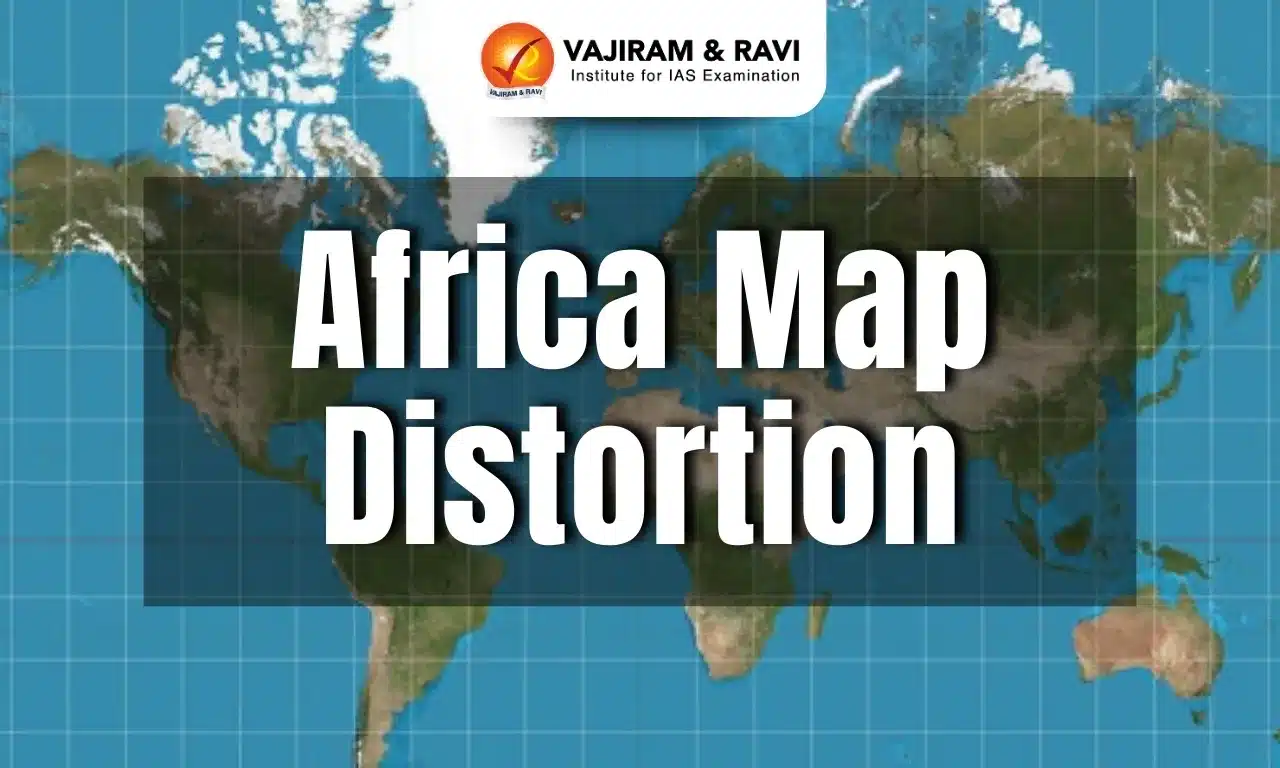
  • The African Union (AU) has endorsed the Correct the Map campaign, calling for the replacement of the Mercator projection with alternatives like the Equal Earth map
  • The Mercator projection, still widely used in schools and media, distorts geography by shrinking Africa and inflating Europe, North America, and Greenland
  • The AU argues this has perpetuated symbolic marginalisation for centuries and believes adopting a fairer projection will restore geographical accuracy and dignity.

Why the Mercator Map Faces Criticism

  • The Mercator projection, created in 1569 to aid navigation, allowed sailors to follow straight rhumb lines across seas, revolutionising European exploration and colonial expansion. 
    • A rhumb line (also called a loxodrome) is a line on the Earth’s surface that crosses all meridians at the same angle.
    • It represents a constant compass direction (e.g., always going northwest at 45°). On a globe, this path is a spiraling curve toward the poles.
    • On the Mercator map projection, rhumb lines appear as straight lines, which is why the Mercator map was so useful for sailors in the Age of Exploration.
  • However, this convenience came at the cost of distorting scale: landmasses near the poles appear much larger, while those near the equator are shrunk. 
  • For instance, Africa (30 million sq. km) is shown as nearly the same size as Greenland, which is actually 14 times smaller. 
  • Similarly, Europe appears comparable to Africa, despite being only one-third its size. 
  • Over centuries, the Mercator map became the default in classrooms, offices, and digital platforms, reinforcing a Eurocentric view of the world
  • Critics argue that these distortions have subtly shaped perceptions of power and importance, diminishing Africa, South America, and Asia while inflating Europe, Russia, and North America.

Why Maps Are Distorted

  • All world maps are distorted because it is mathematically impossible to flatten the Earth’s spherical surface onto a rectangle without compromising area, shape, distance, or direction
  • The Mercator projection, for instance, preserves local shapes and angles but greatly enlarges landmasses near the poles, making Europe and Greenland look much bigger while shrinking Africa and South America. 
  • In contrast, the Equal Earth projection maintains the relative sizes of continents and countries more accurately, but introduces curved or stretched shapes. 
    • Equal Earth projection was introduced in 2018 by cartographers Bojan Šavrič, Tom Patterson, and Bernhard Jenny.
    • It minimises distortion of landmass sizes; Africa and other equatorial regions shown proportionally.
  • The orthographic projection offers a realistic view of Earth as seen from space, yet shows only one hemisphere at a time and compresses areas at the edges. 
  • Each projection, therefore, reflects a trade-off between accuracy and usability, with political as well as technical implications.

Impact of Map Distortion on Africa

  • The Mercator projection has long reinforced Africa’s marginalisation by shrinking its size, creating the perception that the continent is less significant. 
  • This distortion, embedded in textbooks, policymaking, and popular culture, suggested—whether intentionally or not—that Africa was small, conquerable, and irrelevant. 
  • Critics called the map a “political tool” that aided colonial domination, while it falsely depicted Africa as marginal. 

The Road Ahead for Correcting the Map

  • The Equal Earth projection, developed in 2018, is the leading alternative to the Mercator map as it preserves relative areas, though continents appear stretched or curved. 
  • Other options include the Gall-Peters projection, which also preserves area but elongates landmasses vertically, and creative efforts like Stuart McArthur’s 1979 “Universal Corrective Map” that inverted the world to place Australia on top. 
  • The African Union’s endorsement of the Correct the Map campaign marks the strongest institutional push yet, with support also coming from the World Bank, National Geographic, NASA, and petitions to the UN for adoption. 
  • However, replacing the Mercator projection will be challenging since it is deeply entrenched in schools, textbooks, digital platforms, and institutional use.
  • It would require significant curricular revisions and interface redesigns to shift global cartographic norms.

Source: TH | IE

Africa Map Distortion FAQs

Q1: Why is the Mercator map criticised for Africa’s portrayal?

Ans: It shrinks Africa while inflating Europe and Greenland, reinforcing perceptions of Africa as less significant in global imagination.

Q2: What is the Equal Earth projection?

Ans: Introduced in 2018, it preserves relative sizes of continents, ensuring Africa and equatorial regions are shown proportionally, though shapes appear stretched.

Q3: How has Mercator distortion impacted Africa?

Ans: It perpetuated symbolic marginalisation, influencing textbooks, policymaking, and public perception by making Africa appear small and less important.

Q4: What alternatives exist to Mercator?

Ans: Equal Earth, Gall-Peters, and creative maps like McArthur’s Universal Corrective Map provide fairer, area-preserving alternatives to Mercator.

Q5: Why is replacing Mercator challenging?

Ans: It is deeply entrenched in schools, media, and digital platforms, requiring curricular revisions, redesigns, and institutional shifts.

ICMR Introduces ‘CEREBO’ to Diagnose Brain Injury

Brain Injury

Brain Injury Latest News

  • ICMR has launched CEREBO, an indigenous portable device for rapid, radiation-free diagnosis of traumatic brain injuries, aiming to improve emergency and rural healthcare access.

Introduction

  • India records one of the world’s highest incidences of head injuries, with more than 100,000 deaths annually and over a million serious injuries. 
  • Timely diagnosis of traumatic brain injuries (TBI) is critical, as nearly half of the fatalities occur within the first two hours. 
  • However, advanced diagnostic tools like CT (Computed Tomography) and MRI (Magnetic Resonance Imaging) remain inaccessible in many rural and emergency settings. 
  • Addressing this gap, the Indian Council of Medical Research (ICMR) has introduced CEREBO, an indigenous, portable, and non-invasive diagnostic tool that can revolutionise TBI care in India.

About the CEREBO Device

  • CEREBO is a handheld diagnostic device developed using near-infrared spectroscopy combined with machine learning algorithms. It is:
    • Radiation-free and safe for infants and pregnant women.
    • User-friendly, operable by paramedical staff or unskilled personnel after just 30 minutes of training.
    • Efficient, capable of detecting intracranial bleeding and oedema in under a minute.
    • Cost-effective, eliminating the need for expensive imaging infrastructure.
  • The device provides colour-coded results that enable quick triage and decision-making in critical situations.

Development and Collaboration

  • CEREBO is a product of collaboration between ICMR, the Medical Device and Diagnostics Mission Secretariat (MDMS), AIIMS Bhopal, NIMHANS Bengaluru, and Bioscan Research. It has undergone:
    • Clinical validation and regulatory approvals.
    • Multi-centre performance trials supported by ICMR’s mPRiDE scheme.
    • Feasibility studies at trauma and neurosurgical centres to test diagnostic accuracy and integration in emergency care pathways.
  • This groundwork ensures that CEREBO is ready for widespread deployment in hospitals, ambulances, rural clinics, and disaster response units.

Significance for Healthcare

  • CEREBO addresses multiple challenges in brain injury diagnosis:
    • Accessibility Gap - Rural and semi-urban regions often lack CT/MRI facilities, delaying critical care.
    • Affordability - CT and MRI scans are expensive and require trained personnel; CEREBO reduces costs significantly.
    • Speed and Precision - Immediate diagnosis improves survival rates and reduces disability.
    • Emergency Deployment - Designed for ambulances and trauma centres, the tool strengthens India’s disaster and military healthcare response.
  • By offering an indigenous alternative, India also reduces dependence on imported diagnostic equipment.

Public Health Impact

  • According to the Indian Head Injury Foundation, nearly 50% of TBI-related deaths happen within two hours of injury. 
  • Often, secondary brain damage caused by bleeding and swelling progresses during this window. Early detection through CEREBO can:
    • Reduce mortality rates.
    • Improve recovery outcomes.
    • Lower the long-term disability burden on patients and families.
  • The device also aligns with India’s goal of affordable healthcare access and complements emergency medical services in high-risk areas like highways, rural belts, and conflict-prone regions.

Future Outlook

  • ICMR is seeking support from State governments to integrate CEREBO into tertiary care systems. The aim is to:
    • Accelerate access to CT/MRI scans where needed.
    • Optimise patient triage in overcrowded trauma wards.
    • Reduce overall imaging costs.
    • Scale up adoption in military, emergency, and global healthcare systems.
  • If widely adopted, CEREBO could serve as a global model for low-cost TBI diagnosis, particularly in developing countries facing similar healthcare challenges.

Source : TH

Brain Injury FAQs

Q1: What is CEREBO?

Ans: CEREBO is a portable, non-invasive, radiation-free device developed by ICMR to detect traumatic brain injuries.

Q2: How does CEREBO benefit patients?

Ans: It enables rapid detection of intracranial bleeding and edema, improving survival and recovery rates.

Q3: Where can CEREBO be deployed?

Ans: It can be used in ambulances, trauma centres, rural clinics, and disaster response units.

Q4: Who developed CEREBO?

Ans: CEREBO was developed by ICMR in collaboration with AIIMS Bhopal, NIMHANS Bengaluru, Bioscan Research, and MDMS.

Q5: Why is CEREBO significant for India?

Ans: It addresses the lack of CT/MRI facilities in rural areas, reduces costs, and enhances early diagnosis of brain injuries.

18th Pravasi Bharatiya Divas: Honoring the Indian Diaspora’s Global Contributions

18th Pravasi Bharatiya Divas

What’s in today’s article?

  • Why in News?
  • What is Pravasi Bharatiya Diwas? 
  • Indian Diaspora: Key Statistics and Influence
  • How does the government categorise overseas Indians?
  • Key highlights of the 18th Pravasi Bharatiya Divas
  • Prime Minister Modi’s Message at the 18th Pravasi Bharatiya Divas Convention

Why in News?

Prime Minister Narendra Modi inaugurated the 18th Pravasi Bharatiya Divas convention. This significant event, celebrated once every two years, honoured the contributions of the Indian diaspora to their homeland. 

The theme for this year was the “Diaspora’s contribution to a Viksit Bharat”.

What is Pravasi Bharatiya Diwas (PBD)?

  • About
    • The PBD is observed on January 9 to strengthen the engagement of the Indian community overseas with the India government and reconnect them with their roots. 
      • January 9 was chosen as the day to celebrate PBD as it was on this day, in 1915, that Mahatma Gandhi had returned to India from South Africa.
    • It also marks the contribution of the Indians living abroad in the development of the land of their ancestors.
    • PBD conventions were being held every year since 2003. 
    • Since 2015, its format has been revised. PBD is now celebrated once in every two years.
  • Background
    • A High-Level Committee on Indian Diaspora, headed by LM Singhvi, had recommended in January 2002 that the government must renew and strengthen linkages of overseas Indians to their place of origin, and with each other.
    • The decision to celebrate PBD was taken by the former Indian Prime Minister, late Shri Atal Bihari Vajpayee in 2003.
    • The 1st PBD was celebrated on 9th January, 2003 in New Delhi. 
    • It is organized by the Ministry of External Affairs, Government of India, in partnership with the Confederation of Indian Industry (CII) and other stakeholders.
  • Pravasi Bharatiya Samman Award
    • During the Convention, Pravasi Bharatiya Samman Award (PBSA) is conferred on the selected overseas Indians.
    • This award is given for the significant contributions by overseas Indians to various fields both in India and abroad.
      • It is the highest honour conferred on a Non-Resident Indian, Person of Indian Origin; or an organisation or institution established and run by Non-Resident Indians or Persons of Indian Origin.
    • PBSA is conferred by the President of India.

Indian Diaspora: Key Statistics and Influence

  • Population:
    • USA: 54 lakh
    • UAE: 35 lakh
    • Canada: 28 lakh
    • Saudi Arabia: 24 lakh
  • Economic Contribution: The diaspora remitted $125 billion to India in 2023.
  • Political and Diplomatic Influence:
    • Indian diaspora plays a crucial role in strengthening bilateral ties.
    • Members are increasingly active in politics in countries like the US and Canada.
      • The "Howdy Modi" event in Texas (2019) showcased the influence of the diaspora, with PM Modi and then US President Donald Trump addressing one of the largest gatherings of Overseas Indians.

How does the government categorise overseas Indians?

  • Overseas Indians are classified into the following categories:
    • Non-Resident Indians (NRIs) - Indian citizens residing in foreign countries.
    • Overseas Citizens of India (OCI) - Foreign nationals of Indian origin registered under Section 7A of the Citizenship Act, 1955. Eligibility criteria include:
      • Eligible to be Indian citizens on January 26, 1950, or were Indian citizens after this date.
      • Belonged to territories that became part of India after August 15, 1947.
      • Minor children of eligible individuals, except those from Pakistan or Bangladesh.
  • The Persons of Indian Origin (PIO) category was abolished in 2015 and merged with the OCI category.
  • According to the Ministry of External Affairs, more than 3.5 crore Overseas Indians (that is, Non-Resident Indians or NRIs and Persons of Indian Origin or PIOs) are based abroad.

Key highlights of the 18th Pravasi Bharatiya Divas

  • Chief guest
    • This year’s chief guest Christine Carla Kangaloo, President of the Republic of Trinidad & Tobago, virtually addressed the convention.
  • Pravasi Bharatiya Samman Awards (PBSA) 2025
    • Global Representation: 27 individuals and organisations from 24 countries, including Malawi, Fiji, Spain, Romania, the US, and the UK.
    • Notable Awardees:
      • Lekh Raj Juneja (Japan): Awarded in the ‘Science & Technology’ category. Former pharma CEO in Japan; now heads a snack company.
      • Robert Masih Nahar (Spain): Honoured in the ‘Community Service’ category. First person of Indian origin in the Spanish Senate (2017). Promoted cricket in Catalonia, earning the title “godfather of local cricket”.
      • Syed Anwar Khursheed (Saudi Arabia): Recognised in the ‘Medical Services’ category. Royal protocol physician for the Saudi royal family.

Prime Minister Modi’s Message at the 18th Pravasi Bharatiya Divas Convention

  • Call for Global Peace: From Yuddha to Buddha
    • PM Modi emphasized that the future lies in peace, symbolized by Lord Buddha, not in war.
    • Cited Emperor Ashoka’s transformation at Dhauli in Odisha as an inspiration for India’s advocacy for peace.
  • India’s Expanding Global Role
    • Highlighted India’s achievements and its growing influence on the global stage.
    • India represents the Global South and advocates initiatives like making the African Union a permanent G20 member.
    • Stressed the principle of ‘humanity first’ in India’s international engagements.
  • Spotlight on Historical Diaspora Journeys
    • Example of Mandvi to Muscat: Exhibition on Gujaratis who migrated to Oman 250 years ago.
    • Proposed creating a database on Girmitiyas (indentured laborers) to study their migration, challenges, and achievements.
    • Suggested research, studies, and regular conferences to explore their legacy.
  • Vision for a Developed India by 2047
    • Acknowledged the contributions of the Indian diaspora toward making India a developed nation by its 100th year of independence.
    • Encouraged collaborative efforts to celebrate and protect the diaspora’s role in India’s progress.

Q.1. What is the Pravasi Bharatiya Divas (PBD)?

The PBD, celebrated biennially on January 9, honors the Indian diaspora’s contributions. It reconnects overseas Indians with their roots and commemorates Mahatma Gandhi’s return to India in 1915.

Q.2. Why is the Indian diaspora important globally?

The Indian diaspora strengthens bilateral ties, contributes $125 billion in remittances, and actively participates in global politics. Events like “Howdy Modi” exemplify their influence on diplomacy and cultural connections.

Source: IE | TH | IE | IE

Enquire Now