
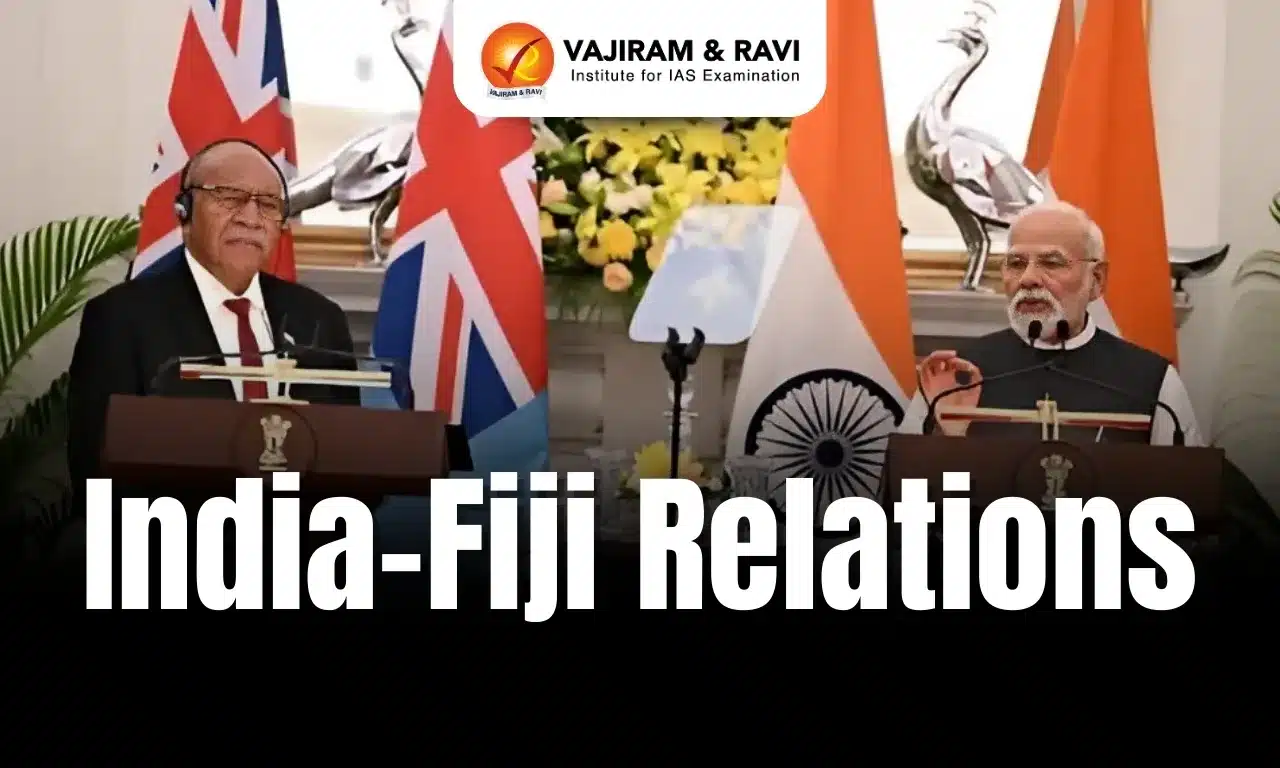
India–Fiji Relations: Key Outcomes of Fiji PM Sitiveni Rabuka’s 2025 Visit

India–Fiji Relations

India–Fiji Relations Latest News

  • Prime Minister of Fiji, Sitiveni Rabuka, paid an official visit to India from 24–26 August 2025. This was his first visit in his current capacity.

India–Fiji Bilateral Relations

  • Ties began in 1879 when ~60,553 Indians were brought under the indenture system to work in Fiji’s sugar plantations (till 1916).
  • India established a Commissioner’s office in 1948, upgraded to High Commission after Fiji’s independence in 1970.

FIPIC (Forum for India-Pacific Islands Cooperation)

  • 2014 (FIPIC-I, Suva): Historic first summit hosted by PM Modi; participation of 14 Pacific Island Countries.
  • 2023 (FIPIC-III, Papua New Guinea): 12-step action plan; PM Modi awarded Fiji’s highest honour – Companion of the Order of Fiji.

Development Partnership & Assistance

  • Capacity Building: Annual ITEC slots increased from 55 to 110; Sagar Amrut Scholarships (1000 across Pacific, 100 annually for Fiji). Centre of Excellence in IT established at Fiji National University (2021).
  • Humanitarian Aid: Support after Cyclone Yasa (2020): relief materials, renovation of schools, seeds, $1mn to relief fund. Regular supply of medical kits, vehicles, and election materials.
  • Community Projects: Jaipur Foot Camps (600 beneficiaries), Youth Farm Initiative support, parametric insurance schemes.
  • Solarisation Project: India co-funded solarisation of Fijian State House & traditional sites (2023).

Economic and Commercial Ties

  • Trade statistics apparently do not project realistically the trade happening through third countries/places such as Australia, New Zealand, Hong Kong, etc. 
  • Bilateral trade heavily in India’s favour – In 2023-24; Indian exports $76.28mn; Fijian exports to India only $1.19mn.

Cultural and People-to-People Links

  • Indian Diaspora: About 2300 Indians living in Fiji; Indo-Fijians form ~1/3rd of Fiji’s population (2017 Census).
  • Girmitiyas’ legacy honoured through Girmit Day commemorations, postage stamps, and events in both countries.
  • World Hindi Conference (2023, Nadi): 1000 participants from 31 countries; stamp releases and publications.
  • Pravasi Bharatiya Samman Awards: Recognising Indo-Fijians like PM Mahendra Chaudhry, golfer Vijay Singh, NGOs.
  • Know India Programme (KIP): Popular among Indo-Fijian youth.

New Areas of Cooperation

  • Global Biofuels Alliance: Fiji joined in November 2024.
  • Digital Transformation: MoU signed in 2024 on sharing population-scale digital solutions.
  • Pharmacopoeial Cooperation (2025): Recognition of Indian Pharmacopoeia, paving way for Jan Aushadhi Kendras in Fiji.

Outcomes of Fiji PM Sitiveni Rabuka’s Visit to India

  • PM Modi welcomed Fiji’s Prime Minister Sitiveni Rabuka on his first official visit to India.
  • The leaders celebrated the deep-rooted people-to-people ties, acknowledging the role of over 60,000 Girmitiyas in shaping Fiji’s society and economy.

Defence & Security

  • MoU on Defence Cooperation (2017) strengthened → focus on UN peacekeeping, military medicine, maritime security.
  • Defence Wing in Suva to be set up.
  • Cyber Security Training Cell (CSTC) in Fiji.
  • Indian Naval Ship port call planned; ambulances gifted to Fijian Military Forces.

Healthcare & Development

  • MoU for 100-bed Super Specialty Hospital in Suva (largest Indian grant project in Pacific).
  • Expansion of Jan Aushadhi Kendras in Fiji.
  • e-Sanjeevani telemedicine to link India–Fiji.
  • Heal in India: advanced treatment for 10 Fijians annually.
  • 2nd Jaipur Foot Camp to be held in Fiji.
  • Quick Impact Projects: Tubalevu Village Ground Water Project for clean drinking water.

Trade, Economy & Agriculture

  • MoUs signed: NABARD–Fiji Development Bank, CII–FCEF, BIS–DNTMS, NIELIT–Pacific Polytechnic.
  • Indian ghee gets Fijian market access.
  • Support for sugar sector: 12 agri drones, 2 soil-testing labs, ITEC expert deputation, training programmes.
  • Supply of 5 MT cowpea seeds for food security.

Climate & Energy

  • Shared commitment to Mission LiFE & Fiji’s Blue Pacific 2050 Strategy.
  • Collaboration under ISA, CDRI, GBA.
  • STAR-Centre to be set up at Fiji National University.
  • Focus on scaling biofuels, solar, resilience projects.

Culture, Education & People-to-People Ties

  • Declaration on Migration & Mobility to ease movement of students/professionals.
  • Hindi–Sanskrit teacher deputed to University of Fiji.
  • Training for Fijian Pundits in India; joint celebration of International Geeta Mahotsav 2025.
  • Exchange visits: Parliamentary delegation & Great Council of Chiefs (2026).
  • Land handover for Indian Chancery in Suva; reciprocal plot for Fiji in New Delhi.

Regional & Global Cooperation

  • Fiji joins Indo-Pacific Oceans Initiative (IPOI) → supporting regional maritime security.
    • IPOI was launched by India in November 2019 at the ASEAN-led East Asia Summit (EAS) in Bangkok.
  • Fiji supports India’s UNSC permanent membership & candidature (2028–29).
  • Shared voice for Global South → active role in Voice of Global South Summits and DAKSHIN Centre of Excellence.

Diplomatic Statement

  • India-Fiji Joint Statement on partnership in the spirit of Veilomani Dosti.

Source: TH | MEA | HCoIF

India–Fiji Relations FAQs

Q1: What was the purpose of Fiji PM Sitiveni Rabuka’s 2025 India visit?

Ans: To strengthen India–Fiji ties through cooperation in defence, healthcare, agriculture, trade, climate action, and cultural exchanges.

Q2: What healthcare initiatives were announced during the visit?

Ans: India pledged a 100-bed Super Specialty Hospital in Suva, telemedicine collaboration via e-Sanjeevani, Jan Aushadhi Kendras, and ‘Heal in India’ programme for Fijian patients.

Q3: What defence agreements were made?

Ans: MoUs on defence cooperation, establishment of a Defence Wing in Suva, creation of a Cyber Security Training Cell, and port calls by Indian Naval ships.

Q4: How will agriculture benefit from this visit?

Ans: India announced gifting drones, soil-testing labs, cowpea seeds, and training experts to support Fiji’s sugar industry and food security initiatives.

Q5: How do India and Fiji collaborate globally?

Ans: Both nations cooperate on climate action, support UN reforms, strengthen Global South initiatives, and uphold peace in the Indo-Pacific under IPOI and FIPIC.


Understanding India’s Internal Diasporas: Cultural, Linguistic, and Migration Patterns

India’s Internal Diasporas

India’s Internal Diasporas Latest News

  • Since the High-Level Committee on the Indian Diaspora report (2001-02), the term ‘diaspora’ has gained traction in policy debates. 
  • India’s international diaspora, now estimated at over 30 million, has been widely studied on its various aspects. However, the concept of diaspora need not be confined to crossing national borders. 
  • In India, terms like pravasi and videshi often apply to long-distance internal migrants as well. For example, Odia workers in Surat describe their relocation as going “abroad.” 
  • A diasporic experience arises from crossing significant cultural zones, whether within or outside national boundaries. Yet, compared to the extensive literature on international migration, research on internal diasporas remains limited.

Internal Diasporas in India

  • Internal diasporas differ from simple migration as they reflect both historical and recent population movements that have established enduring cultural and linguistic communities. 
  • For example, while Census data in Madurai, Tamil Nadu, records few Gujarati ‘migrants’, the language Census identifies over 60,000 Gujarati speakers—a number larger than India’s diaspora in many countries. 
  • Like the Indian diaspora in Mauritius, which originated from 19th-century migration, such communities emerge from layers of past and present movements.
  • A recent study in Sociological Bulletin estimated internal and international diasporas through language data. 
  • Strikingly, while India’s international diaspora is about 30 million, the internal diaspora—measured by dispersed language groups across states—totals over 100 million, highlighting a far more significant domestic diasporic experience.

Patterns of India’s Internal Diasporas

  • Among Indian language groups, Punjabi, Malayalam, and Tamil are the most dispersed (over 10% relative to their size), followed by Telugu and Gujarati
  • Hindi speakers (including Bhojpuri and Marwari) form the largest diaspora overall but are less dispersed proportionally, while Marathi, Kannada, and Bengali are the least dispersed. 
  • Internal diasporas also show a distinction between ‘old’ communities, such as Gujarati traders and weavers in Tamil Nadu for centuries, and ‘new’ communities linked to more recent business migrations in Karnataka and Maharashtra. 
  • Significant clusters include the Telugu diaspora in West Bengal and Maharashtra, complementing the well-known Telugu presence in the US. 
  • Notably, except for Malayalam and Tamil, all major Indian languages have larger internal than international diasporas, with nearly one-third of the internal diaspora concentrated in India’s ten largest cities.
  • This highlights the enduring and evolving role of internal migration in shaping India’s cultural and linguistic landscapes.

Cultivation of Diasporic Identities

  • Diasporic identities are often sustained through community associations, such as Bengali groups organising Durga Puja, Marathi Mandals promoting Ganapati festivals, and Gujarati Samaj bodies in India and abroad. 
    • The Gujarat State Non-Resident Gujaratis Foundation once recorded 176 Gujarati associations within India and 120 overseas, underscoring their scale. 
  • A key marker of diasporic identity is the preservation of language, though this tends to weaken over generations. 
  • While some communities balance their native and local languages, in highly cosmopolitan settings, learning local languages is sometimes deemed unnecessary, reflecting varied patterns of cultural adaptation.

Rethinking Diaspora: Beyond Borders

  • The challenges of integration and intergenerational conflicts between first- and second-generation migrants, evident in cases of international migration, are equally visible within India’s internal diasporas. 
  • Yet, despite being nearly three times larger than international diasporas, they remain understudied. 
  • Viewing diasporas through the lens of linguistic dispersion highlights their interlinkages — for instance, Antwerp’s diamond trade with Surat or West Asia’s oil sector links with Kerala were enabled by Gujarati and Malayalam diasporas in Mumbai. 
  • Internal migration often precedes international migration, and sometimes the reverse
  • Limiting diaspora to national borders is misleading; India’s true diasporic experience is closer to 100 million people, shaping the spread of customs, cuisines, and cultures both abroad and within India. 
  • Recognising the subnational as part of the transnational is essential to fully understand what it means to be videshi — outside one’s homeland, whether abroad or within the country itself.

Source: IE

India’s Internal Diasporas FAQs

Q1: What defines internal diasporas in India?

Ans: Internal diasporas are enduring communities formed by historical and recent migrations across cultural zones, marked by distinct language, traditions, and identities within India.

Q2: How large is India’s internal diaspora compared to international?

Ans: India’s internal diaspora exceeds 100 million, far larger than its 30 million international diaspora, highlighting significant domestic cultural and linguistic dispersal.

Q3: Which Indian language groups are most dispersed?

Ans: Punjabi, Malayalam, Tamil, Telugu, and Gujarati are highly dispersed, while Hindi is the largest group by size but proportionally less dispersed.

Q4: How do diasporic identities sustain across India?

Ans: Through community associations, religious events, and cultural bodies like Bengali Durga Puja committees or Gujarati Samajs that preserve traditions and languages.

Q5: Why rethink diaspora beyond borders?

Ans: Internal diasporas shape culture, trade, and migration patterns, showing that diasporic experiences exist within India as much as across national borders.

Explained | Key Features of Online Gaming Act 2025

Online Gaming Act

Online Gaming Act Latest News

  • The Online Gaming Act 2025 has been passed by Parliament, banning Real Money Games while promoting e-sports and social gaming under a regulated framework.

Introduction

  • The Indian Parliament has passed the Online Gaming Act 2025, marking a decisive step in regulating the rapidly growing digital gaming industry. 
  • The Act aims to strike a balance between promoting innovation in e-sports and social gaming while addressing the social and economic harms caused by Real Money Games (RMGs). 
  • With government data estimating annual losses of Rs. 15,000 crore by Indians on such games, the legislation comes amid rising concerns of addiction, suicides, fraud, and tax evasion linked to online money gaming.

Key Provisions of the Online Gaming Act 2025

  • The Act classifies online games into three categories: e-sports, social gaming, and RMGs.
    • E-sports: Games officially recognised under the National Sports Governance Act, 2025. These include competitive video games with performance-based prize pools, such as Call of Duty and Grand Theft Auto.
    • Social Gaming: Games played primarily for recreation or educational purposes, often without monetary stakes. The Act encourages their development through budgetary support.
    • Real Money Games (RMGs): Defined as online games played with stakes involving money, credits, or convertible tokens, including Poker, Rummy, Fantasy Cricket, and Ludo variants. These have been banned outright.
  • The ban extends to advertisements, celebrity endorsements, and platforms offering RMGs. Notably, several high-profile celebrities had previously endorsed such platforms, raising concerns about their influence on youth.

Penalties and Enforcement Mechanisms

  • The Act prescribes stringent penalties to curb illegal activities:
    • Offering or facilitating RMGs: Up to three years of imprisonment or a fine of Rs. 1 crore, or both.
    • Unlawful advertisements: Two years of imprisonment or a fine of Rs. 50 lakh, or both.
    • The offences are classified as cognisable and non-bailable under the Bharatiya Nagarik Suraksha Sanhita (BNSS), 2023.
  • For enforcement, the government has empowered CERT-IN (Indian Computer Emergency Response Team) to block or disable non-compliant apps. 
  • It may also collaborate with Interpol to target offshore operators bypassing Indian laws. Importantly, the Act does not criminalise players but targets operators and promoters.

Rationale Behind the Legislation

  • The government clarified that the move is not a knee-jerk reaction but a response to alarming trends:
    • Addiction and suicides: WHO has linked RMGs to compulsive behaviour, and Karnataka alone reported 32 gaming-related suicides in 31 months.
    • Financial fraud: A Defence Ministry report revealed Chinese app FIEWIN defrauded Indians of Rs. 400 crore.
    • Tax evasion: Reports show gaming firms evaded over Rs. 30,000 crore in GST liabilities and Rs. 2,000 crore in income tax.
    • Money laundering and terrorism funding: A 2023 Parliamentary Panel flagged gaming portals as potential conduits for terror financing.
  • By targeting opaque algorithms and offshore operators, the Act seeks to safeguard users and restore transparency in the sector.

Legal and Constitutional Challenges

  • Skill vs. chance debate - The law does not differentiate between games of skill (like Fantasy Sports or Rummy) and games of chance, which critics argue violates Article 19(1)(g), guaranteeing the right to trade and occupation.
  • Jurisdictional overlap - Betting and gambling fall under State jurisdiction (Entries 34 and 62 of the State List). States like Telangana, Andhra Pradesh, and Tamil Nadu have already banned online gambling, creating legal ambiguities.
  • Supreme Court intervention - Earlier rulings held Rummy and Fantasy Sports as games of skill. The SC has also stayed retrospective GST notices to gaming firms. Future judgments will determine how far the Act aligns with constitutional guarantees.

Promoting E-sports and Social Gaming

  • Unlike its restrictive stance on RMGs, the Act actively promotes safe online gaming ecosystems:
    • Government funding from the Consolidated Fund of India will support e-sports and social gaming.
    • Provisions encourage educational and recreational games, fostering innovation and digital inclusion.
    • No restrictions have been placed on minors accessing social games or e-sports, though critics argue that stronger safeguards are needed.
  • This dual approach reflects India’s ambition to become a hub for competitive gaming while protecting citizens from exploitative practices.

Source: TH

Online Gaming Act FAQs

Q1: What does the Online Gaming Act 2025 ban?

Ans: It bans all Real Money Games (RMGs) and their advertisements in India.

Q2: Who will regulate online gaming under the new Act?

Ans: The Central government will constitute a regulatory authority with CERT-IN enforcing compliance.

Q3: What penalties does the Act prescribe for illegal RMGs?

Ans: Operators face up to three years’ imprisonment or a fine of ₹1 crore, while unlawful ads can lead to two years’ jail or a ₹50 lakh fine.

Q4: How does the Act treat e-sports and social gaming?

Ans: It promotes e-sports as recognised competitive games and encourages social gaming for recreation and education.

Q5: Why has the Act faced criticism?

Ans: Critics argue it erases the distinction between games of skill and chance, raising constitutional concerns and industry challenges.

Enquire Now