India’s Fertiliser Shortage 2025: Causes, Supply Issues and Policy Lessons

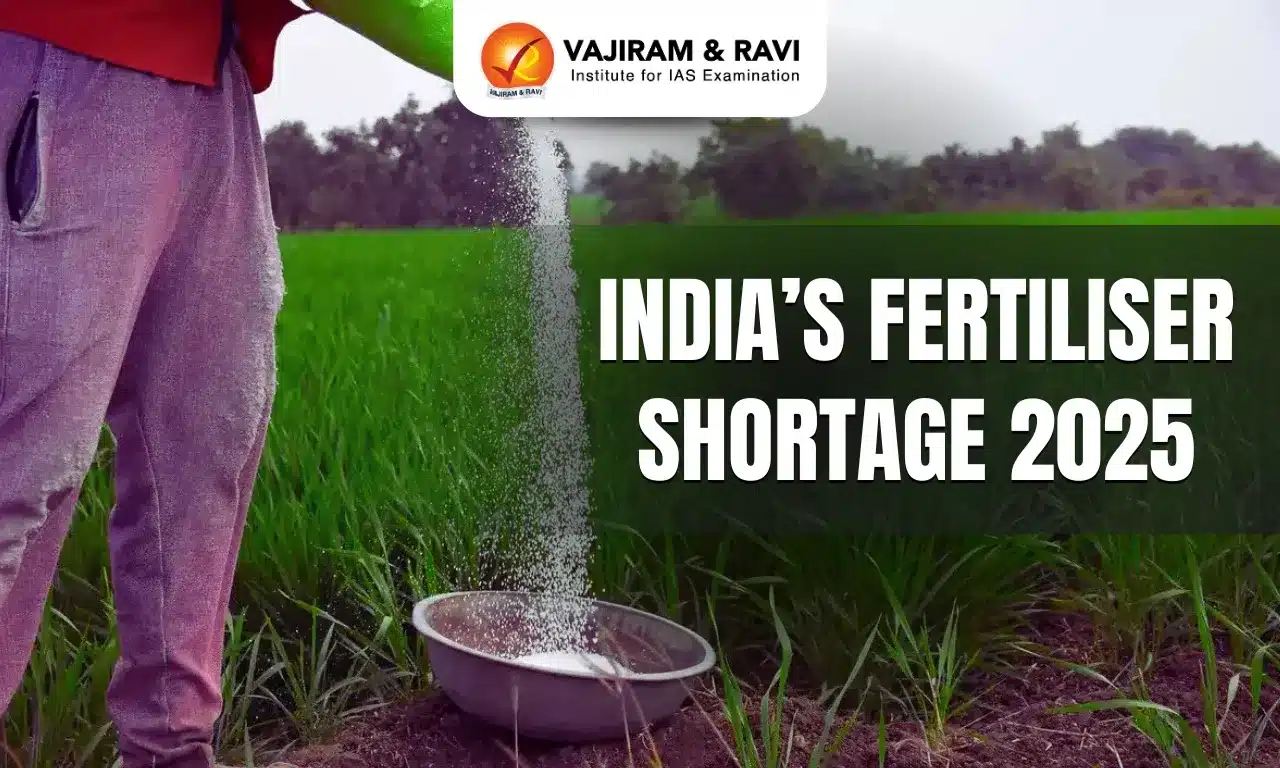
India’s fertiliser shortage 2025

India’s Fertiliser Shortage 2025 Latest News

  • India witnessed an excellent southwest monsoon this year, with June–August rainfall 6.1% above the historical average and well-distributed across regions. 
  • Rainfall exceeded norms in June (8.9%), July (4.8%), and August (5.5%), while May also recorded 106.4% above-normal rain. 
  • Out of 36 meteorological subdivisions, 33 received normal rainfall, with deficiencies seen only in Bihar, Assam, Meghalaya, and Arunachal Pradesh. 
  • The timely and evenly spread rains have spurred higher kharif sowing: rice acreage rose 7.6% to 420.4 lakh hectares, while maize cultivation jumped 11.7% to 93.3 lakh hectares. 
  • This, in turn, has boosted fertiliser sales as higher crop acreages drove demand for essential fertilizers.

Fertiliser Sales Surge with Good Monsoon

  • Between April–July 2025 and the same period in 2024, most fertilisers — including urea, single super phosphate (SSP), muriate of potash (MOP), and complex blends — recorded double-digit growth in sales.

Dip in DAP Sales, Rise of Alternatives

  • The only exception was diammonium phosphate (DAP), whose sales fell by 12.8%. 
  • This decline continues a trend from recent years, driven by supply shortages. 
  • Farmers have increasingly substituted DAP with other phosphorus-rich fertilisers such as SSP and the complex 20:20:0:13.

20:20:0:13 Emerges as a Major Player

  • With 20% phosphorus content — less than DAP’s 46% but more than SSP’s 16% — 20:20:0:13 has emerged as a popular choice. 
    • The ratio 20:20:0:13 is commonly used to represent the composition of a specific type of fertilizer, known as Ammonium Phosphate Sulphate (APS).
    • APS provides 20% Nitrogen (N), 20% Phosphorus pentoxide (P₂O₅), and 13% Sulphur (S), with no potassium (K).
  • Its sales reached a record 69.7 lakh tonnes in 2024–25, making it India’s third-largest selling fertiliser after urea (387.7 lt) and DAP (92.8 lt).

Rising Demand vs. Limited Supply

  • Despite a surge in fertiliser demand during the good monsoon, supply has not kept pace. 
  • Domestic urea production in April–July 2025 fell to 93.6 lt from 102.1 lt the previous year, while DAP output remained flat at 13.7 lt. 
  • Production rose modestly for NPKS complexes (35 lt to 37.4 lt) and SSP (17.1 lt to 19.1 lt), but imports of urea and DAP also declined, worsening the gap.

Sharp Stock Depletion

  • Government data show steep declines in fertiliser stocks as of August 1, 2025. 
  • Urea stocks dropped to 37.2 lt from 86.4 lt a year earlier. 
  • DAP (13.9 lt vs 15.8 lt), complexes (35 lt vs 47 lt), and MOP (6.3 lt vs 8 lt) also saw lower inventories. 
  • Only SSP stocks saw a marginal rise to 20.7 lt.

Peak Season Shortages

  • The supply crunch hit hardest during July–August, peak consumption months for kharif crops. 
  • Farmers need phosphatic fertilisers like DAP at sowing for root growth, while urea is applied in split doses later.
  • Reports of farmers queuing for hours to secure urea bags highlighted the shortages. 
  • Industry experts noted that fear-driven pre-stocking worsened the situation, amplifying the actual shortage during the critical sowing season.

Policy Lessons for Fertiliser Management

  • The government appears to have underestimated fertiliser demand this kharif, particularly for rice and maize, which are nitrogen-intensive crops requiring multiple urea applications. 
  • In contrast, soyabean and pulses, which need little urea, saw reduced acreage this season. 
  • With kharif consumption peaking, the focus now shifts to ensuring adequate fertiliser supplies for the rabi season, supported by strong water availability in reservoirs and aquifers. 
  • Falling imports of urea and DAP since 2023–24, largely due to Chinese supply curbs, may ease with the recent thaw in India–China ties. 
  • Experts suggest moderating usage by substituting some urea with ammonium sulphate and restricting DAP primarily to rice and wheat, while promoting complexes for other crops to ensure sustainability.

Source: IE | ET

India’s Fertiliser Shortage 2025 FAQs

Q1: What caused India’s fertiliser shortage in 2025?

Ans: A surge in demand after good monsoon rains and higher crop acreages, coupled with stagnant domestic output and reduced imports, led to the shortage.

Q2: Which fertilisers recorded the highest sales in 2025?

Ans: Urea remained the top-seller, followed by diammonium phosphate (DAP) and ammonium phosphate sulphate (20:20:0:13), which saw record demand due to DAP shortages.

Q3: Why has DAP sales declined in India?

Ans: Supply shortages and rising prices have pushed farmers to substitute DAP with alternatives like single super phosphate (SSP) and complex fertilisers such as 20:20:0:13.

Q4: How did supply shortages impact farmers?

Ans: Farmers faced long queues and pre-stocking pressures during kharif sowing, especially for urea and DAP, amplifying the sense of scarcity in July–August 2025.

Q5: What policy lessons emerge from this crisis?

Ans: The government needs advance planning, better imports, and promoting alternatives like ammonium sulphate to moderate urea/DAP consumption and ensure stable supplies.


India’s Federal Design and the Debate on J&K Statehood Formation

Statehood Formation

Statehood Formation Latest News

  • The Supreme Court’s directive on restoring Jammu and Kashmir’s statehood has revived debate on India’s federal design and the balance between Union authority and State autonomy.

Introduction

  • The question of Jammu and Kashmir’s statehood has reignited the debate on India’s federal design. 
  • The Supreme Court, while upholding the abrogation of Article 370 in December 2023, directed the Union Government to restore statehood and conduct Assembly elections. 
  • Although elections were held in October 2024, no roadmap for restoration has been announced. 
  • This delay raises larger concerns about the constitutional balance between India’s federal spirit and the Union’s authority.

Constitutional Framework for State Formation

  • The Indian Constitution outlines three processes for creating States: admission, establishment, and formation.
    • Admission: Political units like Jammu and Kashmir joined India through the Instrument of Accession in 1947.
    • Establishment: New territories like Goa and Sikkim were admitted following acquisition under international law.
    • Formation: Most common, this involves reorganising existing States under Article 3. Parliament may alter boundaries, merge, divide, or rename States.
  • However, while Parliament can reorganise States, it cannot permanently downgrade a State into a Union Territory. This principle underscores the federal foundation of India.

The Federal Character of India

  • India’s Constitution establishes a Union of States rather than a traditional federation. 
  • The term “Union” was chosen deliberately to ensure indivisibility, reflecting strong central authority alongside federal features.
  • Key aspects of India’s federal design include:
    • Indivisibility of the Union: States cannot secede, ensuring unity.
    • Bicameralism with Rajya Sabha: A permanent Upper House ensures continuous State representation at the Union level.
    • Basic Structure Doctrine: Federalism has been recognised as part of the Constitution’s basic structure, making it immune from dilution.
  • Thus, federalism in India balances diversity with unity, providing space for States while keeping the Union intact.

J&K and the Federal Debate

  • The 2019 Jammu and Kashmir Reorganisation Act converted the State into two Union Territories, J&K and Ladakh. 
  • While this was upheld as constitutional in 2023, the Court mandated eventual restoration of J&K’s statehood.
  • Critics argue that the delay undermines federalism by extending Union dominance through the Lieutenant Governor, restricting the powers of elected representatives. 
  • Proponents, however, argue that given J&K’s sensitive security situation, Union control remains essential until stability deepens.

Importance of Restoring Statehood

  • Restoration of statehood carries deep constitutional and political significance:
    • Federal Integrity: Reaffirming India’s commitment to shared governance between the Union and States.
    • Democratic Rights: Empowering the elected Assembly ensures people’s representation and accountability.
    • Balancing Power: Curtailing the excessive influence of the Lieutenant Governor aligns governance with democratic federalism.
    • Judicial Mandate: Compliance with the Supreme Court’s directive strengthens constitutional trust.
    • Political Stability: Restoring statehood could reduce alienation in the region and reinforce faith in India’s federal compact.

The Larger Federal Design Challenge

  • India’s federalism is often described as “quasi-federal,” combining strong central authority with regional autonomy. 
  • While this has enabled national unity, it has also led to tensions, especially when Union powers are exercised extensively, such as in J&K.
  • The debate underscores a fundamental question: how should India balance national security concerns with federal principles? The answer lies in respecting constitutional commitments while pragmatically addressing ground realities.

Source : TH

Statehood Formation

Q1: What does India’s federal design mean?

Ans: It refers to India’s unique system where the Union holds strong central authority while States enjoy constitutionally guaranteed powers.

Q2: Can Parliament convert a State into a Union Territory permanently?

Ans: No, under Article 3, Parliament can reorganise States but cannot downgrade a State into a Union Territory permanently.

Q3: Why is restoring J&K’s statehood important for federalism?

Ans: It reaffirms India’s federal principles, empowers elected representatives, and reduces central overreach.

Q4: What role does the Rajya Sabha play in India’s federal design?

Ans: As a permanent House, it ensures continuous State representation at the national level, protecting federal balance.

Q5: How did J&K originally join India?

Ans: Through the Instrument of Accession in 1947, signed by Maharaja Hari Singh under the Indian Independence Act, 1947.

Green Credit Programme (GCP) – Revised Rules for Tree Plantation

Green Credit Programme

Green Credit Programme (GCP) Latest News

  • The Union Environment Ministry has recently notified a new methodology for awarding green credits under the Green Credit Programme (GCP). 
  • This replaces the earlier methodology, with significant changes in eligibility, time frame, and use of credits.

Overview of the Green Credit Programme (GCP)

  • Launched: In November 2023, at the UN Climate Conference (COP28, Dubai) by the Prime Minister of India.
  • Objective: To promote voluntary environmental protection actions such as tree plantation, water conservation, waste management, etc.
  • Mechanism: Under GCP, the environment ministry seeks ‘voluntary actions’ from companies, individuals, or groups for environmental protection activities, and awards credits in return.

Key Changes in Rules

  • Awarding of credits:
    • Earlier system: The earlier benchmark awarded green credit subject to a minimum density of 1,100 trees per hectare, within two years of plantation.  It is criticized for not focusing on survival, and quality and density of canopy. 
    • New methodology: 
      • Those who have invested in tree plantation activities will earn green credits on completion of a minimum of five years of restoration activities on degraded forest land.
      • The green credit shall be calculated based on the vegetation status, including the change in the canopy density (after achieving a minimum canopy density of 40%) and the number of surviving trees.
  • Tradability of credits:
    • Earlier system: Market-based trading of credits.
    • New methodology: The credit for tree plantation will be non-tradable and non-transferable, except in the case of transfer between the holding company and its subsidiary companies.
  • Permissible uses of green credits:
    • Those involved in tree plantation under GCP will still be allowed a one-time exchange of green credit for compensatory afforestation obligations, 
      • To meet corporate social responsibility requirements or 
      • For other legal tree planting obligations. 
    • The credit will cease after exchanging it for compliance with legal obligations.
    • The credit for tree plantation may be used for reporting under environmental, social, and governance (ESG) leadership indicators.

Rationale Behind Changes

  • Focus on quality and survival:
    • Moves away from just counting trees per hectare.
    • Emphasizes long-term health of plantations (minimum 5 years).
    • Addresses criticism of government afforestation drives that focus on quantity over survival and canopy quality.
  • Focus on credibility:
    • So far, 57,986 hectares of degraded forest land have been registered under GCP, as per government data. 
    • Revised rules expected to improve credibility and long-term sustainability.

Conclusion

  • The revised Green Credit Programme marks a shift from tokenistic tree-plantation drives to sustainable ecological restoration with a focus on quality, survival, and canopy growth. 
  • Going forward, this approach can strengthen India’s climate resilience, improve biodiversity, and enhance corporate accountability in environmental stewardship.

Source: IE

Green Credit Programme (GCP) FAQs

Q1: Why has the Union Environment Ministry revised the methodology of awarding green credits under the Green Credit Programme (GCP)?

Ans: To ensure focus on long-term tree survival and canopy density rather than short-term plantation targets.

Q2: What are the key conditions for awarding green credits for tree plantation under the new rules of GCP (2025)?

Ans: Credits will be awarded after 5 years, based on a minimum canopy density of 40% and verified tree survival.

Q3: How does the revised GCP address the criticism of earlier afforestation and plantation initiatives in India?

Ans: By shifting from a tree-count benchmark (1,100 per hectare) to quality indicators like canopy density and growth.

Q4: What is the significance of restricting green credits under GCP as non-tradable and non-transferable?

Ans: It prevents commercial speculation, while allowing use mainly for CSR, legal obligations, or ESG reporting.

Q5: In what way can the GCP contribute to India’s climate commitments and sustainability goals?

Ans: By incentivising voluntary ecological restoration on degraded lands, enhancing carbon sequestration and biodiversity.

PM Modi–Xi Jinping Tianjin Summit 2025: Key Outcomes and Strategic Shifts

PM Modi Xi Jinping Meeting 2025

PM Modi Xi Jinping Meeting 2025 Latest News

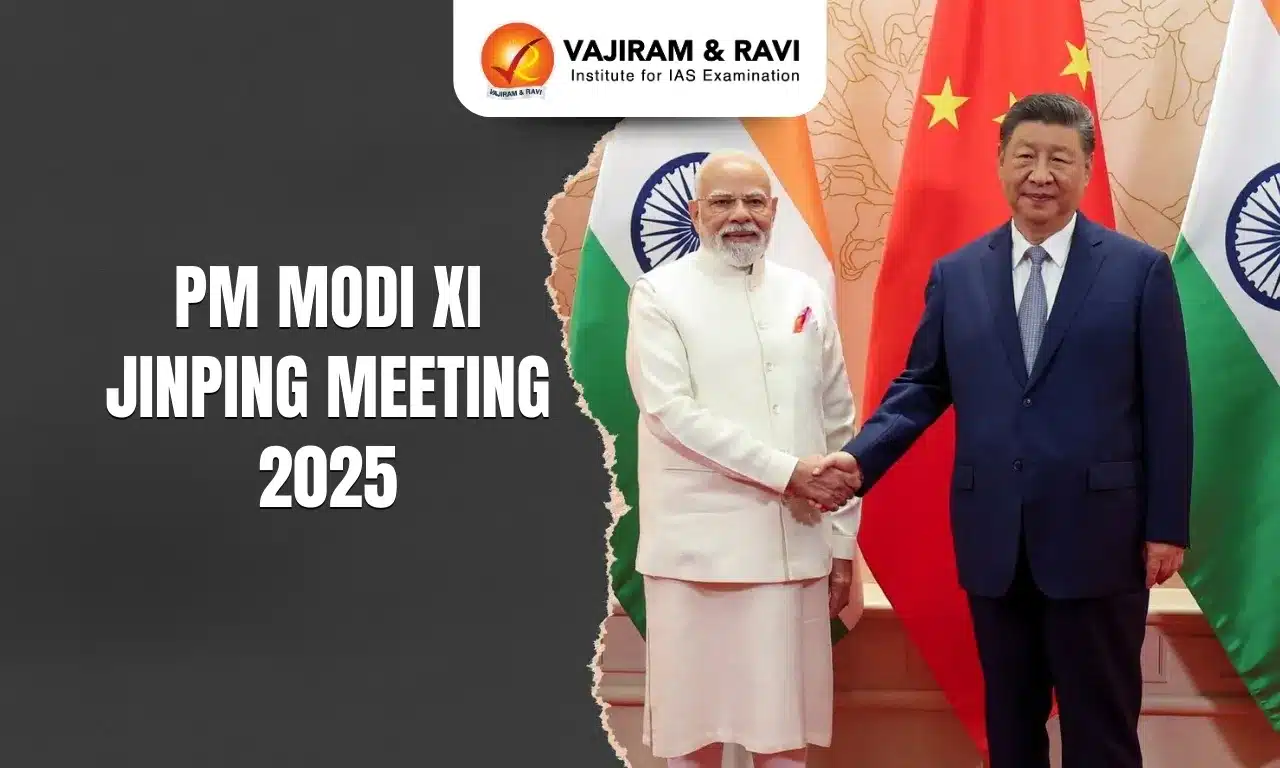
  • PM Modi met Chinese President Xi Jinping on the sidelines of the SCO Summit 2025 in Tianjin
  • Both leaders welcomed the positive momentum since their October 2024 meeting in Kazan and reaffirmed that India and China are development partners, not rivals. 
  • They agreed that bilateral differences should not escalate into disputes and emphasized the need for stable relations based on mutual respect, interest, and sensitivity.

PM Modi–Xi Jinping Meeting in Tianjin: Key Highlights

  • PM Modi and Chinese President Xi Jinping held wide-ranging talks in Tianjin, marking Modi’s first visit to China in seven years. 
  • The meeting came soon after the US imposed 50% tariffs on Indian goods due to India’s purchase of Russian oil. 
  • Both leaders reviewed bilateral ties and global challenges, seeking to expand cooperation while managing differences.

Border Issues

  • PM Modi underlined that peace and stability along the border are essential for advancing relations, likening it to an “insurance policy” for bilateral ties. 
  • He reiterated India’s unchanged stance on Taiwan. 
  • Both sides acknowledged recent steps to rebuild trust after the Galwan Valley clashes of 2020.

Upgrading Strategic Relations

  • President Xi proposed four suggestions: strengthen strategic communication, deepen trust, expand cooperation, ensure mutual benefit, and enhance multilateral cooperation
  • PM Modi responded positively, signalling intent to upgrade ties.

Cross-Border Terrorism

  • The Prime Minister raised the issue of cross-border terrorism, stressing that both India and China have suffered from the threat. 
  • He urged mutual support to combat terrorism effectively.

Trade and Economic Cooperation

  • Both leaders acknowledged their economies’ stabilising role in global trade and agreed to expand bilateral investment while addressing the trade deficit
  • The ongoing discussions on balancing trade, involving governments, businesses, and institutions. 
  • Modi and Xi also discussed ways to boost people-to-people ties.

Global Order and Multilateralism

  • The two leaders shared concerns over the functioning of global bodies like the WTO and UN. 
  • Modi emphasised that India and China, both pursuing strategic autonomy, should not let relations be defined through the lens of a third country
  • Xi called for cooperation between India and China as leading Global South economies to uphold multilateralism and a multipolar world.

Connectivity and Regional Cooperation

  • The leaders discussed connectivity projects with Myanmar, with Modi highlighting their importance for India’s ties with Southeast Asia. 
  • Modi also invited Xi to the 2026 BRICS Summit in India, which Xi welcomed while expressing support for India’s BRICS leadership.

Partners, Not Rivals

  • The two leaders agreed that domestic development goals remain their priority. 
  • They stressed that cooperation benefits the 2.8 billion people of both nations and is essential for an Asian century and a multipolar world order.

Analysis: India’s Diplomatic Rebalancing Amid Trump’s Turbulence

  • Recently, India has launched a major diplomatic effort to rebalance its great-power relations, driven by the disruptions of US President Donald Trump’s policies. 
  • PM Modi’s back-to-back visits to Tokyo and Tianjin highlight this recalibration, deepening ties with Japan while cautiously re-engaging with China.

Tokyo: Strengthening Partnership with Japan

  • In Tokyo, Modi signed agreements to expand cooperation in commerce, technology, security, and human resources. 
  • This builds on the strong India–Japan partnership, vital in the face of regional instability and Trump’s erratic pressure on US allies.

Tianjin: Resetting Ties with China

  • In Tianjin, Modi and Xi Jinping agreed to consolidate commitments after years of tension, addressing boundary issues, lifting economic restrictions, and seeking common ground on regional and global challenges. 
  • This marks a step toward stabilising ties after the Galwan clash.

Trump’s Role in the Shift

  • Trump’s tariff hikes on Indian goods and personal attacks on Modi, driven by resentment over India’s refusal to endorse him for a Nobel Prize, have destabilised India–US ties. 
  • His unilateral trade demands and humiliation of allies like Japan, South Korea, and Australia forced Asian nations, including India, to rethink their strategies and reduce tensions with China.

India’s Strategic Autonomy

  • Delhi has avoided public confrontation with Trump but quietly resisted pressure, reaffirming the importance of US ties while broadening relations with China, Japan, Europe, and Russia. 
  • India’s Foreign Office underscored its emphasis on “strategic autonomy,” ensuring it is not seen as aligning too closely with either Washington or Beijing.

Conclusion

  • China, facing relentless US pressure, is diversifying its partnerships with Russia, Europe, and Asian allies, while keeping a cautious door open for US engagement. 
  • India, from a different position, is moving along a similar path—seeking balanced ties, avoiding overdependence, and leveraging multipolarity to safeguard its long-term security and prosperity.

Source: IE | MEA | ET

PM Modi Xi Jinping Meeting 2025 FAQs

Q1: What was the key message of Modi and Xi’s 2025 meeting?

Ans: Both leaders agreed India and China are “partners, not rivals,” emphasising stable ties, border peace, and cooperation for a multipolar Asia and world.

Q2: What role did border issues play in the talks?

Ans: PM Modi stressed peace and tranquillity at the border as an “insurance policy” for stronger relations, while both sides acknowledged progress since Galwan 2020.

Q3: How did India raise cross-border terrorism?

Ans: PM Modi highlighted terrorism as a shared challenge and called for mutual support, with China signalling understanding during the SCO summit discussions.

Q4: What was discussed on trade and economy?

Ans: Leaders agreed to expand bilateral trade and investment, narrow the trade deficit, and strengthen people-to-people ties while stabilising global trade.

Q5: How does this meeting fit into India’s larger diplomacy?

Ans: With US tariffs straining ties, India is rebalancing its great-power relations by strengthening partnerships with Japan and cautiously resetting ties with China.

Enquire Now