Punjab’s Recurrent Flooding Crisis: Rivers, Dams, and Governance Failures

Punjab Flooding Crisis

Punjab Flooding Crisis Latest News

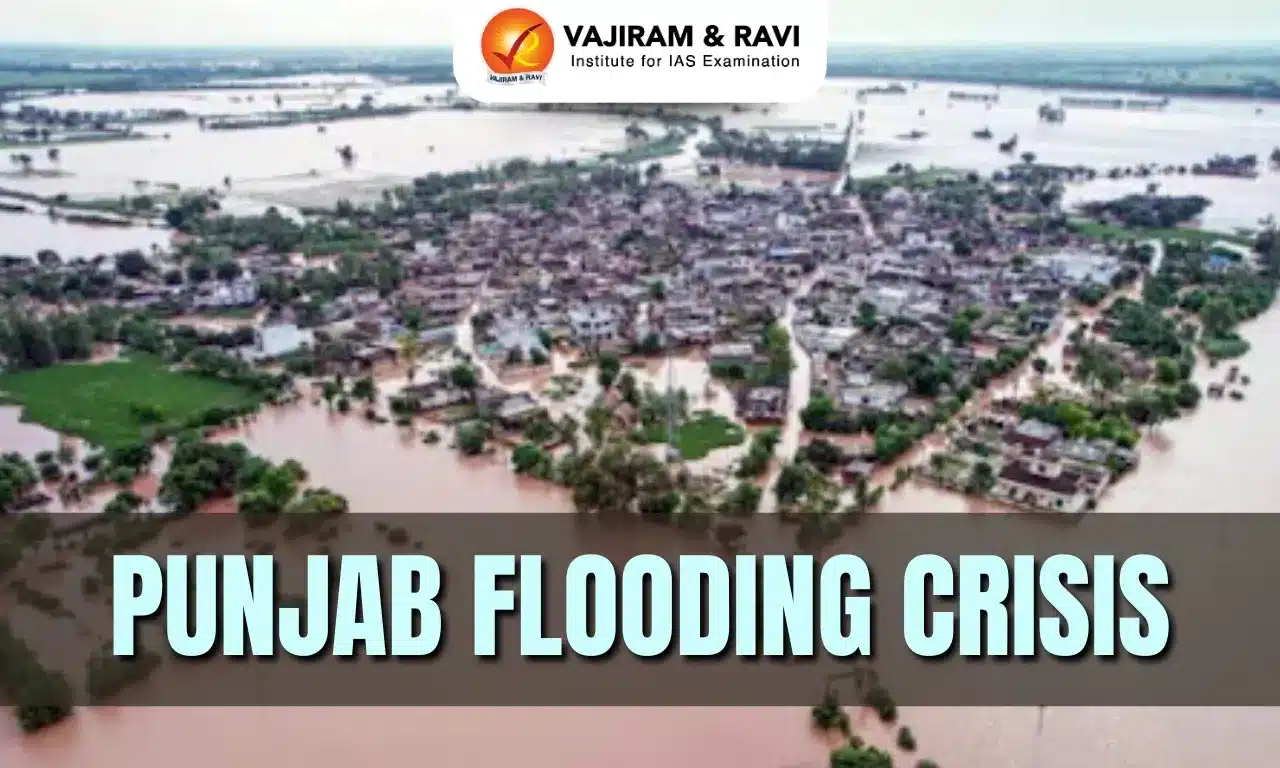
  • Punjab is witnessing one of its worst floods, with all 23 districts declared flood-hit. 
  • Over 1,900 villages, 3.8 lakh people, and 11.7 lakh hectares of farmland have been affected, with 43 deaths reported. Gurdaspur is the worst-hit district. 
  • Across the border, Punjab in Pakistan has also faced severe flooding, displacing over 9 lakh people. 
  • While the region’s riverine geography makes it naturally flood-prone, human factors have worsened the crisis.

Rivers: Boon or Bane for Punjab

  • Punjab is nourished by three perennial rivers — Ravi, Beas, and Sutlej — along with the seasonal Ghaggar and smaller hill streams (choes). 
  • These rivers deposit fertile alluvium, making Punjab one of the most productive agricultural regions globally. 
  • Despite comprising just 1.5% of India’s landmass, Punjab contributes nearly 20% of the nation’s wheat and 12% of its rice, earning it the title “food bowl of India.”

The Bane: Recurrent Flooding

  • The same rivers that sustain agriculture also bring devastation during the monsoon. 
  • Rainfall in Punjab and upstream catchments of Himachal Pradesh and J&K causes rivers to swell. 
  • Though dhussi bundhs (earthen embankments) offer protection, they are often overwhelmed by heavy inflows.

Floods in 2024 and Historical Recurrence

  • Punjab has witnessed major floods repeatedly in 1955, 1988, 1993, 2019, and 2023. 
  • This year, excessive rainfall triggered flooding once again. 
  • The Beas overflowed in August due to heavy rain in Himachal, inundating villages and farmland in Kapurthala, Tarn Taran, Ferozepur, Fazilka, and Hoshiarpur. 
  • Soon after, the Ravi swelled dangerously; the collapse of two gates of Madhopur Barrage led to catastrophic flooding in Pathankot, Gurdaspur, and Amritsar.

Widespread Impact of Excess Rainfall

  • Simultaneously, incessant rainfall across Punjab worsened the crisis. 
  • While Sutlej embankments held, the Malwa region experienced severe waterlogging, affecting Ludhiana, Jalandhar, Ropar, Nawanshahr, and Moga. 
  • According to the Indian Meteorological Department, Punjab, Himachal Pradesh, and J&K have all received over 45% excess rainfall this year, far above seasonal norms.

The Role of Dams in Punjab’s Floods

  • Every time Punjab faces floods, attention turns to three major dams on its perennial rivers. These are: Bhakra dam; Pong dam; Thein dam.
  • The Bhakra Dam on the Sutlej (Bilaspur, Himachal Pradesh) and the Pong Dam on the Beas (Kangra, Himachal Pradesh) are run by the Bhakra Beas Management Board (BBMB).
    • BBMB is a statutory body constituted under the Punjab Reorganisation Act, 1966.
  •  The Thein or Ranjit Sagar Dam on the Ravi (border of J&K and Punjab) is managed by Punjab’s State Power Corporation and Irrigation Department. 
  • These dams regulate river flow and play a critical role in flood control.

Release of Water from Dams

  • When heavy rainfall fills reservoirs beyond safe levels, dam operators must release water to avoid overtopping, which can be disastrous
  • The BBMB follows a “rule curve” that guides how much water should be stored or released based on weather forecasts and hydrology. 
  • However, extreme rainfall events often force sudden releases. This year, inflows into the Pong Dam were about 20% higher than 2023, an unprecedented surge. 
  • The Bhakra Dam also saw very high inflows, though not entirely new in scale.

Punjab’s Concerns with BBMB

  • Punjab has long argued that the BBMB prioritizes irrigation and power generation over flood management. 
  • According to state officials, BBMB keeps reservoir levels too high in July and August to secure water for winter farming and power supply, leaving little cushion for sudden heavy rains in August-September. 
  • Sudden water releases, often without timely warnings, worsen flooding downstream and leave local officials unprepared.

Governance Issues and Tensions

  • At the core of Punjab’s problem is the structure of the BBMB. 
  • It is a Centre-controlled body whose main mandate is irrigation and power, not flood management. 
  • Punjab feels it has too little say in the Board’s decisions. 
  • Tensions increased after the Centre amended BBMB rules in 2022, allowing officers from across India—not just Punjab and Haryana—to hold top positions.
  • Punjab criticized the BBMB, accusing it of holding back water until the last moment before suddenly releasing it. 

Governance Failures Behind Punjab’s Floods

  • Experts stress that poor dam management, delayed warnings, and weak infrastructure worsened Punjab’s floods this year. 
  • The collapse of two Madhopur barrage gates after sudden water release from the Thein dam highlighted gaps in coordination within Punjab’s own Irrigation Department. 
  • Environmentalists noted that reservoirs at Ranjit Sagar, Pong, and Bhakra were kept too full and then emptied abruptly, triggering severe downstream flooding. 
  • Weak dhussi bundhs, further damaged by illegal mining, added to the crisis. 

Source: IE

Punjab Flooding Crisis FAQs

Q1: What makes Punjab prone to recurrent floods?

Ans: Punjab’s geography with perennial rivers and upstream rainfall in Himachal and J&K makes it naturally flood-prone, while weak embankments worsen the risk during monsoon.

Q2: How have Punjab’s rivers contributed to both prosperity and floods?

Ans: Ravi, Beas, and Sutlej make Punjab fertile, sustaining agriculture, but their swelling during monsoons repeatedly devastates villages, farmland, and infrastructure.

Q3: What role do dams play in Punjab’s flooding?

Ans: Bhakra, Pong, and Thein dams regulate water but sudden releases during heavy rains, guided by “rule curves,” often cause flooding downstream.

Q4: Why does Punjab criticize the Bhakra Beas Management Board (BBMB)?

Ans: Punjab alleges BBMB prioritizes irrigation and power over flood control, maintains high reservoir levels, and issues delayed warnings, worsening flood damage.

Q5: What governance failures worsen Punjab’s flood crisis?

Ans: Poor dam coordination, sudden water releases, weak bundhs damaged by illegal mining, and lack of preventive investment amplify Punjab’s flood disasters.
Centre Approves Independent Environment Auditors under Environment Audit Rules 2025

Environment Audit Rules 2025

Environment Audit Rules 2025 Latest News

  • The Environment Ministry has introduced the Environment Audit Rules, 2025, creating a new class of independent “environment auditors.”
  • These accredited private agencies, similar to chartered accountants, will be licensed to inspect and verify project compliance with environmental laws. 
  • Their role will supplement State Pollution Control Boards by conducting environmental impact assessments and ensuring adherence to best practices in pollution prevention and control.

Environment Audit Rules, 2025

  • The Ministry of Environment, Forest and Climate Change (MoEFCC) has introduced the Environment Audit Rules, 2025 as part of India’s commitment to Ease of Doing Business and sustainable governance
  • Drawing on international best practices, the rules address gaps in monitoring environmental compliance, ensuring protection of natural resources while enabling development.

Need for the Rules

  • Monitoring is currently carried out by the Central Pollution Control Board (CPCB), State PCBs, and regional offices, but limited manpower, infrastructure, and resources hamper effective enforcement. 
  • The new scheme bridges these gaps, aiming to enhance transparency, accountability, and credibility in compliance monitoring while building trust among stakeholders.

Main Features of the Rules

  • Certification and Registration: Environment auditors must be certified and registered through the Environment Audit Designated Agency (EADA).
  • Assignment of Auditors: Auditors are assigned randomly to avoid bias and conflict of interest.
  • Responsibilities: Registered auditors will verify compliance, conduct sampling and analysis, calculate compensation, and ensure adherence to laws like the Green Credit Rules, waste management regulations, and forest/environmental legislation.
  • Self-Compliance Verification: Auditors can also verify self-reported compliance by project proponents.

Key Stakeholders

  • Certified Environment Auditor (CEA): Qualified through Recognition of Prior Learning or a National Certification Examination.
  • Registered Environment Auditor (REA): Certified professionals officially licensed to perform audits.
  • Environment Audit Designated Agency (EADA): Responsible for certification, registration, oversight, training, and maintaining an online registry.
  • MoEFCC: Oversees implementation and issues guidelines.
  • CPCB, SPCBs, and Regional Offices: Continue inspections and assist in enforcing the rules.

Oversight Mechanism

  • A Steering Committee, led by an Additional Secretary of MoEFCC with representatives from regulatory bodies, will monitor progress, resolve challenges, and propose reforms for effective implementation.

Expected Outcomes

  • Stronger Compliance: Independent audits will make monitoring more credible and enforceable.
  • Integration with Frameworks: Supports Green Credit Programme, Ecomark certification, and Extended Producer Responsibility under waste rules.
  • Enhanced Capacity: Expands trained professionals, enabling regulators to focus on high-risk enforcement and policymaking.
  • Transparency and Accountability: Random auditor assignment reduces conflicts of interest and promotes trust.
  • Data-Driven Governance: Digitized audit records enable better decision-making, disclosure, and targeted interventions.
  • Proactive Risk Management: Early detection of non-compliance allows timely corrective action and prevents environmental harm.

Analysis: A Shift in Environmental Monitoring

  • The Environment Audit Rules, 2025 mark a major reform in India’s environmental governance. 
  • These rules expand the scope of monitoring and auditing beyond State Pollution Control Boards (PCBs), allowing accredited private agencies to take on the task.

Addressing Regulatory Gaps

  • The current compliance system, managed by the CPCB, State PCBs, and the Environment Ministry’s regional offices, faces severe manpower and resource shortages
  • These limitations hinder comprehensive monitoring of the large number of projects and industries across the country. 
  • The new scheme aims to bridge these deficits and strengthen compliance mechanisms.

Role of Private Environment Auditors

  • Under the rules, private agencies can become licensed environment auditors, similar to chartered accountants. They will be authorised to:
    • Evaluate compliance with environmental laws.
    • Assess adherence to best practices in pollution prevention and control.
    • Support Green Credit Rules, enabling tradeable credits for afforestation, water management, and waste management.
  • Auditors will help companies account for both direct and indirect carbon emissions, requiring complex evaluation beyond the capacity of PCBs.

Challenges at the Grassroots

  • While the reforms strengthen top-level monitoring, challenges remain at the district, block, and panchayat levels, where environmental violations are often most severe. 
  • The success of the new regime depends on empowering local staff and ensuring that core monitoring responsibilities are not compromised.

Conclusion

  • The Environment Audit Rules, 2025 aim to modernise compliance monitoring, bring in private expertise, and prepare India for future climate-related regulations. 
  • At the same time, local-level enforcement must be strengthened to ensure holistic and effective environmental governance.

Source: TH | PIB | TH

Environment Audit Rules 2025 FAQs

Q1: What are the Environment Audit Rules 2025?

Ans: The Environment Audit Rules 2025 are new regulations by MoEFCC introducing certified independent auditors to ensure compliance with environmental laws and improve governance.

Q2: Why were independent environment auditors introduced?

Ans: They were introduced to address manpower and resource shortages in Pollution Control Boards, ensuring credible compliance monitoring and building trust among stakeholders.

Q3: What responsibilities will independent environment auditors have?

Ans: Auditors will verify compliance, conduct sampling, calculate compensation, and oversee adherence to laws like Green Credit Rules and waste management regulations.

Q4: How will the Environment Audit Rules 2025 improve transparency?

Ans: Random assignment of auditors reduces conflicts of interest, while digitized audit records enhance accountability, data-driven governance, and informed decision-making.

Q5: What challenges might affect implementation of the Environment Audit Rules 2025?

Ans: Challenges remain at grassroots levels—districts and panchayats—where local enforcement is weak, making effective monitoring essential for holistic governance.

Indian Science Congress to be Replaced by the ESTIC

Indian Science Congress

Indian Science Congress Latest News

  • The Indian Science Congress has been replaced by the Emerging Science, Technology and Innovation Conclave (ESTIC), with its first edition scheduled for November 2025 in New Delhi.

Introduction

  • For over a century, the Indian Science Congress (ISC) has been the premier platform for Indian scientists, researchers, and policymakers to deliberate on national scientific priorities. 
  • Established in 1914, the ISC grew into a prestigious event inaugurated annually by the Prime Minister, bringing together global and Indian experts. 
  • However, over recent years, concerns over its effectiveness, controversies in its sessions, and institutional disputes have diminished its relevance.
  • In 2025, the government announced a new approach with the Emerging Science, Technology and Innovation Conclave (ESTIC), scheduled to be held in November. 
  • This marks a historic transition in India’s science policy ecosystem, signalling a move toward a more structured, innovation-driven forum aligned with national priorities like Viksit Bharat 2047.

Achievements and Issues with the Indian Science Congress

  • Achievements
    • Platform for Scientific Exchange: The ISC played a crucial role in creating a scientific community in pre- and post-Independence India.
    • Global Participation: It hosted Nobel Laureates, international scholars, and top Indian scientists.
    • Policy Influence: Many national science policies were shaped through discussions at ISC sessions.
    • Public Engagement: It popularised science among school and college students through exhibitions and public lectures.
  • Issues
    • Erosion of Academic Quality: Over time, the ISC faced criticism for allowing unscientific and controversial statements by some participants.
    • Reduced Relevance: Its role as a serious forum for science policy and research exchange declined.
    • Institutional Conflict: Disputes between the Department of Science and Technology (DST) and the Indian Science Congress Association (ISCA), which organised the event, led to funding cuts.
    • COVID-19 Disruptions: After the pandemic, only the 2023 edition was held, with no physical conferences thereafter.
  • The growing disconnect between ISC and India’s contemporary science needs created the ground for ESTIC.

The Emerging Science, Technology and Innovation Conclave (ESTIC)

  • Overview
    • The first ESTIC will be held at Bharat Mandapam, New Delhi, from November 3-4, 2025, and is expected to be inaugurated by Prime Minister Narendra Modi
    • Organised by the DST in collaboration with all science-related ministries, ESTIC aims to become India’s leading forum for advancing innovation-driven research.
  • Key Features
    • Thematic Sessions: 11 technical sessions will focus on frontier areas such as space, biotechnology, deep-tech, and renewable energy.
    • Innovation Showcase: 75 exhibition stalls will be set up by deep-tech startups.
    • Global Participation: Nobel Laureate Andre Geim (Physics, 2010), French space expert Jean-Yves Le Gall, and Japanese biologist Professor Masaru Tomita are among the confirmed international guests.
    • Government Involvement: Unlike the ISC, ESTIC will involve direct participation from all science-related ministries, including atomic energy, IT, and space.
    • Prime Minister’s Presence: PM’s attendance at the inaugural underlines the strategic importance given to ESTIC.
  • Objectives
    • To showcase cutting-edge research and technology breakthroughs.
    • To align India’s science innovation ecosystem with the vision of Viksit Bharat 2047.
    • To provide a serious global platform for scientists and innovators, different from IISF (India International Science Festival), which is designed more as a science popularisation event.

Significance of the Transition

  • Replacing ISC with ESTIC represents:
    • Policy Modernisation: Moving from a general science gathering to a high-level innovation conclave.
    • Focus on Innovation: Prioritising applied research and startup-driven technology ecosystems.
    • Global Leadership: Positioning India as a key player in international science and technology networks.
    • Institutional Clarity: Shifting control directly to DST reduces friction with external associations like ISCA.

Source: TH

Indian Science Congress FAQs

Q1: What is ESTIC?

Ans: The Emerging Science, Technology and Innovation Conclave (ESTIC) is a new government-led forum to replace the Indian Science Congress, focusing on deep-tech and innovation.

Q2: Why is ESTIC replacing the Indian Science Congress?

Ans: ESTIC is being introduced to modernize India’s science forums, addressing issues of relevance, quality, and innovation focus in the Indian Science Congress.

Q3: When and where will the first ESTIC be held?

Ans: The first ESTIC will be held at Bharat Mandapam, New Delhi, on November 3-4, 2025.

Q4: Who are some of the international dignitaries expected at ESTIC?

Ans: Nobel Laureate Andre Geim, French space leader Jean-Yves Le Gall, and Japanese biologist Masaru Tomita are among the participants.

Q5: How is ESTIC different from the India International Science Festival (IISF)?

Ans: Unlike IISF, which popularizes science among the public, ESTIC will serve as a serious forum for scientists, policymakers, and innovators to deliberate on advanced science and technology.

India–Europe Energy Dynamics – India’s Rising Diesel Exports to Europe Amid EU’s Upcoming Ban on Russian Crude Products

India-Europe Energy Dynamics

India-Europe Energy Dynamics Latest News

  • The European Union (EU) plans to ban imports of fuels refined from Russian crude starting January 21, 2026.
  • Europe is stockpiling petroleum products, particularly diesel, ahead of the ban.
  • Amid this scenario, India has become a major swing supplier of petroleum products to Europe, bringing a fresh perspective to the India-Europe energy dynamics.

India’s Petroleum Exports to Europe

  • Role in India’s economy:
    • India’s petroleum industry is a key driver of foreign exchange earnings and global trade presence. 
    • Exports to Europe, a market with high energy demand and stringent quality standards, strengthen India’s position as a reliable global energy supplier.
  • Export volumes and revenue:
    • Petroleum exports to Europe in April–January 2024 valued at $18.4 billion.
    • July 2024: Exports rose 26%, reaching 266,000 barrels/day (bpd).
      • Major products: Diesel (238,000 bpd) and aviation fuel (81,000 bpd) exports.
    • Historical growth: Between 2018–19 and 2023–24, petroleum exports to Europe surged by over 253,000% in volume and nearly 250% in value, reflecting Europe’s dependence on Indian refined fuels.
    • Global export comparison: Top global petroleum exporters - Saudi Arabia (16.2%), Russia (9.14%), Canada (8.48%), while India has carved a growing niche through refined product exports.
  • Types of exports:
    • Crude oil derivatives – Diesel, gasoline, naphtha, kerosene, fuel oil.
    • Refined petroleum products – Aviation turbine fuel (ATF), industrial fuels.
    • Petrochemicals – Polypropylene, polyethylene, and polymers for manufacturing.
  • Strategic importance:
    • Europe’s steady energy demand and India’s advanced refining capacity provide mutual benefits
    • The trend underscores India’s growing role in global energy trade, while exporters can leverage logistics solutions to expand further.

India-Europe Energy Dynamics

  • India’s diesel exports to Europe: 
    • It jumped to around 260,000 barrels per day (bpd) in August 2025, up nearly 63% over July 2025 and 103% over August of last year (according to Kpler). 
    • India’s total petroleum product exports to Europe in August jumped 41% month-on-month to nearly 399,000 bpd.
  • Largest exporter: All of India’s diesel exports to Europe in August were from Reliance Industries (RIL), the country’s largest private sector refiner and petroleum product exporter.

Drivers of Export Growth

  • EU stockpiling ahead of the 2026 sanctions.
  • Advancing of maintenance shutdown of Shell’s Pernis refinery in the Netherlands from 2026.
    • This is as part of Europe's strategy to make sure its own refineries are not hampered by turnaround schedules once the January 2026 ban goes into force.
  • West Asia refinery maintenance expected in late 2025, reducing supplies to Europe.
  • India’s role as a swing supplier of middle distillates (diesel, jet fuel, kerosene).

Geopolitical Dimensions

  • Western concerns: US and Western allies allege India is profiteering by refining discounted Russian crude and exporting products to Europe.
  • India rejects allegations, emphasizing:
    • Import of Russian crude is legal.
    • Export of refined fuels is within global trade norms.
    • Countries objecting can stop importing from India.

EU Ban on Russian-Origin Fuels

  • The EU had already banned direct imports of Russian petroleum products in February 2023.
  • From January 2026, the ban extends to fuels refined from Russian crude, even if processed in third countries.
    • Exemptions: Canada, Norway, Switzerland, UK, and US.

Challenges and Uncertainties

  • Enforcement issues:
    • Refineries process mixed crude baskets (60–70% non-Russian in India).
    • Difficult to differentiate refined fuels from Russian vs. non-Russian crude.
    • RIL operates two separate refining systems, aiding compliance flexibility.
  • Impact on India: If Europe halts imports from India -
    • Impact may be transitory.
    • India can divert exports to other markets.
    • Global fuel flows would adjust (e.g., Europe sourcing more from West Asia, India shifting to markets served by West Asia).

Conclusion

  • India’s growing role as a swing supplier of petroleum products positions it as a critical player in Europe’s energy security and India-Europe energy dynamics during the transition away from Russian crude. 
  • Going forward, India must leverage this opportunity to strengthen its global energy trade while preparing for policy shifts like the 2026 EU ban through market diversification and diplomatic engagement.

Source: IE

India-Europe Energy Dynamics FAQs

Q1: Why have India’s diesel exports to Europe surged ahead of the EU’s January 2026 sanctions on Russian-origin fuels?

Ans: It is due to Europe’s stockpiling, refinery maintenance in the Netherlands and West Asia, and India’s role as a swing supplier of middle distillates.

Q2: What are the key allegations made by Western countries against India regarding its crude oil trade with Russia?

Ans: The West alleges India profits by refining discounted Russian crude and exporting to Europe.

Q3: What are the enforcement challenges of the EU’s 2026 ban on petroleum products refined from Russian crude?

Ans: As refineries process mixed crude baskets, it is difficult to trace whether refined fuels are from Russian or non-Russian sources.

Q4: How might the EU’s 2026 fuel import ban affect India’s petroleum product exports?

Ans: The impact may be temporary as India can redirect exports to other markets, with global fuel flows adjusting to regional supply-demand shifts.

Q5: What is the significance of Reliance Industries Limited (RIL) in India’s petroleum exports to Europe?

Ans: RIL, India’s largest private refiner, was the sole exporter of diesel to Europe in August 2025, highlighting its pivotal role in India’s energy trade.

Enquire Now