Representation in the Rajya Sabha/Upper House of the Parliament

Rajya Sabha

Rajya Sabha Latest News

  • The Union Law and Justice Ministry recently rejected the Election Commission’s (EC) proposal for a presidential order to stagger the terms of Jammu and Kashmir’s (J&K) four Rajya Sabha seats
  • This has left the Union Territory (UT) without representation in the Upper House since 2021.

Background

  • Vacancy of seats: J&K’s four Rajya Sabha seats became vacant in 2021 when MPs completed their terms during President’s Rule.
  • Elections 2024: Despite Assembly elections being held in Sept–Oct 2024, Rajya Sabha elections are yet to be conducted.
  • Political concern: The current Chief Minister of the UT of J&K has raised questions about the delay.

EC’s Proposal

  • Proposal: A presidential order to curtail the terms of some of the Rajya Sabha seats of J&K.
  • Objective: Ensure staggered retirement of J&K’s Rajya Sabha members, preventing simultaneous vacancy.
  • Reference: A similar presidential order was issued in 1952 after the first Rajya Sabha election to create a staggered cycle.
  • Article 83: Provides that one-third of Rajya Sabha members retire every two years, ensuring continuity. It is a permanent House as opposed to the Lok Sabha that has a fixed five-year term.
  • Disturbance in cycle: In J&K (since the 1990s) and in Delhi (post-1991 NCT of Delhi Act), terms have become concurrent due to President’s Rule or institutional changes.

Law Ministry’s Response

  • Reason for rejection: No provision in current law to issue such an order.
  • Past precedents: Orders were issued only in 1952 and 1956 under the Representation of the People Act (RPA), 1951 and subsequent Seventh Constitutional Amendment (1956).
  • Legal position: According to Section 154 of the RPA 1951, the term of Rajya Sabha members is six years. Presidential orders for staggering were permitted only at the first constitution (1952) and after the 1956 amendment.
  • Implication: Any new order requires a statutory amendment to the RPA, 1951 and must cover all affected states/UTs, not only J&K.

Current Status

  • No representation: J&K has had no Rajya Sabha MPs for four years.
  • National impact:
    • J&K had no vote in the 2022 Presidential and Vice-Presidential elections.
    • It will also remain unrepresented in the Vice-President election (Sept 9, 2025).
  • Pending action: Uncertainty remains over when the EC will schedule Rajya Sabha elections for J&K.

Conclusion

  • A clear legislative amendment to the Representation of the People Act, 1951 can ensure staggered Rajya Sabha representation for all affected states and UTs, safeguarding federal continuity
  • Restoring J&K’s voice in the Upper House will not only uphold democratic legitimacy but also strengthen its integration into India’s parliamentary framework.

Source: IE

Rajya Sabha FAQs

Q1: Why has Jammu & Kashmir remained unrepresented in the Rajya Sabha since 2021?

Ans: J&K’s four Rajya Sabha seats fell vacant during President’s Rule in 2021, and elections have not been conducted despite Assembly polls in 2024.

Q2: What proposal did the Election Commission make to address the Rajya Sabha vacancy issue in J&K?

Ans: The EC proposed a presidential order to stagger the terms of J&K’s Rajya Sabha seats, preventing all from becoming vacant simultaneously.

Q3: Why did the Union Law and Justice Ministry reject the Election Commission’s request?

Ans: The Ministry stated there is no legal provision under the Representation of the People Act, 1951, to issue such an order now; it was only allowed in 1952 and 1956.

Q4: What constitutional and legal provisions govern the continuity of the Rajya Sabha?

Ans: Article 83 mandates one-third retirement every two years; Section 154 of the RPA, 1951 sets six-year terms, with initial staggering done by presidential orders in 1952 and 1956.

Q5: What are the implications of J&K’s lack of Rajya Sabha representation?

Ans: It creates a democratic deficit, as J&K could not participate in the 2022 Presidential and Vice-Presidential elections.
India’s Foreign Policy Shift: SCO Summit, U.S. Tensions, and Strategic Autonomy

India Foreign Policy Shift

India Foreign Policy Shift Latest News

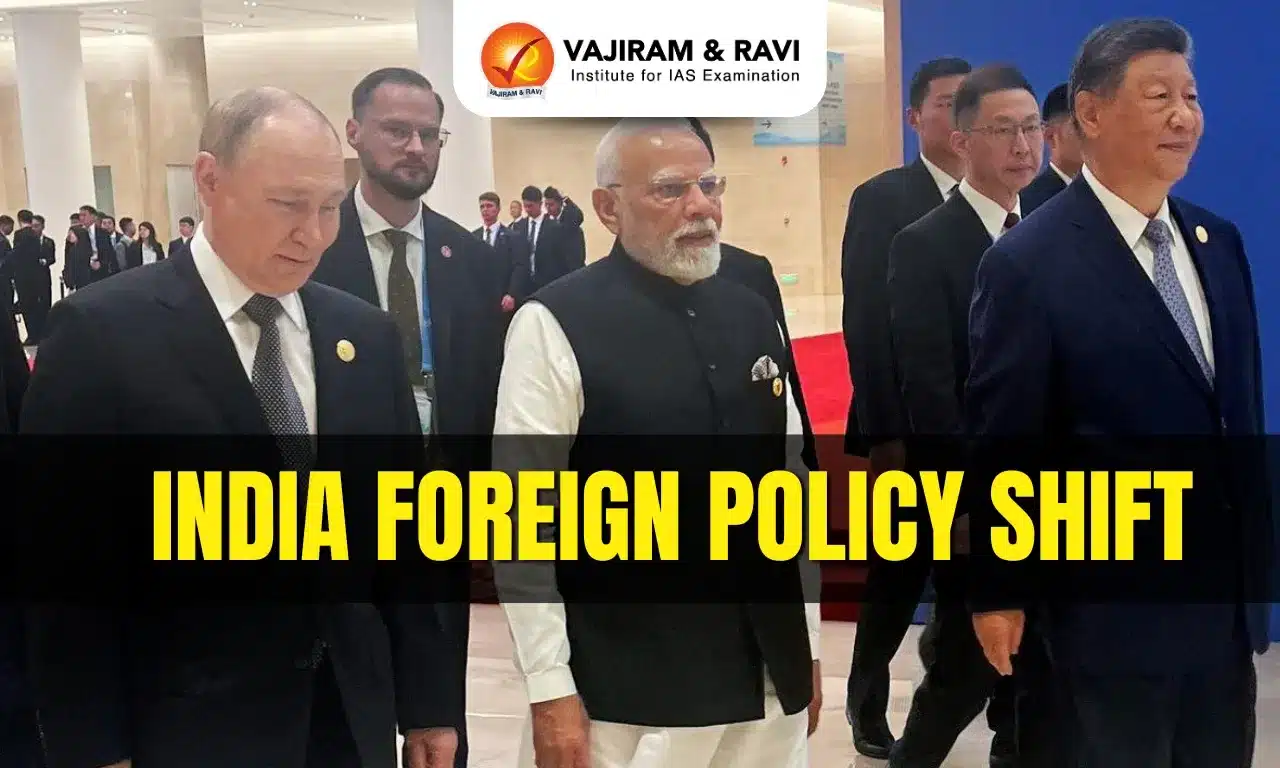
  • Modi began attended the SCO summit in Tianjin, where a photo with Chinese President Xi Jinping and Russian President Vladimir Putin drew global attention. 
  • It seemed to upset U.S. President Donald Trump, who made sarcastic remarks while the U.S. increased tariffs to 50%, imposed sanctions on India’s Russian oil imports, and urged the EU to do the same. 
  • Despite the tensions, Modi and Trump struck a conciliatory tone recently.

Power Play at the Tianjin SCO Summit

  • The 10-nation SCO summit in Tianjin showcased China’s growing influence, with leaders from Turkey, Nepal, Maldives, Azerbaijan, Armenia, Indonesia, and Malaysia in attendance. 
  • The focus then shifted to Beijing, where President Xi Jinping and President Vladimir Putin led a grand military parade marking 80 years since World War II’s end, joined by North Korea’s Kim Jong Un and others. 
  • The summit’s declarations criticized “coercive, unilateral” economic measures, targeting U.S. tariffs and European sanctions.
  • China promoted a “Global Governance Initiative,” while PM Modi called for “civilisational dialogue” among SCO members. 

Modi–Xi Bilateral: Steps Toward Normalisation

  • PM Modi’s first China visit since 2018, and first direct meeting with President Xi since the 2020 Galwan clashes, marked a cautious thaw in ties. 
  • Xi called India and China “partners, not rivals,” while India softened its earlier stance of linking broader ties strictly to border normalisation. 
  • Both sides agreed that Special Representatives — Chinese Foreign Minister Wang Yi and India’s NSA Ajit Doval — would continue talks on the boundary issue. 
  • Besides revival of flights, visa facilitation and the Kailash Manasarovar Yatra, they agreed to resolve the trade issues between them.

U.S. Reaction to India’s SCO Engagements

  • In Washington, images of the Tianjin “troika” with Modi, Xi, and Putin — alongside other leaders from Russia, China, North Korea, Iran, and Pakistan — were viewed as India drifting away from the West
  • Former U.S. President Donald Trump posted that America had “lost India and Russia to deepest, darkest China,” while Trade Adviser Peter Navarro criticized India for aligning with Russia and China. 
  • Some even dubbed the Ukraine conflict “Modi’s war,” a claim India’s MEA rejected. 
  • Despite tensions over tariffs, visas, and trade, Trump later softened his stance, calling India–U.S. ties a “special relationship” and praising his friendship with Modi, who in turn welcomed Trump’s positive remarks.

The Road Ahead for India’s Foreign Policy

  • Despite perceptions of India swinging between East and West, its approach continues to reflect its long-standing policy of strategic autonomy and balance
  • PM Modi’s China visit for the SCO, following the Xi-Modi meeting in Kazan in 2024, was aimed at normalising ties after years of tension, though the Modi-Xi-Putin interaction carried limited weight without a revival of formal RIC talks. 
  • India–U.S. ties remain strained over tariffs, Russian oil imports, and market access, but military cooperation and official exchanges continue. 
  • The upcoming UNGA visit by External Affairs Minister Jaishankar and discussions on the Quad summit, with Trump expected in India later this year, will be key in shaping the trajectory of India–U.S. relations.

Source: TH

India Foreign Policy Shift FAQs

Q1: What was significant about Modi’s participation in the SCO summit?

Ans: At Tianjin, Modi engaged with Xi and Putin, supporting “civilisational dialogue,” while SCO declarations criticized unilateral measures, signaling India’s balancing role.

Q2: What progress came from the Modi–Xi bilateral meeting?

Ans: It marked the first direct meeting since Galwan 2020. Both agreed to border talks, revive flights, facilitate visas, and address trade issues.

Q3: How did the U.S. react to India’s SCO participation?

Ans: Washington saw India aligning with China and Russia. Trump called it “losing India,” though he later praised India–U.S. ties as “special.”

Q4: What challenges define current India–U.S. relations?

Ans: Key tensions involve U.S. tariffs, sanctions on Russian oil imports, and demands for India to open agricultural and dairy sectors to American trade.

Q5: What lies ahead for India’s foreign policy?

Ans: India continues its policy of strategic autonomy. Talks at the UNGA, Quad summit planning, and Trump’s expected India visit will shape future ties.

Spending on Children’s Education in India: Gender Gaps and State Variations

Gender Gap in Education Expenditure India

Gender Gap in Education Expenditure India Latest News

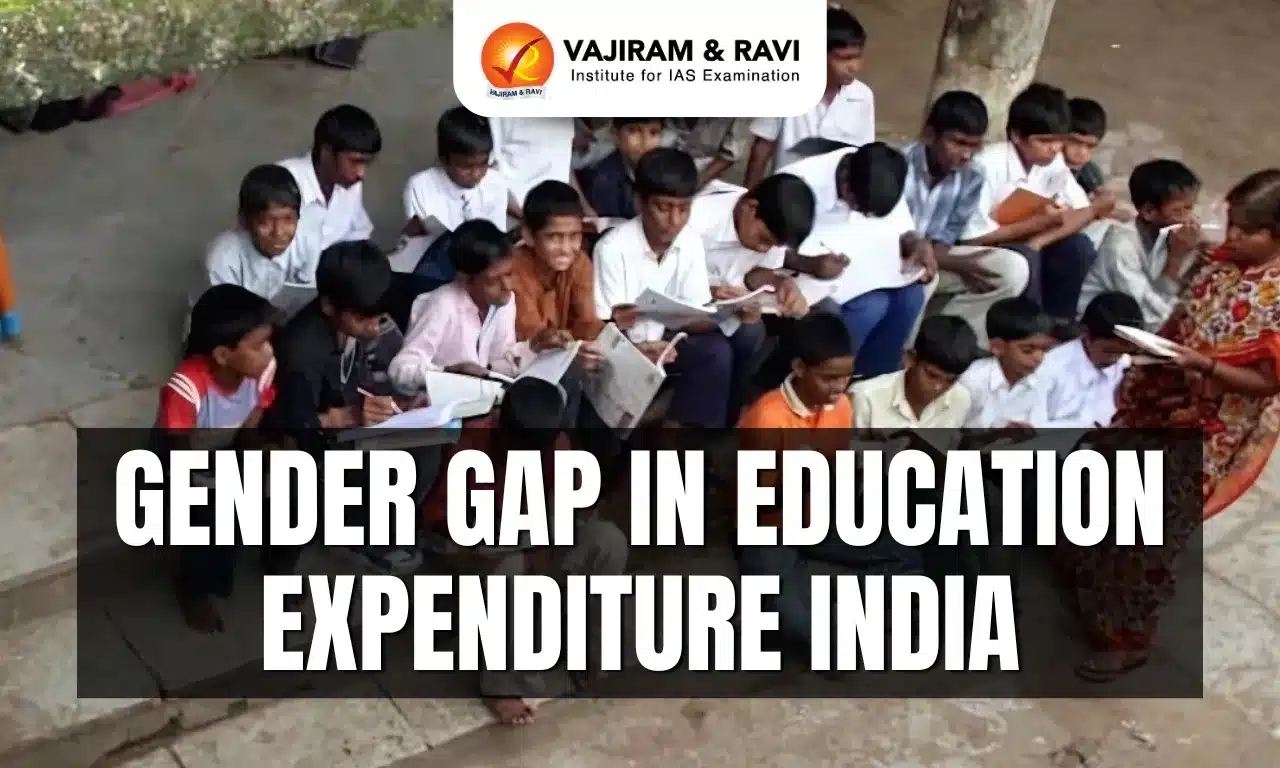
  • Despite a recent drop in the World Economic Forum’s gender gap rankings, partly due to the education category, India has increased girls’ school enrolment, with girls now forming 48% of the student population and slightly higher participation in higher education than men. 
  • However, National Sample Survey data reveal a persisting gender gap: families spend significantly less on daughters’ education compared to sons, highlighting unequal investment despite improved enrolment.

Gender Gaps in Education Expenditure in India

  • The Comprehensive Modular Survey on Education (NSS 80th round, April–June) reveals consistent gender disparities in spending on children’s education across India. 
  • The survey shows that families spend less on girls than boys at every stage of schooling, from pre-primary to higher secondary, in both rural and urban areas. 
  • In rural India, households spend about ₹1,373 (18%) more on boys, while in urban India, girls receive ₹2,791 less on average. 
  • By higher secondary school, urban families spend nearly 30% more on boys’ education. 
  • Considering course fees alone, the gap widens further, with boys receiving 21.5% more spending nationwide. 
  • Enrollment patterns reflect this bias: 58.4% of girls study in government schools compared to 34% of boys in private unaided schools, highlighting unequal access to costlier private education. 
  • The disparity extends to tuition classes as well, with 22% more spent on boys’ tuition at the higher secondary level.

State-Level Gaps in School Enrolment

  • Gender disparities in school enrolment vary widely across India. 
  • In Delhi, 65% of girls attend government schools compared to 54% of boys, while 38.8% of boys attend private schools against 26.6% of girls. 
  • Similar gaps of over 10 percentage points are seen in Madhya Pradesh, Rajasthan, and Punjab
  • In Gujarat, the divide is sharper in urban areas but narrower in rural regions. 
  • In contrast, Tamil Nadu and Kerala show near-equal ratios for boys and girls across government and private schools, while several northeastern States send more girls to private schools than boys.

Differences in Education Expenditure

  • Spending patterns also differ by State, especially at higher classes. 
  • In Telangana, Tamil Nadu, and West Bengal, families spend far more on boys at the higher secondary level, despite spending more on girls at the secondary level. 
  • For instance, in Tamil Nadu, average secondary-level spending is ₹23,796 for girls and ₹22,593 for boys, but at the higher secondary level, it jumps to ₹35,973 for boys versus just ₹19,412 for girls. 
  • Dropouts and subsidies for girls partly explain this reversal.

States Spending More on Girls

  • Some States show the opposite trend. 
  • In Andhra Pradesh, Himachal Pradesh, and Kerala, families spend more on girls in higher secondary education, particularly in urban areas where higher transport costs are linked to parental concerns about girls’ safety.

Private Tuition Expenditure Gaps

  • Private coaching costs reveal further inequalities. 
  • In Himachal Pradesh, families spend ₹9,813 per boy in higher secondary tuition, compared to just ₹1,550 per girl. 
  • Significant tuition-related gender gaps are also seen in Bihar, Jharkhand, Rajasthan, and Tamil Nadu, underscoring how education spending priorities differ across regions.

Reasons Behind Gender Gaps in Education Expenditure

  • Societal Preferences and Gender Bias
    • Deep-rooted cultural norms often prioritize sons’ education over daughters, as boys are seen as future breadwinners.
    • Daughters are frequently expected to marry early, reducing perceived returns on investing heavily in their education.
  • Type of Schools Chosen
    • Families disproportionately send boys to private unaided schools, which charge higher fees, while girls are more likely to attend government schools.
    • This directly reduces average per-student expenditure on girls.
  • Dropouts Among Girls
    • Higher dropout rates among girls, especially after secondary school, mean families spend less on their higher secondary education.
    • Safety concerns, early marriage, and household responsibilities are key drivers of dropout.
  • Access to Private Tuitions
    • Although boys and girls enroll in tuition classes at similar rates, families spend significantly more on boys’ coaching, especially at higher classes.
    • This reflects a belief that competitive exams and higher education are more important for boys’ futures.
  • Economic Considerations and Subsidies
    • Government schemes often subsidize girls’ fees, uniforms, and transport, lowering the reported expenditure on them.

Source: TH

Gender Gap in Education Expenditure India FAQs

Q1: What does the NSS survey reveal about education expenditure in India?

Ans: The NSS 80th round shows families spend consistently less on girls’ education than boys at all schooling levels, in both rural and urban areas.

Q2: How wide is the rural-urban gap in education spending on girls?

Ans: In rural areas, families spend ₹1,373 more on boys, while in urban India, the per-student expenditure on girls is ₹2,791 less than boys.

Q3: Which states show the largest enrolment gender gaps?

Ans: Delhi, Madhya Pradesh, Rajasthan, and Punjab display enrolment gaps of over 10 percentage points between boys and girls in private vs government schools.

Q4: How does education spending vary by class level?

Ans: Spending often favors boys at higher secondary levels. In Tamil Nadu, for example, boys receive ₹35,973 against ₹19,412 for girls at this stage.

Q5: What explains persistent gender gaps in education expenditure?

Ans: Cultural norms, higher dropout rates among girls, school type, unequal tuition spending, and government subsidies collectively drive unequal investment in daughters’ education.

GST Rate Cuts 2025: Impact on Economy and Revenue

GST Rate Cuts

GST Rate Cuts Latest News

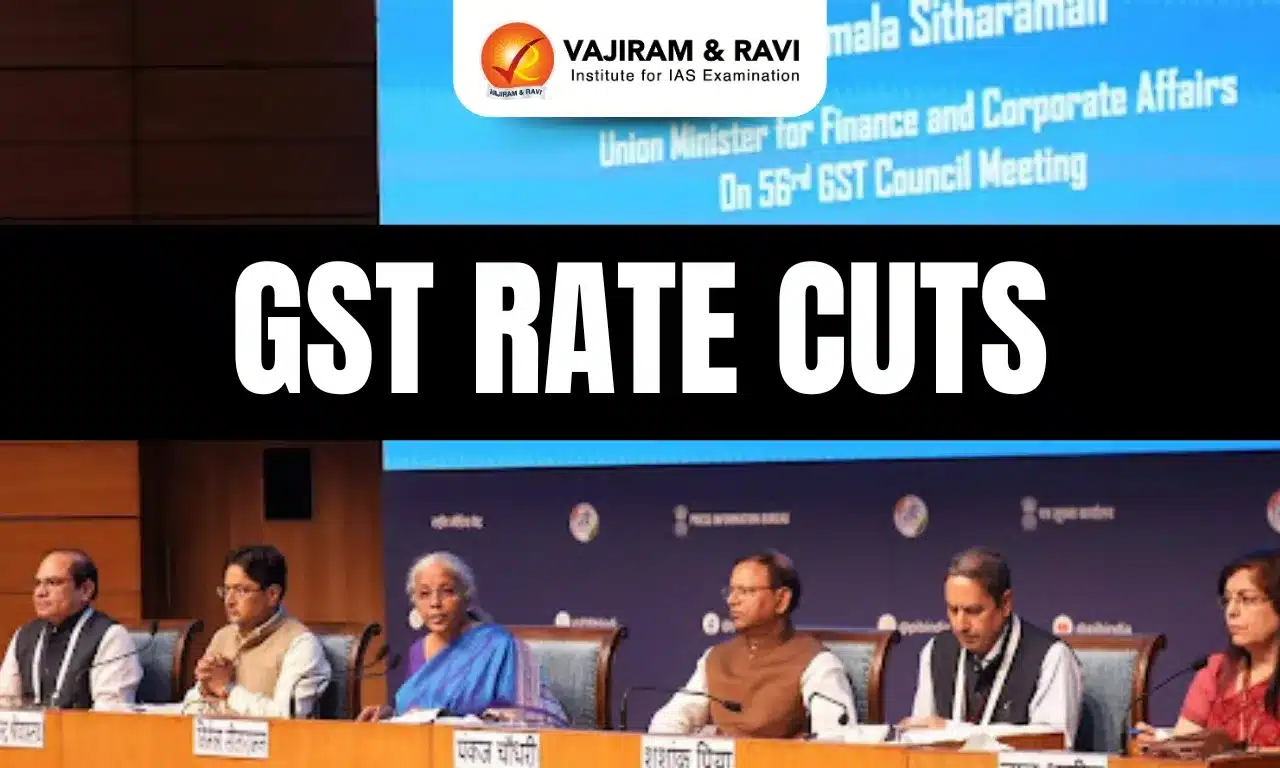
  • The GST Council has implemented major GST rate cuts in 2025, reducing slabs and taxes on over 90% of items to boost consumption and simplify India’s indirect tax system.

Introduction

  • The Government of India has undertaken one of the most significant overhauls of the Goods and Services Tax (GST) regime since its introduction in 2017. 
  • In September 2025, the GST Council announced major rate rationalisation, reducing the number of slabs and cutting taxes on a wide range of items. 
  • This reform, projected as a "next-generation" step, is expected to spur demand, ease compliance, and stimulate growth at a time when India faces external shocks such as steep U.S. tariffs on Indian exports. 
  • However, it also raises questions on revenue sustainability and uneven sectoral impacts.

GST Rationalisation: A Long-Pending Reform

  • The idea of simplifying GST has been under discussion for years. Initially, GST featured multiple rates: 0%, 5%, 12%, 18%, and 28%, along with compensation cess. 
  • Critics argued that this complicated structure undermined the “one nation, one tax” principle. 
  • In 2021, a Group of Ministers (GoM) was formed to suggest rationalisation, but progress was slow until the Union government revived the proposal in 2025.
  • The reforms introduced now reduce the slabs to 0%, 5%, 18%, and 40%, with the compensation cess retained only temporarily for tobacco products. 
  • Over 91% of items that underwent rate changes witnessed cuts, signalling a clear pro-consumer approach.

Key Changes Announced

  • Wider Tax Reductions: Of 453 items reviewed, 413 saw rate cuts, particularly shifting goods from the 12% to the 5% slab.
  • Luxury Items: While 17 goods moved from 28% to 40%, the effective tax incidence on items like luxury cars fell, since the cess was subsumed.
  • Healthcare and Renewable Energy: Rates on medical products and renewable energy components dropped from 12% to 5%, benefiting patients and clean energy expansion.
  • Construction Materials: Cement moved from 28% to 18%, providing relief to the real estate sector.
  • Automobiles: Cars and non-luxury two-wheelers moved from 28% to 18%, boosting the auto sector.

Need for the Reforms

  • Two factors added urgency to these changes:
  • End of Compensation Cess: With cess repayment to States nearing completion, the government sought a new rate structure to prevent “sin goods” like tobacco from becoming artificially cheap.
  • U.S. Tariffs Impact: With 50% tariffs imposed by the U.S. on Indian imports, India anticipated stress on exports and private investment. By rationalising GST, the government aimed to boost domestic consumption to offset external shocks.

Beneficiary Sectors

  • Healthcare: Cheaper medical devices and equipment promise direct consumer benefits.
  • Renewable Energy: Lower tax on solar, wind, and related equipment supports India’s 2030 clean energy targets.
  • Real Estate and Construction: Lower GST on cement and slabs reduces costs, likely stimulating housing demand.
  • Consumer Goods and Appliances: Reduced costs could accelerate sales during the festive season.
  • Automobile Sector: Car manufacturers expect a stronger demand revival.

Concerns and Criticisms

  • Despite widespread approval, some sectors expressed concerns:
    • Textiles: Although raw material rates fell, garments priced above Rs. 2,500 attract 18% GST, burdening premium segments.
    • Insurance: While life and health insurance gained exemptions, the removal of input tax credits could raise insurer costs.
    • Aviation: Airlines opposed higher GST on non-economy seats, citing cost escalation.
    • MSMEs: Labour-intensive sectors fear rising costs due to increased GST on labour charges from 12% to 18%.
    • Oil Industry: The inverted duty structure in edible oils remains unresolved.

Revenue Implications

  • The Centre estimated a revenue shortfall of Rs. 48,000 crore in 2023-24 due to GST cuts, though State Bank of India research suggested a much lower impact of around Rs. 3,700 crore. 
  • Opposition-ruled States demanded a new cess on items in the 40% slab to compensate for losses, but this was rejected by the Council. The ultimate impact will depend on how higher consumption offsets rate cuts.

Future Outlook

  • The reforms position India towards a simpler GST architecture, potentially improving compliance and reducing litigation. 
  • While short-term fiscal challenges exist, long-term gains could emerge through stronger demand, private investment, and the formalisation of the economy. 
  • The GST rationalisation also complements India’s broader economic reforms agenda and may help cushion the economy against global uncertainties.

Source: TH

GST Rate Cuts FAQs

Q1: What are the new GST slabs after rationalisation?

Ans: The new slabs are 0%, 5%, 18%, and 40%, with the compensation cess retained only on tobacco until year-end.

Q2: Which sectors benefit the most from GST cuts?

Ans: Healthcare, renewable energy, real estate, automobiles, and consumer appliances are the biggest beneficiaries.

Q3: Why were the GST rate cuts implemented now?

Ans: The reforms were timed with the end of compensation cess and to cushion the impact of U.S. tariffs on Indian exports.

Q4: What is the estimated revenue loss from GST cuts?

Ans: The Centre estimates ₹48,000 crore, while SBI research pegs it at around ₹3,700 crore.

Q5: Which sectors have expressed concerns about the GST changes?

Ans: Textiles, insurance, aviation, edible oil producers, and MSMEs have raised concerns over higher costs or unresolved anomalies.

Enquire Now