

India’s Generic Medicines: Ensuring Affordable Healthcare Worldwide

Indian Generic Medicines

Indian Generic Medicines Latest News

  • The Indian pharmaceutical sector, heavily reliant on the U.S. — which accounts for over 31% of its exports and sources nearly half of its generics from India — faces serious concerns over potential U.S. sector-specific duties. 
  • With the global generic market projected to reach $614 billion by 2030, ongoing trade negotiations with Washington are crucial for the industry’s future. 
  • Policymakers worry that U.S. tariff threats could undermine India’s role as a key global supplier of affordable medicines, raising broader questions of public interest and long-term viability.

India’s Contribution to Affordable Healthcare

  • India supplies about 20% of all generic drugs and is known as the “pharmacy of the world.” 
  • It produces affordable versions of brand name medicines, which are widely prescribed around the world.
  • Indian generics already dominate U.S. prescriptions, accounting for over 90% in areas like diabetes, anxiety, depression, and cancer. 
  • They saved the U.S. healthcare system $219 billion in 2022 alone, and nearly $1.3 trillion between 2013 and 2022 — underscoring India’s indispensable role in global healthcare affordability.

U.S. Tariff Threats and Indian Pharma’s Stakes

  • The U.S., India’s largest pharmaceutical export market, sources nearly half of its generics from India, making tariff threats a major concern for policymakers. 
  • With the global generic market projected to reach $614 billion by 2030, the outcome of U.S.–India trade talks is critical for the industry’s future and global access to affordable medicines.
  • Commentators suggest India should use its pharmaceutical strength in bilateral trade negotiations, positioning Indian generics as a global public good
    • To do so, India must recalibrate its trade and investment strategy while mobilising public opinion in the U.S. and beyond.

Key U.S. Concerns in Negotiations

  • The Trump administration’s main concerns are high drug prices in the U.S. and India’s intellectual property (IP) regime.
  • It is pushing international reference pricing (IRP) to cut drug prices, while also seeking stronger IPR protections that extend monopolies for Big Pharma. 
  • This would raise drug costs and delay generic entry into global markets
  • The U.S. also demands extended patent exclusivity and stricter data protection beyond TRIPS requirements, using FTAs as leverage. 
  • So far, India has resisted such norms and must continue safeguarding TRIPS flexibilities, including compulsory licensing provisions.
  • To safeguard exports, India is prepared to make concessions, including supplying generics at 20–25% of branded prices for three years after patent expiry, followed by further 10–15% reductions over seven years.

Need for a Strategic Shift in Trade Negotiations

  • India must move beyond a transactional approach in its Bilateral Trade Agreement (BTA) talks with the U.S. 
  • The Indian Pharmaceutical Alliance (IPA) had proposed reducing import tariffs on U.S. pharma products to zero, but this fell flat as U.S. concerns lie elsewhere. 
  • Despite earlier exemptions, President Trump imposed levies of 26% plus penalties of 25% on Indian pharma imports, signalling that financial incentives alone cannot resolve issues.

India’s Negotiating Capital

  • India has long upheld its patent laws against foreign pressure and now holds negotiating capital to make a strategic move. 
  • By highlighting the global public good created by Indian generics, India can strengthen its bargaining power. 
  • Offering joint ventures in the pharma sector not just to the Global South but also to the U.S. and EU could recalibrate the trade dynamic in India’s favour.

Diversification of Markets

  • India must diversify pharma trade and investment beyond the U.S., tapping into growing markets in West Asia, Central Asia, Africa, South America, China, Russia, and ASEAN. 
  • Overseas investments with social impact can build stronger global alliances and reduce dependence on U.S. markets.

Focus on Technology Transfer and R&D

  • India should link price reductions on generics supplied to the U.S. with demands for technology transfer, voluntary licensing, and collaborative R&D. 
  • The India–U.S. TRUST (Transforming the Relationship Utilizing Strategic Technology) initiative should be directed toward biotechnology, pharma manufacturing, and innovation partnerships.

Conclusion: Championing Public Health as a Global Good

  • India must resist unreasonable U.S. demands while promoting generics as a global public good. 
  • By pursuing joint ventures worldwide, especially with the Global South, India can expand its role as a key supplier of affordable essential medicines. 
  • This strategic move would protect public health, secure domestic industry interests, and position Indian pharma as a global leader.

Source: TH | IG

Indian Generic Medicines FAQs

Q1: Why are Indian generics important globally?

Ans: India supplies 20% of generics worldwide, dominating U.S. prescriptions in diabetes, cancer, and other diseases, saving billions in healthcare costs annually.

Q2: What threat does the U.S. pose to Indian pharma?

Ans: The U.S., India’s largest export market, has threatened high tariffs and tougher IP rules, risking India’s role as a global supplier of affordable medicines.

Q3: How is India preparing to safeguard its pharma exports?

Ans: India is ready to offer generics at 20–25% of branded drug prices for three years post-patent expiry, with further 10–15% reductions thereafter.

Q4: What strategic shift is needed in India–U.S. trade talks?

Ans: India must move beyond financial concessions, highlight generics as a public good, push for joint ventures, and diversify markets beyond the U.S.

Q5: How can India strengthen its pharma sector globally?

Ans: By linking drug price cuts with technology transfer, boosting R&D, and forging partnerships with the U.S., EU, and Global South, India can enhance its global role.

The Declining Investor Sentiment Towards India: Growth vs Capital Outflows

Investors Sentiment

Investors Sentiment Latest News

  • India has been the world’s fastest-growing major economy, averaging 8.2% GDP growth between 2021 and 2024 — higher than Vietnam, China, and other major economies. The momentum continued in 2025 with growth of 7.4% and 7.8% in the first two quarters. 
  • Yet, this impressive performance has not translated into steady foreign portfolio investment (FPI) inflows
  • Except for 2023-24, when FPIs invested $25.3 billion, all other recent years saw net outflows — $18.5 billion in 2021-22, $5.1 billion in 2022-23, $14.6 billion in 2024-25, and $2.9 billion in 2025-26 (till September). 
  • This disconnect highlights persistent investor caution despite robust growth.

Role of Foreign capital in India's growth

  • Foreign capital, which includes Foreign Direct Investment (FDI) and Foreign Portfolio Investment (FPI), has played a significant role in India's economic growth, especially since the economic liberalization of 1991. 
  • It provides financial resources that the domestic economy may lack, acting as a crucial driver of development.
  • Foreign capital supplements domestic savings, finances investment needs, and bridges the gap in capital-scarce sectors. 
  • Foreign Direct Investment (FDI) has modernised industries, brought in advanced technologies, boosted infrastructure, and created employment opportunities. It has also integrated India into global supply chains and enhanced competitiveness. 
  • FPI has deepened capital markets and provided liquidity, though with volatility risks. 
  • Beyond finance, foreign capital strengthens innovation, supports services like IT and e-commerce, and improves balance of payments by financing current account deficits. 

The Foreign Capital Paradox in India

  • Despite India’s robust GDP growth of 7.8% in early 2025, overseas capital inflows have remained weak. 
  • Net capital flows fell to $18.3 billion in 2024-25, the lowest since the global financial crisis of 2008-09, and inflows in April-June 2025 were over 40% lower than the same period last year
    • Net capital flows into India includes foreign investment, commercial borrowings, external assistance and non-resident Indian deposits.
  • Balance of payments (BoP) data show net foreign investment plunging from a peak of $80.1 billion in 2020-21 to just $4.5 billion in 2024-25, with minimal FDI ($959 million) and modest FPI inflows ($3.6 billion, largely in debt). 
    • BoP records all financial transactions between a country and the rest of the world over a period. 
    • It tracks money inflows and outflows from trade in goods and services, investments, and loans involving individuals, companies, and governments.
  • Equity markets, however, saw heavy sell-offs. 
  • Meanwhile, external commercial borrowings rose to $15.8 billion in 2024-25, reversing the outflows of previous years. 
  • The disconnect between high growth and low foreign capital underscores investor caution about India’s economic prospects.

Why Capital Flows to India Have Declined

  • Impact of Past Investments
    • Much of the FDI that entered India during the last decade, peaking in 2020-21, came from private equity (PE) and venture capital (VC) in sectors like retail, e-commerce, financial services, green energy, healthcare, and real estate. 
    • These investors are now exiting to monetise mature positions, leading to reduced net inflows.
  • Investor Exits and Monetisation
    • According to industry experts, PE/VC exits were valued at $24 billion in 2022, $29 billion in 2023, and $33 billion in 2024. 
    • Nearly 59% of exits in 2024 were through public markets, supported by India’s strong stock valuations.
  • Foreign Portfolio Investor (FPI) Behaviour
    • FPIs too have been selling off, but their exits have been offset by bullish domestic investors who sustain attractive market valuations, enabling profitable exits for both FPIs and PE/VC firms.

Balance of Payments Challenges for India

  • India’s merchandise trade deficit surged to $287.2 billion in 2024-25, more than triple the 2007-08 level. 
  • These deficits have so far been offset by strong surpluses in services exports and remittances, keeping current account deficits under $50 billion in most years and financed through steady capital inflows that boosted forex reserves. 
  • However, risks are rising. U.S. President Trump’s 50% tariffs threaten Indian exports to a $86.5 billion market, while capital inflows remain uncertain, driven more by investor confidence in corporate earnings and valuations than headline GDP growth. 
  • Recent capital outflows and tariff concerns pushed the rupee to a record low of 88.37 per dollar. 
  • In response, the current government has cut GST rates to stimulate consumption and earnings and announced a task force for next-generation reforms to improve ease of doing business.

Source: IE

Investors Sentiment FAQs

Q1: How has foreign capital shaped India’s growth?

Ans: Since 1991, FDI and FPI have modernised industries, created jobs, financed deficits, deepened markets, and integrated India into global supply chains.

Q2: What is the foreign capital paradox in India?

Ans: Despite 7.8% GDP growth in 2025, net capital inflows dropped to $18.3 billion, the lowest since 2008-09, highlighting investor caution.

Q3: Why have capital flows to India declined recently?

Ans: Past PE/VC investments are being monetised, leading to exits worth $24–33 billion annually. FPIs too sold off, though supported by strong domestic investors.

Q4: What BoP challenges does India face?

Ans: Merchandise trade deficits tripled to $287.2 billion in 2024-25. Though offset by services and remittances, tariffs and weak inflows pressure forex and the rupee.

Q5: How is India responding to declining investor sentiment?

Ans: The government is cutting GST rates, pushing reforms, and forming a task force for next-generation changes to boost ease of doing business and corporate earnings.

Indo-China Border Dispute: Challenges in Defining the LAC

Indo-China Border

Indo-China Border Latest News

  • The India-China border dispute, after decades of talks and agreements since 1993, has failed to define the Line of Actual Control, keeping tensions unresolved.

Introduction

  • The India-China border dispute remains one of the most complex territorial issues in Asia, shaped by history, geopolitics, and national security concerns. 
  • Despite decades of dialogue, agreements, and attempts at confidence-building, the Line of Actual Control (LAC) remains undefined, leading to recurring face-offs and clashes. 
  • This article traces the evolution of negotiations since the late 1980s and highlights why the inability to formalise the LAC has kept the dispute alive.

Early Efforts and Diplomatic Engagements

  • India-China border negotiations gained momentum after Prime Minister Rajiv Gandhi’s 1988 visit to Beijing, which marked a turning point in bilateral relations. 
  • Subsequent political changes in India initially slowed progress, but by the early 1990s, both nations recognised the necessity of peaceful engagement.
  • Six rounds of the Joint Working Group (JWG) meetings between 1988 and 1993 laid the groundwork for military-to-military engagement and the resumption of border trade. 
  • India’s Defence Minister Sharad Pawar’s 1992 visit to Beijing further expanded cooperation in academic, military, and scientific exchanges.

The 1993 Border Peace and Tranquillity Agreement (BPTA)

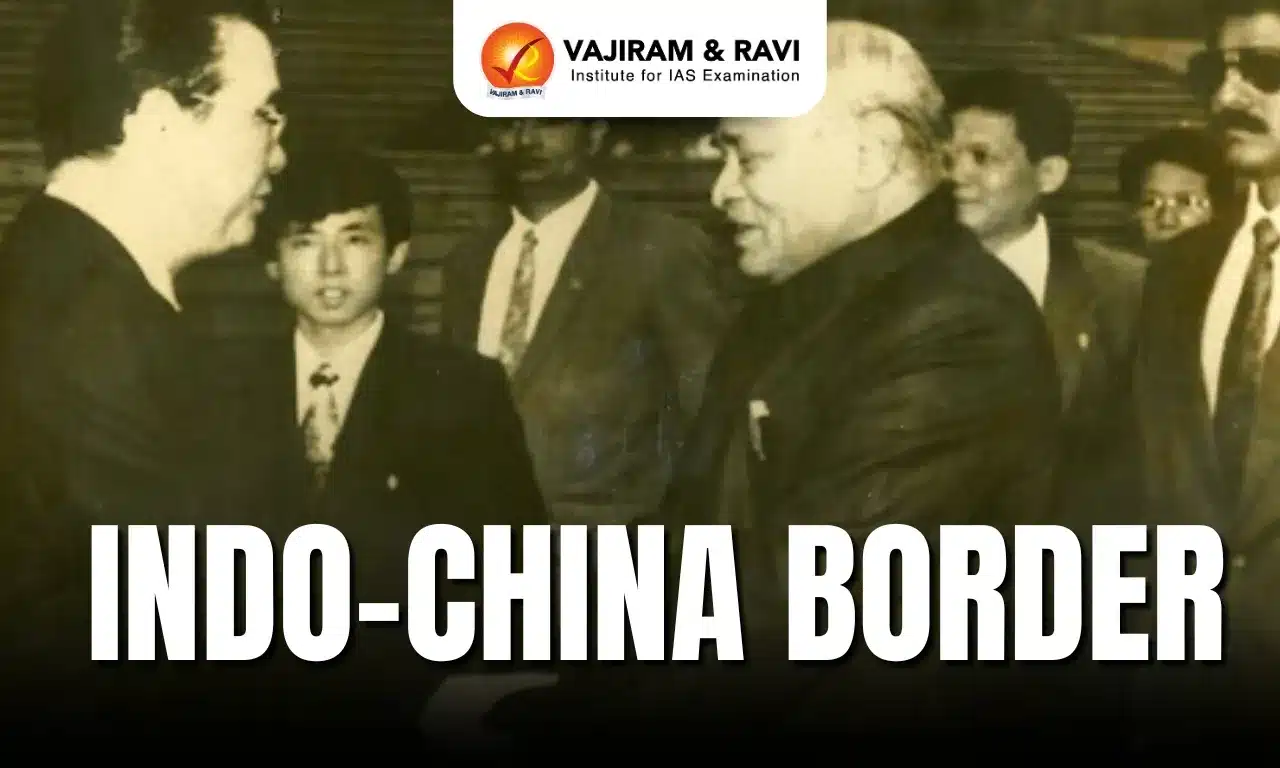
  • In September 1993, Prime Minister P.V. Narasimha Rao’s visit to Beijing resulted in the signing of the Border Peace and Tranquillity Agreement (BPTA). 
  • This landmark nine-article agreement committed both countries to peaceful consultation and the non-use of force. It was the first document to explicitly refer to the LAC.
  • Key provisions included:
    • Both sides are to refrain from crossing the LAC and withdraw if cautioned.
    • Minimal troop deployment along the border.
    • Reduction of forces on the principle of “mutual and equal security.”
  • The agreement aimed to freeze the status quo and promote cooperation in other areas of bilateral relations.

Expansion Through the 1996 Agreement

  • The 1996 agreement, signed during Chinese President Jiang Zemin’s visit to India, expanded on the BPTA by introducing detailed military confidence-building measures (CBMs). It emphasised:
    • Limits on the deployment of heavy weaponry, missiles, and large-scale exercises near the LAC.
    • Restrictions on military exercises facing the other side.
    • Mutual agreement on ceilings for forces in sensitive sectors.
  • However, the agreement also acknowledged that successful implementation depended on a common understanding of the LAC’s alignment, something both sides failed to achieve.

Attempts at Clarification and Collapse of Map Exchange

  • Between 2000 and 2002, India and China exchanged maps of the central and western sectors. 
  • However, the process collapsed almost immediately, with both sides rejecting the maximalist claims presented. 
  • Disputes persisted over areas such as Depsang, Pangong Tso, Demchok, and Chumar. By 2005, the mapping exercise was abandoned altogether.
  • This failure institutionalised ambiguity around the LAC. Many of the same disputed areas later witnessed face-offs, including the 2020 Galwan Valley clash.

Structural Problem in Defining the LAC

  • The central issue is that neither India nor China is willing to concede ground in strategically sensitive areas. 
  • China’s infrastructure advantage, roads and logistics in Tibet, contrasts with India’s more difficult terrain in Ladakh and Arunachal Pradesh. This imbalance complicates negotiations.
  • Without a common definition of the LAC, both armies continue to patrol up to their perceived lines, increasing the likelihood of accidental confrontations turning into violent clashes.

Current Implications and Lessons

  • While the 1993 and 1996 agreements temporarily reduced tensions, their failure to resolve the core issue of defining the LAC has kept the border volatile. 
  • India and China have invested in mechanisms to prevent escalation, but the lack of political will to finalise the boundary has undermined peace-building efforts.
  • The recurring standoffs highlight the urgency of either clarifying the LAC or developing stronger mechanisms to prevent patrol confrontations from spiralling into conflict.

Source: TH

Indo-China Border FAQs

Q1: What was the 1993 Border Peace and Tranquillity Agreement (BPTA)?

Ans: The BPTA was the first formal agreement between India and China recognizing the LAC and committing to non-use of force.

Q2: Why did the 2002 map exchange between India and China fail?

Ans: Both sides presented maximalist positions, making it impossible to reach a common definition of the LAC.

Q3: What did the 1996 agreement add to the 1993 BPTA?

Ans: It expanded military CBMs, including limits on heavy weapons and restrictions on exercises near the LAC.

Q4: Which areas remain most disputed between India and China?

Ans: Key disputed areas include Depsang, Pangong Tso, Demchok, Chumar, and parts of Arunachal Pradesh.

Q5: Why has the India-China border dispute persisted?

Ans: The dispute continues due to the absence of a mutually accepted definition of the LAC and unwillingness to compromise on strategic areas.

Enquire Now

