MHA’s Twin Decisions: SoO Renewal and NH-02 Reopening in Manipur

Manipur SoO agreement

Manipur SoO Agreement Latest News

  • Ahead of PM Modi’s upcoming visit to Manipur, the Ministry of Home Affairs announced two important steps. 
  • First, it renewed the Suspension of Operations (SoO) agreement with Kuki militant groups under the Kuki National Organisation (KNO) and United People’s Front (UPF), with renegotiated terms. 
  • Second, it secured an agreement with the Kuki-Zo Council to reopen National Highway-02, a vital route for the movement of commuters and essential supplies. 
  • These measures are seen as crucial for easing tensions and restoring some normalcy in the state, which has been grappling with ethnic conflict since May 2023.

The SoO Agreement and Its Breakdown in Manipur

  • The Suspension of Operations (SoO) agreement, signed in 2008 as a tripartite ceasefire between the Centre, Manipur government, and Kuki insurgent groups under KNO and UPF, aimed to facilitate political dialogue. 
  • It was periodically renewed until March 2023, when the Biren Singh government withdrew from the pact with the Zomi Revolutionary Army (ZRA) and Kuki National Army (KNA), accusing them of fuelling unrest in Churachandpur after eviction drives. 
  • Following the ethnic violence between Kukis and Meiteis in May 2023, insurgent groups on both sides became active in the conflict, leading to the complete lapse of the SoO agreement in 2024.

Renegotiated Terms of the SoO Agreement

  • The renewed SoO agreement, according to the MHA, requires Kuki militant groups under KNO and UPF to uphold Manipur’s territorial integrity and pursue a negotiated political solution. 
  • Key provisions include relocating camps from sensitive fringe areas.
    • There are 14 Kuki militant camps in hills of Manipur; seven are at the periphery of the Kuki-dominated hills, near the Meitei-dominated valley. 
    • Meiteis have long called for these camps’ relocation, alleging that they are used to launch attacks on nearby Meitei villages.
  • It also includes consolidation of smaller camps into larger ones, and depositing weapons with CRPF or BSF to prevent misuse. 
  • Cadres will undergo strict physical verification, with identity cards issued and movements regulated through local police stations, while foreign nationals will be removed from lists. 
  • Remuneration will now be transferred directly to cadres’ bank accounts to ensure transparency. 
  • A Joint Monitoring Group will oversee enforcement, with violations potentially leading to a review of the pact.

Government Response to Kuki Demands

  • The Centre has addressed several key Kuki demands, including the removal of Biren Singh as Manipur’s Chief Minister, whom hill tribes accused of partisanship during the ethnic conflict. 
  • Following the imposition of President’s Rule in February, Kuki militant groups began engaging in talks with the government. 
  • Another major concern was the unchecked activity of Valley-based Meitei insurgent groups in Imphal
  • To address this, the government signed a peace pact with the United National Liberation Front (UNLF) in November 2023. 
  • Camps for UNLF cadres are now being set up, with ID cards being prepared, and the process is close to completion.

Mixed Reactions to the Renewed SoO Agreement

  • The renewal of the SoO agreement has drawn sharp responses from both Meitei and Kuki-Zo groups. 
  • A Meitei civil society organisation, condemned the deal, calling it undue legitimacy for “armed narco-terrorist groups” and objected to Manipur’s state government being a party while under President’s Rule
  • On the Kuki-Zo side, the inclusion of a clause affirming Manipur’s “territorial integrity” raised concerns, as their central demand has been for a separate administration. 
  • However, other Kuki groups argued that the agreement’s reference to a “negotiated political solution” leaves room to pursue their demand.

Controversy Over ‘Free Movement’ on NH-02

  • The conflict in Manipur has hardened inter-district boundaries, restricting safe movement between Kuki-Zo and Meitei-majority areas. 
  • While restoring free movement of people and goods has been a key government goal under President’s Rule, Kuki-Zo groups have resisted until their political demands are addressed. 
  • Recently, alongside the renewed SoO deal, the MHA announced that the Kuki-Zo Council (KZC) had agreed to open National Highway-02. 
  • However, Kuki-Zo groups quickly contested the claim, stating that essential goods were already moving and that the term “free movement” was vague. 
  • They stressed cooperation with security forces did not imply consent for unrestricted Meitei movement in Kuki areas. 
  • Moreover, no reciprocal commitment had been made by Meitei groups. Within hours, the KZC clarified its statement, saying it should not be read as endorsing unrestricted movement across buffer zones.

Source: IE | HT | TP

Manipur SoO Agreement FAQs

Q1: What is the SoO agreement in Manipur?

Ans: The Suspension of Operations (SoO) agreement, signed in 2008, is a tripartite ceasefire between the Centre, Manipur government, and Kuki insurgent groups to enable dialogue.

Q2: Why was the SoO agreement renewed now?

Ans: The Centre renegotiated the SoO to restore peace before PM Modi’s visit, including relocation of militant camps, weapon deposit, and strict cadre verification.

Q3: How did the government address Kuki concerns?

Ans: Key steps included removing CM Biren Singh, signing a peace pact with Meitei-based UNLF, and preparing camps and IDs for UNLF cadres.

Q4: What mixed reactions followed the SoO renewal?

Ans: Meitei groups condemned it as legitimising “narco-terrorists,” while some Kuki factions opposed the territorial integrity clause but welcomed room for political negotiation.

Q5: Why is NH-02 reopening significant?

Ans: Reopening NH-02 aims to restore free movement of people and goods across ethnic divides, though Kuki-Zo groups later contested the MHA’s claims of “free movement.”
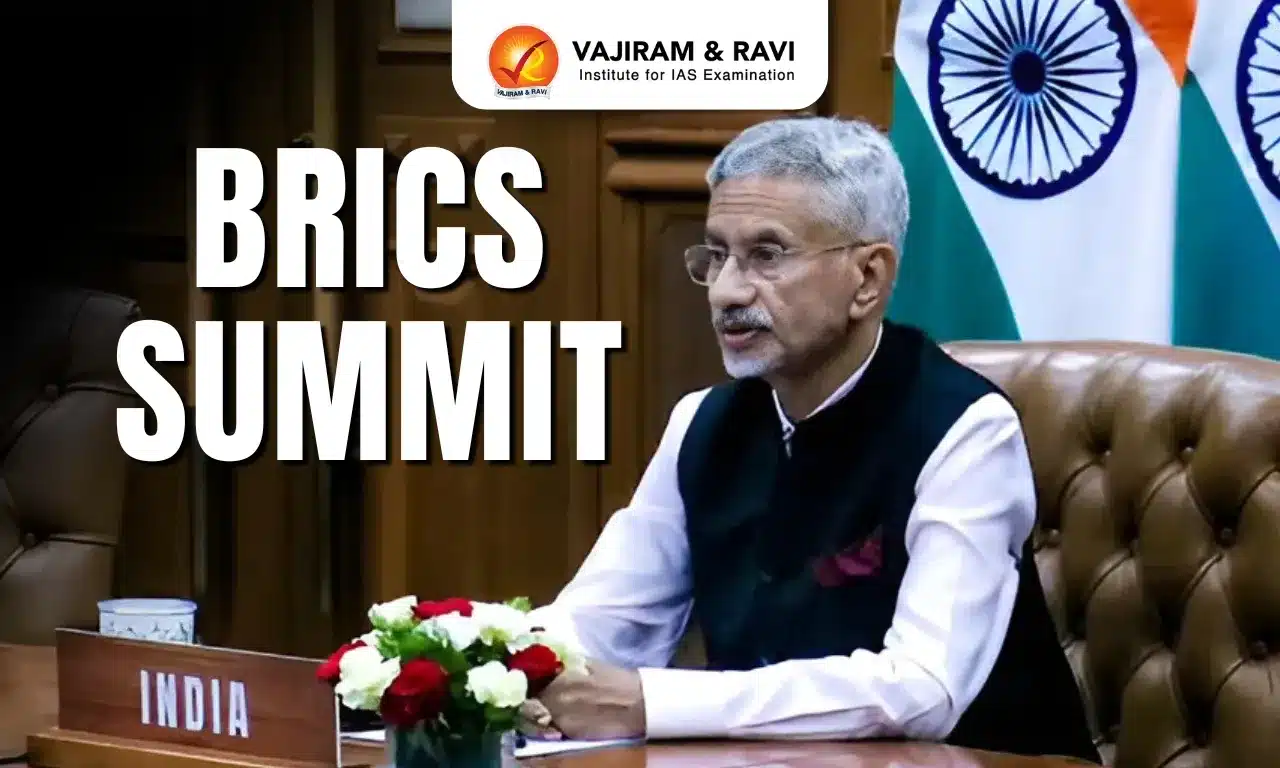
BRICS Summit 2025 – India Calls for Fair Economic Practices

BRICS Summit

BRICS Summit Latest News

  • India at the BRICS Summit 2025 called for fair and transparent economic practices, opposing the linkage of trade measures with non-trade issues amid rising US tariff disputes.

Introduction

  • The BRICS Summit 2025, convened virtually under the leadership of Brazil, has emerged as a key platform for discussions on global economic disruptions triggered by rising tariff wars and geopolitical tensions. 
  • Representing India, External Affairs Minister (EAM) S. Jaishankar underscored the urgent need for fair, transparent, and rules-based economic practices. 
  • He highlighted India’s concerns over linking trade measures with non-trade issues, a veiled reference to the United States’ recent tariff escalations.

Understanding BRICS

  • BRICS, an acronym for Brazil, Russia, India, China, and South Africa, is an influential intergovernmental grouping that represents nearly 42% of the world’s population and about a quarter of global GDP.
  • Historical Background
    • The concept of BRICS was first introduced in 2001 by economist Jim O’Neill to describe emerging economies shaping the global order. 
    • The first BRIC Summit was held in 2009 in Russia, and South Africa joined in 2010, transforming it into BRICS.
  • Objectives
    • Reform of global financial and political institutions to reflect emerging economies.
    • Enhanced trade, investment, and sustainable development among member states.
    • Cooperation on security, technology, and climate change.
    • Advocacy for a multipolar world order to counter Western dominance.
  • Achievements
    • Over the years, BRICS has launched initiatives like the New Development Bank (NDB), which finances infrastructure and sustainable projects, and the Contingent Reserve Arrangement (CRA) to stabilise economies during crises. 
    • It has also served as a forum for discussing counter-terrorism, energy security, digital innovation, and global governance reforms.
  • Challenges
    • Internal divisions - particularly between India and China due to border tensions.
    • Economic asymmetry - China’s overwhelming dominance compared to other members.
    • Geopolitical contradictions - diverging interests in Ukraine, West Asia, and trade policies.
    • Limited integration - trade among BRICS members is often constrained by deficits and protectionist measures.

Summary of the 2025 BRICS Summit

  • India’s Concerns on Tariff Wars
    • At the 2025 BRICS Summit, EAM S. Jaishankar raised concerns over the United States’ imposition of 50% tariffs on Indian and Brazilian exports, citing penalties for oil trade with Russia. 
    • He strongly objected to linking trade measures with non-trade matters, arguing that such practices destabilise the global economic order.
  • Call for Fair and Transparent Economic Practices
    • S. Jaishankar emphasised that the international trading system must remain open, fair, transparent, non-discriminatory, and rules-based
    • He stressed that increasing barriers and protectionism would not help developing economies, especially when global food, energy, and fertiliser security is already strained.
  • Need for Resilient Supply Chains
    • Highlighting vulnerabilities exposed by the COVID-19 pandemic, geopolitical conflicts, and climate disruptions, S. Jaishankar called for resilient, redundant, and diversified supply chains
    • He advocated democratizing manufacturing across geographies to prevent overdependence on specific regions.
  • Global South and Multilateralism
    • The External Affairs Minister noted that the Global South has been disproportionately affected by conflicts in Ukraine and West Asia, experiencing shortages in food, fuel, and fertilisers. 
    • He pressed for a diplomatic resolution to conflicts and reformed multilateralism, particularly within the United Nations system.
  • India’s Trade Deficits within BRICS
    • S. Jaishankar pointed out that India faces some of its largest trade deficits with BRICS partners, especially China. 
    • He urged member states to review trade flows and adopt more cooperative mechanisms that can reduce imbalances and boost intra-BRICS trade.

Source : TH | IE

BRICS Summit FAQs

Q1: What is BRICS?

Ans: BRICS is a grouping of Brazil, Russia, India, China, and South Africa focused on economic cooperation, global governance reform, and multipolarity.

Q2: What were India’s key concerns at the BRICS 2025 Summit?

Ans: India objected to linking trade measures with non-trade issues and called for fair, transparent economic practices.

Q3: Why did the US tariffs figure prominently in the summit?

Ans: The US imposed 50% tariffs on Indian and Brazilian exports, prompting BRICS to discuss trade disruptions and economic fairness.

Q4: What did Jaishankar say about supply chains?

Ans: He stressed the need for resilient, reliable, and diversified supply chains to withstand global disruptions.

Q5: How does India view its trade relations within BRICS?

Ans: India has significant trade deficits with BRICS partners, especially China, and urged for balanced trade flows among members.

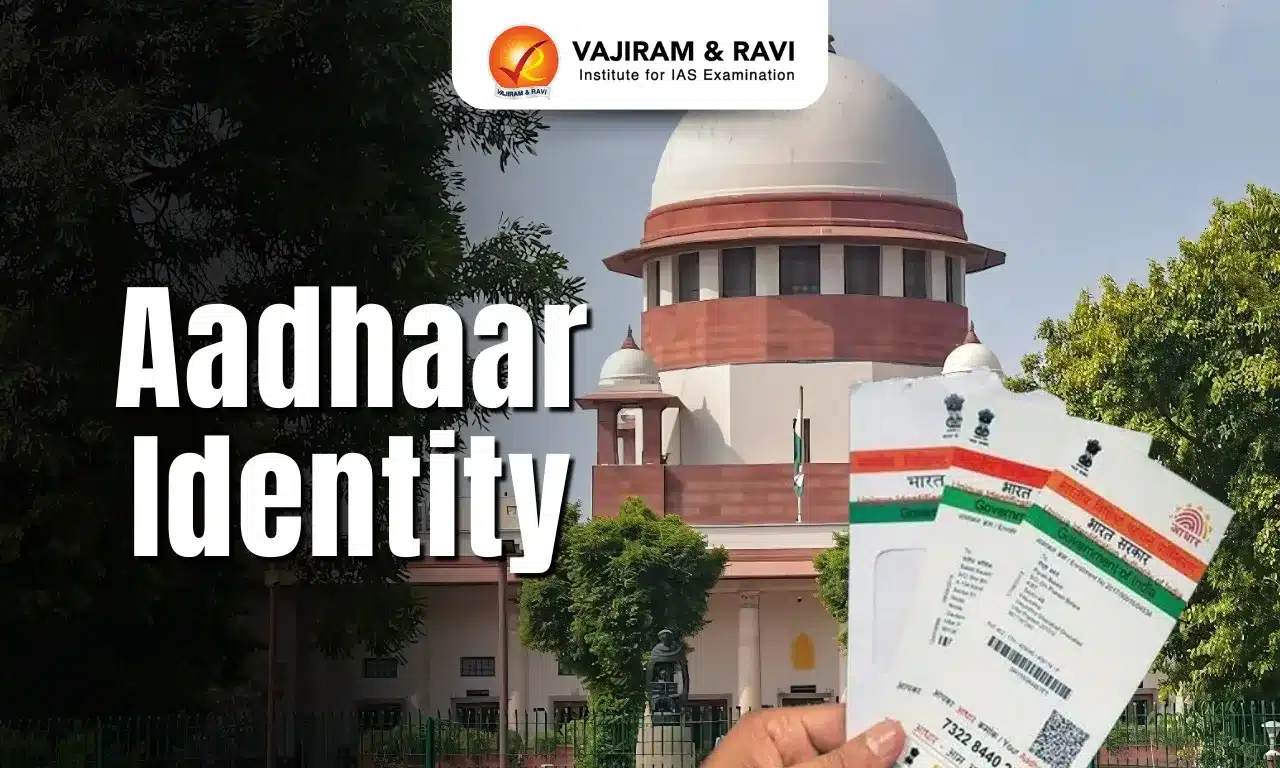
SC: Aadhaar Valid for Identity, Not Citizenship

Aadhaar identity

Aadhaar Identity Latest News

  • The Supreme Court directed the Election Commission to include Aadhaar as the 12th valid identity document for Bihar’s Special Intensive Revision (SIR) of electoral rolls, while clarifying that Aadhaar establishes identity but not citizenship.
  • This strengthens the ability of excluded individuals to use Aadhaar, along with other listed documents, to challenge deletions or file claims for inclusion. 
  • Given Aadhaar’s coverage of over 87% of India’s population, this order significantly broadens the net for voter inclusion.

Background

  • The Supreme Court is hearing petitions challenging the Election Commission of India’s (ECI) June 24 directive for a Special Intensive Revision (SIR) of electoral rolls in Bihar. 
  • Petitioners argue that the SIR risks arbitrary voter deletions without safeguards, potentially disenfranchising lakhs and undermining fair elections. 
  • The ECI defends the exercise as necessary to ensure only eligible citizens remain on the rolls ahead of the Bihar Assembly polls. 
  • A key dispute is over which documents should be accepted to verify voter identity.

SC Clarifies Aadhaar’s Role in Bihar Voter List Revision

  • The Supreme Court directed the Election Commission to accept Aadhaar as the 12th valid identity document for Bihar’s Special Intensive Revision of electoral rolls but clarified it cannot prove citizenship. 
  • The EC must verify the authenticity of Aadhaar numbers before inclusion and ensure only genuine citizens are enrolled, excluding illegal immigrants or those using forged documents. 
    • With this, the EC is permitted to verify Aadhaar’s authenticity and, if doubts persist, exclude individuals from the rolls. 
    • Even genuine Aadhaar holders can face scrutiny over their citizenship, similar to those presenting other documents like caste or matriculation certificates.
  • Referring to the Aadhaar Act, 2016 and the Representation of Peoples Act, the bench reiterated that Aadhaar cannot establish citizenship but can be accepted as proof of identity.
    • Citizenship, the Court stressed, is determined under the Citizenship Act, 1955, based on birth and parental status, not a single document.

What Aadhaar Can and Cannot Do

  • The Supreme Court clarified that Aadhaar can serve as proof of a voter’s identity and residence but not citizenship, since even non-citizens residing in India may hold Aadhaar cards. 
  • The Election Commission (EC) has been directed to verify the genuineness of Aadhaar cards to prevent forged use in electoral rolls.

How Citizenship Is Proved

  • Citizenship must be established through documents such as passports, birth certificates with parental details, citizenship or naturalisation certificates, or certain government/school records backed by additional evidence. 
  • Importantly, the Court held that booth-level officers (BLOs) cannot decide citizenship; only the Centre can, under the Citizenship Act. BLOs may verify only local identity and residence.

Other Valid Documents in Bihar’s SIR

  • Identity card/Pension Payment Order issued to regular employee/pensioner of Central/State Govt/PSU
  • Identity card/Certificate/Document issued in India by Govt./local authorities/Banks/Post Office/LIC/PSUs before 01.07.1987
  • Birth Certificate issued by competent authority
  • Passport
  • Matriculation/Educational certificate from recognised Boards/universities
  • Permanent Residence certificate issued by competent State authority
  • Forest Right Certificate
  • OBC/SC/ST or any caste certificate issued by competent authority
  • National Register of Citizens (wherever it exists)
  • Family Register prepared by State/Local authorities
  • Land/house allotment certificate by Government

Significance of This Judgement

  • Bihar’s voter list revision is one of India’s largest, covering 7.24 crore voters, with over 65 lakh names proposed for deletion. 
  • The inclusion of Aadhaar aims to protect genuine voters, particularly the poor who lack passports or formal IDs, from disenfranchisement.
  • The Court also urged political parties to help excluded people during the revision process.

Nationwide Implications

  • Although the order directly applies to Bihar, it has wider implications. 
  • The EC is expected to conduct a nationwide SIR in 2026, and leaving Aadhaar out of accepted documents elsewhere will be difficult. 
  • The EC is also seeking state-level suggestions on additional documents, especially in border states.

Unsettled Question

  • A key unresolved issue is whether the EC has the authority to decide matters of citizenship
  • While the EC insists its mandate is to ensure only citizens vote, petitioners question its power to enforce this mandate. 
  • The SC may need to address this broader constitutional question in future hearings.

Source: ToI | B&B | IE

Aadhaar Identity FAQs

Q1: What did the SC rule on Aadhaar in Bihar’s SIR?

Ans: The Court directed the Election Commission to accept Aadhaar as proof of identity for voter rolls, while clarifying it cannot establish citizenship.

Q2: Why is this judgement significant for Bihar?

Ans: With 7.24 crore voters and 65 lakh names proposed for deletion, Aadhaar inclusion reduces the risk of disenfranchising genuine voters, especially poorer sections.

Q3: What can Aadhaar prove and not prove?

Ans: Aadhaar verifies identity and residence but not citizenship, since non-citizens can also hold Aadhaar cards. Citizenship requires proof under the 1955 Act.

Q4: What other documents are valid for Bihar’s SIR?

Ans: Accepted documents include passports, birth certificates, caste certificates, permanent residence certificates, matriculation certificates, NRC records, and land or family registers.

Q5: What wider impact could this ruling have?

Ans: Though directed at Bihar, the decision may influence a nationwide voter list revision in 2026, making Aadhaar difficult to exclude in other states.

Global Capability Centres (GCCs) in India – Opportunities and Challenges

Global Capability Centres (GCCs)

Global Capability Centres (GCCs) Latest News

  • India has emerged as a hub for Global Capability Centres (GCCs) with nearly 1,600 centres of multinational companies operating in diverse sectors. 
  • While GCCs contribute significantly to India’s services exports and generate employment, concerns are rising about their long-term impact on the domestic IT services sector, innovation ecosystem, and intellectual property (IP) creation.

What are GCCs?

  • GCCs are fully-owned, strategic offshore units of multinational corporations (MNCs) established in talent-rich, cost-effective locations to provide specialized functions like IT, finance, R&D, and customer service. 
  • Initially focused on cost savings and back-office support, GCCs have evolved into innovation hubs and centers of excellence.
  • They drive product development and complex business processes, adding significant value to the parent organization. 
  • Key benefits include access to diverse global talent, operational efficiency, enhanced control, and fostering innovation. 

GCCs in India

  • India is home to over 1600 GCCs, employing 1.9 million professionals and generating $64.6 billion in revenue as of 2024. 
  • Key GCC hubs are located in Bengaluru, Hyderabad, Pune, Chennai, Mumbai, and the National Capital Region (NCR). 
  • The sector is projected to expand to $105 billion by 2030, with around 2,400 GCCs employing over 2.8 million people, solidifying India's role as a global hub for enterprise operations and innovation.

Growth of GCCs in India

  • India is now a center for high-value technology-driven solutions, with GCCs accounting for -
    • ~40% of digital transformation projects. 
    • ~20% of the world’s chip designers.
    • ~40% of India’s services exports, second only to IT services.
  • Major companies like Amazon (Hyderabad) and Goldman Sachs (Bengaluru and Hyderabad) have set up their largest global offices in India.
  • Thus, India is becoming for services what China is for tech hardware.

Factors Driving GCC Expansion

  • Large talent pool: Of engineers and STEM graduates.
  • Cost advantage: Relatively cheaper labour, real estate, and rentals.
  • Favourable regulations: Simpler labour laws and longer working hours.
  • Global digitalisation: Demand for R&D, data analytics, and design outsourcing.

Concerns and Challenges

  • Impact on IT services sector:
    • GCCs overlap with the traditional IT outsourcing model, threatening revenue streams of IT firms.
    • Possibility of zero-sum game - GCC gains may offset IT sector losses.
  • Nature of work:
    • Most GCCs focus on outsourceable, fungible tasks, not high-end innovation.
    • Lack of core technology functions and CTO-level presence in India.
    • Very limited IP creation and patent registration in Indian entities.
  • Quality of jobs:
    • Trend of hiring lower-paid science graduates instead of engineers.
    • Risk of AI tools replacing low-skill functions performed in GCCs.
  • Policy dilemmas:
    • Balancing GCC promotion with protection of the domestic IT ecosystem.
    • Addressing risk of backlash from global markets, similar to China’s manufacturing rise.

Government Response

  • Push towards making India a ‘Product Nation’ by upgrading work quality.
  • Exploring mandatory IP localisation requirements for foreign companies (Design Linked Incentive [DLI] scheme 2.0 for chip design).
  • Encouraging IT firms to incubate GCC-like models to remain competitive.

Conclusion

  • India must move beyond cost arbitrage to high-value, innovation-driven work. Policy support should encourage R&D, patent ownership, and localisation of IP.
  • Reskilling the workforce in AI, advanced digital technologies, and semiconductor design is crucial.
  • GCCs can be an asset if they evolve into centres of core functions and innovation, rather than mere backoffices.

Source: IE | IE

Global Capability Centres (GCCs) FAQs

Q1: What factors have contributed to India becoming a major hub for Global Capability Centres (GCCs)?

Ans: Large STEM talent pool, cost advantage (30–50% cheaper), supportive labour laws, robust IT ecosystem, and expanding higher education institutions (IITs & IIITs).

Q2: How do GCCs contribute to India’s economy and employment generation?

Ans: GCCs employ ~2.16 million professionals (expected 2.8 million by 2030), contribute $68 billion GVA (~1.6% of GDP), and host 32% of global GCC talent.

Q3: What are the key concerns policymakers have regarding the rise of GCCs in India?

Ans: Overlap with IT services outsourcing, lack of IP creation, prevalence of low-value jobs, vulnerability to AI disruption, etc.

Q4: How are Indian GCCs shifting towards high-value-added work?

Ans: Engineering R&D GCCs have grown 1.3 times faster than overall GCCs, increasingly focusing on product development, strategic business functions, and global leadership roles.

Q5: What policy measures are being considered to strengthen the GCC ecosystem in India?

Ans: Encouraging IP localisation (DLI 2.0 scheme), reskilling workforce in AI & advanced technologies, promoting innovation-led work, etc.

Enquire Now