India’s Shipbuilding Sector – Poised to Enter Global Top 5

Shipbuilding Sector

Shipbuilding Sector Latest News

  • The Union government has announced plans to make the country one of the world’s top five shipbuilding nations by 2047, with shipbuilding and repair driving the Blue Economy.

Introduction

  • India’s maritime strength is integral to its economic and strategic ambitions. 
  • Despite currently holding less than 1% share of the global shipbuilding market, the government has charted a clear path to position the country among the top five shipbuilding nations by 2047. 
  • With initiatives under Maritime India Vision 2030 and large-scale infrastructure investments, India seeks to transform shipbuilding and repair into central pillars of its Blue Economy, generating employment, fostering sustainability, and boosting global competitiveness.

Current Status of Shipbuilding in India

  • India is the world’s 16th largest maritime nation, contributing around 4% to its GDP but less than 1% to global tonnage. 
  • Indian shipyards, both public and private, primarily cater to domestic defence and commercial shipping demands, with limited global market penetration.
  • Key indicators include:
    • Global Market Share: India accounts for under 1% of the $200 billion global shipbuilding industry.
    • Tonnage Contribution: Around 18 million deadweight tonnage, ranking 16th globally.
    • Seafarers’ Share: Indian seafarers represent 12% of the global maritime workforce.

Government Measures to Promote Shipbuilding

  • The Government of India has adopted a multi-pronged approach to support the sector:
  • Financial Support Schemes
    • Shipbuilding Finance Assistance Scheme to provide capital support.
    • Shipbreaking Credit Note Scheme to promote the recycling of ships.
    • Upfront subsidies of up to 30% for non-conventional (green) ships.
  • Development Funds and Missions
    • $3 billion Maritime Development Fund, with 45% allocated to shipbuilding and repair, and 20% to enhance Indian tonnage.
    • National Shipbuilding Mission for industry-wide modernisation.
  • Policy and Infrastructure Initiatives
    • 100% FDI under the automatic route in shipping and shipbuilding.
    • $82 billion investment plan to expand port capacity by 2035.
    • Promotion of shipbuilding and repair clusters.

Strategic Goals for Shipbuilding Growth

  • The government has set ambitious targets for the sector:
    • By 2030: Enter the top 10 maritime nations globally.
    • By 2047: Secure a position among the top 5 shipbuilding powers.
    • GDP Contribution: Increase maritime sector’s share from 4% to 12% of GDP.
    • Seafarers’ Expansion: Raise India’s share of the global workforce from 12% to 25%.

News Summary

  • At the INMEX SMM India 2025 event in Mumbai, Shantanu Thakur, Minister of State for Ports, Shipping and Waterways, highlighted India’s trajectory toward becoming a top-five shipbuilding nation by 2047. 
  • He emphasised shipbuilding and repair as growth engines of the Blue Economy.
  • The Director General of Shipping underscored that with India’s current maritime contribution at 4% of GDP, government schemes such as subsidies, financial assistance, and green shipbuilding efforts are vital to scaling up.
  • Chairman of the INMEX Advisory Board noted that nearly 45% of the Maritime Development Fund is dedicated to shipbuilding and repair, showing unprecedented state commitment. 
  • Meanwhile, private sector engagement, supported by liberalized FDI norms and public-private partnerships, has accelerated investments in maritime infrastructure.
  • MD of Informa Markets India, added that with $82 billion planned investment in ports by 2035, India’s maritime sector is poised to become a cornerstone of national economic growth.

Source: TH

Shipbuilding Sector FAQs

Q1: What is India’s current share in global shipbuilding?

Ans: India holds less than 1% share in the $200 billion global shipbuilding industry.

Q2: What is the government’s target for India’s shipbuilding sector by 2047?

Ans: India aims to be among the world’s top five shipbuilding nations by 2047.

Q3: What financial support schemes exist for shipbuilding in India?

Ans: Schemes include the Shipbuilding Finance Assistance Scheme, Shipbreaking Credit Note scheme, and subsidies up to 30% for non-conventional ships.

Q4: How is India promoting green shipbuilding?

Ans: India is incentivizing non-conventional builds with upfront subsidies and aligning shipyards with global green shipping initiatives.

Q5: What role do Indian seafarers play in the global workforce?

Ans: Indian seafarers make up 12% of the global workforce, with a target to expand to 25% by 2047.
Geotagging in India’s 2027 Census: Process, Benefits & Implementation

Geotagging in Census

Geotagging in Census Latest News

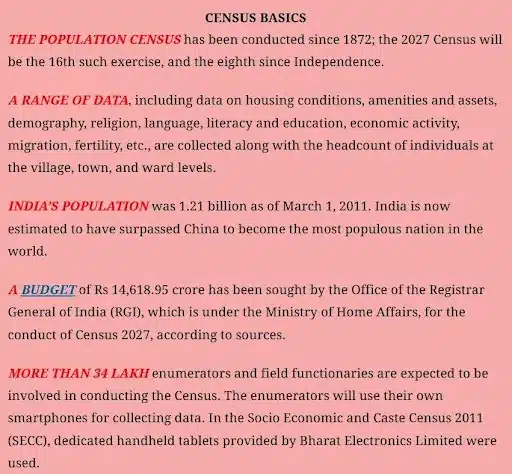
  • India’s 2027 Census will introduce several firsts, including digital enumeration, self-enumeration, and caste counting after 1931. 
  • A major innovation will be geotagging of all buildings across the country. Each structure will be assigned precise GPS coordinates using mobile devices, ensuring accurate mapping of households and institutions. 
  • This will help remove duplication, improve coverage, and create a reliable spatial database to aid urban planning, infrastructure development, and better targeting of welfare schemes.

About Geotagging

  • Geotagging is the process of marking a building’s exact latitude-longitude coordinates on a Geographic Information System (GIS) map
  • A GIS is a computer system that records, checks, and displays data linked to specific positions on Earth’s surface. 
  • Latitudes (horizontal lines) measure north-south distance from the equator, while longitudes (vertical lines) measure east-west distance from the prime meridian in Greenwich, UK. 
  • Together, these create a grid that allows any location to be uniquely identified. 
  • Through this system, geotagging assigns each building a precise locational identity that can be accurately pinpointed.

Number of Buildings in India (Census 2011)

  • In Census 2011, a ‘Census House’ was defined as any building or part of a building with a separate main entrance, used as a distinct unit. 
  • Such houses could be occupied or vacant, and used for residential, non-residential, or mixed purposes. 
  • The Census recorded 330.84 million houses across India, of which 306.16 million were occupied and 24.67 million vacant
  • Rural areas accounted for 220.70 million houses, while 110.14 million were in urban areas.

How Geotagging Will Be Conducted in Census 2027

  • Geotagging will take place during the Houselisting Operations (HLO), the first phase of the Census scheduled for April–September 2026. 
  • The second phase, Population Enumeration (will begin in February 2027) will record demographic, socioeconomic, and cultural details.
    • In Ladakh, Jammu & Kashmir, Himachal Pradesh, and Uttarakhand, it will begin earlier in September 2026.

Role of Enumerators

  • Enumerators will visit all buildings within their assigned Houselisting Blocks (HLBs) — clearly demarcated areas in villages or town wards with notional maps. 
  • Using Digital Layout Mapping (DLM) and smartphone apps, they will switch on location services and geotag each building.
  • The exercise will record the number of Census Houses and Households in each building. 
  • Buildings will be classified as residential, non-residential, partly residential, or landmarks.

Definition of Household

  • As per Census 2011, a household is a group of people normally living together and sharing meals from a common kitchen, unless prevented by work conditions.

Benefits of Geotagging in the Census

  • Geotagging during the Census will provide accurate estimates of Census houses and households, ensuring better workload distribution for enumerators. 
  • Unlike earlier Censuses that relied on hand-drawn sketches, digital geotagging offers precision and efficiency. 
  • The government already uses geotagging on a smaller scale, such as for tracking houses built under Pradhan Mantri Awaas Yojana (PMAY) in rural and urban areas, demonstrating its practical usefulness.

Source: IE | JJ

Geotagging in Census FAQs

Q1: What is geotagging in Census?

Ans: Geotagging marks each building’s latitude and longitude on a GIS map, giving it a unique identity and ensuring precise data for Census operations.

Q2: How many buildings were recorded in Census 2011?

Ans: Census 2011 recorded 330.84 million houses in India, with 306.16 million occupied and 24.67 million vacant, spread across rural and urban areas.

Q3: When will geotagging be carried out?

Ans: Geotagging will take place during Houselisting Operations (April–September 2026), the first phase of Census 2027, using smartphones and Digital Layout Mapping.

Q4: How will enumerators conduct geotagging?

Ans: Enumerators will visit assigned Houselisting Blocks, switch on smartphone location, and geotag buildings while classifying them as residential, non-residential, or landmarks.

Q5: What are the benefits of geotagging in Census?

Ans: Geotagging ensures accurate workload distribution, eliminates duplication, and creates a spatial database useful for urban planning, infrastructure, and welfare targeting.

Himachal Pradesh Declared Fully Literate: Meaning, ULLAS Programme & Literacy Trends

Fully Literate State in India

Fully Literate State in India Latest News

  • Himachal Pradesh has been declared ‘fully literate’, joining Goa, Ladakh, Mizoram, and Tripura. However, ‘fully literate’ does not imply 100% literacy. 
  • It means the state has achieved a literacy rate above 95%, with Himachal recording 99.3%. 
  • Other states also fall in this category, though none have absolute universal literacy.

Defining Literacy and Full Literacy in India

  • The Ministry of Education defines literacy as the ability to read, write, and compute with comprehension, including skills like digital and financial literacy
  • A State/UT is considered ‘fully literate’ when it achieves 95% literacy. 
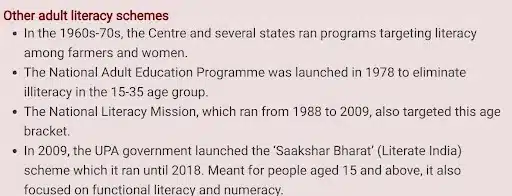
  • These definitions were issued in August 2023 for the ULLAS programme, launched in 2022 to promote adult education for those above 15. 
  • Aimed at achieving 100% literacy by 2030, ULLAS aligns with the UN’s Sustainable Development Goals and India’s National Education Policy 2020.

ULLAS Programme

  • ULLAS (Understanding Lifelong Learning for All in Society) is a national adult education initiative launched in 2022 by the Ministry of Education. 
  • It targets individuals aged 15 and above who missed formal schooling, aiming to equip them with reading, writing, numeracy, digital skills, and financial literacy. 
  • The programme aligns with the National Education Policy 2020 and the UN Sustainable Development Goal of achieving 100% literacy by 2030.

How Literacy is Attained under ULLAS

  • Under the ULLAS programme, adults are taught basic reading, writing, and arithmetic (up to Class 3 level), along with practical skills like reading time, using calendars, handling money, writing cheques, and making safe digital transactions. 
  • Training is delivered via a mobile app or offline by students and community volunteers. 
  • Learners then take the Functional Literacy Numeracy Assessment Test (FLNAT), a 150-mark test in their chosen language. 
  • Successful candidates are certified by the National Institute of Open Schooling (NIOS) as having achieved foundational literacy and numeracy.

Process of Becoming a ‘Fully Literate’ State

  • To achieve the ‘fully literate’ tag, states first identify adults lacking literacy through door-to-door surveys or data records. 
  • These individuals are trained under the ULLAS programme and tested through the Functional Literacy Numeracy Assessment Test (FLNAT)
  • States where the number of illiterate adults is relatively small — due to already high literacy levels or smaller populations — achieve the milestone more quickly. 
  • For example, according to the 2011 Census, Goa, Himachal Pradesh, Mizoram, and Tripura already had literacy rates well above the national average of 74%.

Measuring Literacy in India

  • In the 2011 Census, literacy was defined as the ability to read and write with understanding in any language for those aged seven and above. 
  • The literacy rate stood at 80.9% for men and 64.6% for women, while adult literacy (15+) was 69.3%. 
  • Subsequent surveys have tracked progress. The NSS 71st round (2014) reported 71% adult literacy nationally, with Mizoram at 96%, Goa at 90%, Himachal at 83%, and Tripura at 86%. 
  • The PLFS 2023-24 estimated a national literacy rate of 77.5%, with Mizoram (98.2%), Goa (93.6%), Tripura (93.7%), and Himachal (88.8%) among the top performers. 
  • However, 22.3% of Indians aged 15+ were still not literate, with the highest levels in Bihar (33.1%), Andhra Pradesh (31.5%), and Madhya Pradesh (28.9%).

Source: IE | TH | NPI

Fully Literate State FAQs

Q1: What does ‘fully literate state’ mean?

Ans: A state is declared fully literate when it achieves over 95% literacy, though not necessarily 100%. Himachal Pradesh reached 99.3% literacy in 2025.

Q2: What is the ULLAS programme?

Ans: ULLAS, launched in 2022, is an adult literacy scheme for individuals above 15, offering basic literacy, numeracy, and skills like digital and financial literacy.

Q3: How is literacy attained under ULLAS?

Ans: Adults are trained in reading, writing, arithmetic, and practical skills, then tested via FLNAT. Successful learners are certified by the National Institute of Open Schooling.

Q4: How do states become fully literate?

Ans: States identify illiterate adults through surveys, provide ULLAS training, and conduct FLNAT. States with higher baseline literacy or smaller populations achieve this milestone faster.

Q5: How has literacy been measured in India?

Ans: Census 2011 defined literacy as the ability to read and write with understanding. Later NSS and PLFS surveys tracked progress, with PLFS 2023-24 estimating 77.5% literacy nationally.

Enquire Now