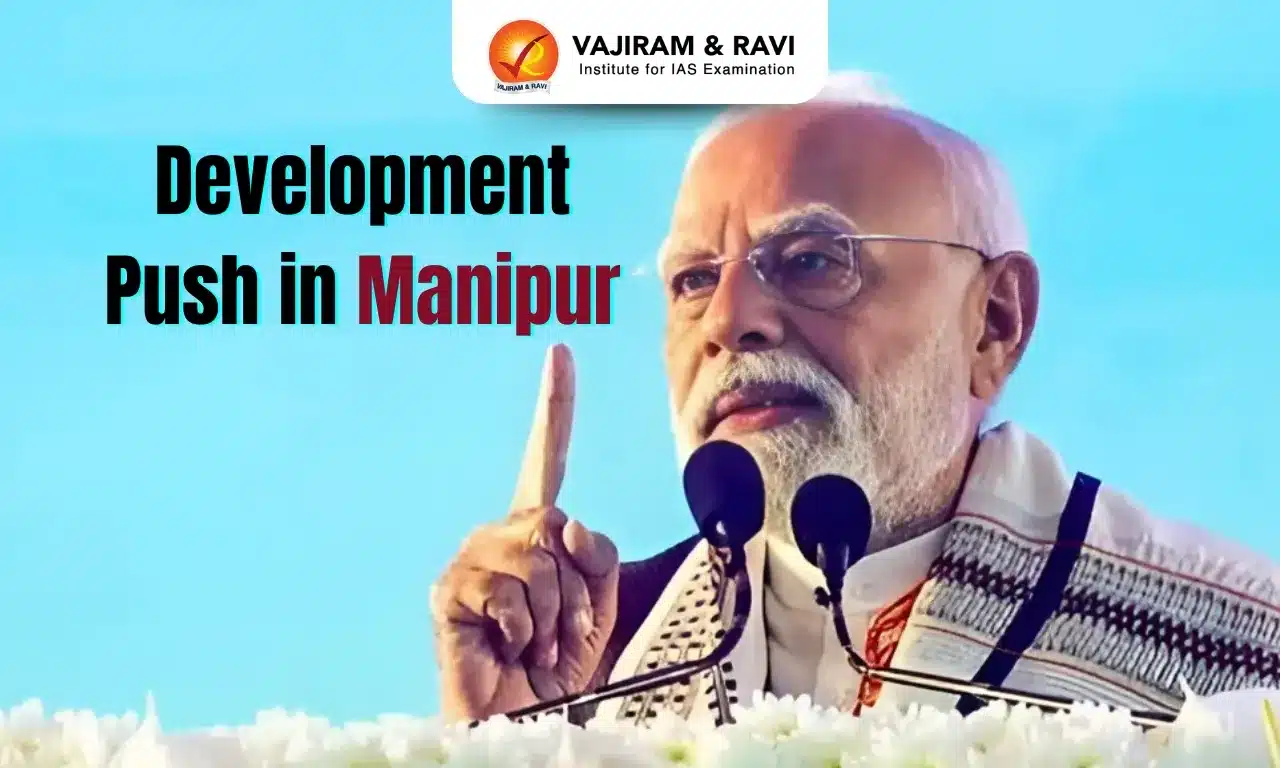
Development Push in Manipur – PM Modi Inaugurates Projects Worth ₹1,200 Crore

Development Push in Manipur

Development Push in Manipur Latest News

  • Prime Minister Narendra Modi inaugurated and laid the foundation stone of multiple development projects worth over ₹1,200 crore in Imphal, Manipur
  • These initiatives focus on infrastructure, digital connectivity, women empowerment, sports, governance, and disaster resilience, highlighting the government’s commitment to inclusive growth in the North-East.
  • His visit to Manipur’s capital Imphal, is the first since the onset of ethnic violence in the state (in May 2023).
  • He urged both the Meitei-dominated valley and the Kuki-dominated hill districts to “build a strong bridge of harmony” and move forward on the path of peace and development.

Development Push in the North-East

  • Mizoram connected to railways:
    • Before Manipur, PM visited Mizoram and inaugurated the 51.38-km Bairabi–Sairang railway line, connecting Aizawl (Mizoram’s capital) to the Indian Railways network for the first time.
    • With this, Aizawl becomes the fourth Northeastern capital (after Guwahati, Agartala, and Itanagar) linked to the railway grid.
    • Alongside, he laid the foundation stone and inaugurated development projects worth over ₹9,000 crore in Aizawl.
  • Significance:
    • Act East Policy: Mizoram, sharing borders with Myanmar and Bangladesh, is crucial for India’s Act East Policy. Railway connectivity strengthens trade, transit, and people-to-people ties with Southeast Asia.
    • Economic integration: Boosts movement of goods and people, reducing transport costs. Facilitates export of local products (agriculture, bamboo, horticulture, handicrafts). Enhances tourism potential of Mizoram.
    • National integration: Makes Mizoram less isolated by physically linking it with the Indian heartland. Aizawl joins other connected state capitals in the Northeast, strengthening inclusivity in development.

Key Announcements and Projects for the Manipur

  • Infrastructure development:
    • Launch of Manipur Urban Roads Project (₹3,600 crore) to boost connectivity in Imphal.
    • Enhanced pace of National Highway and rural road construction, connecting villages.
    • Civil Secretariat and Police Headquarters inaugurated at Mantripukhri.
  • Digital and IT growth:
    • Manipur Infotech Development Project (₹500 crore).
    • IT Special Economic Zone to encourage startups and tech industries.
  • Smart city and urban development:
    • He informed that under this vision, several projects have been completed in Imphal, and many other projects are progressing rapidly.
    • Manipur Bhawans at Delhi and Kolkata for affordable accommodation, especially for women.
  • Women empowerment:
    • Inauguration of 4 new Ima Markets (women-only markets).
    • Emphasis on Ima Keithel tradition as a symbol of women-led economy.
    • Women empowerment linked to Atmanirbhar Bharat vision.
  • Disaster management: Recognition of flood-related challenges; new projects underway for mitigation.
  • Cultural and historical identity:
    • Manipur is described as the “crown jewel of India.”
    • Tribute to Indian National Army (INA) flag hoisting in Manipur and renaming of Mount Harriet as Mount Manipur.
    • Stress on peace, dialogue, and harmony between hills and valleys.
  • Sports as a growth driver:
    • Establishment of National Sports University in Manipur.
    • Khelo India and Olympic Podium schemes supporting Manipuri athletes.
    • To promote polo, the Marjing Polo Complex has been established, featuring the world’s tallest polo statue. 
  • Socio-economic relief:
    • Highlighting that their government has significantly reduced GST, the PM stated that this will bring double benefits to the people of Manipur.
    • 7,000 new houses have been approved for displaced families. The central government has recently declared a special package of approximately ₹3,000 crore for Manipur. 
    • He added that over ₹500 crore has been allocated specifically to assist displaced individuals.
  • National security and defence contribution:
    • Tribute to Shaheed Deepak Chingkham (Operation Sindoor).
    • Recognition of Manipuri youth in armed forces and sports.

Significance for Manipur and North-East

  • Shift from marginalisation to mainstream development.
  • Manipur is positioned as a hub for connectivity, culture, sports, and IT.
  • Promotes peace, stability, and women empowerment as foundations for inclusive growth.

Way Forward

  • Peace and stability: Violence undermines Manipur’s historical legacy and development potential. Therefore, peace-building and dialogue are crucial.
  • Balanced growth: Bridging divides between hills and valley is essential for long-term harmony.
  • Women-centric economy: Strengthening Ima Markets and women-led initiatives will boost local entrepreneurship.
  • Sports diplomacy and soft power: Leveraging Manipuri athletes’ contributions enhances India’s global sporting image.
  • Integration with national growth: Projects reflect Act East Policy and aim to make Manipur a growth engine for the 21st-century North-East.

Source: IE  | PIB

Development Push in Manipur FAQs

Q1: What is the significance of the inauguration of the Bairabi-Sairang rail line for Mizoram?

Ans: The 51.38 km rail line integrates the state with national transport and boosts connectivity under the Act East policy.

Q2: What significance do the Manipur Urban Road Project and the Infotech Development Project have?

Ans: These projects aim to modernize connectivity and digital infrastructure, making Imphal a “city of possibilities” and a growth hub in the Northeast.

Q3: In what ways did the PM highlight the role of women in Manipur’s economy?

Ans: By celebrating the Ima Keithel tradition, the PM linked women empowerment to Atmanirbhar Bharat.

Q4: How did PM Modi invoke Manipur’s cultural and historical legacy to promote unity?

Ans: He recalled the INA’s flag hoisting in Manipur, renamed Mount Harriet as Mount Manipur, etc.

Q5: What measures did the PM outline for addressing the humanitarian crisis arising from ethnic violence in Manipur?

Ans: He assured continuous efforts for peace, stability, and rehabilitation, announcing special packages, housing projects for displaced families.


Enhanced Powers of Foreigners Tribunals under Immigration and Foreigners Act 2025

Foreigners Tribunals

Foreigners Tribunals Latest News

  • The Union Home Ministry has notified Rules, Order, and Exemption Order under the Immigration and Foreigners Act, 2025.
  • This law regulates all matters on foreigners and immigration, replacing older legislations including the Passport (Entry into India) Act, 1920, the Registration of Foreigners Act, 1939, the Foreigners Act, 1946, and the Immigration (Carriers’ Liability) Act, 2000.

Rationale Behind the New Immigration and Foreigners Act

  • The government introduced the Immigration and Foreigners Act, 2025 to prevent overlap among multiple pre-Independence laws on passports, travel documents, visas, registration, and immigration.
  • While most provisions existed in earlier notifications, new clauses and conditions have been added to address significant changes in travel, security, and immigration that have emerged since the old Acts were enacted.

Key Provisions of the Immigration and Foreigners Rules

  • The new Rules formally empower the Bureau of Immigration (BOI) to investigate immigration fraud, coordinate with states on identifying and deporting foreigners, and maintain an immigration database.
  • They also mandate biometric recording of all foreigners, previously limited to select visa categories.
  • Educational institutions must now report details of all foreign students, including semester-wise attendance and conduct, to the Foreigners Regional Registration Office (FRRO).
  • Additionally, premises such as resorts or clubs can be shut down if frequented by illegal migrants, alongside earlier categories of undesirable foreigners or those linked to crime.
  • The Rules also define “immigration officers” as Intelligence Bureau personnel.

Provisions of the Immigration and Foreigners Order, 2025

  • The Immigration and Foreigners Order, 2025 grants Foreigners Tribunals (FTs), earlier unique to Assam, the powers of a first-class judicial magistrate, enabling them to send individuals without proof of citizenship to detention or holding centres.
  • FTs can now issue arrest warrants if contested individuals fail to appear, with membership capped at three, and ex-parte orders open for review within 30 days.
  • Though applicable nationwide, FTs currently operate only in Assam, where 100 are functional after the NRC process excluded 19 lakh applicants.
  • The Order also legalises the role of border forces like BSF and Assam Rifles in preventing illegal entry by recording biometric and demographic data before sending migrants back.
  • Entry refusal now includes broader grounds such as anti-national activities, terrorism, espionage, human trafficking, cybercrime, narcotics trade, financial crimes like hawala, and crimes against humanity.

Immigration and Foreigners (Exemption) Order, 2025

  •  The Exemption Order spares Nepalese, Bhutanese, and Tibetans from the Immigration and Foreigners Act, 2025, while adding two new groups.
  •  Registered Sri Lankan Tamil nationals who sought shelter in India before January 9, 2015, are exempted from the passport/visa requirements under Section 3.
  • Additionally, undocumented minorities from Afghanistan, Bangladesh, and Pakistan — including Hindus, Sikhs, Buddhists, Jains, Parsis, and Christians — who entered India without valid documents or whose documents expired before December 31, 2024, are exempted from penal provisions and deportation.
  • However, only these minorities can apply for long-term visas (LTVs) leading to citizenship, while the exemption for Sri Lankan Tamils does not extend to LTVs.

Source: TH

Foreigners Tribunals FAQs

Q1: What is the Immigration and Foreigners Act, 2025?

Ans: The Act regulates all matters relating to foreigners and immigration, replacing older legislations like the Passport Act, Foreigners Act, and Immigration (Carriers’ Liability) Act.

Q2: What powers have been given to Foreigners Tribunals under the 2025 Order?

Ans: Foreigners Tribunals now hold the powers of a first-class judicial magistrate, including issuing arrest warrants and sending undocumented persons to detention or holding centres.

Q3: What are the key provisions of the Immigration and Foreigners Rules, 2025?

Ans: They empower the Bureau of Immigration to investigate fraud, mandate biometric recording of foreigners, and require institutions to report details of foreign students.

Q4: Who is exempt under the Immigration and Foreigners (Exemption) Order, 2025?

Ans: Exemptions cover Nepalese, Bhutanese, Tibetans, Sri Lankan Tamils sheltered before 2015, and undocumented minorities from Afghanistan, Bangladesh, and Pakistan.

Q5: What new grounds have been added for refusing entry under the 2025 Order?

Ans: New grounds include anti-national activities, terrorism, espionage, narcotics trafficking, cybercrime, financial crimes, and crimes against humanity.

Missed Demographic Dividend in South Asia: Youth Unemployment, Protests, and India’s Future Potential

Demographic Dividend

Demographic Dividend Latest News

  • In recent years, youth-led uprisings have erupted across Sri Lanka, Bangladesh, Indonesia, and Nepal, where economic growth has failed to translate into better opportunities for the young. Instead, corruption and elite prosperity dominate. 
  • Nepal’s protests have spotlighted “nepo kids” flaunting luxury lifestyles, fuelling Gen Z anger over inequality. 
  • Transparency International’s 2024 corruption rankings placed Nepal at 107, Bangladesh 151, Sri Lanka 121, and Indonesia 99, underscoring widespread governance challenges.

Youth Uprisings and the Missed Demographic Dividend in Asia

  • In recent years, youth-led uprisings have shaken Sri Lanka (2022), Bangladesh (2024), Indonesia (2025), and Nepal, driven by frustration over economic growth that has failed to create better opportunities for young people. 
  • Despite headline growth, the benefits have largely bypassed the labour force entrants, while ruling elites and business classes prospered.

Corruption and Optics of Power

  • Nepal’s Gen Z protests spotlighted the luxurious lifestyles of political elites’ children, with “nepo kids” trending on social media. 
  • Transparency International’s 2024 rankings reflect deep-rooted corruption: Nepal (107), Bangladesh (151), Sri Lanka (121), and Indonesia (99). 
  • Leaders’ actions worsened optics — for instance, Indonesia’s President Prabowo Subianto dismissed respected finance minister Sri Mulyani Indrawati amid backlash over lawmakers’ extravagant $3,000 housing allowance, nearly 10 times Jakarta’s minimum wage.

Economic Growth Without Inclusion

  • Although these nations witnessed economic expansion, high corruption and weak political continuity prevented inclusive growth. 
  • The youth remain the worst affected, struggling with unemployment and limited opportunities.

A Young Demographic at Risk

  • With median ages of Nepal (25), Bangladesh (25.7), Indonesia (30.1), and Sri Lanka (33.1), these countries are among the youngest globally. 
  • Yet, instead of reaping a demographic dividend, they face unrest as disillusioned youth demand accountability and equitable growth.

The Vanishing Demographic Dividend in Asia

  • The demographic dividend arises when a country’s working-age population grows faster than dependents, boosting economic potential. 
  • However, many Asian economies have failed to harness this advantage. Despite strong growth, millions of new jobs have not materialised, leaving young people underemployed. 
  • Automation has sharply reduced opportunities in traditional sectors such as textiles and auto manufacturing, once the backbone of youth employment. 
    • The Asian Development Bank notes that today’s car factories employ only 15% of the workforce needed 25 years ago. 
  • The World Bank warned in 2023 that South Asia may waste its demographic dividend, as it created only 10 million jobs a year from 2000 to 2023 — just half of what was needed. 
  • This shortfall underscores the urgent need for inclusive job creation to ensure the region’s youth can drive growth rather than unrest.

High Youth Unemployment in South Asia

  • Indonesia’s Youth Struggles - In 2024, Indonesia’s unemployment rate was 4.91%, but for ages 20–24 it spiked to 15.34%, showing youth face joblessness at over three times the national average.
  • Bangladesh’s Jobless Youth - Bangladesh recorded 3.35% overall unemployment in 2023. However, youth aged 15–24 had the highest rate at 8.24%, underscoring the lack of opportunities for the young workforce.
  • Nepal’s Employment Crisis - Nepal’s unemployment rose from 11.4% in 2017–18 to 12.6% in 2022–23, with underemployment widespread among youth. Limited industrial growth and reliance on remittances highlight weak domestic job creation.
    • Young Nepalis seek jobs abroad, making remittances nearly a quarter of GDP. Without urgent investment in emerging sectors, Nepal risks losing its demographic dividend.

India’s Demographic Dividend in the Making

  • India has shifted from a high fertility-high mortality society to a low fertility-low mortality one, reshaping its age profile and creating the potential for a demographic dividend.

Changing Age Profile

  • According to the 2011 Census, 48% of Indians were in the working-age group (15–59 years), 31% were children under 14, and 9% were elderly above 60. 
  • The dependency ratio fell from 64% in 2001 to 55% in 2011, indicating fewer dependents per worker. 
  • India’s median age is just 28, making it one of the youngest nations globally.

Peak Demographic Dividend

  • The Economic Survey 2018–19 estimates that India’s demographic dividend will peak around 2041, when the working-age population (20–59 years) is expected to reach nearly 59%. 
  • The UN Population Fund notes India’s demographic window spans five decades (2005–2055), longer than any other country.
  • Unlike China, which saw its demographic dividend peak around 2010, India’s more gradual transition ensures opportunities until 2055, giving it an unparalleled advantage globally.

Source: IE | TH

Demographic Dividend FAQs

Q1: What is meant by the demographic dividend?

Ans: The demographic dividend refers to accelerated economic growth when the working-age population outnumbers dependents, boosting productivity and income—provided enough jobs are created.

Q2: Why has South Asia struggled to benefit from its demographic dividend?

Ans: South Asia has failed to create enough jobs, with automation shrinking traditional sectors and corruption blocking inclusive growth, leading to unrest among youth.

Q3: What do recent youth-led uprisings in Asia reveal about missed opportunities?

Ans: Uprisings in Nepal, Sri Lanka, Bangladesh, and Indonesia highlight how growth failed to deliver jobs or equity, leaving youth angry over corruption and inequality.

Q4: How severe is youth unemployment in South Asian countries?

Ans: Indonesia’s youth unemployment is 15.34%, Bangladesh’s 8.24%, and Nepal’s 12.6%, with many young Nepalis seeking work abroad, making remittances vital to GDP.

Q5: How does India’s demographic dividend differ from its neighbours?

Ans: India’s demographic dividend window spans 2005–2055, longer than most nations. It will peak around 2041, giving India time to align education, skilling, and jobs.

India’s Outward FDI Trends – Shift Towards Tax Havens

Outward FDI

Outward FDI Latest News

  • Nearly 60% of India’s outward FDI is now routed through tax havens like Singapore, Mauritius, and the UAE, reflecting both tax advantages and strategic global expansion needs.

Introduction

  • India’s outward foreign direct investment (FDI) has grown significantly over the past two decades, reflecting the ambition of Indian companies to expand their global presence. 
  • While domestic reforms have supported inbound investment, outward investment trends reveal a distinct preference for low-tax jurisdictions. 
  • According to Reserve Bank of India (RBI) data, nearly 60% of India’s outward FDI in 2023-24 was routed through tax havens such as Singapore, Mauritius, and the UAE. 
  • This pattern highlights not only tax efficiencies but also strategic advantages for Indian companies seeking global expansion.

India’s Outward Investment Trends

  • India’s outward FDI has witnessed structural changes in both volume and destination preferences. 
  • From traditional investments in manufacturing and energy, Indian firms have diversified into IT services, pharmaceuticals, consumer goods, and infrastructure globally. The main objectives driving this trend include:
    • Access to new markets: Indian companies are establishing subsidiaries abroad to tap into consumer demand in Europe, the U.S., and Africa.
    • Technology acquisition: Outward investments enable Indian firms to access advanced technologies, particularly in healthcare, automotive, and clean energy.
    • Strategic partnerships: Cross-border mergers, acquisitions, and joint ventures strengthen Indian firms’ positioning in global supply chains.
    • Risk diversification: By expanding abroad, companies hedge against domestic regulatory and market volatility.
  • The government has supported outward FDI by easing regulatory approvals, enhancing bilateral investment treaties, and facilitating credit support through institutions like EXIM Bank. 
  • However, the heavy reliance on tax havens underscores a complex mix of regulatory arbitrage, strategic structuring, and global investor preferences.

News Summary

  • Recent data shows that 56% of India’s outward FDI in 2023–24, amounting to about Rs. 1,946 crore out of a total of Rs. 3,488 crore, flowed into low-tax jurisdictions such as Singapore (22.6%), Mauritius (10.9%), and the UAE (9.1%).

[my_image src="https://vajiramandravi.com/current-affairs/wp-content/uploads/2025/09/Outward-Investment-Trends.png"]

Image Caption: Outward Investment Trends

  • In the first quarter of 2024-25, this figure rose further, with 63% of outward FDI routed through these jurisdictions. Experts clarify that this is not solely for tax avoidance but also for strategic reasons:
    • Global investor comfort: International partners prefer investing in entities located in jurisdictions with stable tax laws and flexible fund transfer regimes.
    • Strategic structuring: Using special-purpose vehicles in hubs like Singapore helps Indian companies attract investors and manage stake dilutions effectively.
    • Joint ventures: Almost 60% of outward FDI in these low-tax hubs in July 2025 was in joint ventures, showing their role as neutral platforms for partnerships.
  • Experts also note that rising U.S. tariffs on Indian exports could push more firms to establish subsidiaries abroad to mitigate trade risks.
  • Thus, while India continues efforts to curb profit shifting to tax havens, the outward FDI trend reflects a blend of tax advantages and global business strategy.

Conclusion

  • India’s outward FDI trajectory highlights a dual narrative: on one hand, concerns about tax revenue leakage and regulatory arbitrage; on the other, the strategic necessity for Indian firms to leverage tax-efficient jurisdictions to expand globally. 
  • With nearly 60% of investments flowing through tax havens, it is evident that these destinations serve as both gateways for third-country expansion and buffers against global trade risks. 
  • Going forward, India’s challenge will be to balance regulatory oversight with the need to support its companies’ global ambitions.

Source: TH

Outward FDI FAQs

Q1: What percentage of India’s outward FDI goes to tax havens?

Ans: Nearly 60% of India’s outward FDI is routed through low-tax jurisdictions.

Q2: Which countries receive the largest share of India’s outward FDI?

Ans: Singapore, Mauritius, and the UAE account for over 40% of the total outward FDI.

Q3: Why do Indian companies prefer tax havens for FDI?

Ans: They offer tax stability, flexible fund transfers, and attract global investors.

Q4: What role do joint ventures play in outward FDI?

Ans: Around 60% of investments in tax havens are through joint ventures, enabling cross-border partnerships.

Q5: How might U.S. tariffs affect India’s outward FDI?

Ans: High tariffs could drive Indian firms to set up overseas entities to bypass trade restrictions.

Enquire Now