

NPS to UPS: Govt Extends One-Time Switch Option

Unified Pension Scheme

Unified Pension Scheme Latest News

  • Central government employees have until September 30 to opt for the Unified Pension Scheme (UPS) under NPS (National Pension System), introduced in April 2025. 
  • Despite 23.94 lakh employees being eligible, only around 40,000 have opted so far. 
  • To regulate service matters for those choosing UPS, the Department of Pension and Pensioners’ Welfare notified the Central Civil Services (Implementation of the Unified Pension Scheme under the National Pension System) Rules, 2025, on September 2.

Govt Extends UPS Option to New Employees

  • The government has allowed central employees who joined between April 1 and August 31, 2025, under NPS to migrate to the Unified Pension Scheme (UPS). 
  • This one-time option, available until September 30, 2025, aligns with the existing cut-off for other eligible categories. 
  • Employees opting for UPS will also retain the right to later switch back to NPS, ensuring flexibility in planning post-retirement financial security.

Switch Option from UPS to NPS

  • UPS subscribers have a one-time option to switch to NPS, but cannot return to UPS.
  • The switch must be exercised at least one year before retirement or three months before VRS, and is barred in cases of dismissal, removal, compulsory retirement, or pending disciplinary proceedings. 
  • Those not opting will remain under UPS. 
  • Employees switching to NPS will receive its benefits along with the differential 4% contribution, giving greater flexibility and informed choice for retirement planning.

Unified Pension Scheme (UPS)

  • Before UPS, central government employees hired before January 1, 2004, were covered under the Old Pension Scheme (OPS), which guaranteed fixed pensions, while those joining after were under the market-linked National Pension System (NPS)
  • Amid persistent demands to restore OPS, the Union Cabinet approved the Unified Pension Scheme (UPS) in August 2024 as an optional scheme. 

About UPS

  • From April 1, 2025, the government introduced the UPS as an option under NPS for central government employees hired after January 1, 2004. 
    • Around 23 lakh employees can choose between NPS and UPS.
  • Unlike NPS, UPS guarantees an assured pension: 50% of the average basic pay of the last 12 months before retirement, provided the employee has served a minimum of 25 years. 
  • In case of the pensioner’s death, the spouse will receive up to 60% of the pension being drawn.
  • Unlike the Old Pension Scheme, which guaranteed 50% of last drawn basic pay without employee contribution, UPS combines assured benefits with mandatory contributions.

Key Differences Between UPS and NPS

  • The NPS is mandatory, while the UPS is optional, with employees given a one-time chance to switch back to NPS before retirement or VRS. 
  • Under the NPS, through the Permanent Retirement Account Number (PRAN), employees contribute 10% and the employer 14% of basic pay plus dearness allowance (DA), with pension benefits entirely dependent on the accumulated corpus
  • In contrast, the UPS requires 10% contributions each from employee and employer, with an additional 8.5% contribution by the government to create a pool corpus. 
  • This pool funds an assured pension of 50% of the employee’s average basic pay over the last 12 months, provided a minimum of 25 years of service is completed. 
  • Unlike NPS, UPS guarantees a minimum monthly payout of ₹10,000 after 10 years of service, ensuring greater financial security.
  • UPS also offers a lump sum equal to one-tenth of the last basic pay plus DA for every six months of service, whereas NPS has no such provision. 
  • Employees dismissed from service are ineligible for the assured UPS payout.

Why the Unified Pension Scheme Is Slow to Take Off

  • Although the government extended the deadline to September 30 for employees to opt into the Unified Pension Scheme (UPS), uptake remains low. 
  • The Department of Pension is holding awareness drives, but many employees still prefer the Old Pension Scheme (OPS), which required no employee contribution and guaranteed 50% of the last drawn basic pay plus DA as pension. 
  • In contrast, UPS involves contributions and is seen as less beneficial. 
  • The Central Secretariat Service Forum has also criticised both NPS and UPS, reiterating its demand for a complete return to OPS.

Source: IE | LM | PIB

Unified Pension Scheme FAQs

Q1: What deadline has the govt set for NPS to UPS switch?

Ans: Central govt employees can opt for UPS until September 30, 2025, after which those not switching will continue under NPS.

Q2: What is the main difference between UPS and NPS?

Ans: NPS is market-linked with no assured payout, while UPS guarantees 50% of last 12 months’ average basic pay after 25 years of service.

Q3: Can employees switch back to NPS after choosing UPS?

Ans: Yes, but only once, at least one year before retirement or three months before VRS. After switching, they cannot return to UPS.

Q4: Why is UPS slow to take off?

Ans: Many employees prefer the Old Pension Scheme (OPS) and find UPS less beneficial due to contributions, unlike OPS which required none.

Q5: What additional provision does UPS have compared to NPS?

Ans: UPS ensures a minimum monthly pension of ₹10,000 after 10 years and offers a lump sum payout, unlike NPS.
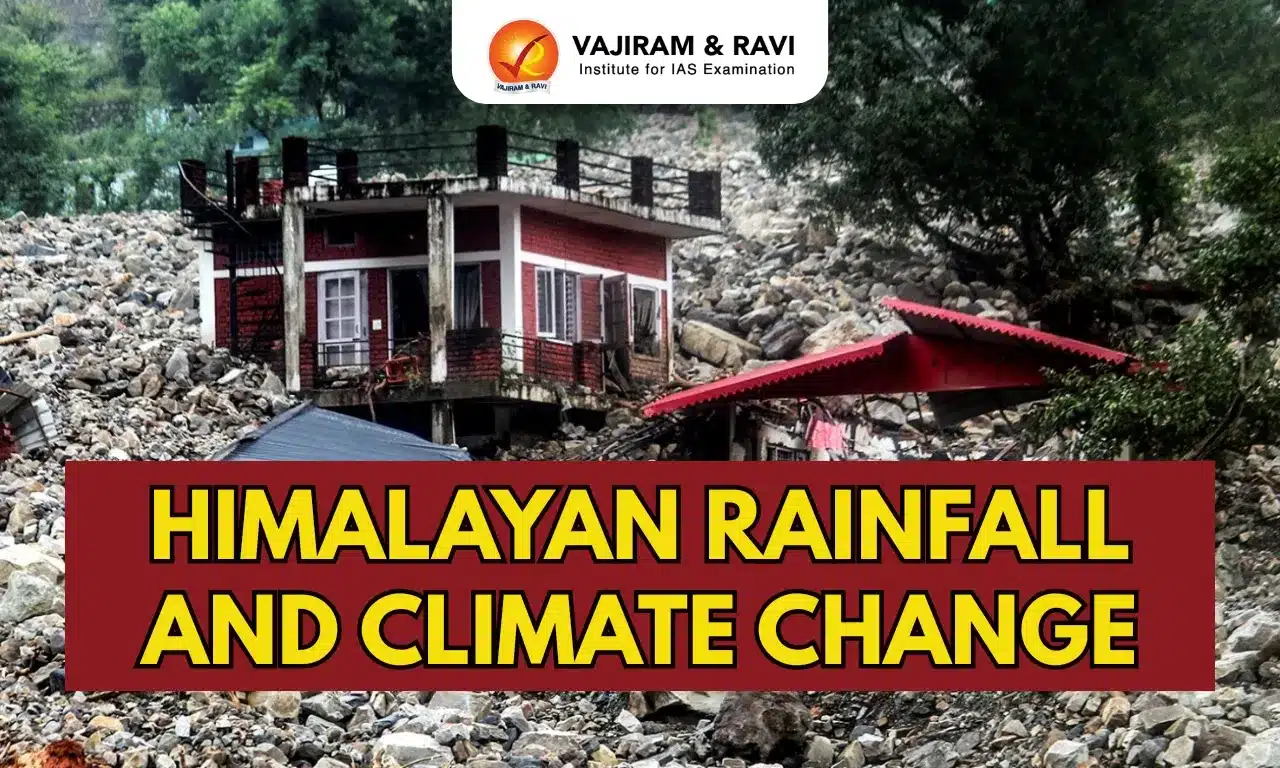

Himalayan Rains: Topography and Climate Change Explained

Himalayan Rainfall and Climate Change

Himalayan Rainfall and Climate Change Latest News

  • Dehradun and several districts of Uttarakhand have seen very heavy rainfall in recent days, triggering landslides, swollen rivers, and at least 15 deaths. 
  • Over the past month, both Uttarakhand and Himachal Pradesh have witnessed repeated incidents of cloudbursts, flash floods, mudslides, and damaged communication networks. 
  • While such events are typical of the monsoon, their growing frequency and intensity in recent years have raised serious concerns about safety and resilience in the Himalayan region.

Why Hilly Regions Receive More Rainfall

  • This monsoon, the northwestern region has seen unusually high rainfall, with 34% surplus in August and over 67% above normal in early September.
  • Consecutive low-pressure systems from the Bay of Bengal moved farther north, intensifying rains. 
  • In hilly areas like the western Himalayas, geography amplifies the impact: rising air forms massive, steep clouds that release heavy local precipitation
  • Such rainfall levels, manageable in coastal states like Goa or Kerala, trigger disasters in mountains. 
  • For example, Udhampur in J&K recorded 630 mm in 24 hours — equal to Rajkot’s annual rainfall — while Leh received 59 mm in two days, a record since 1973.

Why Hilly Regions Face Greater Disaster Risks

  • In plains, heavy rainfall usually drains into rivers or local water bodies, but in mountains it often triggers landslides, mudslides, and flash floods as water rushes downhill carrying mud, soil, and debris
  • This has recently occurred in Mandi, Kullu, Dharali, Tharali, and Jammu. 
  • When major rivers get choked, overflowing water and debris can inundate settlements, destroying roads and bridges. 
  • However, not every cloudburst results in disaster — the impact depends on local factors, such as slope stability and whether debris falls into river channels.

Climate Change and Himalayan Rainfall Extremes

  • Recent years show a southward shift of western disturbances — wind systems from the Mediterranean that bring rain and snow to northern India. 
  • Their increasing interaction with southwest monsoon currents, driven by global warming, has complicated rainfall patterns over the Himalayas. 
  • This shift is linked to more frequent extreme rainfall events and longer dry spells. 
  • Additionally, Arctic Sea ice melting may further influence these changing monsoon dynamics, raising concerns about heightened climate risks in hilly regions.

Why the Himalayas Are Prone to Cloudbursts

  • The Himalayas, positioned where moist tropical monsoon winds meet mid-latitude westerlies, experience strong uplift and instability that often trigger cloudbursts
  • Warm, moisture-rich air forced up the slopes cools quickly, condenses, and produces intense, localised downpours. 
  • Climate change is worsening this vulnerability: rapid Arctic warming weakens the jet stream, causing westerly troughs to interact more with monsoon currents, while warmer air carries more moisture, intensifying rainfall. 
  • A slower, wavering jet stream makes storms linger, leading to prolonged heavy rain and devastating floods — trends already seen globally, including in Germany (2021), Pakistan (2010), and West Asia (2024).

Observational Tools and Their Limitations in Forecasting Cloudbursts

  • Cloudburst forecasting relies on Doppler Weather Radars (DWRs), satellites, rain gauges, GPS-based moisture monitoring, and high-resolution numerical weather prediction (NWP) models. 
  • While DWRs provide detailed cloud and rainfall structures, their coverage is limited in Himalayan terrain
  • Rain gauges and automatic weather stations offer accurate point data but lack spatial density. 
  • Satellites like INSAT-3D/3DR, GPM, and Himawari capture convective growth and rainfall but struggle with coarse resolution and biases in rugged topography. 
  • NWP models simulate convection and storm dynamics but require very fine resolution (<1 km), precise initial conditions, and explicit process representation, making sudden bursts hard to predict. 
  • To improve accuracy, denser observation networks, advanced models with better cloudburst representation, and AI/ML integration for data assimilation are essential.

Source: IE | FE

Himalayan Rainfall and Climate Change FAQs

Q1: Why do hilly regions like the Himalayas receive more rainfall?

Ans: Geography forces moist air upward, forming massive clouds that release intense local rain, unlike plains or coastal areas where drainage reduces impact.

Q2: Why are hilly regions more disaster-prone during heavy rains?

Ans: Extreme rainfall triggers landslides, mudslides, and flash floods as water carries debris downhill, often overwhelming rivers and settlements.

Q3: What role does climate change play in Himalayan rains?

Ans: Global warming shifts western disturbances southward, increasing interaction with monsoon systems, leading to more extreme rainfall events and prolonged dry spells.

Q4: Why are the Himalayas prone to cloudbursts?

Ans: Their location at the intersection of monsoon winds and westerlies causes strong uplift, while warmer, moisture-rich air under climate change fuels intense downpours.

Q5: What are the limitations of current forecasting tools for cloudbursts?

Ans: DWRs, satellites, and NWP models face terrain coverage, resolution, and data accuracy issues, making sudden convective bursts hard to predict reliably.

ASI to Revise Sarnath Plaque, Credits Benares Ruler’s Family

Sarnath Plaque

Sarnath Plaque Latest News

  • The Archaeological Survey of India (ASI) is revising the Sarnath plaque to credit the Benares ruler’s family, instead of the British, for preserving the heritage site ahead of a UNESCO team’s visit.

About Sarnath

  • Sarnath, located about 10 km from Varanasi in Uttar Pradesh, is one of the most revered sites in the Buddhist world. 
  • It holds immense historical, cultural, and religious significance as the place where Gautama Buddha delivered his first sermon after attaining enlightenment at Bodh Gaya. 
  • Known as the Dharmachakra Pravartana or Turning of the Wheel of Dharma, this event marked the formal beginning of the Buddhist Sangha (community).

Historical Significance

  • Buddha’s First Sermon: Around 528 BCE, Buddha preached the Four Noble Truths and the Eightfold Path here to his five ascetic disciples. This sermon became the foundational philosophy of Buddhism.
  • Mauryan Patronage: Emperor Ashoka (3rd century BCE), after embracing Buddhism, visited Sarnath and commissioned several stupas, monasteries, and pillars. The famous Ashokan Lion Capital, India’s national emblem, was erected here.
  • Medieval Flourishing: Over centuries, Sarnath grew into a vibrant monastic and educational hub. Numerous monasteries, stupas, and sculptures were added, especially under the Gupta dynasty (4th-6th century CE), which produced exquisite Buddhist art.
  • Decline: With the decline of Buddhism in India (around the 12th century CE) and repeated invasions, Sarnath fell into ruin and was largely forgotten until rediscovery in the colonial era.

Key Monuments and Structures

  • Dhamek Stupa:
    • Built initially by Ashoka and later enlarged, this massive cylindrical stupa (43.6 meters high, 28 meters in diameter) marks the exact spot of Buddha’s first sermon.
    • The lower portion is decorated with intricate floral and geometric patterns, characteristic of Gupta art.
  • Chaukhandi Stupa:
    • An early stupa commemorating the meeting between Buddha and his first disciples.
    • Later, a Mughal-era pavilion was added to the top.
  • Ashokan Pillar:
    • The pillar, erected by Ashoka, bore the famous Lion Capital of Ashoka, now preserved in the Sarnath Archaeological Museum.
    • The capital, with four lions back-to-back, is India’s National Emblem and also featured on Indian currency.
  • Mulagandha Kuti Vihar:
    • A modern monastery built by the Mahabodhi Society in 1931, it contains impressive frescoes depicting scenes from Buddha’s life.
  • Monastic Ruins:
    • The site contains remains of monasteries that once hosted thousands of monks, serving as a leading centre of Buddhist learning.


Debate Over Historical Attribution

  • For decades, the mainstream narrative credited British officials such as Duncan and Mackenzie in 1798 and later archaeologists like Alexander Cunningham for discovering and preserving Sarnath. 
  • However, recent scholarship and archival records challenge this view, pointing to Jagat Singh’s excavation in 1787-88 as the actual turning point
  • His digging at the ancient mound unearthed Buddhist relics, shifting the perception of who deserves credit for uncovering Sarnath’s legacy.
  • This change is not merely a matter of rewriting history; it reflects a broader attempt to decolonise India’s historical narratives and recognise indigenous agency in heritage preservation.

Background of the Case

  • Jagat Singh, a descendant of Benares ruler Chait Singh, ordered excavation at Sarnath for construction purposes, which unexpectedly revealed Buddhist relics. Parts of these relics remain housed in the Asiatic Society in Kolkata.
  • The existing plaque at Sarnath emphasises British-led excavations from 1798 onwards, overshadowing Singh’s contribution. 
  • Earlier this year, following a petition by Singh’s descendants, the ASI revised a separate plaque at the Dharmarajika Stupa, removing language that labelled him a “destroyer” of monuments
  • The new version acknowledged that the stupa came to light through his actions, highlighting the contested nature of colonial-era historical narratives.

Summary of Recent Developments

  • The upcoming plaque revision at Sarnath comes as UNESCO evaluates India’s proposal to include the site in its World Heritage List.
  • ASI’s New Decision: The corrected plaque will formally acknowledge Jagat Singh’s role in exposing Sarnath’s importance in 1787-88, predating British accounts by a decade.
  • Research Support: Former National Museum Director B.R. Mani’s excavations have revealed evidence of Buddhist activity at Sarnath even before Emperor Ashoka, strengthening the case for recognising local contributions.
  • Cultural Impact: Singh’s family has also requested the ASI to revise accompanying cultural notice boards to reflect the corrected history.
  • Broader Context: India’s cultural diplomacy emphasises its Buddhist heritage globally. The revision of plaques aligns with this strategy, especially as South Asian tourists form a large segment of visitors to Sarnath.
  • UNESCO Candidacy: Sarnath, long on UNESCO’s tentative list, is now a strong contender for inclusion, with the government keen to assert its cultural and historical primacy.

Source: IE

Sarnath Plaque FAQs

Q1: Why is the ASI revising the Sarnath plaque?

Ans: To credit Babu Jagat Singh’s family for preserving the site instead of British officers.

Q2: What role did Jagat Singh play in Sarnath’s discovery?

Ans: He ordered excavations in 1787–88 that exposed Buddhist relics and highlighted the site’s importance.

Q3: How does the existing plaque describe Sarnath’s preservation?

Ans: It credits British officials from 1798 onwards for the site’s discovery and preservation.

Q4: Why is this revision significant now?

Ans: The correction coincides with Sarnath’s nomination for the UNESCO World Heritage List.

Q5: What broader objective does this move reflect?

Ans: It aligns with India’s efforts to decolonize historical narratives and emphasize indigenous contributions.

Enquire Now

