
Bima Sugam: One-Stop Digital Insurance Marketplace for Policyholders

Bima Sugam digital insurance marketplace

Bima Sugam Digital Insurance Marketplace Latest News

  • Bima Sugam, envisioned as the world’s largest online insurance marketplace, was officially launched by the Bima Sugam India Federation (BSIF) at IRDAI’s Hyderabad headquarters. 
  • The platform will roll out features in phases—starting as an information and guidance hub, with full-fledged transactions to follow as insurers and partners integrate. 
  • This phased approach aims to allow the insurance ecosystem time to adapt.

Bima Trinity: India’s Three-Pronged Insurance Strategy

  • Earlier, the central government, through IRDAI, had launched Bima Trinity to enhance insurance penetration by focusing on the three As — availability, affordability, and accessibility.

Components of Bima Trinity

  • Bima Sugam: A unified digital portal integrating insurers and distributors on one platform.
  • Bima Vistaar: A comprehensive, affordable, all-in-one insurance product.
  • Bima Vahak: A women-led field distribution network to expand reach.

Bima Sugam: India’s Unified Digital Insurance Marketplace

  • Launched by IRDAI, Bima Sugam is being hailed as a groundbreaking initiative, unmatched in scale worldwide. 
  • Unlike other countries’ digital channels, it offers a single, unified marketplace for all insurance needs—life, health, motor, travel, property, and agricultural policies—on one platform.
  • Bima Sugam allows users to buy, sell, renew, manage, and claim insurance policies with ease and full transparency. 
  • Policy documents will be securely stored, ensuring easy access. 
  • It aims to do for insurance what UPI and NPCI have done for digital payments by creating common infrastructure for all stakeholders.
  • The platform charges minimal fees and has all insurance companies as members, many of whom also hold equity stakes in the Bima Sugam India Federation (BSIF), which manages the system.
  • Unlike private aggregators such as PolicyBazaar, which mainly distribute policies and earn high commissions, Bima Sugam offers end-to-end services including claim settlement, making it a low-cost, integrated, and transparent alternative.

Bima Sugam: A Milestone in India’s Digital Insurance Infrastructure

  • For the first time, insurers, agents, brokers, banks, and aggregators will operate under one platform, enabling customers to easily compare, purchase, and manage policies. 
  • It will also function as a centralised database to resolve queries and promote innovation by supporting new and sandbox products.

Step Towards Digital Public Infrastructure

  • IRDAI hailed Bima Sugam as the first visible step in building India’s Digital Public Infrastructure (DPI) for insurance. 
  • This foundation aims to simplify access, increase transparency, and redefine how citizens secure financial protection.

Empowering Policyholders and Expanding Coverage

  • Bima Sugam is a “critical step” toward insurance reform. 
  • It would empower policyholders, deepen penetration, and ensure fairness across the value chain, aligning with the national goal of Insurance for All by 2047 under Viksit Bharat 2047.
  • With hundreds of insurance schemes available, customers often struggle to compare options. Bima Sugam will help them identify the most suitable plan transparently.

Support for Insurers and Intermediaries

  • The portal will provide insurers real-time access to validated data and help agents/intermediaries sell and service policies efficiently while reducing paperwork.

Universalising and Democratising Insurance

  • Bima Sugam, designed as an electronic marketplace protocol, aims to make insurance universal and accessible. 
  • Linked with India Stack APIs, it ensures seamless delivery of digital services nationwide.

Bima Sugam: Wide-Ranging Insurance Offerings

  • Bima Sugam will host diverse life insurance products, including term plans, savings (participating and non-participating), annuities, pensions, and ULIPs. 
  • It will also provide extensive health insurance solutions covering medical and wellness needs.
  • The platform will offer motor insurance, including third-party liability and own-damage cover. 
  • It will also provide travel insurance and personal accident policies for individuals and families.
  • Businesses can access property and commercial insurance products, including marine, agricultural, and industry-specific covers, ensuring broad protection for multiple sectors.

Future-Ready Ecosystem

  • The marketplace is designed to remain flexible, accommodating new products introduced by regulatory councils. 
  • Industry leaders described Bima Sugam as a transformative step toward an inclusive, seamless, and tech-driven ecosystem, setting a global benchmark in digital public infrastructure.

Source: IE | MC | TH

Bima Sugam FAQs

Q1: What is Bima Sugam?

Ans: Bima Sugam is India’s unified digital insurance marketplace, allowing users to buy, manage, and claim policies across life, health, motor, and more on one platform.

Q2: How does Bima Sugam benefit policyholders?

Ans: It offers a single window for purchase, servicing, and claims, empowering consumers with transparency and easier comparison of hundreds of insurance products.

Q3: How is Bima Sugam different from private aggregators?

Ans: Unlike PolicyBazaar, Bima Sugam provides end-to-end services including claim settlement, with minimal charges and equity participation by insurers themselves.

Q4: What role does Bima Sugam play in India’s Digital Public Infrastructure?

Ans: It marks the first step toward building DPI for insurance, aiming to democratise access and achieve the goal of Insurance for All by 2047.

Q5: What range of insurance products will Bima Sugam host?

Ans: It will cover life, health, motor, travel, property, agriculture, and commercial insurance, with flexibility to include new products in the future.

India’s New Geothermal Energy Policy: Potential, Benefits, and Challenges

India Geothermal Energy Policy

India Geothermal Energy Policy Latest News

  • According to the govt, India’s new national geothermal energy policy aims to test the technology’s commercial viability, with firms from the US, Iceland, and Norway exploring R&D and pilot projects in the Gulf of Cambay, Arunachal Pradesh, and Uttarakhand.

About Geothermal Energy

  • Geothermal energy harnesses the Earth’s heat from hot springs or underground reservoirs, using steam to generate electricity
  • It can also provide heating, cooling, greenhouse support, and aquaculture benefits. 
  • The Geological Survey of India (GSI) has identified 381 hot springs with surface temperatures of 35°C to 89°C.

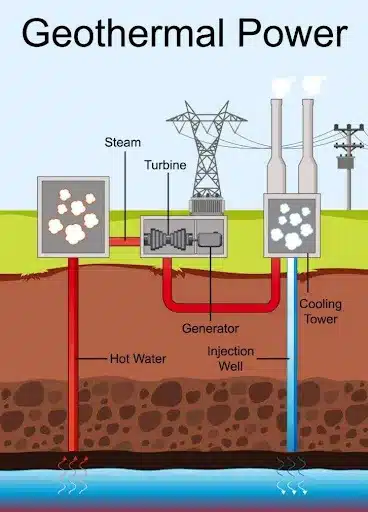
How it Works: The Process

  • The process of harnessing geothermal energy typically involves drilling wells to access underground reservoirs of hot water and steam, known as hydrothermal resources

  • The most common method for generating electricity from these resources involves a few key steps:
    • Extraction: Wells are drilled deep into the Earth to tap into geothermal reservoirs.
    • Conversion: The hot water or steam is brought to the surface. In a dry steam plant, the steam is used directly to spin a turbine. In a flash steam plant, high-pressure hot water is converted to steam in a "flash tank" before it turns the turbine.
    • Electricity Generation: The spinning turbine is connected to a generator, which converts the mechanical energy into electricity.
    • Reinjection: The cooled water or condensed steam is then pumped back into the geothermal reservoir, a crucial step for maintaining the pressure and sustainability of the resource.

India’s Geothermal Potential

  • India’s estimated geothermal potential is 10.6 GW, with major sites in the Himalayan Geothermal Province (Uttarakhand, Himachal Pradesh, Ladakh, Jammu and Kashmir, Arunachal Pradesh), the Cambay Graben in Gujarat, and the Andaman and Nicobar Islands. 
  • Abandoned oil wells in Cambay and Gandhar (ONGC, Gujarat) are being considered for geothermal use.

Global Geothermal Capacity

  • Globally, geothermal capacity is less than 17 GW, dominated by the US, Indonesia, and the Philippines, while Iceland and Norway lead in technology innovation.
  • The US International Trade Administration identified Ladakh’s Puga and Chumathang fields as India’s most promising. 
  • According to the International Energy Agency (IEA), China, the US, and India account for 75% of next-generation geothermal potential, with India’s capacity projected to reach 4.2 GW by 2035 and nearly 100 GW by 2045.

India’s Geothermal Energy Push

  • The Ministry of New and Renewable Energy (MNRE) launched its geothermal energy policy, to promote exploration and development. 
  • Companies from Norway and Iceland have begun pilot studies in the Gulf of Cambay, Arunachal Pradesh, and Uttarakhand.
  • Collaborations with the US and Indonesia are also being explored, especially for enhanced geothermal systems suited for large-scale power plants.

Potential Benefits in Remote Areas

  • According to the policy, geothermal energy can transform energy access in remote regions. 
  • In the Andaman and Nicobar Islands, where electricity costs ₹30–32 per unit, geothermal could reduce costs to ₹10–11 per unit. 
  • In Ladakh, it could supply both heating and electricity during extreme winters.

Repurposing Oil Wells

  • India has thousands of abandoned oil wells, particularly in the Gulf of Cambay, which can be repurposed for geothermal use. 
  • Oil and gas firms are showing interest: IIT Madras is piloting a 450 kWh project in Barmer, Rajasthan, with support from MNRE and Vedanta’s Cairn Oil & Gas. 
  • Reliance Industries also plans to expand into geothermal through its oil and gas business.

Challenges and Policy Support

  • Geothermal projects face high upfront costs and exploration risks, with an estimated ₹36 crore required per megawatt of capacity
  • To address this, the National Policy on Geothermal Energy will support R&D, pilot projects, and coordination across stakeholders, including the Ministry of Petroleum and Natural Gas and state governments. 
  • A viability gap funding (VGF) scheme is also being considered.

Ongoing Initiatives

  • MNRE has already sanctioned five projects, including one backed by Vedanta. 
  • With the new policy, it expects to expand this list. 
  • The policy follows the creation of an MNRE task force on geothermal energy (formed in August 2024) and aims to demonstrate commercial feasibility while building technical and financial frameworks for scaling up.

Source: IE | FE

India Geothermal Energy Policy FAQs

Q1: What is geothermal energy and how is it used?

Ans: Geothermal energy harnesses Earth’s heat from hot springs or reservoirs to generate electricity, heating, cooling, greenhouse support, and aquaculture benefits.

Q2: What is India’s geothermal potential?

Ans: India has an estimated 10.6 GW potential, mainly in Himalayan provinces, Cambay Graben, and the Andaman Islands, with prospects for expansion through further exploration.

Q3: How does the new policy support geothermal development?

Ans: It promotes R&D, pilot projects, repurposing oil wells, and viability gap funding, while coordinating efforts across MNRE, state governments, and petroleum ministries.

Q4: What benefits can geothermal bring to remote areas?

Ans: In Andaman, power costs could drop from ₹30 to ₹10 per unit; in Ladakh, geothermal can provide both electricity and winter heating.

Q5: What challenges does geothermal face in India?

Ans: High upfront costs (~₹36 crore per MW) and exploration risks are major hurdles, but policy support and industry pilots aim to demonstrate commercial feasibility.

EU-India Strategic Roadmap: Trade, Tech, and Defence

EU-India Strategic Roadmap

EU-India Strategic Roadmap Latest News

  • The European Union has unveiled a new EU-India Strategic Roadmap to boost cooperation in trade, technology, defence, connectivity, and climate action.

Introduction

  • The European Union (EU) has announced a comprehensive new strategic roadmap with India, aimed at strengthening ties across trade, technology, defence, connectivity, and climate action. 
  • This initiative comes at a time of shifting global geopolitics and underscores the recognition of India as a vital partner for Europe in ensuring growth, security, and a rules-based global order. 
  • The roadmap seeks to elevate bilateral cooperation to a higher level, laying the groundwork for long-term engagement.

EU-India Strategic Roadmap: Background and Vision

  • The roadmap was unveiled by European Commission President Ursula von der Leyen
  • It is presented as part of the EU’s joint communication on a New Strategic EU-India Agenda, reflecting the bloc’s intent to deepen relations with India.
  • The Commission emphasised the shared values and mutual benefits driving the partnership, noting that Europe is already India’s largest trading partner. 
  • It highlighted the aim to finalise the Free Trade Agreement (FTA) with India by the end of the year, which would become the largest deal of its kind globally.
  • At the same time, EU officials acknowledged points of contention, such as India’s purchase of Russian oil and participation in Russian military exercises, which could pose challenges in advancing ties.

Key Areas of Cooperation

  • Trade and Economic Ties
    • The EU is India’s biggest trading partner and views the FTA as a central element of the roadmap.
    • The strategy emphasises diversifying supply chains, enhancing investment flows, and fostering a conducive environment for business.
    • The proposal includes the creation of an EU-India Business Forum to increase business-to-business engagement.
  • Technology and Innovation
    • A strong focus has been placed on critical emerging technologies, digital transformation, and strengthening the EU-India Trade and Technology Council (TTC).
    • Initiatives include deepening digital cooperation, supporting startups, and inviting India to associate with the Horizon Europe programme, aimed at research and innovation.
  • Defence and Security Cooperation
    • The roadmap introduces a proposed EU-India Security and Defence Partnership, covering maritime security, cyber defence, crisis management, and counterterrorism.
    • It suggests launching negotiations for a Security of Information Agreement to facilitate classified information exchange.
    • The plan also emphasises strengthening defence industrial collaboration to boost technological capabilities and innovation.
  • Connectivity and Global Governance
    • The roadmap highlights regional connectivity initiatives such as the India-Middle East-Europe Economic Corridor (IMEC) and trilateral cooperation projects under the EU Global Gateway.
    • It prioritises cooperation in multilateral forums, promoting international law, and supporting global governance reforms.
    • Labour mobility is also being addressed through a European Legal Gateway Office and a broader mobility cooperation framework covering study, work, and research opportunities.
  • Climate Change and Sustainability
    • The agenda commits both sides to advancing climate action and clean energy cooperation, aligning with their shared global responsibility to combat climate change.
    • Cooperation will also extend to sustainable development initiatives and green technologies.

India’s Response and Global Implications

  • Prime Minister Narendra Modi welcomed the roadmap, reaffirming India’s commitment to strengthening its partnership with the EU. 
  • He emphasised India’s stance on a peaceful resolution of the Ukraine conflict and reiterated his invitation for the next India-EU Summit to be hosted in India.
  • The strategic roadmap reflects India’s growing global influence and the EU’s recognition of New Delhi as a critical partner in reshaping global economic and security architecture. 
  • Both sides acknowledge disagreements but underscore the broader alignment of interests in maintaining a rules-based international order.

Source: IE

EU-India Strategic Roadmap FAQs

Q1: What is the focus of the EU-India Strategic Roadmap?

Ans: It aims to deepen cooperation in trade, technology, defence, connectivity, and climate action.

Q2: Why is the EU-India Free Trade Agreement significant?

Ans: The FTA, once finalized, would be the largest deal of its kind in the world, boosting bilateral trade and investment.

Q3: How does the roadmap address defence and security?

Ans: It proposes a Security and Defence Partnership covering maritime security, cyber defence, and defence industrial cooperation.

Q4: What role does technology play in the roadmap?

Ans: It emphasizes emerging technologies, digital cooperation, startup partnerships, and research through the Horizon Europe programme.

Q5: What challenges could affect closer EU-India ties?

Ans: Differences over India’s purchase of Russian oil and participation in Russian military exercises remain key concerns.

Enquire Now