
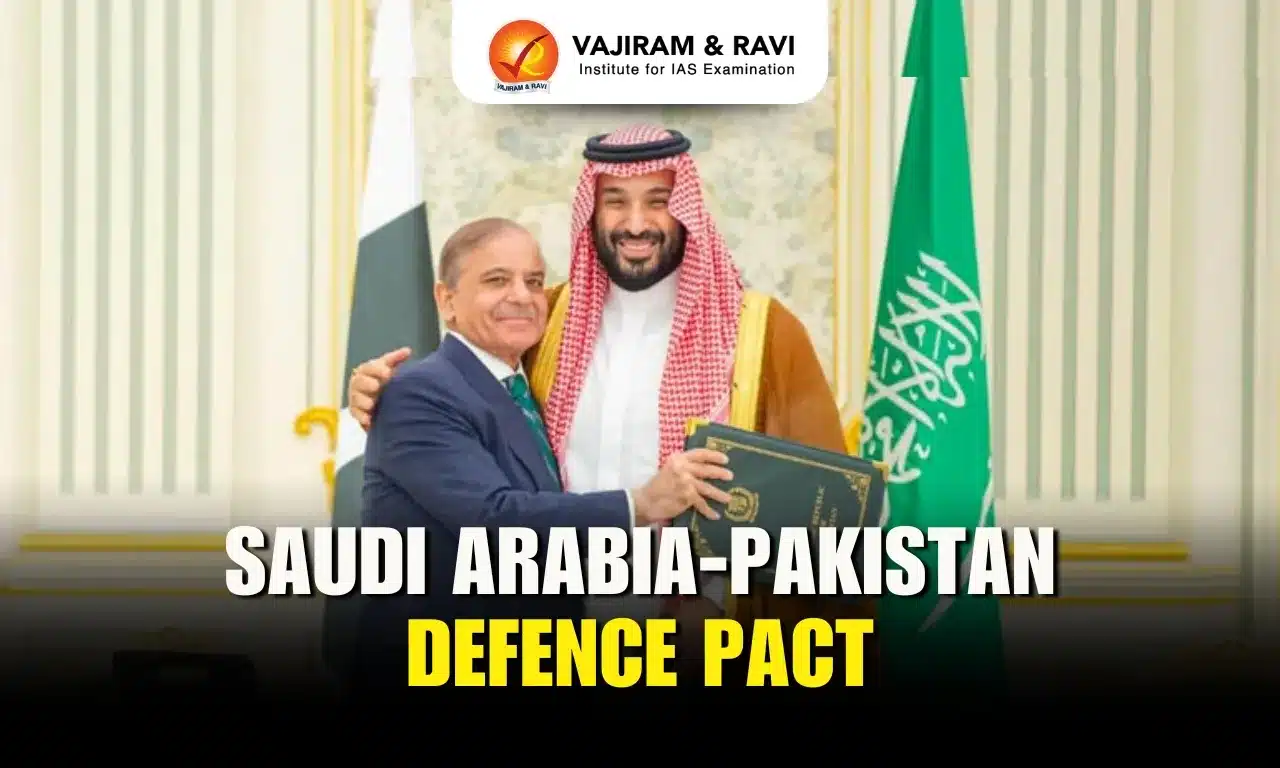
Saudi Arabia-Pakistan Defence Pact: Strategic Shift in Regional Security

Saudi Arabia-Pakistan Defence Pact

Saudi Arabia-Pakistan Defence Pact Latest News

  • Pakistan and Saudi Arabia have signed a landmark mutual defence pact, formalising a security partnership rooted since the 1960s. 
  • The agreement declares that “any aggression against either country shall be considered aggression against both.” It aims to deepen defence cooperation and strengthen joint deterrence in the region. 
  • The pact, finalised after Israel’s recent strike in Qatar and amid waning US defence assurances, marks the first major defence agreement between an Arab nation and a nuclear-armed state. 
  • While Saudi Arabia maintains close ties with India as well, this development signals a significant strategic shift in regional security dynamics.

Saudi Arabia-Pakistan Defence Pact and India’s Response

  • During Prime Minister Shehbaz Sharif’s visit to Riyadh, Pakistan and Saudi Arabia signed a mutual defence pact declaring that “any aggression against either country shall be considered an aggression against both.” 
  • The agreement builds on nearly eight decades of partnership, rooted in brotherhood, Islamic solidarity, and strategic defence cooperation. 
  • It aims to strengthen deterrence and promote regional and global security.
  • The defence pact signals a strategic shift, particularly as Saudi Arabia balances its close ties with both Pakistan and India. 
  • It highlights the evolving security and diplomatic landscape in the region.

India’s Cautious Response to Saudi-Pakistan Defence Pact

  • India reacted carefully to the Saudi Arabia-Pakistan mutual defence agreement, with MEA spokesperson noting that the government was aware of the long-standing arrangement. 
  • The Ministry of External Affairs said it will study its implications for national security and regional stability, reaffirming India’s commitment to protecting its interests.

Deepening Pakistan-Saudi Arabia Defence Ties

  • Pakistan and Saudi Arabia share a long history of military cooperation, beginning with Pakistani troop deployments in the 1960s and special forces support during the 1979 Mecca Grand Mosque crisis
  • Their ties were institutionalised in 1982 through a Bilateral Security Cooperation Agreement, enabling training, advisory roles, and arms sales. 
  • Pakistani personnel have played a key role in training the Saudi Air Force, while Saudi Arabia has been a major arms buyer. 
  • Recent meetings have pledged expanded training and exchanges. 
  • The latest defence pact marks Pakistan’s most significant formal commitment in decades, securing Saudi investment during its fiscal crisis and reinforcing its pan-Islamic security role. 
  • Analysts suggest Pakistan may now access U.S. weapons through Saudi funding
  • For Riyadh, the pact strengthens defences against Iran, Houthi militias, and instability triggered by Israel’s actions.

Saudi Arabia’s Strategic Ties with India

  • Economic Partnership
    • Saudi Arabia is India’s fifth-largest trading partner, while India is its second-largest
    • In FY 2023-24, bilateral trade reached USD 42.98 billion, with Indian exports at USD 11.56 billion and imports at USD 31.42 billion.
  • Political and Strategic Milestones
    • Relations deepened with King Abdullah’s 2006 visit, leading to the Delhi Declaration, followed by the Riyadh Declaration in 2010 that elevated ties to a Strategic Partnership. 
    • In 2016, PM Narendra Modi’s visit saw him receive Saudi Arabia’s highest civilian honour, the ‘King Abdulaziz Sash’.
  • Recent Engagements and Crisis Diplomacy
    • High-level exchanges have since continued. During PM Modi’s April 2025 visit, Saudi Arabia swiftly condemned the Pahalgam terror attack. 
    • Its Minister of State for Foreign Affairs also visited during Operation Sindoor.
  • Balanced Approach on Sensitive Issues
    • Saudi Arabia has maintained measured positions during India-Pakistan tensions — condemning terror attacks like Pulwama, but refraining from criticising India’s Article 370 abrogation or the Balakot strikes
    • It has often positioned itself as a mediator, engaging with both neighbours.

Source: IE | TH | TW

Saudi Arabia-Pakistan Defence Pact FAQs

Q1: What is the Saudi Arabia-Pakistan Defence Pact

Ans: The pact declares that any aggression against either country will be considered aggression against both, deepening defence cooperation and regional deterrence.

Q2: Why is the pact considered significant?

Ans: It marks the first major defence pact between an Arab nation and a nuclear-armed state, signed amid waning U.S. assurances and regional instability.

Q3: How has India reacted to the pact?

Ans: India responded cautiously, noting awareness of the arrangement and stating it will study implications for national security and regional stability.

Q4: What is the history of Saudi-Pakistan military ties?

Ans: Their cooperation dates back to the 1960s, formalised in 1982, with Pakistani forces training Saudi troops and providing advisory roles.

Q5: How does Saudi Arabia balance ties with India?

Ans: Despite deep defence ties with Pakistan, Saudi Arabia maintains strategic and economic ties with India, being its fifth-largest trade partner.
SC Guidelines vs Adani Gag Order: Free Speech and Defamation Cases

Adani Gag Order

Adani Gag Order Latest News

  • Recently, a lower court issued a sweeping ex-parte gag order restraining several journalists, including Paranjoy Guha Thakurta, from publishing allegedly defamatory content against Adani Enterprises Limited (AEL). 
  • The order also directed removal of numerous articles and social media posts. 
  • Following this, the Ministry of Information and Broadcasting issued takedown notices, resulting in the removal of 138 YouTube videos and 83 Instagram posts — some being satire or indirect references to Adani.

SC Guidelines on Defamation Injunctions

  • The Bonnard Standard
    • The Supreme Court follows the Bonnard principle (1891, Bonnard vs Perryman).
    • It states that a court can grant an injunction only when it is satisfied that the defendant may not be able to justify the defamation, and not merely when it suspects defamation.
  • SC’s Bloomberg Ruling (2024)
    • In 2024, the SC applied this principle while overturning an ex parte injunction ordering Bloomberg to take down an article on Zee Entertainment. 
    • The Court stressed that pre-trial injunctions should be rare, granted only when withholding them would cause “greater injustice.”
  • Supreme Court’s Caution on Ex Parte Orders
    • The SC has held that ex parte injunctions in free speech cases must only be granted in exceptional circumstances, and only when content is “malicious” or “palpably false.” 
    • Otherwise, they risk stifling public debate and undermining the public’s right to know.

The September 6 Adani Gag Order

  • A Delhi court issued a blanket gag order restraining Paranjoy Guha Thakurta and others from publishing content about Adani Enterprises Limited (AEL), while also authorising takedown of existing material within 36 hours.
  • This judgement had serious lacunas:
    • No judicial examination of the allegedly defamatory content was carried out.
    • The order effectively allowed AEL to curate public information about itself.
    • Journalists were restrained from publishing “unverified or defamatory” reports, amounting to prior restraint — unconstitutional under Article 19(1)(a).

Why Prior Restraint is Problematic

  • Restrictions on speech are valid only under Article 19(2), covering grounds like sovereignty, security, public order, morality, and defamation.
  • But prior restraint carries a heavy burden of proof and is rarely justified.
  • Journalists must be heard since truth and fair comment are lawful defences in defamation cases.

Delhi Court Quashes Gag Order in Adani Defamation Case

  • Later, District Judge of Delhi Court quashed the gag order for four journalists — Ravi Nair, Abir Dasgupta, Ayaskant Das, and Ayush Joshi — stating the order was unsustainable.
  • The court emphasised that the journalists had not been given an opportunity to be heard, violating principles of natural justice.
  • It noted that declaring articles defamatory and ordering their removal without defence could lead to irreversible consequences.
    • If later found non-defamatory, restoring removed content would be infeasible.

Key Highlights of the Judgement

  • The gag order was quashed for being ex-parte and unsustainable.
    • An ex parte order is a court ruling made at the request of one party without the other being present or notified
    • It is granted only in urgent situations for temporary relief, such as restraining orders, to prevent harm until a full hearing with both parties ensures fairness and due process.
  • The court reaffirmed that defendants must be given a chance to present their defence before sweeping takedown orders.
  • Judge warned against irreversible harm from premature content removal.
  • The ruling narrowed the scope but left other related appeals and the main defamation trial pending.

Source: IE | TH | B&B

Adani Gag Order FAQs

Q1: What is the Bonnard standard in defamation cases?

Ans: It states injunctions can be granted only if the defendant clearly cannot justify defamation, not merely on suspicion of defamation.

Q2: How did the SC apply this in 2024?

Ans: The SC overturned an ex parte injunction against Bloomberg, warning pre-trial gag orders must be rare and justified only to prevent greater injustice.

Q3: What did the September 6 Adani gag order state?

Ans: It restrained journalists from publishing content on AEL, ordered content takedowns within 36 hours, and imposed broad prior restraint.

Q4: Why was the gag order quashed?

Ans: The Delhi court ruled it violated natural justice, as journalists weren’t heard, and premature content removal could cause irreversible harm.

Q5: Why is prior restraint considered unconstitutional?

Ans: Because restrictions on free speech must fall under Article 19(2). Prior restraint without hearing the defence undermines lawful safeguards like truth and fair comment.

Onion Sector in India – Price Distress and Policy Challenges

Onion Sector

Onion Sector Latest News

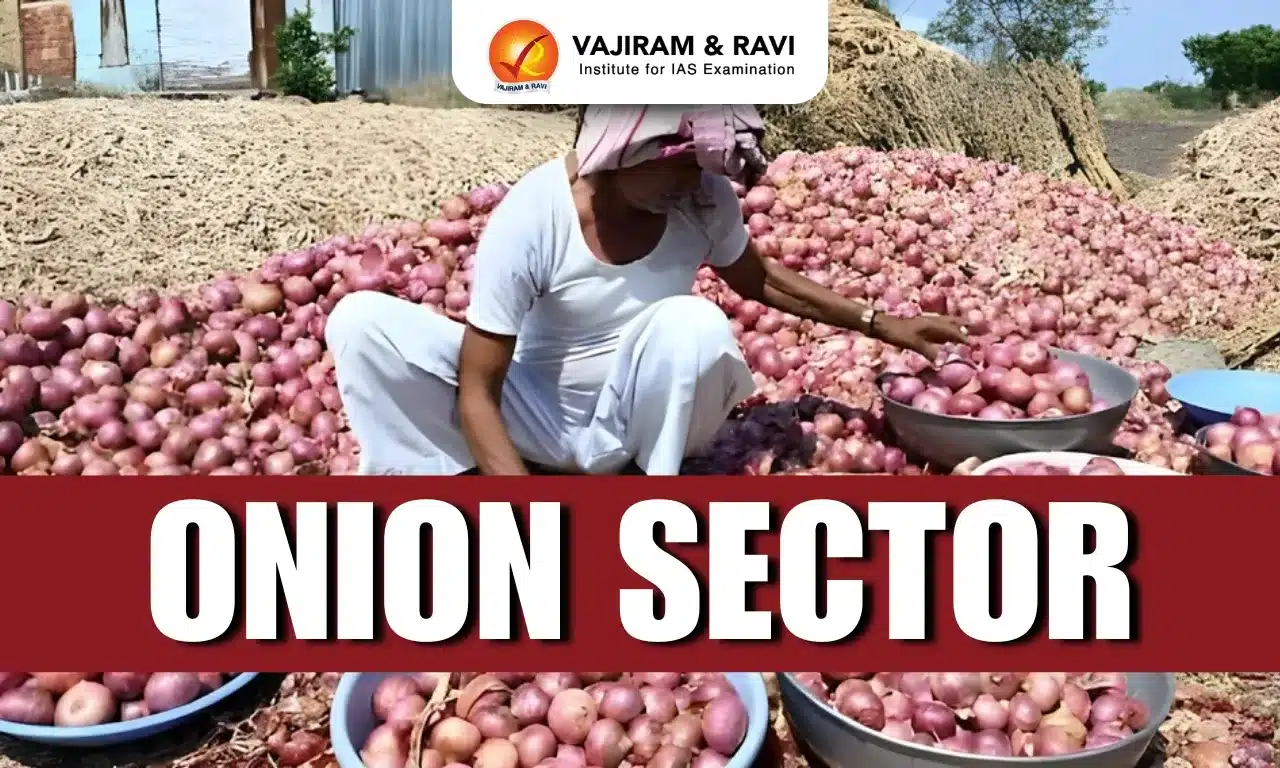
  • Maharashtra’s onion farmers are protesting after prices crashed below production costs, demanding compensation, stable export policies, and procurement support.

Onion Production in India

  • India is the world’s second-largest producer of onions, after China, with annual production averaging 25–30 million tonnes. 
  • Maharashtra, Madhya Pradesh, Karnataka, Gujarat, and Rajasthan are the leading producers. 
  • The country grows three onion crops, Kharif, Late Kharif, and Rabi, with Rabi onions having higher storage potential and accounting for nearly 60% of annual output.
  • Maharashtra dominates production due to a favourable climate and large-scale cultivation in districts like Nashik, Ahmednagar, Pune, and Solapur. However, despite its massive output, the sector faces persistent problems.

Challenges Faced by the Onion Sector

  • Price volatility: Onions often witness extreme price fluctuations due to excess production, poor storage, and sudden export restrictions.
  • Storage losses: A significant portion of Rabi onions deteriorates due to poor storage infrastructure, leading to wastage and distress sales.
  • Export policy flip-flops: Frequent bans and restrictions undermine India’s credibility in global onion markets, leading to competitors like China and Pakistan capturing India’s lost share.
  • High production costs: Fertilisers, seeds, storage, and labour raise production costs to Rs. 2,200-Rs. 2,500 per quintal, but farmers often receive far less in the market.

News Summary

  • Farmers in Maharashtra began agitating on September 12, 2025, after onion prices fell sharply. 
  • Currently, they are receiving only Rs. 800-Rs. 1,000 per quintal, less than half the cost of production. 
  • The crisis worsened because Rabi onions stored in anticipation of higher prices began deteriorating, forcing distress sales.
  • Adding to the distress, the government released buffer stocks into the market through the National Cooperative Consumers’ Federation (NCCF) and National Agricultural Cooperative Marketing Federation of India (NAFED). 
  • While the buffer stock policy aims to stabilise consumer prices, it further dragged down wholesale rates, aggravating farmers’ losses.
  • Farmers’ Demands
    • A compensation of Rs. 1,500 per quintal for the losses.
    • Immediate halt to the sale of NCCF and NAFED buffer stocks in cities.
    • A uniform and stable export policy to restore trust among importing nations.
    • Discussions with key buyers like Bangladesh and Sri Lanka, which were once major markets for Indian onions.
  • Impact of Export Policy
    • India exported 25.25 lakh tonnes of onions in 2022–23, but exports fell drastically to 11.47 lakh tonnes in 2024–25. 
    • This sharp fall eroded India’s competitiveness, with buyers shifting to China and Pakistan. 
    • Experts argue that inconsistent export policies have damaged India’s reputation in global markets.
  • Alternative Solutions Suggested
    • Farmers and exporters have urged the government to incentivise exports to regain India’s lost market share.
    • Replicating Andhra Pradesh’s procurement model, where onions are purchased at Rs. 1,200 per quintal, is being suggested for Maharashtra to ensure a minimum support price.
    • Long-term measures such as cold storage expansion and farmer-producer organisations (FPOs) for collective bargaining have been emphasised.

Conclusion

  • The onion crisis in Maharashtra reflects the deep-rooted systemic flaws in India’s agricultural pricing and export policies. 
  • While buffer stock release and price stabilisation policies aim to protect consumers, they often end up hurting farmers. 
  • The current protests underline the urgent need for structural reforms, from stable export strategies to better procurement models and infrastructure upgrades. 
  • Without these, India’s onion farmers will remain at the mercy of volatile markets, recurring protests, and policy inconsistencies.

Source: TH

Onion Sector FAQs

Q1: Why are onion farmers in Maharashtra protesting?

Ans: Farmers are protesting due to a price crash that has left them earning less than half their production costs.

Q2: What price are farmers demanding as compensation?

Ans: They are demanding government aid of Rs. 1,500 per quintal.

Q3: How is the buffer stock policy affecting onion farmers?

Ans: Releasing NCCF and NAFED buffer stocks has further depressed market prices, worsening farmers’ losses.

Q4: Why have India’s onion exports declined sharply?

Ans: Inconsistent export policies have caused credibility issues, leading countries like Bangladesh and Sri Lanka to turn to competitors.

Q5: What solution is suggested as a model for Maharashtra?

Ans: Experts suggest emulating Andhra Pradesh’s model of procuring onions at ₹1,200 per quintal to safeguard farmer incomes.

Enquire Now

