
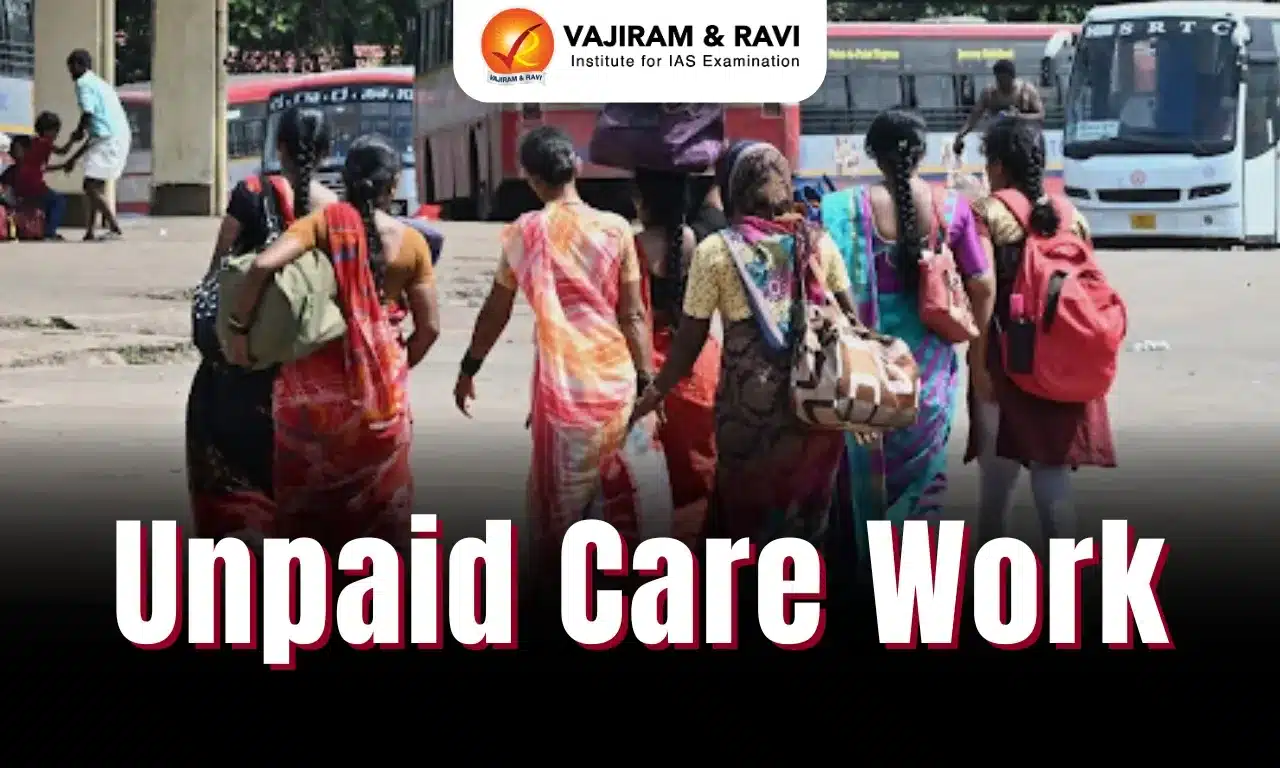
Women’s Unpaid Care Work – Calls for Better Data

Unpaid Care Work

Unpaid Care Work Latest News

  • Experts have urged the government to refine the Time Use Survey to capture whether women’s rising unpaid care work is a matter of choice or obligation.

Introduction

  • Unpaid care work forms the invisible backbone of economies worldwide, yet it remains undercounted and undervalued. 
  • In India, women disproportionately shoulder this burden, spending hours daily on household chores, caregiving, and community work that go unrecognised in formal economic indicators like GDP. 
  • While India conducts a Time Use Survey (TUS) to map these patterns, experts argue that it does not fully capture the reasons behind women’s engagement in unpaid labour. 
  • The need for more granular data has become crucial as female labour force participation rates (FLFPR) in India remain among the lowest in the world, raising concerns over gender inequality in economic and social outcomes.

Women’s Unpaid Care Work in India

  • Globally, women spend three times more hours than men on unpaid care work. In India, the gender gap is even more striking. 
  • According to the 2019 TUS, Indian women spend 4.5 hours daily on unpaid household and caregiving tasks, compared to just 1.5 hours for men. Activities include:
    • Cooking, cleaning, and household maintenance.
    • Caring for children, elderly, and sick family members.
    • Community-related unpaid services, such as water collection.
    • While vital, these activities are excluded from GDP accounting, thereby undervaluing women’s economic contributions. 
  • This unpaid work also constrains women’s access to education, skill development, and formal employment, creating a vicious cycle of economic dependency.
  • Impact on Female Labour Force Participation
    • India’s female labour force participation rate hovers around 23% (PLFS 2022-23), far lower than global averages and peers like China (61%) and Bangladesh (38%). 
    • A significant factor behind this gap is the disproportionate unpaid care burden on women. 
    • The absence of institutional support, such as affordable childcare, elderly care infrastructure, and flexible work arrangements, worsens the problem.

Limitations of the Time Use Survey

  • The National Sample Survey Office (NSSO) conducted India’s first TUS in 1998-99, followed by the second in 2019. 
  • While the survey captures the number of hours men and women spend on paid and unpaid activities, experts argue it falls short in answering critical questions:
    • Choice vs. Compulsion: Are women engaging in unpaid care work voluntarily, or because societal and economic pressures leave them with no option?
    • Quality of Work: Does unpaid care work affect women’s health, aspirations, and capacity to enter paid employment?
    • Policy Integration: How can the findings be used to design childcare schemes, flexible employment policies, and social security?
  • Without capturing these nuances, the TUS risks portraying unpaid labour as an accepted “choice” rather than an economic compulsion rooted in gender norms.

Expert Recommendations for Improvement

  • Several labour economists, gender experts, and social researchers have called for reforms in how India measures unpaid care work:
  • Refined Survey Methodology
    • Introduce qualitative questions on whether women see unpaid care work as a duty or a choice.
    • Capture intergenerational differences, as younger women may perceive unpaid labour differently than older cohorts.
  • Integration with Labour Statistics
  • Policy-Oriented Use of Data
    • Use findings to strengthen schemes like the Pradhan Mantri Matru Vandana Yojana (PMMVY) and Anganwadi services, ensuring women get institutional support for care responsibilities.
  • Recognition in GDP Accounting
    • Explore satellite accounts or alternative GDP frameworks that assign economic value to unpaid care work.

Source: IE

Unpaid Care Work FAQs

Q1: What is unpaid care work?

Ans: Unpaid care work refers to household chores, caregiving, and community-related services performed without pay, predominantly by women.

Q2: How many hours do Indian women spend on unpaid care work?

Ans: On average, Indian women spend 4.5 hours daily on unpaid care work, compared to 1.5 hours for men.

Q3: Why is the Time Use Survey important for women’s empowerment?

Ans: It helps track the distribution of unpaid and paid work, influencing policies on childcare, labour force participation, and social security.

Q4: What reforms are experts suggesting in the TUS?

Ans: Experts recommend adding questions on whether unpaid care is a matter of choice or compulsion and linking it with labour force data.

Q5: How does unpaid care work affect India’s economy?

Ans: It keeps millions of women out of the formal workforce, reducing female labour participation and undervaluing women’s contributions to GDP.
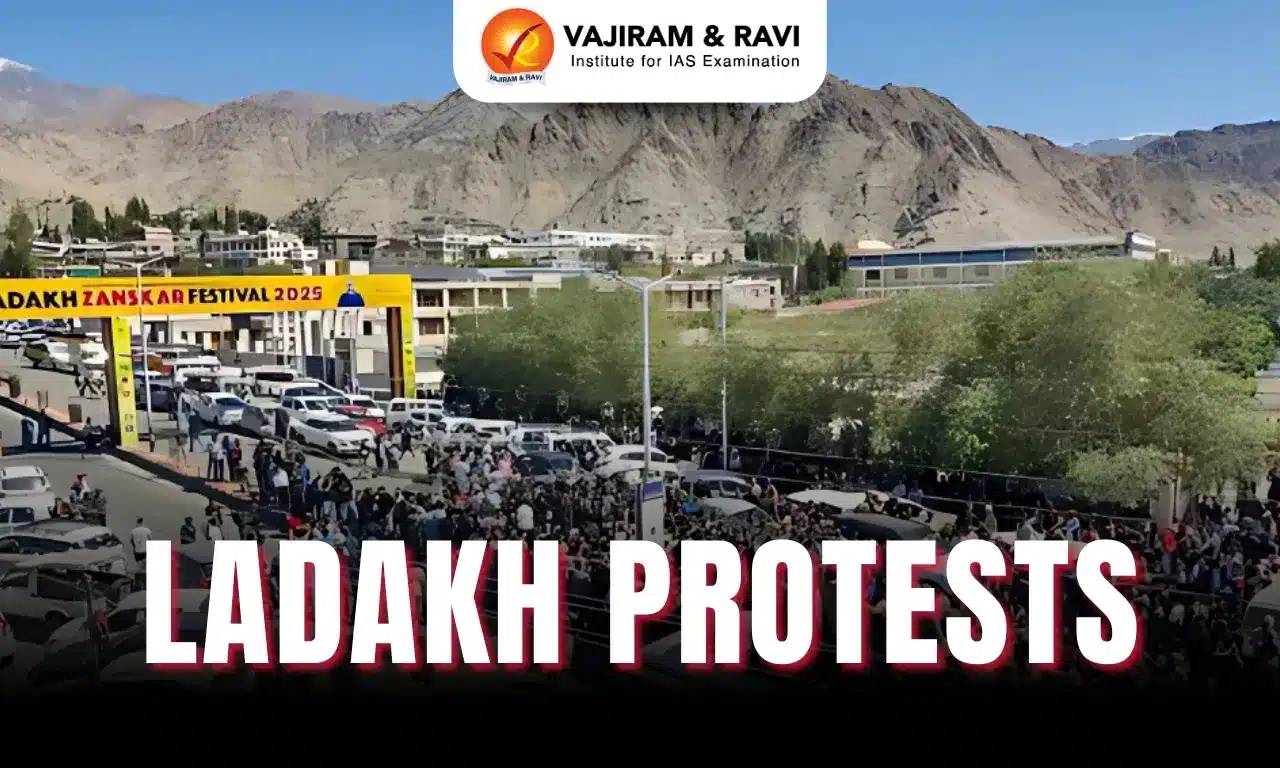
Youth-led Ladakh Protests: Demands for Statehood, Sixth Schedule and Autonomy

Ladakh Protests

Ladakh Protests Latest News

  • Protests in Ladakh demanding statehood and inclusion under the Sixth Schedule escalated, when demonstrators turned violent.  
  • The clashes left four people dead and 30 others injured, prompting a massive shutdown in Leh town led by the Leh Apex Body (LAB). 
  • Amid the unrest, climate activist Sonam Wangchuk ended his 15-day hunger strike, urging Ladakh’s youth to continue their demonstrations peacefully and safeguard the five-year-long movement pressing the Centre to act on these demands.

Root Cause of Ladakh Protests

  • The current protests in Ladakh stem from the 2019 repeal of Article 370 and the passage of the Jammu and Kashmir Reorganisation Act, 2019, which bifurcated the erstwhile state. 
  • While Jammu and Kashmir became a Union Territory with a legislature, Ladakh was made a Union Territory without one, placing it under direct central administration. 
  • This lack of political representation and autonomy has kept Ladakh’s status contentious, fueling long-standing discontent and the present demand for statehood and inclusion under the Sixth Schedule.

Demand for Sixth Schedule in Ladakh

  • With over 90% of Ladakh’s population belonging to Scheduled Tribes, there is a strong demand to bring the region under the Sixth Schedule of the Constitution
  • This provision under Article 244 allows the creation of Autonomous District Councils (ADCs) that govern tribal-majority areas with powers to make laws on land, forests, water, agriculture, village councils, health, sanitation, and local policing. 
  • Each ADC has up to 30 members with a five-year term
    • At present, there are 10 such councils in the Northeast—three each in Assam, Meghalaya, and Mizoram, and one in Tripura. 
  • Supporters argue that a similar framework in Ladakh would ensure self-governance and protection of tribal rights.

Immediate demands behind Leh protest

  • LAB’s Immediate Demands - The Leh Apex Body (LAB), whose youth wing called for the September 24 protest, demanded an urgent meeting with the central government as members had been on a hunger strike since September 10.
  • Government’s Response - The Ministry of Home Affairs (MHA) announced that the next round of talks would be held on October 6, noting that the last meeting took place in May.
  • LAB’s Objection - LAB leaders rejected the October date as “dictation” while their members were still fasting. They insisted on an immediate agreement before ending the protest.
  • Rising Tensions - LAB warned that while the protest was peaceful, growing impatience among people risked spiraling out of control, eventually sparking violent clashes in Leh.

Government’s Position

  • The MHA has agreed to discuss only the service commission and Lok Sabha seat demands, rejecting statehood and resisting Sixth Schedule inclusion due to its wider ramifications.

Core Demands of Ladakh Protest

  • Since Ladakh became a Union Territory (UT) in 2019, residents have rallied around a four-point agenda:
    • Statehood for Ladakh to ensure self-governance beyond UT status.
    • Inclusion under the Sixth Schedule to safeguard tribal rights.
    • A separate public service commission to address high unemployment.
    • Two parliamentary seats instead of one, to increase representation at the Centre.

Unemployment Concerns

  • Youth discontent is driven by high joblessness, with 26.5% of Ladakh graduates unemployed, compared to the national average of 13.4%. 
  • This has fuelled calls for a separate service commission and 95% job reservation for Ladakhis, reportedly discussed with the MHA in 2024.

Possible Way Forward in Ladakh

  • A short-term solution to Ladakh’s statehood demand appears unlikely due to India’s strategic need for unfettered access in the border region with China. 
  • The Centre fears statehood could complicate troop movements and infrastructure building.
  • Protests are therefore expected to continue, with the LAB and KDA intensifying pressure
  • A possible compromise could involve expanding the powers of Hill Councils, alongside special job and land ownership reservations for locals. 
  • In return, protest groups may need to set aside statehood demands and accept Ladakh’s status as a Union Territory, at least for now.

Source: IE | NDTV | HT

Ladakh protests FAQs

Q1: Why are people protesting in Ladakh?

Ans: The repeal of Article 370 and Ladakh’s UT status without a legislature left people demanding statehood, Sixth Schedule inclusion, and more political autonomy.

Q2: What is the Sixth Schedule demand in Ladakh?

Ans: With over 90% tribal population, people want Sixth Schedule status, granting Autonomous District Councils powers over land, resources, and self-governance.

Q3: What are the core demands of Ladakh protests?

Ans: Protesters demand statehood, Sixth Schedule inclusion, a separate service commission to address unemployment, and two parliamentary seats for stronger representation.

Q4: Why did protests in Leh turn violent?

Ans: The Leh Apex Body (LAB) rejected the MHA’s October talks date, calling it “dictation” amid hunger strikes, leading to clashes that killed four and injured 30.

Q5: Is there a possible solution to the Ladakh unrest?

Ans: A compromise may involve expanding Hill Council powers and job reservations, with protesters accepting UT status while pressing for long-term autonomy.

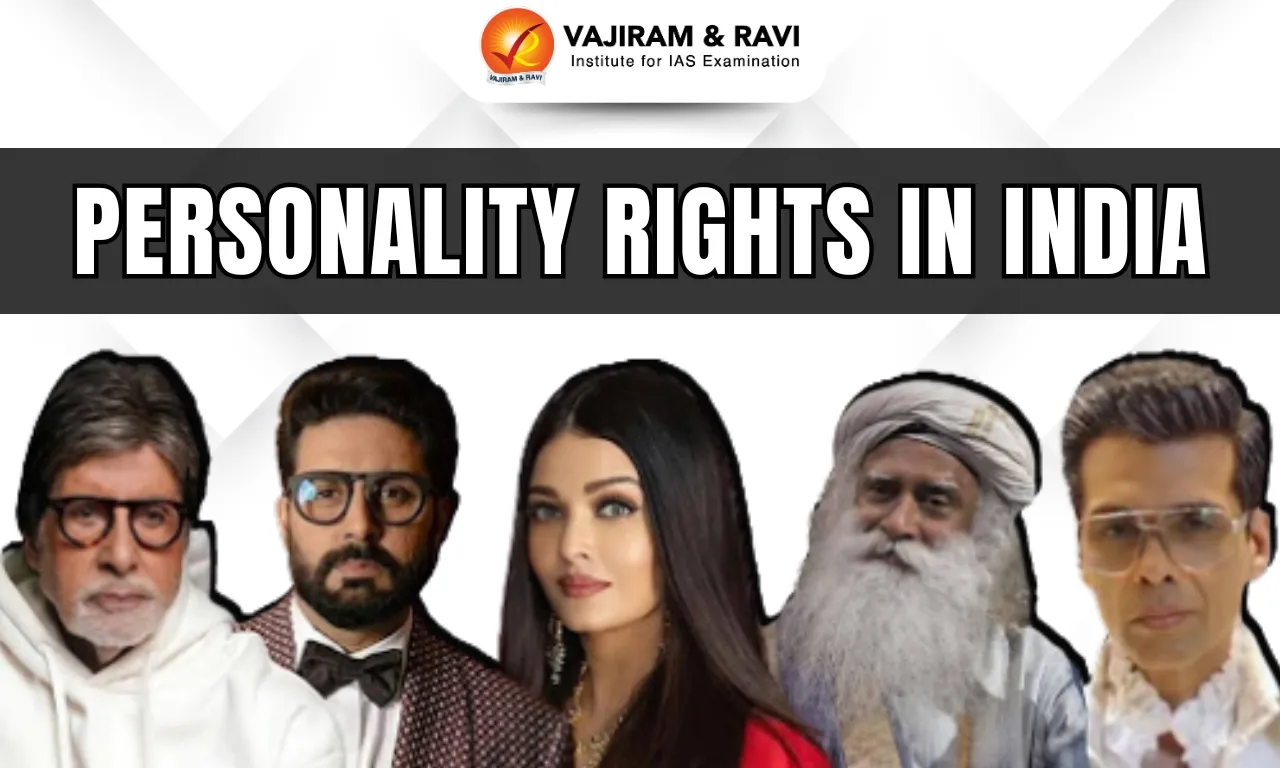
Personality Rights in India: How Courts Protect Celebrities in the Digital Era

Personality Rights in India

Personality Rights in India Latest News

  • The Delhi High Court has recently expanded protection of personality rights for Bollywood stars against unauthorised use of their images, voices, and likeness. 
  • The court granted relief to Aishwarya Rai Bachchan and Abhishek Bachchan, following complaints of AI-generated misuse.
  • Earlier, Amitabh Bachchan, Anil Kapoor, and Jackie Shroff had secured such safeguards. 
  • This growing series of petitions marks a significant judicial shift in recognising and enforcing personality rights in India’s digital era.

Protection of Personality Rights in India

  • Personality rights protect an individual’s name, likeness, image, voice, signature, and other unique traits from unauthorised commercial use
  • Though not codified under a single statute, they are safeguarded through judicial precedents and common law doctrines of privacy, defamation, and publicity rights. 
  • Courts can grant injunctions, damages, or takedown orders to prevent misuse in ads, merchandise, AI-generated content, or digital platforms.

Statutory Safeguards

  • Protection is dispersed across intellectual property laws. 
  • Under the Copyright Act, 1957, performers enjoy exclusive rights (Section 38A) and moral rights (Section 38B) to control reproduction and object to distortion of their work. 
  • The Trade Marks Act, 1999 allows celebrities to register names, signatures, or catchphrases as trademarks — a step taken by actors like Shah Rukh Khan, Priyanka Chopra, Ajay Devgn, and Amitabh Bachchan. 
  • Additionally, the common law tort of “passing off” (Section 27) safeguards goodwill from misrepresentation or false endorsement, though it requires proof of reputation before courts grant relief.

Constitutional Backing

  • Personality rights are rooted in Article 21 of the Constitution, which guarantees autonomy and privacy. 
  • While celebrities may authorise the use of their identity in films, ads, or campaigns, unauthorised use — such as printing images on merchandise or creating AI deepfakes — strips them of control and compromises dignity and agency.

Court Rulings on Personality Rights in India

  • The jurisprudence on personality rights in India began with the 1994 Supreme Court judgment in R. Rajagopal v. State of Tamil Nadu
    • The Court upheld an individual’s right to control their identity, grounding it in the constitutional right to privacy.
  • In 2015, the Madras High Court strengthened the doctrine in a case involving actor Rajinikanth
    • It ruled that infringement occurs even without proof of falsity, confusion, or deception if the celebrity is identifiable, thereby protecting him against unauthorised commercial use of his name, image, and style.
  • The Delhi High Court has since played a pivotal role in addressing new threats posed by AI. 
    • In 2023, it granted Anil Kapoor broad protection over his persona, barring online misuse of his name, likeness, and catchphrase “jhakaas.” 
    • HC clarified that free speech allows parody and criticism but not commercial exploitation or tarnishment of reputation.
    • In 2024, the same court protected Jackie Shroff’s personality rights against misuse by e-commerce platforms and AI chatbots.
  • Later, in 2023, the Bombay High Court upheld Arijit Singh’s rights in a landmark ruling against AI voice cloning. 
    • The court condemned the unauthorised creation of artificial recordings, warning of the dangers generative AI poses to performers’ dignity and control over their identity.

Balancing Personality Rights and Free Expression

  • While courts in India have expanded protection of personality rights, they have also emphasised the need to balance them with Article 19(1)(a).
    •  Article 19 guarantees freedom of speech, including criticism, parody, and satire of public figures.
  • In DM Entertainment Pvt. Ltd. v. Baby Gift House (2010), the Delhi High Court granted relief against unauthorised commercial exploitation of singer Daler Mehndi’s likeness.
    • However, it cautioned that parodies, caricatures, and lampooning would not ordinarily violate publicity rights.
  • This balance was reaffirmed in Digital Collectibles PTE Ltd. v. Galactus Funware Technology Pvt. Ltd. (2023), involving the unauthorised use of sports stars’ likenesses. 
    • The Court ruled that publicity rights cannot override free expression, especially when material is already in the public domain. 
    • It clarified that legitimate uses of celebrity names or images — such as satire, art, scholarship, news, and music — fall under free speech and do not amount to infringement.

Concerns Around Personality Rights in India

  • Experts highlight the urgent need for a comprehensive legislative framework to regulate personality rights, as current enforcement relies heavily on fragmented judicial precedents. 
  • Without a clear regulatory regime, responses remain ad hoc and risk blurring the line between artistic freedom and infringement. 
  • Clear exceptions must be established to prevent misuse of personality rights as a tool for censorship.
  • Experts also stress that personality rights are not exclusive to celebrities. 
  • Ordinary citizens, particularly women, face disproportionate harm through deepfakes, impersonation, and revenge pornography. 
  • While courts often direct governments to block such harmful content, the sheer volume of violations makes consistent enforcement extremely difficult.

Source: TH | BBC | B&B

Personality Rights in India FAQs

Q1: What are personality rights in India?

Ans: Personality rights protect an individual’s name, image, voice, and likeness from unauthorised use. Indian courts enforce them through privacy, publicity rights, and IP laws.

Q2: Which Indian laws support personality rights?

Ans: The Copyright Act, 1957 and Trade Marks Act, 1999 provide safeguards, alongside common law doctrines like “passing off,” protecting celebrities against false endorsements and misrepresentation.

Q3: How have Indian courts ruled on personality rights?

Ans: Key rulings like Rajinikanth’s case, Anil Kapoor’s “jhakaas” protection, and Arijit Singh’s AI voice cloning case highlight judicial recognition of celebrity personality rights.

Q4: Do personality rights conflict with free expression?

Ans: Yes, but courts balance them with Article 19(1)(a). Parody, satire, art, and news use of celebrity images remain protected under free speech.

Q5: Why is a legal framework for personality rights needed?

Ans: Currently, protection relies on scattered judicial precedents. Experts call for a clear law to prevent misuse while safeguarding artistic freedom and privacy.

Enquire Now

