
India Successfully Tests Agni-Prime Missile from Rail-Based Launcher | Strategic Significance Explained

Agni-Prime Missile

Agni-Prime Missile Latest News

  • The Defence Research and Development Organisation (DRDO) successfully test-fired the Agni-Prime (Agni-P) missile from a rail-based mobile launcher
  • This launch has placed India among a select group of nations — Russia, the US, China, and possibly North Korea — with the capability to launch long-range ballistic missiles from railway platforms using canisterised launch systems.

Agni Series of Missiles

  • The Agni series is India’s family of nuclear-capable ballistic missiles, developed under the Integrated Guided Missile Development Programme (IGMDP) by the Defence Research and Development Organisation (DRDO). 
  • They are a key element of India’s strategic deterrence capability.
  • Agni-I (1989): A medium-range ballistic missile (MRBM) with a range of 700–1,000 km. It was India’s first in the series and is road- and rail-mobile.
  • Agni-II (1999): A two-stage solid-fuel missile with a range of 2,000–3,000 km, capable of carrying nuclear warheads.
  • Agni-III (2006): An intermediate-range ballistic missile (IRBM) with a range of 3,500–5,000 km, providing wider regional coverage.
  • Agni-IV (2011): Improved navigation and accuracy, range of 3,500–4,000 km, lighter and more advanced than Agni-III.
  • Agni-V (2012): An intercontinental ballistic missile (ICBM) with a range of 5,000–8,000 km, extending India’s deterrence to cover much of Asia and parts of Europe and Africa.
  • Agni-P (Agni-Prime, 2021): A next-generation variant with a range of 1,000–2,000 km, combining advanced technologies from Agni-IV and V, lighter, more accurate, and canisterised.
  • Agni-VI (under development): Expected range of 8,000–10,000 km, with potential multiple independently targetable re-entry vehicle (MIRV) capability.

Agni-P: The Next-Generation Upgrade to Agni-I

  • India’s Agni missile series, developed since the late 1980s, began with the Agni-I medium range ballistic missile (700–1,000 km range) tested in 1989. 
  • While Agni-I remains in service, defence planners sought upgrades, leading to the development of Agni-P (Agni-Prime).
  • Agni-P combines Agni-I’s range with advanced propulsion and navigation technologies from Agni-IV and Agni-V.
    • It is the sixth missile in the Agni series. 
  • Weighing 11,000 kg, it is a two-stage, solid-fuel missile with an operational range of 1,000–2,000 km, capable of carrying high explosive, thermobaric, or nuclear warheads.
  • A nuclear-capable version tested in 2021 drew praise from the then Defence Minister, who said it would further bolster India’s Credible Deterrence capabilities.

Mobile Launch Platforms and India’s Second-Strike Capability

  • Mobile launch systems are vital to a nation’s second-strike capability, enabling it to retaliate after a nuclear attack. 
  • For India, which follows a “no first use” nuclear doctrine, such survivability is critical.
  • Advances in satellite imagery, missile accuracy, and sensing technologies have made stationary silos increasingly vulnerable. 
  • As noted by defence experts, silos face heightened risks from both conventional and nuclear strikes.
  • To counter this, militaries rely on mobile launch platforms — submarines, aircraft, and road or rail-based launchers — which are harder to detect and more resilient in an all-out conflict.

Advantages of Rail-Based Missile Launchers

  • Rail-based missile platforms offer distinct advantages over road or sea systems. 
  • While road-based launchers are constrained by road width and quality, India’s 70,000-km railway network enables nationwide mobility without major preparation.
  • The numerous railway tunnels provide natural hiding spots, allowing launchers to evade enemy satellite surveillance and remain concealed until deployment.
  • Compared to submarine-launched ballistic missiles (SLBMs), rail-based platforms are also cheaper to build and maintain, making them a more efficient and scalable option for strengthening strategic deterrence.

Countries with Rail-Based Missile Technology

  • India’s recent test places it among a select group of nations with rail-based missile launch capability. 
  • The idea dates back to the Cold War, when both the US and USSR explored rail-mobile ICBMs.
  • The US studied rail launchers for its Minuteman ICBMs in the 1950s and again planned Peacekeeper deployment in the 1980s, but abandoned both due to cost and the Soviet collapse. 
  • The Soviet Union successfully deployed the RT-23 Molodets rail-based ICBM system, later dismantled under the START Treaty
    • Russia later considered reviving the concept with the Barguzin system but shelved it in favour of hypersonic missile development.
  • In 2016, China reportedly tested a rail-mobile version of its DF-41 ICBM. 
  • North Korea has also tested rail-based short-range ballistic missiles (SRBMs), demonstrating their mobility and survivability.
  • Experts note that rail-based missiles are a cheap, reliable option for enhancing nuclear force survivability, with Russia pioneering it, the US considering it, and North Korea actively pursuing it.

Source: IE | FP | PIB

Agni-Prime Missile FAQs

Q1: What is the Agni-Prime missile?

Ans: Agni-Prime is a two-stage, solid-fuel ballistic missile with a 1,000–2,000 km range, carrying nuclear or conventional warheads.

Q2: Why is the Agni-Prime test significant?

Ans: It marks India’s entry into the select group of nations capable of rail-based missile launches, enhancing survivability and deterrence.

Q3: How does a rail-based launcher help India?

Ans: Rail-based platforms provide mobility, concealment in tunnels, and lower costs compared to submarine-based missile systems, strengthening second-strike capability.

Q4: Which countries have rail-based missile technology?

Ans: Russia, the US, China, and North Korea have developed or tested such systems, with India now joining this elite group.

Q5: What role does Agni-Prime play in India’s nuclear doctrine?

Ans: It supports India’s “no first use” policy by ensuring survivability and credible second-strike deterrence against adversaries.
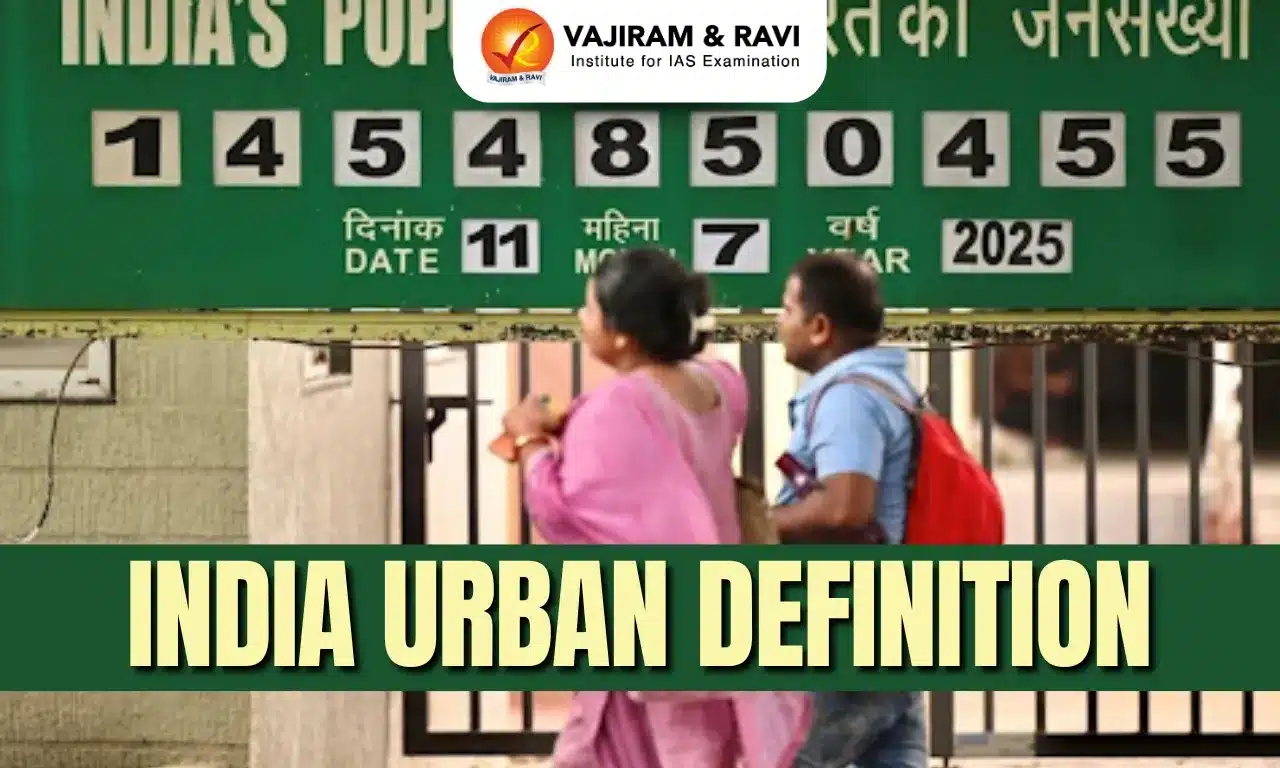

India’s Urban Blind Spot: Why Outdated Census Definitions Must Change

India Urban Definition

India Urban Definition Latest News

  • The Registrar General of India has proposed retaining the 2011 Census definition of urban areas for Census 2027, ensuring comparability and consistency in analysing urbanisation trends.

Criteria for Urban Classification

  • In 2011, an urban unit was defined as either:
    • Statutory Towns – formally notified by State governments with urban local bodies such as municipal corporations, municipal councils, or nagar panchayats.
    • Census Towns – settlements meeting three conditions:
      • Population of at least 5,000
      • At least 75% of the male main working population engaged in non-agricultural activities
      • Population density of at least 400 persons per sq. km
  • By these criteria, only 31.2% of India is considered urban, though the actual extent is believed to be much higher.
  • Though census towns are administratively rural, they function like urban areas, creating a gap between governance and ground realities.

Global Comparisons

  • Unlike India’s strict three-criteria approach, most countries rely on one or two measures such as demographics, density, or infrastructure. 
  • The World Bank’s Agglomeration Index estimated that 55.3% of India’s population lived in urban-like areas in 2010, showing “hidden urbanisation” outside statutory limits.

DEGURBA: A Global Framework

  • To harmonise global urban definitions, six international organisations developed the Degree of Urbanisation (DEGURBA) method, endorsed by the UN in 2020.
    • It uses satellite imagery and population grids of 1 km².
    • Settlements are classified into seven sub-categories: urban centres, dense/semi-dense clusters, peri-urban, and various rural categories.
  • This approach captures the real spatial extent of urbanisation beyond administrative boundaries.
  • DEGURBA helps detect settlement patterns, improve service monitoring, and guide financial targeting. 
  • However, its low-density thresholds may misclassify croplands or peri-urban fringes as urban. 
  • As it relies on algorithms and satellite data, risks of under- or over-detection remain.

Limitations of Current Urban Definition

  • India’s binary definition of urban and rural fails to capture the complex realities of evolving settlements. 
  • While urban local bodies enjoy autonomy and better governance, Panchayati Raj institutions are limited, leaving many fast-urbanising areas under inadequate rural administration. 
  • Villages transforming into towns often remain unrecognised, despite dense populations, non-agricultural livelihoods, and urban lifestyles. 
  • As a result, census towns and peri-urban regions are excluded from proper governance and infrastructure, creating gaps in planning and services. 
  • For example, Census data show that 251 towns identified as urban in 2001 continued to be governed as rural areas even in 2011. 
  • West Bengal, with the highest rise in census towns, illustrates this mismatch, as many newly classified urban settlements were never converted into statutory towns with elected bodies, leaving them underprepared for infrastructure and planning needs.

Implications of Outdated Urban Definition

  • As India prepares for Census 2027, retaining the old definition of “urban” risks undercounting millions and excluding rapidly growing settlements from governance and services. 
  • Studies show India’s true urban population in 2011 may have been 35–57%, much higher than the official 31%. 
  • The rigid rules — such as the 75% male workforce engaged in non-agricultural jobs — are outdated, ignoring women’s informal work and the rise of industries, service jobs, and gig economy employment in semi-urban and rural areas. 
  • Many settlements that function as urban clusters remain unrecognised because they fall outside municipal boundaries or are divided administratively. 
  • Seasonal workers who straddle agriculture and urban jobs also fall through the cracks. 
  • Thus, continuing with the narrow, binary definition will misclassify urbanisation trends, leaving infrastructure, planning, and services ill-suited to India’s evolving settlement patterns.

Source: TH | TH | WRI

India Urban Definition FAQs

Q1: What is India’s current definition of urban?

Ans: Urban areas include statutory towns and census towns meeting criteria of 5,000 population, 400 density, and 75% male non-agricultural workforce.

Q2: Why is this definition outdated?

Ans: It ignores women’s work, gig economy jobs, and peri-urban clusters, misclassifying millions living in urban-like conditions.

Q3: How much of India is truly urbanised?

Ans: Though officially 31.2% in 2011, alternative studies suggest India’s urban population could be 35–57% using modern criteria.

Q4: What is DEGURBA and why is it important?

Ans: DEGURBA is a UN-backed framework using satellite data and population grids, offering nuanced classification beyond binary rural-urban definitions.

Q5: What are the risks of not updating India’s urban definition?

Ans: Misclassification leads to poor planning, misallocation of funds, and exclusion of settlements from governance and infrastructure services.

Regulation of Social Media – Karnataka High Court on Sahyog Portal

Regulation of Social Media

Regulation of Social Media Latest News

  • The Karnataka High Court rejected social media platform X’s plea against the Central Government’s Sahyog Portal - a digital mechanism to issue content takedown notices.
  • The Court upheld the State’s right to regulate social media, calling Sahyog an “instrument of public good” and a “beacon of cooperation” between citizens, state, and platforms.
  • The Court stressed that social media platforms cannot operate in a state of “anarchic freedom.”

Sahyog Portal - A Public Good

  • Launched: October 2024 by the Union Home Ministry, and maintained by the Indian Cyber Crime Coordination Centre (I4C).
  • Purpose: A centralised channel (which connects central agencies, state police, and online intermediaries to combat cybercrime) for issuing takedown notices to intermediaries.
  • Legal basis: Section 79(3)(b), IT Act, 2000 – intermediaries lose “safe harbour protection” if they fail to act upon government notices of unlawful content.
  • Operational data:
    • 65 intermediaries and nodal officers onboarded by April 2025.
    • 130 takedown notices issued (Oct 2024 – Apr 2025) to platforms including Google, YouTube, Amazon, Microsoft.

X Corporation’s Challenge

  • Claim: Sahyog is a “censorship portal” creating a parallel, extra-legal content blocking regime.
  • Arguments:
    • Section 79(3)(b) notices bypass stricter procedural safeguards under Section 69A IT Act. Unlike Section 69A, notices under Section 79(3)(b) lack transparency, hearing, and written reasoning.
    • Violates Shreya Singhal (2015) judgment, in which the apex court had specified that a takedown order under Section 79(3)(b) -
      • Could only be issued pursuant to a court order or a government notification and 
      • Must relate to grounds similar to those in Section 69A.
    • State governments and police issuing notices via Sahyog expands censorship arbitrarily.
  • Support: Supporting X’s challenge, Digipub (collective of 92 digital publishers) argued that blocking orders through Sahyog threatens media freedom.

Government’s Defence

  • Necessity: Social media requires stricter regulation due to algorithmic amplification and rapid spread of harmful content.
  • ‘Safe harbour’ is not absolute: It is a statutory privilege conditional upon due diligence.
  • Separation of powers: Section 79(3)(b) and Section 69A operate independently.
    • Section 79(3)(b): Failure to comply results in loss of safe harbour.
    • Section 69A: Blocking power on grounds of sovereignty, security, public order.
  • Efficiency: Sahyog is an efficient, transparent mechanism to expedite unlawful content removal.
  • X Corp - a foreign entity: Hence, it cannot invoke Article 19 rights (available only to Indian citizens).

High Court’s Ruling

  • The judgment outlined three red lines for social media companies - 
    • Social media cannot remain unregulated.
    • Companies must comply with the laws of the land.
    • Past precedents like Shreya Singhal (2015) cannot be used to interpret new regulatory frameworks under IT Rules 2021.

Key Legal Issues Touched upon by the HC

  • Need for regulation:
    • The spread of information has always been regulated across civilizations.
    • Social media as a “modern amphitheater of ideas” cannot exist in anarchic freedom.
    • Regulation is essential, especially for offences against women to safeguard the constitutional right to dignity.
    • Regulation of social media is not unique to India, it is a global practice.
  • Law of the Land - India is not a playground:
    • Platforms cannot operate in India while ignoring its statutory framework.
    • Liberty is tied to responsibility and accountability.
    • X complies with the Take It Down Act in the US but refuses to follow similar takedown orders in India.
    • American legal principles cannot be transplanted into the Indian constitutional framework.
  • Shreya Singhal not applicable - New law, new interpretation:
    • X argued that the 2015 Shreya Singhal judgment allowed censorship only via courts or under Section 69A, IT Act.
    • Court held -
      • Shreya Singhal judgment applied to the 2011 IT Rules (now obsolete).
      • The 2021 IT Rules are distinct, requiring a new interpretative lens.
  • Precedents cannot bind evolving regulatory regimes.
  • Extent of Article 19 of the Indian Constitution: It applies only to Indian citizens; X, as a foreign corporation, cannot claim these protections.

Implications of the HC Ruling

  • For intermediaries: Non-compliance with Sahyog notices may result in the loss of safe harbour protection - establishing legal liability.
  • Digital governance: Shows India’s move towards platform accountability.
  • Cybersecurity: Strengthens mechanisms against cybercrime, misinformation, and online harms.
  • Law and constitution: Reasserts sovereign right to regulate speech, balancing Article 19(1)(a) – freedom of Speech with reasonable restrictions.
  • Policy relevance: Demonstrates how courts interpret technological evolution in line with national context.

Conclusion

The ruling reaffirms India’s sovereign regulatory authority over digital platforms, emphasizes the balance between free speech and accountability, and calls for continuous legal adaptation in line with technological advancements.

Source: IE | IE

Regulation of Social Media FAQs

Q1: Why did X Corporation challenge the Union Government’s Sahyog portal in the Karnataka HC?

Ans: X argued that Sahyog created a parallel “censorship portal” under Section 79(3)(b) of the IT Act.

Q2: What is the significance of “safe harbour” protection under Section 79 of the IT Act, 2000?

Ans: Safe harbour grants intermediaries immunity from liability for user-generated content, but this protection is lost if they fail to act upon government notices of unlawful content.

Q3: How did the Karnataka HC justify the need for regulation of social media platforms?

Ans: The Court held that social media cannot be left in “anarchic freedom”.

Q4: On what constitutional ground did the Court reject X Corporation’s claim to free speech rights?

Ans: The Court ruled that Article 19 rights apply only to Indian citizens, and hence a foreign entity like X cannot invoke them.

Q5: What broader implications does the Karnataka HC’s ruling on the Sahyog portal hold for internet intermediaries in India?

Ans: The judgment places a clear onus on intermediaries to comply with takedown notices, strengthening India’s digital sovereignty and regulatory framework.

Right to Cooling in the Global South – Explained

Right to Cooling

Right to Cooling Latest News

  • The government’s proposal to regulate air conditioner efficiency has reignited debate on the Right to Cooling as a public health and climate justice imperative in India and the Global South.

Introduction

  • The intensifying heatwaves across the Global South, including India, have turned cooling into an essential public health safeguard rather than a luxury. 
  • In June 2025, the Government of India proposed regulations requiring all new air conditioners to function within a temperature range of 20°C to 28°C, with 24°C as the default setting. 
  • While the Bureau of Energy Efficiency (BEE) projects that such a move could save 20 billion units of electricity annually and cut emissions by 16 million tonnes, the debate extends far beyond efficiency. 
  • It raises urgent questions of equity, climate justice, and the universal right to cooling.

Access to Cooling in India and the Global South

  • Cooling access in India remains severely inadequate. In 2021, only 13% of urban households and 1% of rural households owned air conditioners, with overall national penetration at around 5%. 
  • The disparity is stark: Delhi reports 32% household ownership, while low-income states such as Bihar and Odisha report just 1%, despite recording extreme heat conditions.
  • Globally, the contrast is sharper. Nearly 90% of households in the U.S. and Japan own an air conditioner, compared to 22% in Latin America and just 6% in Sub-Saharan Africa. 
  • Per capita electricity consumption for cooling in the U.S. is 28 times higher than in India. 
  • Despite these inequities, the discourse on cooling in the South is often framed as a climate burden, while in the North it is justified as a health necessity.

Health and Productivity Implications

  • Extreme heat is no longer just a climate phenomenon but a direct public health hazard. 
  • According to the World Health Organisation (WHO), heat exposure caused 489,000 global deaths between 2000 and 2019, with India recording over 20,000. 
  • The lack of reliable electricity, inadequate thermally secure housing, and under-equipped public health infrastructure amplify vulnerabilities.
  • The International Labour Organisation (ILO) estimates that over 70% of the global workforce was exposed to excessive heat in 2020, causing 23 million occupational injuries and nearly 19,000 deaths. 
  • In India, where 80% of workers are in agriculture, construction, or street vending, the absence of heat-resilient workspaces threatens both health and livelihoods.

Policy Interventions and Heat Action Plans

  • Several Indian states and cities have initiated heat action plans, including early warning systems, public shelters, and awareness drives. 
  • However, weak institutional capacity, limited funding, and poor legal backing have restricted their effectiveness. Millions remain vulnerable to heat-related illnesses, productivity losses, and income insecurity.
  • The government’s regulatory approach to air conditioner efficiency is commendable for energy savings, but risks being symbolic if not paired with stronger investments in affordable cooling access for the vulnerable.

Climate Justice and the Right to Cooling

  • Developed countries historically invested heavily in heating systems, often backed by subsidies and unchecked emissions. 
  • Today, developing nations like India face a similar need for cooling but with fewer resources and under mounting international pressure to decarbonise.
  • Global emissions from cooling stand at one billion tonnes annually, far lower than heating-related emissions, yet the cooling demand is projected to triple by 2050, with India’s share growing eightfold. 
  • For the Global South, the challenge is twofold: achieving efficient cooling while ensuring universal access.
  • Thus, cooling must be recognised not merely as a mitigation liability but as a development right tied to health, equity, and livelihood security. 
  • Bridging the gap requires financial and technological support from developed nations, large-scale public investment, and integration of cooling into climate adaptation strategies.

Source: TH

Right to Cooling FAQs

Q1: Why has cooling become a frontline adaptation need in India?

Ans: Because rising heatwaves are directly affecting health, livelihoods, and productivity, making cooling essential for survival.

Q2: What proportion of Indian households own air conditioners?

Ans: Only about 5% nationally, with 13% in urban areas and 1% in rural households.

Q3: How does India compare with developed countries in cooling access?

Ans: Nearly 90% of households in the U.S. and Japan own ACs, while only 5% of Indian households do.

Q4: What are the health impacts of heat exposure globally?

Ans: Between 2000 and 2019, heat contributed to 489,000 deaths worldwide, including over 20,000 in India.

Q5: Why is cooling linked to climate justice?

Ans: Because developed countries had universal access to heating, while developing countries now face a similar cooling need but with limited resources and pressure to cut emissions.

Enquire Now