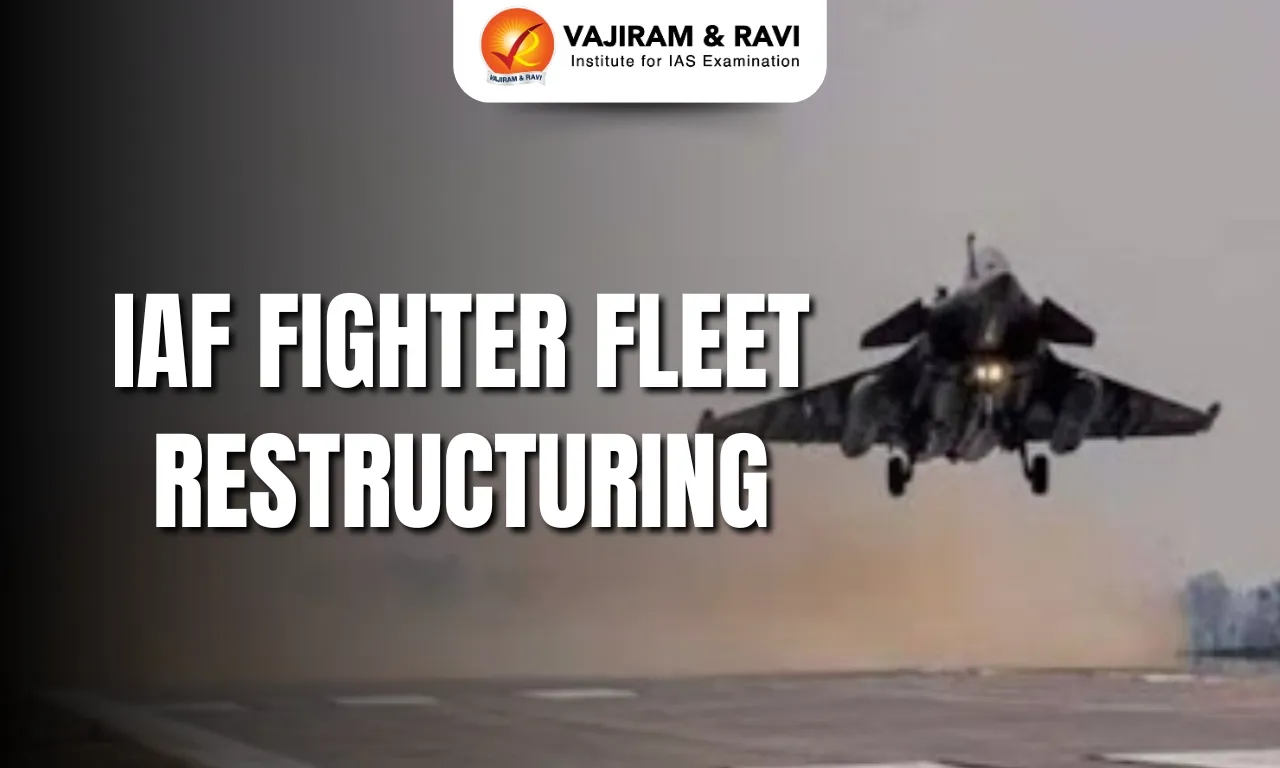
IAF Restructures Fighter Fleet After MiG-21 Retirement

IAF Fighter Fleet Restructuring

IAF Fighter Fleet Restructuring Latest News

  • On September 26, the Indian Air Force formally retired its iconic MiG-21 fighter jets, with the last two squadrons — No. 23 (Panthers) and No. 3 (Cobras), operating 36 jets — decommissioned in Chandigarh. 
  • The move marks the end of a Soviet-era legacy but also highlights the IAF’s shrinking squadron strength, underscoring the challenges it faces in modernising its fleet.

MiG-21: India’s Trusted but Controversial Fighter

  • Inducted in 1963 as cutting-edge interceptors, MiG-21s became the backbone of the Indian Air Force, fighting in the 1965, 1971, and Kargil wars. 
  • Over 700 jets of various variants were procured, with the latest Bison upgrades adding advanced avionics, radar, and missiles. 
  • However, engine flaws plagued the single-engine aircraft, contributing to over 500 crashes and 170 pilot deaths in six decades, including more than 20 since 2010. 
  • Despite this record, many IAF veterans argue the MiG-21’s performance and longevity make its safety record better than often perceived.

IAF’s Fighter Shortfall and Growing Reliance on Air Defence

  • The retirement of the MiG-21s has reduced the Indian Air Force’s strength to 29 fighter squadrons, well below the sanctioned 42 — a target that has never been met. 
  • This decline poses serious concerns, especially in the event of a simultaneous conflict with Pakistan and China. 
  • While Pakistan maintains an estimated 20–25 squadrons, China’s strength exceeds 60, giving both adversaries a numerical edge. 
    • Each squadron comprises 16–18 jets, making the shortfall significant.
  • The challenge will deepen in the coming decade, as several older aircraft — including the MiG-29s, Jaguars, and Mirage 2000s — are slated for phase-out by 2035. 
  • Unless new fighters are inducted soon, India risks falling further behind its regional rivals in air power.

Focus on Air Defence

  • Given this reality, military planners are currently focused on bolstering India’s air defence capabilities to offset the shortage of fighters. 
  • Advanced systems like the Russian S-400 mobile surface-to-air missile (SAM) systems, despite U.S. opposition, have been inducted into service. 
  • Additionally, India’s indigenous Akashteer air-defence system has been deployed. 
  • Both systems demonstrated their effectiveness during Operation Sindoor, underscoring their role as critical stopgaps in safeguarding India’s skies until new fighter jets can fill the squadron gap.

Rebuilding IAF’s Fighter Fleet: Indigenous and Global Plans

  • To address its shrinking fighter fleet, the IAF is banking heavily on indigenous aircraft
  • Currently operating two squadrons of Tejas Mk1, the IAF is set to induct 180 upgraded Tejas Mk1A jets from HAL. 
    • The Mk1A brings advanced features such as AESA radar, an electronic warfare suite with jammers, and enhanced beyond-visual-range (BVR) capabilities through Derby and ASTRA missile integration. 
  • In addition, HAL is working on Tejas Mk2 and the fifth-generation stealth Advanced Medium Combat Aircraft (AMCA), expected to join the IAF in the next decade.

Global Fighter Procurement Plans

  • Alongside indigenous projects, the IAF is also pursuing the acquisition of 114 fighters from global manufacturers. 
  • The Dassault Rafale is reportedly the frontrunner, with plans to procure some jets in flyaway condition for immediate reinforcement. 
  • The majority, however, will likely be manufactured in India under a partnership between Dassault and Indian firms, strengthening the domestic defence ecosystem.

Su-30MKI Upgrades

  • India also intends to modernise its existing fleet of 84 Su-30MKI aircraft under the “Super-30” program. 
  • This upgrade aims to extend their service life and enhance combat effectiveness, ensuring they remain a backbone of the IAF until newer platforms are fully inducted.

Persistent Delays in Aircraft Induction

  • The Indian Air Force continues to grapple with delays in aircraft development and delivery, forcing the MiG-21 to remain operational well beyond its planned phase-out due to the lack of replacements.

The LCA and Tejas Mk1A Delays

  • The LCA program, conceived in the 1980s, has seen repeated setbacks. 
  • Out of 40 Tejas Mk1 jets ordered in 2006 and 2010, only 38 have been delivered so far. 
  • The Tejas Mk1A, expected earlier, will see its first two deliveries in October after a two-year delay caused by late procurement of F404 engines from GE Aerospace and issues in weapons and radar integration. 
  • HAL now plans to manufacture 16 aircraft annually, but even then, deliveries may extend into the mid-2030s, beyond the original 2030 target.

Engine and Technology Transfer Challenges

  • Negotiations between HAL and GE over co-production of F414 engines for the Tejas Mk2 remain slow, despite a deal signed two years ago that promised 80% technology transfer. This delay hampers progress on the Mk2 program.

AMCA and Foreign Fighter Procurement Uncertainty

  • The AMCA, India’s ambitious fifth-generation fighter project, is still in its development phase, with even a prototype several years away. 
  • At the same time, the deal to acquire 114 foreign fighters remains unsigned, further delaying critical reinforcements to the IAF’s dwindling squadrons.

Source: IE | IE

IAF Fighter Fleet Restructuring FAQs

Q1: Why did the IAF retire the MiG-21?

Ans: The MiG-21 was retired due to safety concerns, outdated technology, and the need to modernise the IAF fleet with advanced indigenous and global fighters.

Q2: How has the MiG-21 shaped India’s defence history?

Ans: Since 1963, MiG-21s fought in the 1965, 1971, and Kargil wars, serving as India’s backbone despite accidents and engine issues.

Q3: What is the IAF’s current squadron strength?

Ans: The IAF now has 29 squadrons, far below the sanctioned 42, creating risks during a potential two-front conflict with Pakistan and China.

Q4: How will India rebuild its fighter fleet?

Ans: Plans include inducting 180 Tejas Mk1A jets, developing Tejas Mk2 and AMCA, acquiring 114 foreign fighters, and upgrading 84 Su-30MKI under the Super-30 program.

Q5: What challenges remain for the IAF?

Ans: Persistent delays in Tejas deliveries, slow technology transfer for engines, and uncertainty in AMCA and foreign fighter deals hinder timely modernisation.
India–EU Strategic Agenda: Trade, Technology, Defence, and Connectivity

India–EU Strategic Agenda

India–EU Strategic Agenda Latest News

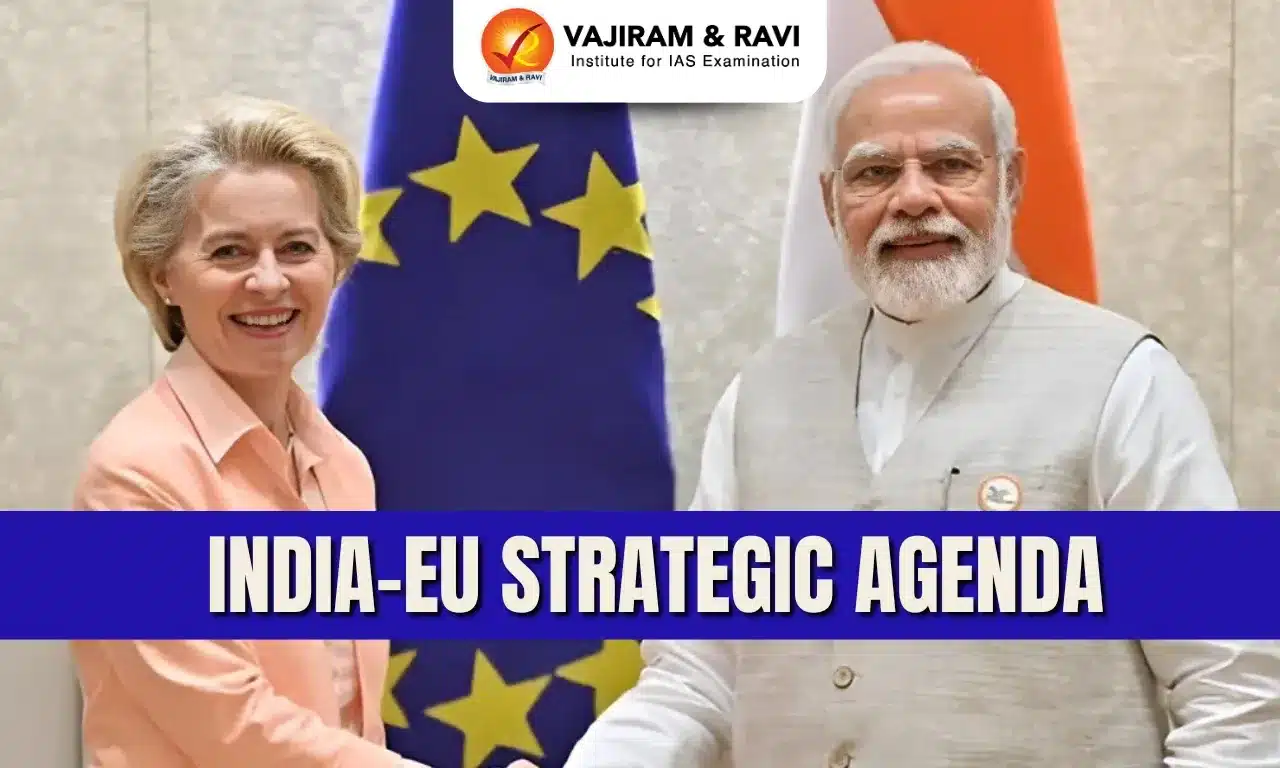
  • As the U.S. under President Trump disrupts long-standing global alignments, Europe is presenting itself as a stable and reliable partner for India. 
  • This shift is underscored by the upcoming India–EU leaders’ summit scheduled for February 2026, which will build upon European Commission President Ursula von der Leyen’s earlier visit to India.
  • The EU has also released a strategic agenda outlining its vision for ties with India, anchored on five key pillars and a commitment to mutual benefit. 
  • This framework signals Europe’s intent to position itself as India’s “all-weather” friend and a counterbalance to the uncertainties in U.S. foreign policy.

Five Pillars of the New India–EU Strategic Agenda

  • The India–EU Strategic Agenda is built on five core pillars:
    • Prosperity and Sustainability – covering trade, investment, resilient supply chains, and sustainable development.
    • Technology and Innovation – focusing on critical technologies, digital infrastructure, and joint research.
    • Security and Defence – emphasising new agreements, regional stability, and countering traditional and hybrid threats.
    • Connectivity and Global Issues – strengthening cooperation in third countries and global governance.
    • Enablers Across Pillars – promoting skills mobility, mutual understanding, business linkages, research collaboration, and stronger institutional frameworks for EU–India relations.

Prosperity and Sustainability: Strengthening India–EU Economic and Trade Ties

  • The EU is India’s largest trading partner, while India is the EU’s biggest partner in the Global South. 
  • In 2024, bilateral trade in goods reached €120 billion — a 90% rise over the past decade — with services adding another €60 billion. 
  • Nearly 6,000 European companies operate in India, directly employing 3 million people and indirectly supporting millions more. 
  • EU foreign direct investment has surged to €140 billion in 2023, nearly doubling in five years.
  • Despite these gains, India accounts for less than 2.5% of the EU’s trade, and Indian investment in the EU stands at only €10 billion. 
  • To expand ties, both sides are pushing to finalise a Free Trade Agreement (FTA) by 2025 to cut tariff and non-tariff barriers. 
  • They are also negotiating an Investment Protection Agreement, a bilateral macroeconomic dialogue, a Geographical Indications pact, and a comprehensive air transport agreement, all aimed at deepening economic cooperation.

India–EU Collaboration on Emerging Technologies

  • India and the EU are leveraging complementary strengths to drive innovation. 
  • The EU offers world-class research, regulation, and green-digital expertise, while India contributes a skilled workforce, vast datasets, a thriving startup ecosystem, and frugal innovation.
  • Planned initiatives include EU-India Innovation Hubs for key technologies and an EU-India Startup Partnership with the European Innovation Council and Start-up India. 
  • Cooperation will focus on AI, particularly large language models, multilingual datasets, and AI applications in healthcare, agriculture, and climate action.
  • Both sides are working on safeguards to prevent unauthorised transfer or misuse of sensitive technologies, aligning with global stability and democratic values. 
  • Additionally, the Euratom-India agreement will boost collaboration in peaceful nuclear energy, including reactor safety, waste management, nuclear security, and fusion research. 

India–EU Connectivity and Strategic Corridors

  • The EU’s Global Gateway initiative (€300 billion) and India’s MAHASAGAR programme provide strong platforms for joint connectivity efforts. 
  • Their 2021 Connectivity Partnership has laid the foundation for cooperation in energy, transport, and digital infrastructure.
  • A flagship project is the India-Middle East-Europe Economic Corridor (IMEC), which integrates maritime, rail, digital, energy, and clean hydrogen networks to revive historic Eurasian trade routes. 
  • Within this, the EU-Africa-India Digital Corridor is advancing through the 11,700 km Blue Raman submarine cable system, linking Europe and India via the Mediterranean, Middle East, and East Africa. 
    • This will ensure ultrafast, secure, and resilient data connectivity.
  • Additionally, India and the EU are developing Green Shipping Corridors to promote sustainable maritime trade and reduce reliance on carbon-intensive transport routes, further boosting commercial and strategic opportunities. 

Deepening India–EU Security and Defence Cooperation

  • India and the EU are strengthening ties through the Strategic Dialogue on Foreign and Security Policy (2025), with thematic discussions on maritime security, cybersecurity, counterterrorism, and non-proliferation. 
  • A formal EU-India Security and Defence Partnership is under consideration.
  • Both sides are negotiating a Security of Information Agreement to enable classified information sharing. 
  • Cooperation will also expand in the Indo-Pacific, with proposed arrangements between the EU Naval Force and Indian Navy to boost coordination in the western Indian Ocean.
  • Joint efforts include combating terrorism, terror financing, online propaganda, drug trafficking, and risks from emerging technologies.
  • On the industrial front, increased collaboration between Indian and EU defence industries aims to strengthen supply chain security, boost innovation, and expand production capabilities. 
  • Plans include establishing an EU-India Defence Industry Forum to connect businesses, share best practices, and explore cooperation opportunities.

Strengthening India–EU People-to-People Ties

  • India and the EU are deepening social and cultural links. 
  • In 2023, 825,000 Indians lived in the EU, forming the largest group receiving Blue Cards and intra-corporate transfer permits. 
  • Travel has become easier, with nearly one million Schengen visas issued in 2024, many as multiple-entry.
  • Educational exchanges are expanding through initiatives like the Union of Skills and Erasmus, making Europe more attractive for Indian students amid U.S. restrictions under Trump.

Source: IE | ORF

India–EU Strategic Agenda FAQs

Q1: What are the five pillars of the India–EU Strategic Agenda?

Ans: They include prosperity and sustainability, technology and innovation, security and defence, connectivity and global issues, and enabling frameworks across all areas.

Q2: How strong are India–EU trade relations?

Ans: The EU is India’s largest trading partner, with €120 billion in goods trade in 2024, €60 billion in services, and €140 billion in EU FDI.

Q3: What role does technology play in India–EU ties?

Ans: Both sides collaborate on AI, digital infrastructure, startups, and nuclear energy research, supported by Innovation Hubs and an EU-India Startup Partnership.

Q4: What is the significance of the India-Middle East-Europe Economic Corridor (IMEC)?

Ans: IMEC integrates maritime, rail, energy, and digital infrastructure to revive Eurasian trade routes and improve connectivity between India, Europe, and Africa.

Q5: How are people-to-people links being strengthened?

Ans: With 825,000 Indians in the EU, rising Schengen visas, and student exchanges like Erasmus, migration and education are central to deeper bilateral ties.

Chero Archers – Honouring Jharkhand’s Warrior Heritage

Chero Archers

Chero Archers Latest News

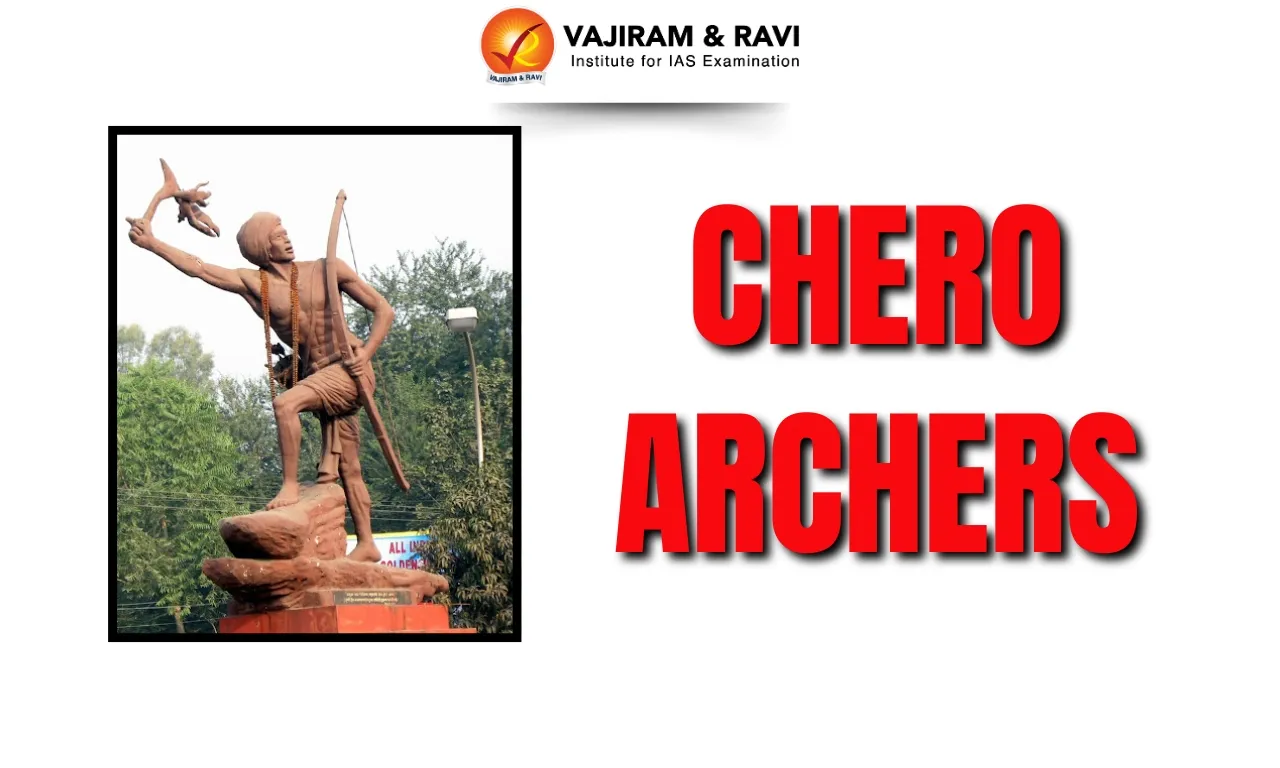
  • The Jharkhand archery team has been named “Chero Archers” in the inaugural Archery Premier League (APL), paying tribute to the legendary Chero warrior clan known for their defiance against the Mughals and British.

About Chero Warrior Clan: A Historical Overview

  • The Cheros were a warrior community that rose to prominence in the medieval period. 
  • Predominantly found in Palamu (Jharkhand), Shahabad (Bihar), and parts of eastern Uttar Pradesh, they were known for their courage, skill with bows and arrows, and their ability to defend their territories against external forces.
  • Resistance against the Mughals
    • During the 16th and 17th centuries, the Cheros fiercely resisted Mughal expansion in eastern India. 
    • Palamu, under the rule of Chero King Medini Rai, became a symbol of defiance. Medini Rai fortified the Palamu forts and challenged Mughal armies led by generals under Emperor Aurangzeb. 
    • Although the forts were eventually captured, the Cheros’ resistance highlighted their martial spirit and determination to remain independent.
  • Defiance against British Colonial Rule
    • The Cheros were equally hostile toward British colonial expansion. 
    • In the late 18th and early 19th centuries, they joined forces with other tribal communities like the Santhals, Mundas, and Oraons in rebellions against British land revenue policies and forest exploitation. 
    • Their familiarity with the rugged terrain of Jharkhand and mastery of archery made them formidable guerrilla fighters.
  • Symbol of Tribal Identity
    • Over time, the Cheros came to represent resistance, valour, and identity for Jharkhand’s tribal population. 
    • Their martial traditions have been celebrated in folklore, songs, and oral histories passed down through generations.

Archery in Jharkhand: A Natural Legacy

  • Archery has always been more than a sport for Jharkhand’s tribal communities. It has been a way of life, a survival skill, and a cultural practice.
  • Traditional Significance: For centuries, bows and arrows were used for hunting and self-defence in the forests of Jharkhand.
  • Sporting Excellence: Jharkhand has produced some of India’s finest archers, including Deepika Kumari and Komalika Bari, who rose from humble tribal backgrounds to international fame.
  • Grassroots Training: Many villages in Jharkhand continue to train young children in archery using bamboo bows, symbolising both tradition and aspiration.
  • By naming its team the Chero Archers, Jharkhand has merged this ancient martial practice with modern sporting aspirations, ensuring that the legacy of the warrior clan finds renewed relevance in today’s context.

News Summary

  • The Archery Premier League (APL) is India’s newest sporting initiative, modelled on the franchise system that has boosted cricket and kabaddi. 
  • Jharkhand’s franchise, named Chero Archers, is not only a nod to the State’s dominance in archery but also a deliberate cultural assertion.
  • Tribute to Warrior Heritage: The team’s name commemorates the Chero warrior clan, whose martial legacy continues to inspire pride in the region.
  • Promoting Cultural Identity: By associating the team with the Cheros, Jharkhand is strengthening its tribal narrative in a national sporting arena.
  • Boost to Sports Tourism: The APL is expected to attract attention to Jharkhand’s rich history and its tradition of producing world-class archers.
  • Empowering Youth: The initiative provides an opportunity for tribal youth to connect with their heritage while pursuing sporting excellence at the professional level.
  • This symbolic gesture resonates deeply with Jharkhand’s population, where history and modernity are often woven together in narratives of struggle and achievement.

Significance of the Move

  • Cultural Revival: The move ensures that the memory of Chero warriors is not confined to history books but celebrated in a contemporary context.
  • Sports and Identity: It bridges the gap between traditional tribal identity and modern sports culture, making archery both a cultural and professional aspiration.
  • Inspirational Symbol: For the younger generation, the “Chero Archers” brand serves as a reminder of resilience, courage, and excellence.
  • National Spotlight: By honouring its indigenous warrior clan, Jharkhand has set a precedent for other States to celebrate local heroes in national sports events.

Source: IE

Chero Archers FAQs

Q1: Who were the Chero warriors?

Ans: The Cheros were a medieval warrior clan known for resisting Mughal and British expansion in Jharkhand, Bihar, and Uttar Pradesh.

Q2: Why is Jharkhand’s archery team named “Chero Archers”?

Ans: The team’s name honors the martial traditions of the Chero clan and their cultural significance in Jharkhand.

Q3: What is the Archery Premier League (APL)?

Ans: The APL is India’s franchise-based professional archery league, modeled on successful formats like the IPL.

Q4: What role did the Cheros play in history?

Ans: The Cheros, under leaders like Medini Rai, fought against Mughal armies and later resisted British colonial policies.

Q5: How is archery linked to Jharkhand’s tribal culture?

Ans: Archery has been a traditional skill among Jharkhand’s tribal communities and has produced world-class athletes like Deepika Kumari.

What is the Khalistan Movement?

What is the Khalistan Movement?

What’s in today’s article?

  • Why in news?
  • What is the Khalistan movement?
  • When did the movement start and why?
  • News Summary: Canada investigates Indian government link to killing of Khalistani activist
  • Background

Why in news?

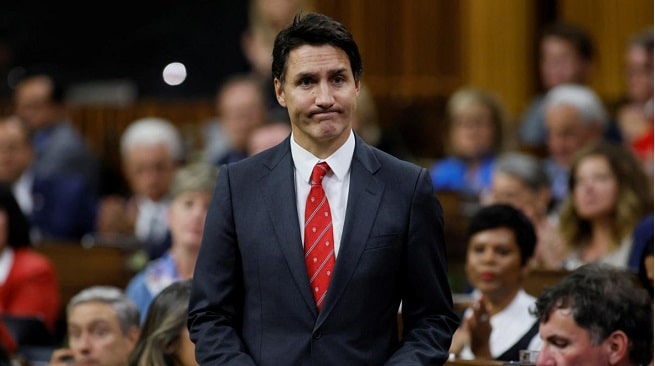
  • Canada is investigating possible links between the Indian government and the assassination of Khalistan Tiger Force (KTF) chief Hardeep Singh Nijjar in Canada.
  • The Canadian government also said that it has expelled a top Indian diplomat as a consequence.

What is the Khalistan movement?

  • About
    • The Khalistan movement is a fight for a separate, sovereign Sikh state in present day Punjab (both India and Pakistan).
    • The movement was crushed in India following Operation Blue Star (1984) and Operation Black Thunder (1986 and 1988).
      • Operation Blue Star began on June 1, 1984 to flush out militants from the Golden Temple and neutralise Bhindranwale.
    • The Khalistan movement is banned in India, where officials see it and its affiliated groups as a national security threat.
    • But the movement still has some support in north India, as well as beyond, in countries like Canada and the United Kingdom which are home to a sizable Sikh diaspora.
  • Khalistan and Canada
    • As per the 2021 Canadian census, Sikhs account for 2.1 per cent of Canada’s population, and are the country’s fastest growing religious group.
      • After India, Canada is home to the largest population of Sikhs in the world.
    • In 2002, Toronto-based Punjabi-language weekly Sanjh Savera greeted Indira’s death anniversary with a cover illustration of her murder.
      • The magazine received government advertisements, and is now a prominent daily in Canada.
    • Last year in Brampton - home to Canada’s largest Sikh population - a pro-Khalistan organisation known as Sikhs for Justice (SFJ) held a so-called referendum on Khalistan.

When did the movement start and why?

  • Origin lies in India’s independence and subsequent Partition along religious lines
    • The Punjab province, which was divided between India and Pakistan, saw some of the worst communal violence and generated millions of refugees.
    • Lahore, the capital of Maharaja Ranjit Singh’s great Sikh Empire, went to Pakistan, as did holy Sikh sites including Nankana Sahib, the birthplace of Guru Nanak, the founder of Sikhism.
    • While most Sikhs found themselves in India, they were a small minority in the country, making up around 2 per cent of the population.
  • Struggle for greater autonomy & States Reorganisation Commission
    • The political struggle for greater autonomy began around the time of Independence, with the Punjabi Suba Movement for the creation of a Punjabi-speaking state.
    • The States Reorganisation Commission, in its 1955 report, rejected this demand, but in 1966, after years of protest, the state of Punjab was reorganised to reflect the Punjabi Suba demand.
    • The erstwhile Punjab state was trifurcated into the Hindi-speaking, Hindu-majority states of Himachal Pradesh and Haryana, and the Punjabi-speaking, Sikh-majority Punjab.
  • Anandpur Sahib Resolution
    • In 1973, leaders of the Akali Dal met at the sacred town of Anandpur Sahib, the birthplace of the Khalsa.
    • They released a list of demands that would guide the political path of the Akali Dal.
    • Among other things, the Anandpur Sahib Resolution demanded autonomy for the state of Punjab, identified regions that would be part of a separate state, and sought the right to frame its own internal constitution.
    • The Akali Dal was trying to cash in on the growing demand for an autonomous state which had emerged alongside the Punjabi Suba movement.
      • This demand had gone global by 1971 — when an advertisement appeared on The New York Times proclaiming the birth of Khalistan.
  • Rise of Jarnail Singh Bhindranwale
    • Many in Punjab sought to go beyond just a demand for greater autonomy. One such man was Jarnail Singh Bhindranwale.
    • Bhindranwale was a charismatic preacher who soon positioned himself as the authentic voice of the Sikhs.
    • He found a captive audience in the state’s youth, especially those in the lower rungs of the social ladder, and massed a massive following.
    • By 1982, he took up residence inside the Golden Temple, directing demonstrations and clashes with the police.
    • The movement was geared towards the demands first articulated in the Anandpur Sahib Resolution.
    • However, amidst growing religious polarisation, sectarian violence, and Bhindranwale’s own harsh rhetoric against Hindus, the then government declared the movement tantamount to secession.
  • The aftermath of Operation Blue Star
    • This operation gravely wounded the Sikh community around the world. It also galvanised the demand for Khalistan.
    • Punjab saw the worst violence, becoming the hub of a long drawn-out insurgency that lasted till 1995.

News Summary: Canada investigates Indian government link to killing of Khalistani activist

Background:

  • Death of the Khalistan Tiger Force (KTF) chief
    • Hardeep Singh Nijjar, wanted by the Indian government, was killed in a targeted shooting in June this year.
      • In 2022, the National Investigation Agency (NIA) declared a Rs 10 lakh reward on Nijjar.
      • This was after he was accused of conspiring to kill a Hindu priest in Punjab's Jalandhar.
    • Nijjar was shot dead outside a gurdwara in Surrey.
  • Issue raised on the sidelines of G20 Summit
    • On the sidelines the G20 Summit in Delhi, Canadian PM and PM Modi had discussed Khalistani extremism.
    • Canadian PM also raised the issue of foreign interference in this murder and asked India for cooperation in the investigation.
    • On the other hand, during the meeting, PM Modi had expressed his deep concerns to Canadian PM about the ongoing anti-India activities being carried out by extremist elements in Canada.
  • Recent anti-India activities in Canada
    • A massive controversy had erupted, in June 2023, over a social media video of a parade float in Canada depicting late PM Indira Gandhi's assassination.
      • A female figure was shown in a blood-stained white saree, with the hands up, as turbaned men pointed guns at her.
      • The parade seemed to celebrate the assassination of former Prime Minister Indira Gandhi.
    • The parade was allegedly organised by pro-Khalistani supporters days before the 39th anniversary of ‘Operation Bluestar’ (celebrated on June 6).

Q1) What is Operation Blue Star?

Operation Blue Star refers to a military operation conducted by the Indian government in June 1984 to remove Sikh militants who had taken shelter in the Golden Temple complex in Amritsar, Punjab, India. The operation was a response to the escalating violence and separatist activities led by Jarnail Singh Bhindranwale, who sought to establish an independent Sikh state called Khalistan.

Q2) What is the geographical location of Canada?

Canada is located in North America, specifically in the northern part of the continent. It spans a vast area, stretching from the Atlantic Ocean in the east to the Pacific Ocean in the west. Canada shares land borders with the United States to the south and maritime boundaries with France (overseas territories) and Denmark (Greenland) to the east.


Source: Canada investigates Indian government link to killing of Khalistani activist, expels Indian diplomat | Hindustan Times | Times of India | India Today

Enquire Now