Insolvency and Bankruptcy Code (IBC) Latest News
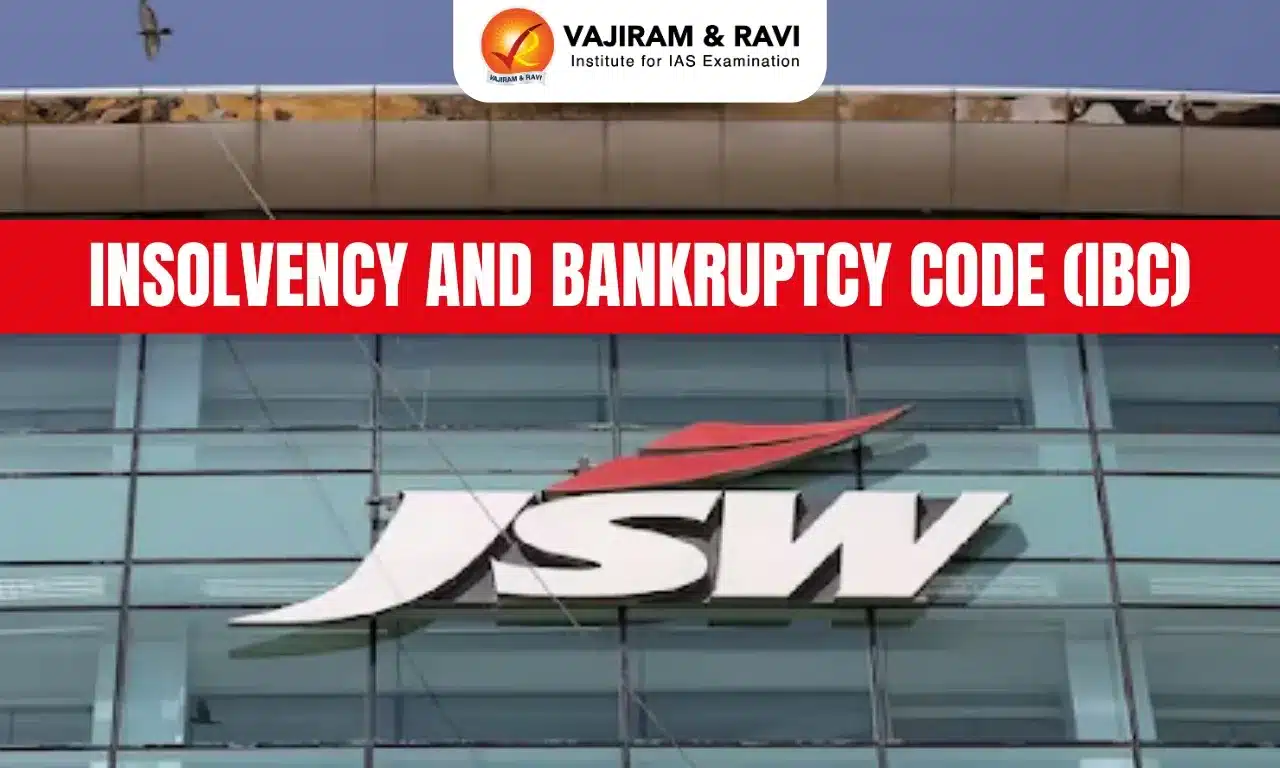
- The Supreme Court of India has approved JSW Steel’s $2.3 billion (₹19,350 crore) acquisition of Bhushan Power and Steel (BPSL), reversing its earlier decision of liquidation.
- This judgment strengthens the Insolvency and Bankruptcy Code (IBC), 2016, by prioritising revival of distressed firms over liquidation.
Understanding Insolvency and Bankruptcy and the IBC
- Insolvency vs Bankruptcy: While insolvency results from an inability to pay debts due to a lack of assets, bankruptcy occurs when an application is presented to an authority declaring insolvency and requesting to be declared bankrupt, which will last until discharge.
- About the IBC 2016:
- It is the bankruptcy law of India which seeks to consolidate the existing framework by creating a single law for insolvency and bankruptcy.
- It is a one stop solution for resolving insolvencies which previously was a long process that did not offer an economically viable arrangement.
- It aims to protect the interests of small investors and make the process of doing business less cumbersome.
- Insolvency and Bankruptcy Board of India (IBBI):
- It is the regulator for overseeing insolvency proceedings and entities like Insolvency Professional Agencies (IPA), Insolvency Professionals (IP) and Information Utilities (IU) in India.
- It was established on 1 October 2016 and given statutory powers through the IBC 2016.
- It functions under the Ministry of Corporate Affairs and covers Individuals, Companies, Limited Liability Partnerships and Partnership firms.
Process Followed under the IBC
- Initiation of CIRP:
- Corporate Debtor (CD): A company that has taken loans and defaults on repayment.
- Who can Apply: Either the creditor or the debtor can initiate proceedings.
- Relevant Section: Corporate Insolvency Resolution Process (CIRP) is governed by Section 6 of the IBC.
- Threshold for default:
- Earlier limit: ₹1 lakh default.
- Revised limit: Raised to ₹1 crore during the pandemic to reduce undue stress on companies.
- Adjudicating Authority (AA):
- Designated authority: National Company Law Tribunal (NCLT) benches across India.
- Role: Receives insolvency applications from creditors or debtors.
- Timeline: Must admit or reject application within 14 days, with reasons for delay if not disposed within this period.
- Commencement of CIRP:
- Trigger point: CIRP begins once NCLT admits the application.
- Resolution timeline: As per amendment, the process must be completed within 330 days (including litigation period).
- Outcome of CIRP:
- Resolution: Revival of the corporate debtor through restructuring or takeover by a Successful Resolution Applicant (SRA).
- Liquidation: If no resolution plan is approved within the stipulated period.
Supreme Court’s Ruling
- Revival of BPSL: JSW Steel has invested in modernisation, safeguarded thousands of jobs, and ensured that the company will continue to operate.
- IBC objective fulfilled: The court emphasised that the essence of IBC is to convert loss-making firms into profitable entities.
- On claims: Creditors’ demand for an additional ₹6,100 crore was dismissed. The Court stated that once the Committee of Creditors (CoC) approves a plan, reopening claims undermines the law.
- CCDs as equity: Compulsorily Convertible Debentures (CCDs) issued by the Successful Resolution Applicant (SRA) must be treated as equity.
Background
- The SC had earlier ordered liquidation, citing JSW Steel’s delay in implementing the plan and failure of CoC to exercise its commercial wisdom.
- The court criticised the Resolution Professional (RP) and CoC for failing to protect creditors’ interests and supporting JSW despite violations.
- The (May 2024) order unsettled investors and cast doubts on the effectiveness of IBC reforms.
Importance of BPSL to JSW Steel
- BPSL contributes significantly to JSW’s revenue and profitability. FY25 performance - Profit of ₹300 crore (Q1), loss of ₹93 crore (Q2), profit of ₹11 crore (Q3).
- BPSL increased capacity from 3.5 MTPA to 5 MTPA, operating advanced facilities across India.
- Analysts estimate an 8–10% revenue and EBITDA decline in FY26 if BPSL is liquidated.
Liquidation Trends and Broader Implications of Judgment
- Rising liquidations: FY24 witnessed 2,476 cases ending in liquidation with total claims of ₹11 lakh crore. Recovery rate remained only 6.33% of admitted claims (₹69,634 crore).
- Example of Jet Airways: Earlier, Jet Airways faced liquidation due to a failed resolution plan (₹15,723 crore admitted claims).
- Liquidation of BPSL: This would have been the largest in corporate history.
- The judgment: This is expected to restore investor confidence in IBC and discourage frivolous delays.
Conclusion
- The Supreme Court’s reversal aligns with the spirit of the IBC by prioritising corporate revival over liquidation.
- The ruling will likely strengthen creditors’ trust in resolution plans, reduce litigation uncertainties, and boost investor confidence in India’s insolvency ecosystem.
- Going ahead, stricter accountability for Resolution Professionals and CoCs is essential to prevent delays and safeguard creditors’ interests.
Source: IE
Insolvency and Bankruptcy Code FAQs
Q1: How does the recent Supreme Court ruling on JSW Steel’s acquisition of Bhushan Power and Steel reinforce the objectives of the IBC?
Ans: It upholds IBC’s core objective of reviving distressed assets into going concerns while protecting jobs and maximising asset value.
Q2: Why did the Supreme Court dismiss creditors’ additional demand in the BPSL case?
Ans: This would undermine the finality of resolution plans and violate IBC provisions.
Q3: What role does Bhushan Power and Steel play in JSW Steel’s revenue profile?
Ans: BPSL contributes significantly to JSW’s revenue and profits, with liquidation projected to cause an 8–10% decline in revenue in FY26.
Q4: What was the SC’s earlier criticism in the JSW–BPSL case?
Ans: The SC highlighted CoC’s failure to exercise commercial wisdom, protect creditors’ interests, and ensure compliance with IBC norms.
Q5: What do the liquidation trends under IBC indicate?
Ans: The data highlights systemic delays and weak enforcement in the resolution process.