India’s E-Waste Recycling Challenges and Opportunities

E-Waste Recycling

E-Waste Recycling Latest News

  • While the Union government promotes local electronics manufacturing through initiatives like semiconductor fabs and the Electronics Component Manufacturing Scheme, e-waste recycling remains a weak link. 
  • Millions of tonnes of discarded consumer electronics and appliances have piled up in recent years. 
  • Policymakers see recycling as crucial to extract scarce and valuable metals, especially as electronics consumption is projected to surge in the coming years.

E-Waste

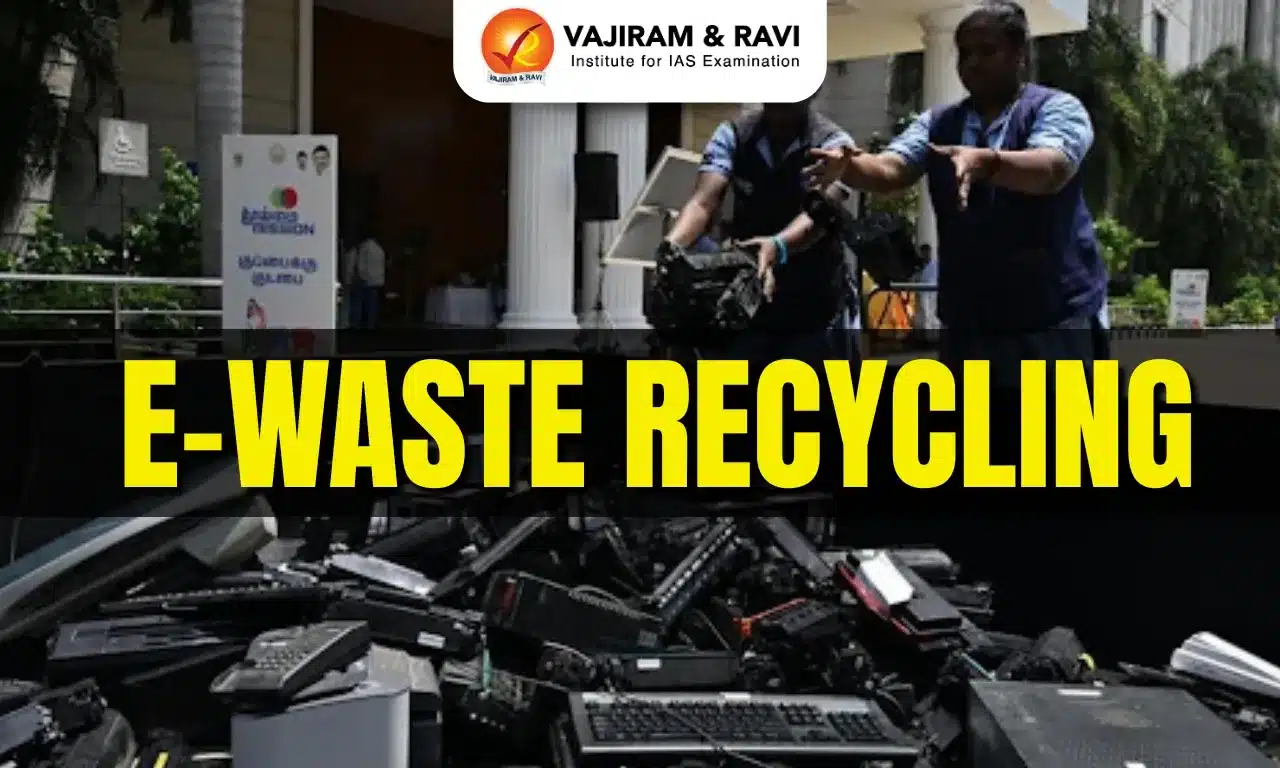
  • E-waste refers to discarded electronic devices such as smartphones, laptops, TVs, fridges, and chargers. 
  • While these often contain valuable materials, they are usually dumped instead of being reused or recycled.

Need for Effective e-Waste Management

  • Health Risks - E-waste contains toxic substances like lead, mercury, and cadmium. Improper handling leads to contamination of soil and water, causing neurological disorders, kidney failure, and long-term chronic diseases.
  • Environmental Damage - Hazardous recycling practices pollute air, soil, and water. They also release greenhouse gases, worsening climate change and harming ecosystems.
  • Economic Loss - Inefficient recycling causes wastage of valuable resources such as gold, silver, and copper, which could otherwise be recovered and reused in production.

Link with Environmental, Gocial, and Governance (ESG) and SDGs

  • E-waste management aligns with global sustainability frameworks:
    • SDG 12: Responsible Consumption and Production.
    • SDG 13: Climate Action.
  • It strengthens India’s ESG commitments by integrating resource efficiency and environmental protection into growth.

Electronics Consumption and Indigenous Push

  • India, despite having over 93.9 crore mobile broadband connections, accounts for only 4% of global electronics consumption
  • Fragile global supply chains have pushed the government to expand domestic manufacturing and raw material access, including a ₹1,500 crore mineral recycling scheme announced in September.

E-Waste Volumes and Processing

  • According to the Global E-Waste Monitor 2020, India is the world’s third-largest e-waste generator after China and the USA. 
    • With India being one of the fastest-growing electronics markets, this trend is expected to rise further.
    • As per one report, India’s electronics industry to grow at a CAGR of 16.6%, from USD 215 billion in FY19 to USD 540 billion by FY25. 
    • This rapid expansion will add significantly to e-waste volumes.
  • India generated an estimated 4.17 million metric tonnes of e-waste in 2022, but only one-third was processed through proper channels

Legal Framework for E-Waste Management

  • Improper disposal of end-of-life EEE products has severe negative externalities, including risks to human health and environmental degradation. Effective management is essential to mitigate these harms.
  • E-waste in India is regulated by the E-Waste (Management) Rules, 2022, published by the Ministry of Environment, Forest and Climate Change (MoEFCC). These rules came into force on April 1, 2023.
  • State Pollution Control Boards, responsible for inventorying, use inconsistent methods, causing discrepancies between Indian and international data.
  • The Central Pollution Control Board has begun auditing recyclers, with over 50 firms checked in recent months. 
  • Companies are working to aggregate informal operations into formal “mandi”-style streams, recovering metals such as gold, copper, aluminium, and steel.

Extended Producer Responsibility (EPR) Framework and Associated Concerns

  • The government has introduced EPR rules requiring manufacturers to collect end-of-life appliances for recycling metals like copper, aluminium, nickel, cobalt, and lithium. 
  • This move is partly driven by geopolitical risks, such as China’s export restrictions on rare earth elements.

Dominance of Informal Sector

  • A 2023 Indian Cellular and Electronics Association report flagged the dominance of the informal sector in India’s recycling ecosystem. 
  • These operators focus on repairing and harvesting components, but remain outside formal frameworks, hindering the creation of a circular economy. 
  • Even within EPR, issues like “paper trading” persist, with recyclers overstating volumes for financial incentives.

Concerns on Traceability and Best Practices

  • Experts stress that malpractices plague the sector, with many players lacking true metal extraction capacity
  • They highlighted the need for third-party audits, better environmental safeguards, and life-cycle visibility of products
  • Inventorying remains weak in India, unlike Western countries that count products as potential e-waste from the point of sale.

Future Potential

  • While the share of recycled precious metals in India’s supply chains remains negligible, industry leaders argue that with the right policy push, India could meet up to 70% of its rare earth requirements within 18 months. 
  • Recycling’s impact is growing each year, highlighting its potential as a key pillar in India’s electronics ecosystem.

Source: TH | PSA | GE

E-Waste Recycling FAQs

Q1: What is e-waste recycling in India?

Ans: E-waste recycling involves recovering valuable metals like copper, gold, and lithium from discarded electronics, but India faces challenges due to informal sector dominance.

Q2: Why is e-waste recycling important in India?

Ans: Recycling reduces toxic pollution, protects human health, and helps recover critical resources needed for India’s growing electronics manufacturing sector and sustainable development goals.

Q3: What are India’s e-waste rules?

Ans: E-waste in India is regulated under the 2022 E-Waste Management Rules, effective from April 2023, focusing on extended producer responsibility (EPR) and proper disposal methods.

Q4: What challenges exist in e-waste recycling?

Ans: Informal sector dominance, lack of traceability, paper trading, and weak inventorying systems undermine India’s recycling ecosystem and prevent a robust circular economy.

Q5: What is the future of e-waste recycling in India?

Ans: With proper policies, India could meet up to 70% of its rare-earth needs within 18 months, making recycling a key pillar of its electronics ecosystem.


India Secures Second Deep-Sea Mineral Exploration Contract in Indian Ocean

Deep-Sea Mineral Exploration

Deep-Sea Mineral Exploration Latest News

  • India has signed a new contract with the International Seabed Authority (ISA) granting exclusive rights to explore Polymetallic Sulphides (PMS) in the Carlsberg Ridge of the Indian Ocean. 
  • With this, India has become the first country in the world to hold two such ISA contracts, commanding the largest seabed area allocated internationally for PMS exploration. 
  • The National Centre for Polar and Ocean Research (NCPOR), Goa, will begin exploration in 2026 through geophysical and hydrographic surveys. 
  • India’s application, submitted in 2024, was approved last week, allotting a 10,000 sq km area in the Carlsberg Ridge
  • This builds on its earlier 2016 contract for exploration in the Central and Southwest Indian Ridges, marking both a scientific breakthrough and a strategic advantage.

Polymetallic Sulphides and Their Importance for India

  • Polymetallic Sulphides (PMS) are rich seabed deposits containing copper, zinc, lead, gold, silver, and trace amounts of rare and precious elements. 
  • Found near hydrothermal vents on the ocean floor, these deposits form when seawater seeps into cracks, interacts with magma beneath the Earth’s crust, and resurfaces as mineral-rich hot water that solidifies on the seabed. 
  • For India, PMS exploration is vital as land-based reserves of such minerals are limited. 
  • Securing these resources is crucial for strategic industries, renewable energy systems, high-technology applications, and green technologies, thereby enhancing the country’s resource security and self-reliance.

India’s Experience in PMS Exploration

  • Since signing its first PMS exploration contract with the International Seabed Authority (ISA) in 2016, India’s National Centre for Polar and Ocean Research (NCPOR) has carried out extensive surveys in the central and southwest Indian Ocean ridges, building significant expertise and infrastructure. 
  • The government’s Deep Ocean Mission has strengthened these efforts by adding deep-sea vessels, advanced tools like Autonomous Underwater Vehicles (AUVs).
  • The upcoming Matsya submersible under the Samudrayaan mission, which will further expand exploration capacity. 
  • NCPOR follows a three-phase plan:
    • Reconnaissance surveys with ship-based tools to locate potential PMS sites.
    • Near-seabed surveys using AUVs and Remotely Operated Vehicles (ROVs) to confirm deposits.
    • Resource evaluation of identified PMS areas for assessing their economic potential.

Significance of the Carlsberg Ridge

  • The Carlsberg Ridge, part of the mid-ocean ridge system in the Indian Ocean, was formed by seafloor spreading between the Indian Plate and Somali Plate about 40 million years ago. 
  • With a slow spreading rate of 2.4–3.3 cm per year, it features rugged flanking topography and a median valley typical of slow-spreading ridges
  • The ridge hosts hydrothermal vent systems, making it a potential hotspot for Polymetallic Sulphide (PMS) deposits. 
  • India has been studying these systems for over three decades. 
  • Strategically, its proximity — located near 2°N latitude, much closer to India than the Central and Southwest Indian Ridges at 26°S — makes it highly significant for resource security and scientific exploration.

How PMS Exploration Differs from Other Underwater Mineral Searches

  • PMS exploration is far more complex than other seabed mineral investigations. 
  • PMS deposits occur near hydrothermal vents along mid-ocean ridges, at depths of 2,000–5,000 metres, where the terrain is rocky, uneven, and remote. 
  • Survey operations require deep-sea vessels with dynamic positioning, precise navigation, and advanced communication systems. 
  • Unlike other explorations, PMS demands a multidisciplinary team of marine geologists, geophysicists, oceanographers, biologists, and deep-sea technologists. 
  • Exploration methods involve ship-mounted geophysical surveys for reconnaissance, and Autonomous Underwater Vehicles (AUVs) and Remotely Operated Vehicles (ROVs) for detailed near-seabed mapping and sample collection. 
  • Advanced tools are essential to accurately analyse mineral composition, making PMS exploration one of the most technically demanding deep-sea missions.

How ISA Allocates Mineral Exploration Sites

  • The International Seabed Authority (ISA), established under the UNCLOS framework, manages mineral exploration in international waters. 
  • Countries, through their governments, public sector bodies, or sponsored entities, apply to the ISA for exploration rights. 
  • Applications must include details of the proposed area, a work plan, environmental baseline studies, and proof of technical and financial capacity
  • The ISA’s Legal and Technical Commission (LTC) reviews these submissions for compliance. 
  • If approved, the application is forwarded to the ISA Council for final clearance, granting the applicant exclusive exploration rights in the designated seabed area.

India’s Plans for Additional Mineral Exploration in the Indian Ocean

  • As part of its Blue Economy initiatives, India is pursuing more seabed mineral exploration rights in the Indian Ocean. 
  • Beyond its existing contracts for Polymetallic Sulphides (PMS), India has applied to the ISA for rights to explore cobalt-rich ferromanganese crusts on the Afanasy-Nikitin Seamount in the Central Indian Ocean. This application is currently under review. 
  • Securing such rights would further strengthen India’s access to strategic and critical minerals vital for technology, renewable energy, and long-term resource security.

Source: IE | PIB

Deep-Sea Mineral Exploration FAQs

Q1: What is deep-sea mineral exploration in India?

Ans: It involves exploring seabed deposits like polymetallic sulphides rich in copper, zinc, gold, and rare elements, vital for India’s green technologies and resource security.

Q2: Why is the Carlsberg Ridge significant for India?

Ans: Located close to India, the ridge hosts hydrothermal vent systems with rich mineral deposits, offering both strategic and scientific advantages for exploration.

Q3: What role does NCPOR play in PMS exploration?

Ans: The Goa-based National Centre for Polar and Ocean Research (NCPOR) leads exploration, using advanced vessels, Autonomous Underwater Vehicles (AUVs), and Remotely Operated Vehicles (ROVs).

Q4: How is PMS exploration different from other seabed mining?

Ans: PMS occurs in rugged, deep-sea hydrothermal zones, requiring specialised technology, multidisciplinary expertise, and precise navigation tools for successful surveys and sampling.

Q5: Is India planning more deep-sea exploration?

Ans: Yes, India has applied to the ISA to explore cobalt-rich ferromanganese crusts in the Central Indian Ocean, strengthening access to critical strategic minerals.

Crime in India 2023 – NCRB Report Highlights Surge in Cybercrime in India

Crime in India 2023

Crime in India 2023 Latest News

  • The National Crime Records Bureau (NCRB) has released its Crime in India 2023 report (after a two-year gap), highlighting a significant increase in cybercrime cases. 
  • The data reflects growing vulnerabilities in India’s digital ecosystem, with fraud, extortion, and sexual exploitation emerging as dominant motives behind such crimes.

Key Findings of the Report

  • Overall crime statistics:
    • The data reflects a 7.2% overall increase in recorded crimes, reaching 6.24 million cases (crimes every five seconds on average in 2023).
    • Traditional violent crimes such as murder (↓2.8%) and rape (↓5.9%) have declined.
    • But cybercrime, economic offences, and miscellaneous crimes like obstruction on public way (Sec.283 IPC - ↑62%) and Motor Vehicle Act violations (↑103%) have surged.
  • Offences against vulnerable sections:
    • Crime against women: Marginal rise of 0.7% (448,211 cases).
    • Crimes against SCs: ↑0.4% (57,789 cases).
    • Crimes against children: ↑9.2%.
    • Crimes against STs: ↑28.8%.

Cybercrime Trends

  • Rising: Cybercrime cases rose 31.2% in 2023, reaching 86,420 cases compared to 65,893 in 2022. The cybercrime rate increased from 4.8% in 2022 to 6.2% in 2023.
  • Consistent rise since 2018:
    • 2018 – 27,248 cases
    • 2019 – 44,735 cases
    • 2020 – 50,035 cases
    • 2021 – 52,974 cases
    • 2022 – 65,893 cases
    • 2023 – 86,420 cases
  • Motives behind cybercrimes:
    • Fraud: 68.9% of total cases (59,526 cases) – the largest category.
    • Sexual exploitation: 4.9% (4,199 cases).
    • Extortion: 3.8% (3,326 cases).

State-Wise Data on Cybercrime

  • Karnataka: Highest with 21,889 cases in 2023 (sharp rise from 8,136 in 2021 and 12,556 in 2022). Included 18,166 cases of cheating by personation and 1,007 obscene video transfers.
  • Telangana: 18,236 cases in 2023 (up from 15,297 in 2022).
  • Uttar Pradesh: 10,794 cases in 2023 (up from 10,117 in 2022).

Economic Offences (Broader Category)

  • Total cases in 2023: 2,04,973 (6% increase from 1,93,385 in 2022).
  • Categories:
    • Forgery, cheating and fraud (FCF) – 1,81,553 cases.
    • Criminal breach of trust – 22,759 cases.
    • Counterfeiting – 661 cases.

Analysis and Implications

  • Crime patterns shifting: From traditional violent crimes to economic and technology-driven crimes. 
  • Shift in crime categorisation and tracking: It is the last annual report under the IPC, as the Bharatiya Nyaya Sanhita (BNS) came into force in July 2024.
  • Digital fraud: It is the biggest challenge in India’s cybercrime landscape. The concentration of cases in Karnataka, Telangana, and UP suggests urbanisation, IT penetration, and digital adoption are key drivers.
  • Economic offences’ steady rise: Highlights the need for robust financial cybersecurity mechanisms.

Way Ahead

  • Strengthening cybersecurity infrastructure and digital literacy programs are crucial.
  • Equipping law enforcement agencies: With advanced cyber forensic tools and training.
  • Enhanced public-private collaboration: In monitoring, prevention, and quick response mechanisms.
  • Multi-stakeholder approach: Covering government, judiciary, tech companies, and citizens—can mitigate risks and build a resilient digital ecosystem.

Source: IE | HT

Crime in India 2023 FAQs

Q1: What major shift in crime trends does the NCRB Crime in India 2023 report highlight?

Ans: Traditional violent crimes like murder and rape have declined, while cybercrimes, fraud, rash driving, and miscellaneous offences have surged.

Q2: Which state reported the highest number of cybercrime cases in 2023 and why is this significant?

Ans: Karnataka reported 21,889 cases, reflecting higher digital penetration and vulnerabilities in IT-driven economies.

Q3: How did crimes against vulnerable groups such as women, children, SCs, and STs evolve in 2023?

Ans: Crimes against women rose marginally (0.7%), against children (9.2%), SCs (0.4%), and saw a sharp increase against STs (28.8%).

Q4: What role did Information Technology Act cases play in the rise of cybercrimes?

Ans: IT Act cases, especially cheating by personation, contributed 60% to cybercrime growth, nearly doubling from 13,506 cases in 2022 to 25,334 in 2023.

Q5: What is the significance of the NCRB 2023 report in the context of India’s criminal justice framework?

Ans: It is the last annual report under the IPC, as the Bharatiya Nyaya Sanhita (BNS) came into force in July 2024, marking a shift in crime categorisation and tracking.

EV Charging Infrastructure – Govt Rolls Out 100% Subsidy

EV Charging

EV Charging Latest News

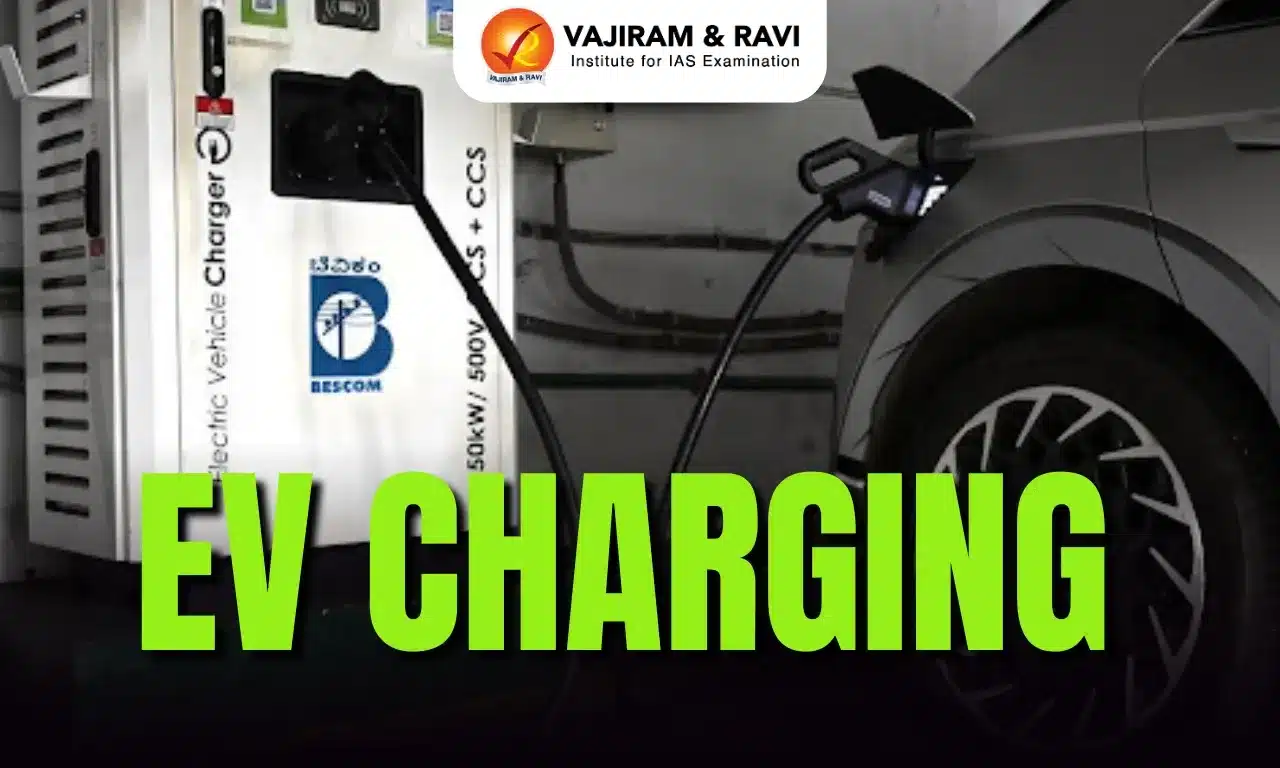
  • The government has launched guidelines under the Rs. 10,000 crore PM E-Drive scheme, offering 100% subsidy for EV charging infrastructure to accelerate India’s transition to clean mobility.

Introduction

  • India has set ambitious targets for transitioning towards sustainable transportation, with electric vehicles (EVs) positioned at the centre of its clean mobility vision. 
  • To bridge the critical infrastructure gap, the government has rolled out guidelines under the Rs. 10,000 crore PM E-Drive scheme, offering up to 100% subsidy for setting up EV charging stations and battery swapping stations. 
  • The move aims to accelerate EV adoption by addressing one of the sector’s biggest challenges, inadequate charging infrastructure.

India’s Push for EV Adoption

  • The EV sector in India has gained momentum over the past decade, supported by policies such as the Faster Adoption and Manufacturing of Hybrid and Electric Vehicles (FAME) scheme and state-level incentives. 
  • However, the lack of sufficient charging points continues to deter buyers. India currently has fewer than 20,000 public charging stations, far behind global EV leaders like China and the U.S.
  • The PM E-Drive scheme seeks to address this bottleneck by prioritising subsidies for high-density urban areas, smart cities, and critical transport corridors. 
  • By linking subsidies to demand aggregation, the scheme ensures a coordinated approach between ministries, state governments, and public sector enterprises.

Key Features of the PM E-Drive Subsidy Scheme

  • The new guidelines allocate Rs. 2,000 crore out of the Rs. 10,000 crore scheme exclusively for charging infrastructure. Some of the notable features include:
  • 100% Subsidy Coverage: Eligible entities will receive full financial support for upstream infrastructure like transformers, cables, circuit breakers, and civil works. In some cases, even the cost of EV supply equipment (EVSE), including charging guns, will be subsidised.
  • Priority Areas: Focus on cities with populations above one million, notified smart cities, satellite towns near metros, and cities under the National Clean Air Programme (NCAP).
  • Highways Integration: Selected inter-city and inter-state highways will be made EV-ready through coordinated planning with the Ministry of Road Transport and Highways.
  • Eligible Entities: Central ministries, State governments, PSUs, and CPSEs can submit proposals. Companies like IOCL, BPCL, HPCL, NHAI, AAI, and metro rail corporations are also eligible.
  • Operational Flexibility: Entities may directly operate charging stations or appoint Charge Point Operators (CPOs).

Expected Impact on EV Ecosystem

  • The subsidy scheme is designed to create a network of charging stations that matches the pace of EV adoption in India. The immediate benefits include:
  • Boost to EV Sales: Assured availability of charging infrastructure is expected to encourage more consumers to switch from internal combustion engine vehicles to EVs.
  • Public Sector Leadership: Involving large PSUs such as IOCL and NHAI ensures that the scheme benefits from established networks and infrastructure expertise.
  • Pollution Reduction: By prioritising NCAP cities and capital cities, the scheme aligns EV infrastructure growth with India’s clean air goals.
  • Economic Opportunities: The expansion of charging networks will create business opportunities for Charge Point Operators, equipment manufacturers, and service providers.

Challenges Ahead

  • While the subsidy plan is a breakthrough, its success will depend on implementation. Some key challenges include:
  • Land Acquisition: Identifying and securing suitable sites for charging stations in densely populated urban areas.
  • Grid Readiness: Strengthening India’s power distribution systems to handle increased EV charging load without causing disruptions.
  • Private Sector Participation: Encouraging private players to complement PSU-led efforts for a balanced rollout.
  • Consumer Awareness: Educating users about charging locations, pricing models, and safety standards.

Source: TH

EV Charging FAQs

Q1: What is the PM E-Drive scheme?

Ans: The PM E-Drive is a Rs. 10,000 crore government scheme to boost electric vehicle adoption, with Rs. 2,000 crore earmarked for charging infrastructure.

Q2: Who is eligible for the EV charging subsidy?

Ans: Central ministries, State governments, PSUs, CPSEs, and entities like IOCL, BPCL, HPCL, and NHAI can apply.

Q3: How much subsidy is offered under the scheme?

Ans: Up to 100% subsidy is provided for upstream infrastructure and, in some cases, EV supply equipment costs.

Q4: Which areas will be prioritized for EV charging stations?

Ans: Cities with populations above one million, smart cities, satellite towns, NCAP cities, and inter-state highways will be prioritized.

Q5: What is the expected impact of this scheme?

Ans: It is expected to boost EV adoption, reduce pollution in cities, and strengthen India’s EV ecosystem through wider charging access.

Enquire Now