
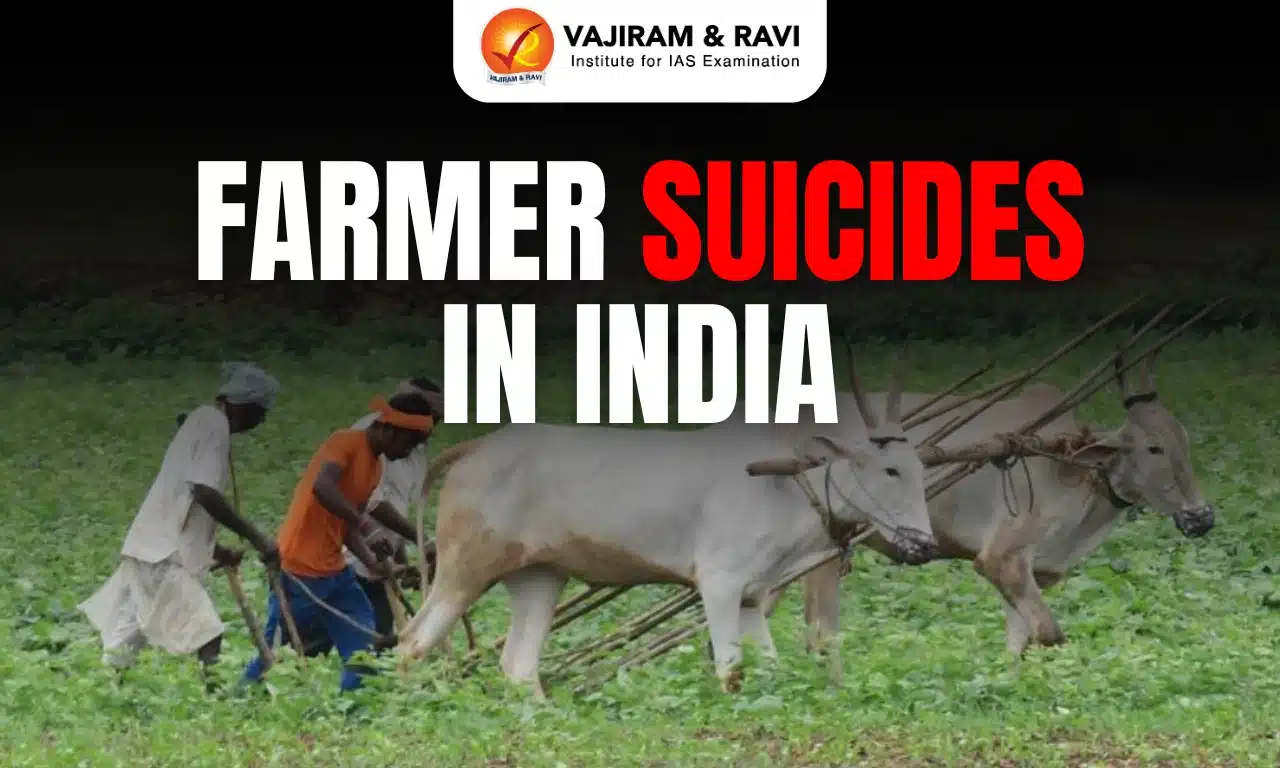
Farmer Suicides in India – NCRB Highlights Alarming Trends

Farmer suicides in India

Farmer Suicides Latest News

  • The NCRB’s 2023 report revealed that over 10,700 farmers and agricultural workers died by suicide, with Maharashtra and Karnataka recording the highest numbers.

Farmer Suicides in India: A Chronic Crisis

  • India’s agricultural sector sustains nearly half of its population, yet farmers often remain economically vulnerable. The recurring phenomenon of farmer suicides is not new and has been deeply linked to issues such as:
    • Debt Burden: Dependence on informal credit and high-interest loans often traps farmers in cycles of unmanageable debt.
    • Crop Failures: Erratic monsoons, droughts, floods, and pest infestations leave farmers unable to recover investments.
    • Market Volatility: Price fluctuations in key crops like cotton, soybean, onion, and pulses reduce profitability.
    • Policy Gaps: Inadequate crop insurance, lack of irrigation coverage, and insufficient procurement mechanisms worsen rural distress.
    • Regional Concentration: Farmer suicides are often concentrated in cotton and soybean belts like Vidarbha and Marathwada in Maharashtra, highlighting the vulnerability of monocrop-dependent regions.
  • Various governments have attempted measures such as loan waivers, crop insurance schemes, and MSP (Minimum Support Price) expansions. 
  • However, the persistence of suicides suggests structural reforms are required, particularly in rural credit systems, diversification of crops, and ensuring stable incomes.

Key Highlights of the NCRB Report on Farmer Suicides

  • According to the National Crime Records Bureau (NCRB) 2023 report, 10,786 farmers and agricultural workers died by suicide across India, accounting for 6.3% of all suicides in the country.
  • State-wise Distribution
    • Maharashtra: Reported the highest share at 38.5% of farmer suicides, with Marathwada and Vidarbha remaining epicentres.
    • Karnataka: Accounted for 22.5%, reflecting widespread distress across drought-prone regions.
    • Andhra Pradesh, Madhya Pradesh, and Tamil Nadu: Reported 8.6%, 7.2%, and 5.9% respectively.
    • Zero Reports: States like West Bengal, Bihar, Odisha, and several north-eastern states officially reported no farmer suicides, though experts question the accuracy of this data.
  • Occupation-wise Split
    • Cultivators (Farmers): 4,690 suicides (mostly male).
    • Agricultural Workers: 6,096 suicides, indicating that landless labourers also face severe economic stress.
  • Broader Trends
    • The NCRB data highlights that more than 10,000 suicides annually have been consistently reported from the farming sector in 2021, 2022, and 2023.
    • Experts and farmer organisations argue that the figures may be underreported due to discrepancies in state-level data recording.

Criticism and Concerns Raised

  • Farmer organisations such as the All India Kisan Sabha (AIKS) argue that the government’s policies have aggravated rural distress rather than alleviating it. 
  • Key criticisms include:
    • Trade Liberalisation: Removal of the 11% import duty on cotton has sparked fears that cheaper American cotton will further undercut Indian farmers.
    • Impact of Free Trade Agreements (FTAs): Concerns that upcoming FTAs could threaten domestic agriculture, dairy, and edible oil sectors.
    • Policy Indifference: Critics argue that successive governments have failed to draw lessons from the crisis, remaining focused on corporate-driven models of growth.
  • The data also underscores a cotton and soybean crisis, with farmer suicides most pronounced in these crop belts. 
  • This makes it evident that agricultural reforms cannot be piecemeal but must focus on holistic rural livelihood security.

Source: TH

Farmer Suicides FAQs

Q1: How many farmer suicides were reported in 2023?

Ans: The NCRB reported 10,786 farmer and agricultural worker suicides in 2023.

Q2: Which state reported the highest number of farmer suicides?

Ans: Maharashtra accounted for the largest share at 38.5%.

Q3: What percentage of total suicides in India are from the farm sector?

Ans: Farmer suicides represented 6.3% of the 1.71 lakh suicides reported in 2023.

Q4: What are the major crops linked to farmer suicides?

Ans: Cotton and soybean belts in Maharashtra, particularly Vidarbha and Marathwada, have seen the highest distress.

Q5: Why are experts critical of the NCRB data?

Ans: Experts believe the figures are underreported, as some states officially recorded zero farmer suicides, which contradicts ground realities.

India Needs Double Growth to Solve Jobs Crisis: Morgan Stanley Report

GDP Growth to address underemployment

Unemployment in India Latest News

  • Morgan Stanley (a global financial services firm) warns that India must nearly double its growth rate to meet rising employment needs and tackle underemployment.
  • The analysis projects that a 7.4% average GDP growth is required to maintain stable unemployment, assuming steady labour participation. 
  • If participation rises to 63%, growth of 9.3% would be necessary. To meaningfully reduce underemployment, growth must reach 12.2%.
  • Currently, GDP growth averages 6.1% over the past decade, with the RBI projecting 6.5% for this fiscal year, though recent data shows a stronger 7.8% in April-June 2025.

India’s Youth Unemployment Challenge

  • Despite being the fastest-growing major economy, India struggles with high youth unemployment, a concern flagged by Morgan Stanley in its latest note.
  • According to the Periodic Labour Force Survey (PLFS), the all-India unemployment rate fell to 5.1% in August, but youth unemployment (ages 15–29) stood much higher at 14.6%.
  • In urban areas, the female youth unemployment rate surged to 25.7%, over 10 percentage points higher than that of young urban males, which fell to 15.6% from 17.1%. 
  • This pushed overall urban youth unemployment down slightly to 18% from 19%.
  • In rural India, female youth unemployment rose to 14.3%, while male youth unemployment declined to 12.6%. Both figures were at 13% in July.

Demographic Pressure

  • India’s median age is 28.4 years, making it one of the youngest countries globally. 
  • However, its youth unemployment rate is the highest in the region, creating a mismatch between demographic advantage and job creation.

Weak Employment Creation

  • Over the last two years, employment creation has been subdued, with only modest improvements recently. 
  • Morgan Stanley cautions that GDP growth averaging 6.5% over the next decade—though among the fastest globally—will still fall short of creating sufficient jobs.

The Workforce Surge Ahead

  • Even without rising participation rates, India’s workforce is expected to grow by at least 8.4 crore in the next decade. 
  • Without stronger job creation, this surge will deepen the unemployment and underemployment crisis.

Unemployment and Underemployment Crisis

  • India faces a dual challenge of high unemployment and widespread underemployment
  • Youth unemployment has surged to 17.6%, the highest in South Asia, while a return to agriculture has pushed farm employment to a 17-year high
  • Much of this reflects underemployment, where skills and time remain underutilised. 
  • India’s broad definition of employment — counting even one hour of work a week, including unpaid family labour — further masks the true scale of labour underutilisation.

Poverty Adds to the Challenge

  • With about 603 million Indians living below the $3.65 per day income threshold, the urgency of job creation and economic transformation is amplified. 
  • Solving unemployment and underemployment is not just an economic priority but also a social imperative to prevent rising tensions and ensure inclusive growth.

Asia’s Growing Youth Unemployment Crisis

  • Youth unemployment is not unique to India; it is a regional challenge across Asia
  • According to Morgan Stanley, Asia’s youth unemployment rate stands at 16%, far higher than the 10.5% in the US.
  • For the three most populous economies — China, India, and Indonesia — the problem is especially severe. 
  • Despite falling headline unemployment rates, joblessness among youth has remained stubbornly high.
  • The challenge is expected to intensify with the growing adoption of artificial intelligence (AI), which could displace jobs unless reforms boost investment and reskilling. 

Way Forward for India

  • The report warns that if joblessness worsens, governments may need to adopt redistributive measures to maintain social stability.
  • For India, while reforms have been undertaken to promote growth, a bigger push is needed in the industrial and export sectors
  • The report highlights that every manufacturing export job creates two additional jobs in related fields like transport and logistics. 
  • Yet, India’s share in global exports is just 1.8%, far below its weight in GDP and working-age population — showing significant untapped potential for job creation.
  • The report stresses urgent reforms in industrial and export growth, infrastructure expansion, and workforce skill upgrades
  • Without stronger investment in advanced manufacturing and technology, India risks falling behind in providing meaningful work for its young population.

Source: IE | TN | BS

Unemployment in India FAQs

Q1: Why does India need faster growth to solve its jobs crisis?

Ans: Morgan Stanley says GDP must rise to 12.2% annually to reduce underemployment and absorb 84 million new workers in the coming decade.

Q2: What is the current state of youth unemployment?

Ans: Youth unemployment in India is 14.6% overall, rising to 25.7% among urban females, highlighting serious job creation challenges.

Q3: What is underemployment in India?

Ans: Underemployment occurs when workers’ skills or time are underutilized. Many return to agriculture or unpaid work, masking the scale of labour underuse.

Q4: Why is Asia’s youth unemployment concerning?

Ans: At 16%, Asia’s youth unemployment is higher than the US, with India, China, and Indonesia worst affected, worsened by AI adoption and labour mismatches.

Q5: What reforms does Morgan Stanley suggest for India?

Ans: It urges boosting industrial and export growth, infrastructure, and skills, noting each manufacturing export job creates two more in related sectors.

Trump’s 20-Point Gaza Peace Plan: Key Provisions and India’s Concerns

Trump’s new Gaza ‘peace plan’

Trump Gaza Peace Plan Latest News

  • US President Donald Trump unveiled a 20-point “Comprehensive Plan to End the Gaza Conflict”, marking one of the most ambitious peace initiatives as the war nears its second anniversary. 
  • The plan, prepared over eight months, was announced following Israeli Prime Minister Benjamin Netanyahu’s visit to Washington. 
  • While it outlines measures with significant implications for the Middle East, Trump’s political standing, and India’s interests, its future remains uncertain as Hamas has not yet accepted the proposal.

Broad Contours of Trump’s Gaza Peace Plan

  • US President Donald Trump’s 20-point “Comprehensive Plan to End the Gaza Conflict” lays out ambitious measures to end hostilities, ensure security, and rebuild Gaza. 
  • The war in Gaza has left more than 66,000 people dead, after the October 7, 2023, attacks by Hamas killed 1,200 people and led to about 250 people being taken hostage.

Hamas Disarmament and Safe Passage

  • The plan’s most critical element requires Hamas to surrender and disarm
  • Members committing to peaceful coexistence will be granted amnesty, while those unwilling can leave Gaza with safe passage to countries like Egypt, Jordan, Qatar, or Iran. 
  • Given Hamas’s two-decade rule and history of armed conflict, this is seen as the plan’s toughest hurdle.

International Stabilization Force (ISF)

  • A temporary ISF, backed by the US and Arab partners, will be deployed in Gaza. 
  • Its role includes training vetted Palestinian police, stopping arms inflow, and facilitating aid and goods movement. 
  • Israel has pledged not to annex Gaza and will gradually withdraw its forces as the ISF establishes control, though it plans to retain a security buffer zone until stability is ensured.

Governance and Transitional Authority

  • Gaza will be run by a technocratic, apolitical Palestinian committee, with oversight from an international Board of Peace led by Trump, alongside other leaders, including former UK Prime Minister Tony Blair. 
  • This arrangement aims to provide neutral governance and oversee reconstruction, though Blair’s inclusion has drawn skepticism given his controversial Iraq War legacy.

Humanitarian Aid and Reconstruction

  • The plan permits the resumption of large-scale humanitarian aid, including rehabilitation of water, electricity, sewage, and healthcare systems. 
  • Aid distribution will be overseen by the UN, Red Crescent, and international agencies, ensuring transparent and interference-free relief for Gaza’s population.

Hostage-Prisoner Exchange

  • Within 72 hours of Israel’s acceptance, all hostages — alive and deceased — must be returned. 
  • In exchange, Israel will release 250 prisoners serving life terms and 1,700 Gazans detained since October 7, 2023, including all women and children. 
  • The deal also covers a 15:1 exchange ratio for remains of deceased hostages and Gazans. 
  • With 48 hostages still held by Hamas, this remains a sensitive issue fueling public protests in Israel.

Regional and Global Guarantees

  • The plan ensures compliance through guarantees from regional partners. Eight nations — Qatar, Jordan, UAE, Indonesia, Pakistan, Turkey, Saudi Arabia, and Egypt — have welcomed the proposal. 
  • Major powers like China and Russia have also expressed support, indicating broad international backing.

India’s Stand on Trump’s Gaza Peace Plan

  • PM Modi welcomed Trump’s 20-point Gaza peace plan, calling it a “viable pathway” to long-term peace, security, and development for Palestinians, Israelis, and the wider West Asian region.
  • India views West Asia as part of its extended neighbourhood, with deep ties to Israel, Iran, and Saudi Arabia. 
  • PM Modi’s endorsement, despite ongoing India-US frictions, is seen as a positive diplomatic gesture, acknowledging Trump’s role as peacemaker and aligning India with efforts to stabilise the region for its strategic and economic interests.

What the Gaza Peace Plan Means for India

  • Trump’s Gaza peace proposal carries direct implications for India’s diaspora, economy, energy security, and strategic standing in the Middle East
  • While peace could open opportunities, some geopolitical concerns remain.

Impact on Indian Diaspora

  • Nearly 90 lakh Indians live in the wider Middle East, including 18,000 in Israel and up to 10,000 in Iran. 
  • Stability in the region is critical for their safety and well-being.

Energy Security and Trade

  • India sources 80% of its crude oil from the Middle East. Any reduction in regional tensions can stabilise energy prices, directly benefiting India’s economy. 
  • Moreover, peace may encourage greater Arab investment in India and accelerate initiatives such as the India-Middle East-Europe Economic Corridor, which New Delhi sees as a game-changing connectivity project.

Strategic Concerns: Pakistan’s Role

  • A worrying element for New Delhi is the visible involvement of Pakistan in the peace process. 
  • Trump publicly thanked leaders from Jordan, UAE, Saudi Arabia, and Pakistan, noting Pakistan’s Prime Minister and field marshal were engaged from the beginning. 
  • This revived US-Pakistan engagement could complicate India’s regional strategy and tilt diplomatic equations in ways unfavourable to New Delhi.

Source: IE | ToI | HT

Trump Gaza Peace Plan FAQs

Q1: What is Donald Trump’s Gaza peace plan?

Ans: It’s a 20-point proposal requiring Hamas disarmament, creation of a stabilization force, humanitarian aid, and a transitional governance structure for Gaza.

Q2: How does the plan address Hamas?

Ans: Hamas must surrender arms, with amnesty for peaceful members and safe passage to other countries. This is the toughest condition of the plan.

Q3: What role will international forces play?

Ans: A US-backed International Stabilization Force will secure Gaza, train police, prevent arms inflow, and ensure aid distribution until local stability returns.

Q4: Why is the plan important for India?

Ans: With 90 lakh Indians in West Asia and 80% oil imports from the region, peace ensures diaspora safety, stable energy prices, and trade growth.

Q5: Why is Pakistan’s role a concern for India?

Ans: Trump credited Pakistan as an early supporter of the plan, signaling stronger US-Pak ties, which could complicate India’s strategic calculations.

Enquire Now

