India-China Flights Resume After 5 Years: What It Means for Airlines and Travellers

India-China Flights

India-China Flights Latest News

  • After more than five years, India and mainland China are set to restart direct flights by the end of October 2025. 
  • The Ministry of External Affairs announced that both nations have agreed to resume air services under the upcoming winter schedule, which begins on October 26. 
  • The resumption will depend on the commercial readiness of designated airlines and compliance with operational requirements, marking a key step toward restoring normal connectivity disrupted since 2020.

India-China Flights Set for Revival Amid Diplomatic Thaw

  • The resumption of direct air connectivity between India and China comes amid improving bilateral ties, even as India’s relations with the US face minor strains. 
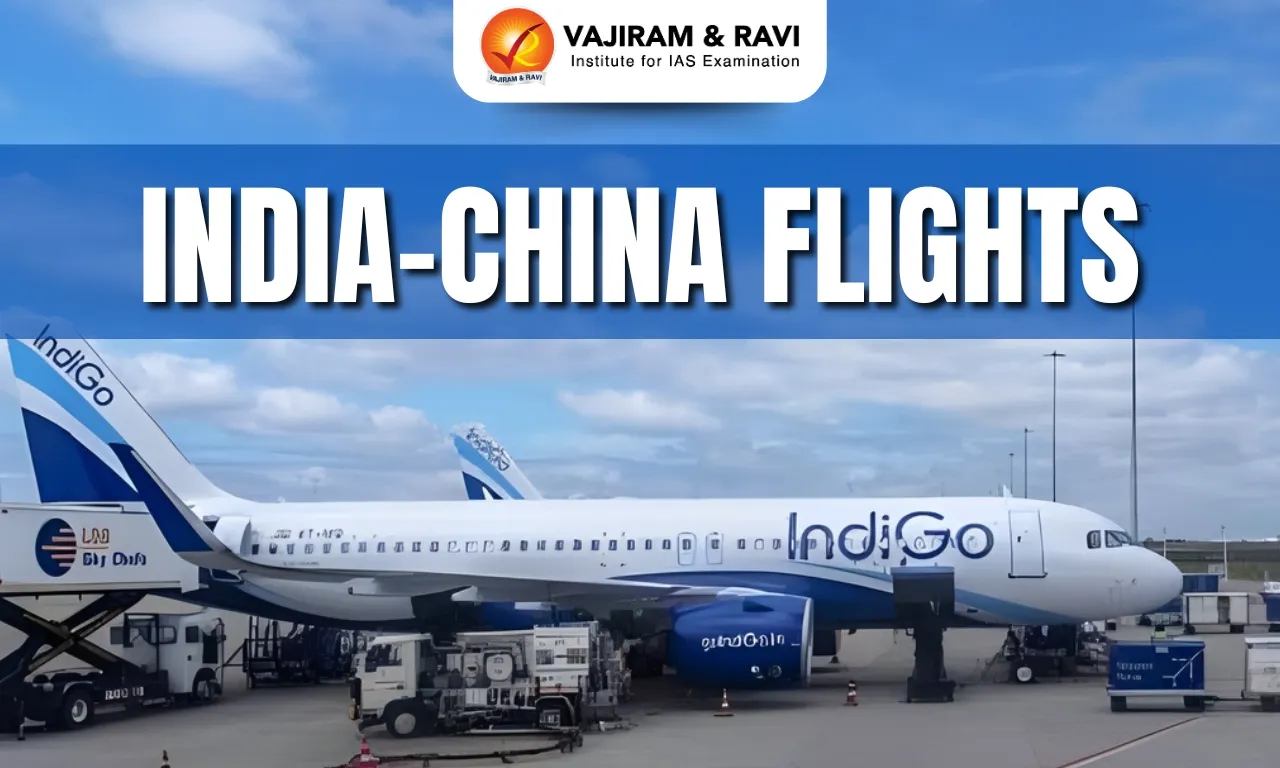
  • Following the MEA’s announcement, IndiGo became the first airline to confirm operations, with daily Kolkata–Guangzhou flights starting October 26. 
  • The carrier also plans future routes from Delhi, while Air India is preparing to launch Delhi–Shanghai flights by year-end. 
  • Chinese airlines, which dominated the route before the pandemic, are expected to re-enter the Indian market soon.
  • The absence of direct flights since 2020 has led to inflated airfares and long travel times, as passengers relied on transit hubs in Southeast Asia. 
  • With direct routes returning, airlines anticipate strong demand — especially from business and trade travelers — and expect to regain significant passenger traffic previously diverted to foreign carriers.

India-China Direct Flights: From Suspension to Resumption

  • Direct air connectivity between India and China was suspended at the onset of the Covid-19 pandemic, which halted international travel worldwide. 
  • However, while other countries gradually restored air routes, flights between India and China remained grounded due to deteriorating bilateral ties following the 2020 Line of Actual Control (LAC) standoff
  • India’s reluctance to resume direct services stemmed from ongoing border tensions and diplomatic friction, even as China consistently pressed for their reinstatement.

Early Signs of Thaw and Diplomatic Engagements

  • With bilateral relations showing signs of improvement in 2024–25, the two sides began to explore ways to normalise travel. 
  • The first major breakthrough came during Foreign Secretary’s visit to Beijing in January 2025, where both nations agreed “in principle” to resume direct flights. 
  • This momentum continued in August, when Chinese Foreign Minister Wang Yi’s visit to New Delhi led to an agreement to restart air services “at the earliest” and ease visa procedures for tourists, businesspersons, journalists, and other travellers.

Ongoing Negotiations Through 2024

  • Throughout 2024, the issue of flight resumption featured in multiple rounds of discussions between Indian and Chinese foreign and aviation officials. 
  • Despite limited progress, both sides continued engagement.

Final Diplomatic Push in Late 2024

  • Momentum built toward the end of 2024, when External Affairs Minister S. Jaishankar and Wang Yi met in Rio de Janeiro on the sidelines of the G20 Summit. 
  • Their discussions followed a key breakthrough — a border patrolling arrangement, signalling de-escalation along the LAC. 
  • Soon after, Prime Minister Narendra Modi and President Xi Jinping met at the BRICS Summit in Russia, effectively paving the way for direct flight resumption — a symbolic and practical step toward normalising India-China ties.

Direct Flights to Boost Connectivity and Competition

  • Both Indian and Chinese airlines are poised to benefit significantly from the resumption of direct air connectivity between the two countries after a five-year hiatus. 
  • Before the pandemic, direct flights accounted for over 45% of all India-China passenger traffic — a market both sides now aim to reclaim and expand.
  • The suspension of direct routes, combined with strict visa norms, had forced passengers to rely on connecting flights through hubs in Southeast Asia such as Singapore, Bangkok, Kuala Lumpur, and Hong Kong. 
  • As a result, airlines from these regions captured the market, with Hong Kong remaining the top transit point due to its separate visa regime. 
  • Currently, India-China passenger traffic stands at less than half of 2019 levels, but demand remains robust, especially for business and trade-related travel.
  • With the return of direct flights, passengers will benefit from greater convenience, reduced travel time, and lower fares as competition intensifies among Indian, Chinese, and third-country carriers. 
  • The renewed connectivity is expected to not only revitalise air travel but also strengthen bilateral trade and people-to-people exchanges.

Chinese Airlines Held Majority of Pre-Pandemic India-China Traffic

  • Before the Covid-19 pandemic, Chinese carriers dominated direct air traffic between India and China, operating nearly 70% of the total flights
  • Beijing’s strong push for resuming direct air connectivity and easing visa restrictions stems from this pre-existing advantage. 
  • However, industry analysts believe the balance may shift once flights resume. 
  • India’s aviation landscape has evolved — Air India, now privatised and financially stronger, is aggressively expanding its international footprint, and IndiGo is prioritising global routes. 
  • This could enable Indian airlines to reclaim a larger share of the India-China travel market.

Source: IE

India-China Flights FAQs

Q1: When will India-China flights resume?

Ans: Direct flights between India and China will resume by late October 2025 under the new winter schedule after a five-year suspension.

Q2: Why were flights suspended?

Ans: They were halted in 2020 due to Covid-19 and prolonged tensions following the Line of Actual Control (LAC) standoff between the two countries.

Q3: Which airlines are restarting operations?

Ans: IndiGo will start Kolkata–Guangzhou flights, while Air India plans Delhi–Shanghai services. Chinese carriers will also resume India routes soon.

Q4: How will the resumption benefit travellers?

Ans: Passengers can expect shorter travel times, lower fares, and more flight options as competition returns between Indian and Chinese carriers.

Q5: Why does China see an advantage?

Ans: Before the pandemic, Chinese airlines held about 70% of India-China air traffic, giving them a strong base to reclaim market dominance.

Organ Donation in India – Challenges and the Way Forward

Organ Donation in India

Organ Donation in India Latest News

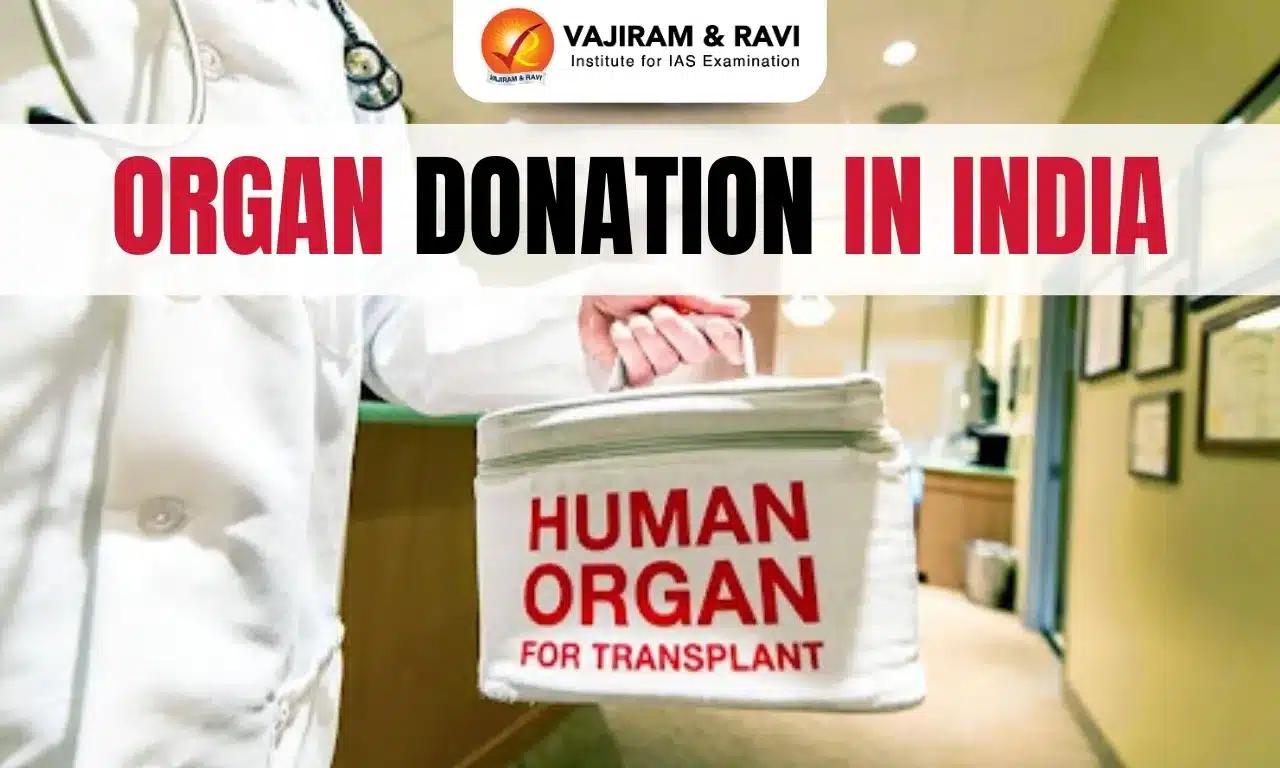
  • Despite India’s high burden of road traffic accidents and ICU-related deaths, organ donation rates remain low
  • A recent national survey highlights systemic gaps in brain death certification, training, and awareness among physicians, directly hampering deceased organ donation.

Organ Donation in India

  • Overview:
    • While India ranks third globally in the total number of organ transplants (over 18,900 in 2024), the country's organ donation rate remains critically low, particularly for deceased donations. 
    • Though India reports 1,60,000 road traffic deaths annually, only 1,000–1,200 deceased organ donations occur per year.
    • This means, India is heavily reliant on living donors for most transplants, especially for kidneys (for which, overall 13,476 transplants performed in 2024) and liver (4,901 transplants). 
  • Statistics:
    • Living vs. deceased donors: In 2024, India recorded just 1,128 deceased donors compared to over 15,000 living donors. Over 700 of these deceased donors came from just six southern states.
    • Donor-per-million rate: India's donation rate is less than 1 donor per million population, far behind developed countries like Spain (~48 per million) and the US (~36 per million).
    • Supply-demand gap: With over 63,000 people needing a kidney transplant and 22,000 needing a liver, the demand for organs vastly outstrips the supply, and thousands die each year while waiting. 

Reasons Behind the Low Donation Rate

  • Lack of awareness: Widespread lack of public knowledge about organ donation, especially the concept of "brain death," is a major barrier. This leads to misinformation and skepticism.
  • Cultural and religious beliefs: Deep-seated social and cultural factors, including beliefs about life after death, create hesitation and prevent families from giving consent for donation, even if the deceased had previously pledged.
  • Family refusal: Even with a donor pledge, family reluctance often results in refusal. A 2025 study cited family refusal as a significant factor for over 60% of respondents.
  • Weak deceased donation system: Many hospitals lack the infrastructure, trained counselors, and trained intensivists needed to identify potential donors and counsel families effectively.
  • Lack of medical training: Example, very few neurosurgeons, neurologists, and critical care specialists are trained during their MBBS studies to certify brain death.
  • Geographical disparities: Transplant facilities are concentrated in major cities, and most deceased donation programs are confined to southern and western states.
  • High cost of transplant: Most transplants occur in the private sector, and the high costs make them inaccessible for many people with end-stage organ failure.
  • Legal and ethical hurdles: Complex legal and ethical issues, including concerns about illegal organ trafficking, can delay or hinder the donation process. 

Survey Findings on Brain Death Certification

  • Conducted by AIIMS neurosurgeons, it surveyed 177 doctors involved in organ donation.
  • Key findings:
    • Fewer than 50% received formal training in brain death certification during medical school.
    • Only 10% routinely trained their residents in brain death protocols.
    • 96% knew the apnea test (for determining brain death), but nearly 50%  failed to screen for drugs or toxins - an essential step in ruling out reversible causes of coma.

Government Steps to Boost Organ Donation in India

  • Institutional reforms:
    • The Indian government has taken several steps to improve organ donation rates through the National Organ and Tissue Transplant Organisation (NOTTO). 
    • These include establishing the National Organ Transplant Programme (NOTP) to provide financial support for infrastructure and setting up regional and state bodies (ROTTOs and SOTTOs). 
  • Legal reforms: In 2023, the government removed the upper age limit for deceased donor registration and the state domicile requirement. 
  • Digital initiatives: Include a unique NOTTO-ID system to monitor transplants. 

Way Forward

  • Integration in medical education: Mandatory inclusion of brain death certification training in undergraduate and postgraduate curricula.
  • Capacity building: Regular refresher courses and hands-on workshops for doctors and residents.
  • Standardised protocols: Development of uniform national guidelines for brain death certification.
  • Institutional reforms: Creation of hospital-level frameworks to streamline processes. Example, the need for hospital-level "green corridors" for smooth organ donation procedures.
  • Awareness campaigns: Public and professional sensitisation to improve acceptance and trust in organ donation.

Conclusion

A comprehensive approach combining education, systemic reforms, and awareness can significantly enhance deceased organ donation rates, aligning with India’s healthcare goals and ethical imperatives.

Source: TH

Organ Donation in India FAQs

Q1: Why is brain death certification critical for improving organ donation rates in India?

Ans: It ensures timely identification of potential donors, which is essential to increase deceased organ donation rates.

Q2: What are the key findings of the national survey on brain death certification among Indian physicians?

Ans: Less than half had formal training, only 10% trained residents, and nearly half failed to rule out reversible causes despite 96% knowing the apnea test.

Q3: What systemic challenges impede organ donation in India despite a high number of road traffic deaths?

Ans: Lack of trained intensivists and counsellors, poor awareness of brain death, and inadequate institutional processes.

Q4: How can reforms in medical education strengthen India’s organ donation programme?

Ans: Mandatory inclusion of brain death certification in curricula and regular practical training for doctors and residents.

Q5: What measures are needed to streamline hospital-level processes to facilitate organ donation in India?

Ans: Creation of hospital “green corridors,” uniform national protocols, and dedicated institutional frameworks for organ donation.

India’s New Strategy to Prevent Crowd Disasters: Guidelines, Laws, and Scientific Measures

Crowd Management

Crowd Management Latest News

  • Recently, a tragic crowd crush at a political rally by actor and Tamilaga Vettri Kazhagam (TVK) founder Vijay in Tamil Nadu’s Karur district claimed 41 lives. 
  • Following the incident, Chief Minister M.K. Stalin announced the formation of a one-member commission led by retired judge Aruna Jagadeesan to investigate the causes of the disaster. 
  • The Chief Minister also stated that new regulations for managing public gatherings would be framed after the commission submits its report.

India’s Evolving Framework for Crowd Management

  • India has strengthened its crowd management mechanisms through updated national guidelines and institutional training. 
  • In June 2025, the Bureau of Police Research and Development (BPR&D) issued Comprehensive Guidelines on Crowd Control and Mass Gathering Management, focusing on scientific and preventive strategies for police and law enforcement agencies. 
  • Similarly, the National Disaster Management Authority (NDMA) continues to implement its 2020 framework, which recommends advance risk assessment, detailed site layouts, pre-defined entry and exit routes, real-time monitoring, and clear communication systems.
  • The National Institute of Disaster Management (NIDM) has also introduced specialised training modules on managing large gatherings as part of its capacity-building initiatives. 
  • Following the February 2025 crowd crush at a New Delhi railway station, the Indian Railways updated safety manuals at around 60 major stations, adding provisions such as holding areas, dispersal zones, and crowd monitoring systems. 
  • However, these measures remain largely advisory rather than legally binding, leaving implementation inconsistent across states and agencies.

State-Level Measures for Crowd Management in India

  • Several States have begun enacting specific laws to manage large gatherings following recent crowd disasters. 
  • After the June 2025 stampede at Bengaluru’s M. Chinnaswamy Stadium, the Karnataka government introduced the Crowd Control (Managing Crowd at Events and Venues of Mass Gathering) Bill, 2025
  • This law covers political, cultural, and religious events, assigning accountability to organisers and empowering district magistrates to cancel or redirect events, regulate loudspeakers, and impose fines or imprisonment for violations. 
  • Similarly, Uttar Pradesh’s State Disaster Management Authority issued the Guidelines for Managing Crowd at Events of Mass Gathering, 2023, institutionalising measures for religious and cultural congregations.

Institutional and Training Initiatives

  • The Gujarat Institute of Disaster Management has developed training materials offering technical guidance on calculating venue capacity, exit planning, volunteer coordination, and fire and first aid preparedness. 
  • Following a July 2025 stampede at Haridwar’s Mansa Devi temple, the Uttarakhand government mandated updated safety protocols at major temples and ordered the removal of encroachments near shrines to improve crowd movement and emergency access.

Event-Specific and Local Protocols

  • The Maharashtra government introduced a Bill empowering the Nasik-Trimbakeshwar Kumbh Mela Authority to establish temporary townships and bypass certain urban planning norms to accommodate large gatherings. 
  • In addition, local enforcement agencies have circulated Standard Operating Procedures (SOPs) to improve inter-departmental coordination, medical preparedness, and fire safety. 
  • For instance, after the Bengaluru incident, Karnataka Police issued a detailed SOP for managing crowds at public events.

Administrative Measures and Challenges

  • Across various districts, police authorities have directed organisers of major religious and political events to submit crowd management plans, limit attendance, set up barricades, deploy medical teams, and divert traffic. 
  • However, most of these directions remain administrative orders rather than statutory mandates, often issued reactively after specific tragedies — such as the Haridwar, Karur, Bengaluru, and Prayagraj incidents. 
  • The absence of uniform legal backing continues to hinder consistent enforcement of crowd safety protocols across States.

Scientific Approach to Crowd Control

  • Scientific crowd control focuses on regulating crowd density and movement patterns to prevent crushes and stampedes. 
  • Studies show that danger increases sharply when density exceeds five persons per square metre
  • To prevent this, organisers should avoid bottlenecks, slopes, and counter-flows, which create pressure buildups and destabilise movement. 
  • The use of drones and ground-linked computer systems for real-time density monitoring is considered a best practice — and failing to deploy such technologies is seen as a major safety gap.

Safety Practices for Individuals

  • In dense or moving crowds, individuals should move diagonally toward less crowded edges instead of pushing against the flow. 
  • Since most deaths result from compressive asphyxia rather than trampling, people are advised to keep forearms across the chest to protect breathing space and maintain balance with staggered footing. 
  • If knocked down, rolling to the side, shielding the head and neck, and standing up quickly can help avoid further injury. 
  • People should also stay away from rigid barriers like fences and walls where pressure can build dangerously, and avoid stopping to retrieve dropped items or take videos, as even short pauses can trigger turbulence in the crowd.

Organisational Best Practices

  • Event organisers should ensure continuous monitoring by trained crowd managers, establish one-way movement routes, provide multiple exits, and display clear signage for crowd direction. 
  • Public address systems must be used to relay safety instructions, and on-site medical facilities should be available for quick response to emergencies. 
  • Together, these measures form the scientific foundation of effective and safe crowd management at mass gatherings.

Source: TH | NDMA

Crowd Management FAQs

Q1: What triggered India’s renewed focus on crowd management?

Ans: A fatal rally crush in Tamil Nadu killing 41 people prompted stronger laws, updated national guidelines, and scientific crowd management strategies.

Q2: What national measures exist for crowd safety?

Ans: The BPR&D issued 2025 crowd control guidelines, and NDMA maintains frameworks for risk assessment, site planning, and real-time crowd monitoring.

Q3: Which States have passed crowd control laws?

Ans: Karnataka, Maharashtra, Uttar Pradesh, and Uttarakhand introduced laws and SOPs to regulate gatherings, assign responsibility, and enforce safety protocols.

Q4: What is the scientific approach to crowd management?

Ans: It involves maintaining density below 5 persons/sq.m., avoiding bottlenecks, and using drones and AI tools for real-time crowd flow monitoring.

Q5: How can individuals stay safe in dense crowds?

Ans: Move diagonally toward open areas, protect the chest, avoid walls or barriers, and never stop to pick items or record videos in dense flows.

SC’s TET Mandate and the Looming Crisis of Empty Schools

TET Mandate

TET Mandate Latest News

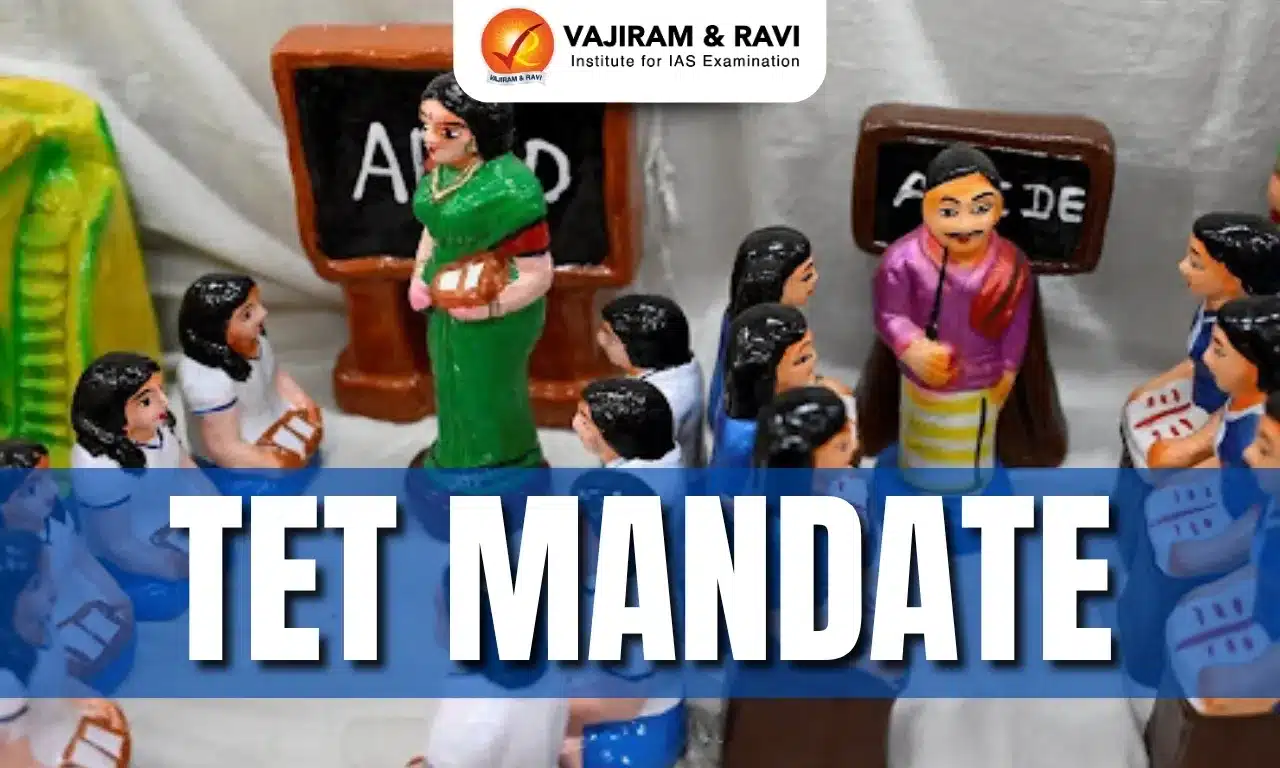
  • The Supreme Court’s directive has mandated all in-service teachers in non-minority schools to clear the Teachers’ Eligibility Test (TET) within two years.

Introduction

  • The Supreme Court’s recent directive mandating that all in-service teachers for Classes 1 to 8 in non-minority schools must clear the Teachers’ Eligibility Test (TET) within two years has sparked widespread concern among States. 
  • Tamil Nadu, in particular, has filed a review petition warning that the ruling could trigger a crisis of “empty classrooms,” as lakhs of unqualified teachers face disqualification or forced retirement. 
  • The issue has opened a deeper debate on balancing the constitutional right to quality education with the practical realities of India’s vast school system.

Understanding the Teachers’ Eligibility Test

  • The Teachers’ Eligibility Test (TET) was introduced as a key quality benchmark under the Right of Children to Free and Compulsory Education (RTE) Act, 2009
  • Conducted by both the Central and State governments, it serves as a minimum qualification for appointment as a teacher in elementary schools (Classes 1-8). 
  • The National Council for Teacher Education (NCTE), under Section 23(1) of the RTE Act, mandates passing the TET to ensure national standards in teacher quality.
  • The rationale behind this test is to strengthen teacher competency and bring consistency in the recruitment process across States. 
  • However, the challenge arises with its retrospective implementation for teachers already in service before the RTE came into effect.

Key Highlights of the Supreme Court Judgment

  • In its September 1, 2025 judgment, a two-judge Bench of the Supreme Court ruled that all in-service teachers in non-minority schools who have more than five years of service left must clear the TET within two years or face compulsory retirement
  • Teachers with less than five years of service are exempted but will need a TET qualification if they seek promotion.
  • While acknowledging that the decision may appear “harsh,” the Bench emphasised that ensuring qualified teaching personnel is central to the constitutional mandate of Article 21A, which guarantees the right to free and compulsory education for children aged 6 to 14.
  • Additionally, the judgment referred to a larger Bench the question of whether minority educational institutions, currently exempt from the RTE Act under the 2014 Pramati Educational and Cultural Trust case, should also be brought under its purview to prevent misuse of minority status to bypass teacher qualification norms.

State Concerns and the Risk of Classroom Vacancies

  • Tamil Nadu, which employs over 4.49 lakh teachers in government and aided schools, has highlighted that nearly 3.9 lakh of them are not TET-qualified
  • Implementing the Supreme Court order, therefore, risks mass teacher disqualification, potentially crippling the State’s school education system and affecting millions of students.
  • The State argues that the ruling creates a direct conflict with Article 21A, as it could simultaneously uphold quality standards while undermining the availability of teachers and disrupting classroom learning. 
  • Other States are likely to follow Tamil Nadu in seeking judicial review, given the magnitude of potential disruption.

Legal and Constitutional Dimensions

  • The controversy primarily revolves around Section 23 of the RTE Act
  • While Section 23(1) empowers the NCTE to set minimum teacher qualifications, Section 23(2) allows the Central government to relax these qualifications for up to five years if States face a shortage of trained teachers.
  • Tamil Nadu argues that this flexibility clause was introduced precisely to address transitional issues in States where teachers were appointed before the introduction of TET. 
  • It contends that applying TET retrospectively to already-appointed teachers goes beyond legislative intent and violates the principle of proportionality.
  • The State’s review petition further suggests alternative methods, such as in-service training, capacity-building programs, and refresher courses, as more balanced ways to enhance teaching standards without destabilising the education system.

Broader Implications for Teacher Policy and Education Quality

  • The judgment underscores a national policy dilemma: how to reconcile the need for qualified teachers with the practical realities of teacher shortages, especially in rural and remote areas.
  • While TET aims to improve education quality, enforcing it rigidly on in-service teachers, many of whom have decades of experience, raises equity and livelihood concerns. 
  • Education experts have warned that an abrupt implementation could lead to a wave of teacher retirements, reducing teacher-student ratios, particularly in public schools already struggling with staffing shortages.
  • Moreover, the call to reconsider the exemption of minority institutions from the RTE Act could reshape the landscape of school regulation in India by standardising teacher qualification requirements across all types of institutions.

Balancing Educational Rights and Practical Realities

  • At the heart of the issue lies the constitutional balance between quality education and access to education
  • Article 21A of the Constitution guarantees both the right to education and the expectation that such education must meet reasonable quality standards. 
  • The Supreme Court judgment, while motivated by the need for uniform teacher standards, risks undermining the accessibility aspect of this right if not implemented pragmatically.
  • States, therefore, seek a phased or alternative approach, focusing on training rather than disqualification, to prevent classroom paralysis
  • The outcome of the review petitions will likely redefine the contours of India’s teacher qualification framework and the interplay between federal authority, quality benchmarks, and education as a fundamental right.

Source: TH

TET Mandate FAQs

Q1: What is the Supreme Court’s TET judgment about?

Ans: The Supreme Court mandated that all in-service teachers for Classes 1–8 in non-minority schools must clear the TET within two years or face compulsory retirement.

Q2: How many teachers in Tamil Nadu are affected by the ruling?

Ans: Around 3.9 lakh of Tamil Nadu’s 4.49 lakh government and aided school teachers are not TET-qualified.

Q3: What exemption does the Supreme Court provide under the judgment?

Ans: Teachers with less than five years of service left before retirement are exempted from the TET requirement.

Q4: What constitutional issue does the judgment raise?

Ans: Tamil Nadu argues the ruling conflicts with Article 21A, which ensures every child’s right to free and compulsory education.

Q5: What alternative approach do States propose?

Ans: States have suggested in-service training, capacity-building, and refresher courses instead of mandatory TET-based disqualification.

Enquire Now