Reducing Judicial Backlogs in India – Explained

Judicial Backlogs

Judicial Backlogs Latest News

  • The government has renewed its focus on strengthening Alternative Dispute Resolution (ADR) mechanisms such as mediation, arbitration, and Lok Adalats to address India’s growing judicial backlog and promote faster, cost-effective justice delivery.

Introduction

  • India’s justice delivery system faces an unprecedented backlog, with more than 4.5 crore cases pending across various courts, as per the National Judicial Data Grid (NJDG)
  • This rising pendency has raised serious concerns about accessibility, timeliness, and efficiency of justice. 
  • In response, the government has been emphasising the strengthening of Alternative Dispute Resolution (ADR) mechanisms, such as arbitration, mediation, conciliation, and Lok Adalats, as a means to promote faster, cost-effective, and socially inclusive justice delivery.
  • Recently, the Union Law Ministry reiterated the government’s focus on legal reforms rooted in India’s civilisational ethos, drawing inspiration from the doctrine of Panch Parmeshwar, which embodies collective consensus in dispute resolution. 
  • The revival of ADR mechanisms thus signifies a blend of traditional wisdom and modern legal frameworks to ease the burden on India’s overworked judiciary.

The Concept and Constitutional Basis of ADR

  • ADR refers to a range of mechanisms that enable disputing parties to resolve conflicts outside formal court systems. It includes arbitration, mediation, conciliation, negotiation, and Lok Adalats.
  • The constitutional foundation of ADR is enshrined in Article 39A of the Indian Constitution, which mandates the State to ensure equal access to justice and provide free legal aid.
  • The statutory backing for ADR is found in Section 89 of the Code of Civil Procedure (CPC), 1908, which explicitly empowers courts to refer disputes for settlement through arbitration, mediation, or Lok Adalats. 
  • The Arbitration and Conciliation Act, 1996, amended several times, most recently in 2021, further strengthens ADR by providing a legal framework for arbitration and conciliation proceedings.
  • Under this law, civil and compoundable offences (such as theft, trespass, or adultery) can be resolved through binding awards within a maximum period of 180 days, ensuring time-bound justice. 
  • The Indian Arbitration Council, created under the 2021 amendment, standardises processes and enhances institutional arbitration quality.

About Lok Adalats

  • One of the most effective ADR mechanisms in India is the Lok Adalat, established under the Legal Services Authorities Act, 1987
  • Guided by the principle of access to justice for all, Lok Adalats provide free, informal, and speedy resolution of disputes, particularly for economically weaker sections.
  • The first Lok Adalat was held in Gujarat in 1999, and since then, several forms have emerged, Permanent Lok Adalat, National Lok Adalat, and e-Lok Adalat, to expand reach and efficiency.
  • A key feature of Lok Adalat judgments is their finality; decisions are binding, and no appeal lies against them. 
  • However, dissatisfied parties retain the right to approach regular courts, ensuring checks against arbitrariness. 
  • These forums help settle disputes before litigation, thereby preventing case inflow into regular courts and easing judicial workloads.

Mediation as a Tool for Social Transformation

  • According to former Chief Justice of India D.Y. Chandrachud, mediation is not merely a legal tool but a platform for social change. It aligns social norms with constitutional values, allowing individuals and communities to resolve disputes through mutual understanding rather than adversarial litigation.
  • Mediation’s key advantage lies in its flexibility and interpersonal approach. It allows parties to communicate directly, maintain relationships, and reach mutually acceptable solutions. 
  • The recent institutionalisation of pre-litigation mediation under the Mediation Act, 2023, has further expanded ADR’s reach by making it mandatory for certain civil and commercial disputes. 
  • This approach not only reduces pendency but also fosters community harmony and social cohesion.

The State of India’s Judicial Backlog

  • The India Justice Report (2024) paints a worrying picture of India’s judicial backlog. With over 5 crore cases pending, courts are under severe stress, especially at the district level, where vacancy rates exceed 20%
  • High Courts face a 33% judge vacancy, and many States like Uttar Pradesh, Bihar, and Andhra Pradesh have some of the highest pendency levels.
  • Judges in States such as Uttar Pradesh, Himachal Pradesh, and Kerala reportedly handle workloads of over 4,000 cases each, making timely disposal nearly impossible. 
  • In several High Courts and subordinate courts, a significant number of cases have been pending for over 10 years.
  • This structural imbalance between case inflow and disposal rate underscores the urgent need for robust ADR mechanisms to divert manageable disputes from the formal court system.

Importance of Strengthening ADR

  • Strengthening ADR offers three-fold benefits to India’s justice system:
    • Reducing Pendency and Delays: ADR diverts civil and commercial disputes away from the courts, allowing judges to focus on complex and high-stakes cases.
    • Promoting Access and Inclusivity: Mechanisms like Lok Adalats and community mediation bring justice closer to citizens, especially in rural and marginalised areas.
    • Enhancing Global Confidence: Efficient ADR frameworks can boost India’s global image as an investor-friendly destination by ensuring quicker commercial dispute resolution.

Source: TH

Judicial Backlogs FAQs

Q1: What is Alternative Dispute Resolution (ADR)?

Ans: ADR refers to methods like arbitration, mediation, and Lok Adalats that help resolve disputes outside traditional courts.

Q2: What is the constitutional basis of ADR in India?

Ans: ADR is supported by Article 39A of the Constitution, which ensures equal access to justice and free legal aid.

Q3: How do Lok Adalats contribute to the justice system?

Ans: Lok Adalats provide quick, cost-free resolution of disputes and help reduce court case pendency.

Q4: What is the maximum time limit for arbitration under Indian law?

Ans: The Arbitration and Conciliation Act mandates that disputes be resolved within 180 days.

Q5: Why is ADR important for India’s judiciary?

Ans: ADR reduces pendency, improves access to justice, and aligns dispute resolution with India’s socio-constitutional ethos.
Ensuring Drug Safety in India – Union Health Ministry Push for Revised Schedule M Norms

Ensuring Drug Safety in India

Ensuring Drug Safety in India Latest News

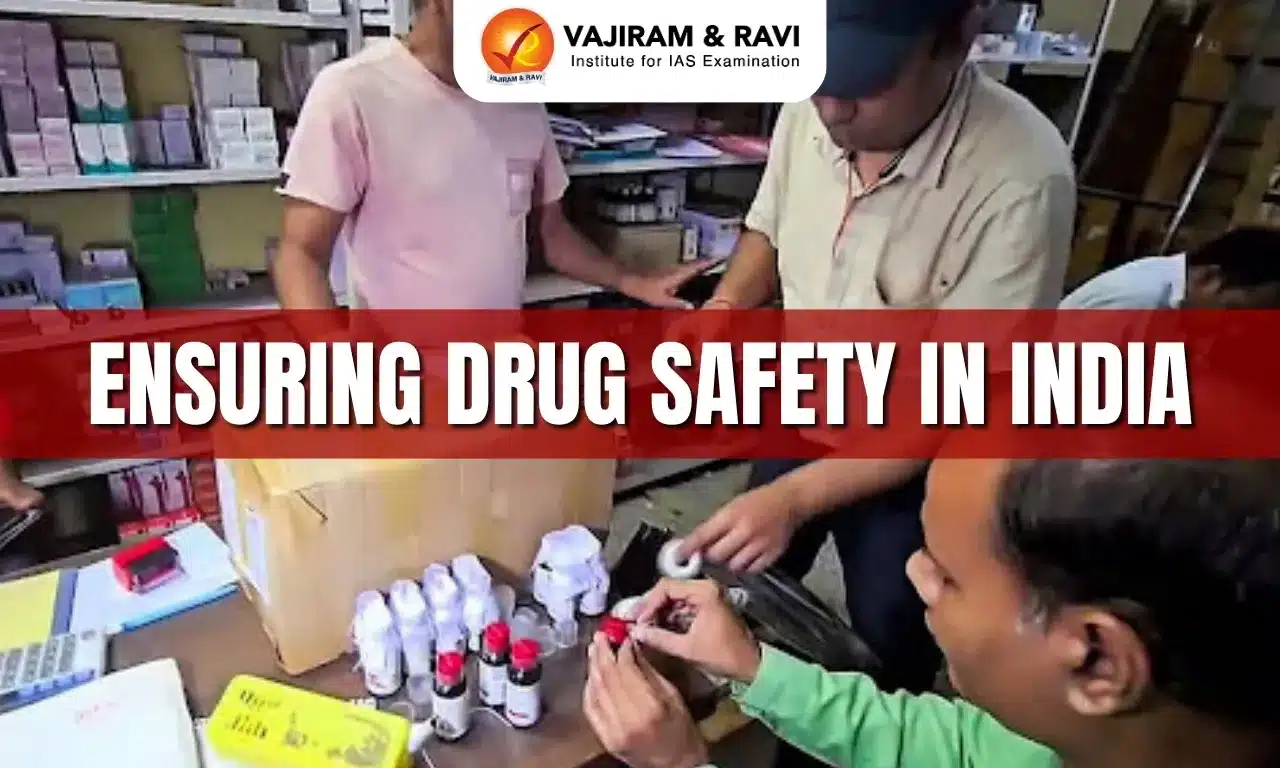
  • The Union Health Ministry has intensified regulatory measures following reports of adulterated cough syrup leading to child deaths in Rajasthan and Madhya Pradesh. 
  • The move underscores India’s efforts to strengthen pharmaceutical quality standards under the revised Schedule M norms of the Drugs and Cosmetics Act, 1940.

Key Developments

  • Trigger event: 
    • Over 10 children died in Rajasthan and Madhya Pradesh after consuming cough syrups.
    • Investigations ruled out infectious diseases, and out of 10 samples tested, one—Coldrif cough syrup—was found with diethylene glycol (DEG) beyond permissible limits.
  • Regulatory action taken:
    • Tamil Nadu Drugs Control Department ordered an immediate stop to production of Coldrif.
    • Inspection by the Central Drugs Standard Control Organisation (CDSCO) recommended cancellation of the manufacturing license.
    • Criminal proceedings initiated against the concerned unit in Kancheepuram.

Revised Schedule M Norms

  • About Schedule M: Schedule M defines the minimum standards for Good Manufacturing Practices (GMP) for pharmaceutical products in India under the Drugs and Cosmetics Act, 1940, and Rules, 1945, aligning with international standards.
  • Revised norms:
    • Notified in (Jan) 2024, the revised norms introduce a comprehensive Pharmaceutical Quality System (PQS), Quality Risk Management (QRM), and Product Quality Review (PQR).
    • Key updates also cover mandatory computerised storage systems, equipment and process validation, more specific rules for hazardous drug products, etc. 
    • It aims to improve product quality, safety, and international harmonisation, with phased implementation timelines based on manufacturer turnover.  
  • Implementation deadline: December 31, 2025.

Government’s Directives

  • Strict compliance: Licenses of non-compliant drug manufacturers will be cancelled.
  • Enhanced surveillance: All States/UTs to ensure timely reporting of adverse drug reactions and deaths.
  • Integrated monitoring: Use of the Integrated Disease Surveillance Programme (IDSP) and Integrated Health Information Platform (IHIP) for community-level reporting.
  • Rational use of cough syrups: Awareness promoted among doctors and parents, especially for children, since most coughs are self-limiting.
  • Inter-state coordination: Strengthened cooperation for early detection and joint action.

Way Forward

  • Strengthening drug regulation: Ensure uniform enforcement of Schedule M norms across States.
  • Capacity building: Training drug inspectors, upgrading labs, and digital monitoring systems.
  • Industry compliance: Support pharmaceutical units in infrastructure upgrade for GMP compliance.
  • Public awareness: Promote safe drug usage and discourage irrational consumption of cough syrups.
  • International image: Restoring trust in Indian pharma exports by aligning with WHO standards.

Conclusion

  • The Coldrif incident highlights recurring lapses in drug quality monitoring in India. 
  • The Union Health Ministry’s push for strict compliance under revised Schedule M is a crucial step to safeguard public health, particularly children. 
  • A coordinated approach will be essential to prevent future tragedies and strengthen India’s pharmaceutical reputation globally.

Source: TH

Ensuring Drug Safety in India FAQs

Q1: What led to the Union Health Ministry’s directive for strict compliance with revised Schedule M norms?

Ans: The deaths of over 10 children in Rajasthan and Madhya Pradesh due to adulterated cough syrup (Coldrif) containing diethylene glycol triggered the directive.

Q2: What regulatory actions were taken against the manufacturer of Coldrif cough syrup?

Ans: The Tamil Nadu Drugs Control Department ordered a stop to production, CDSCO recommended license cancellation, and criminal proceedings were initiated.

Q3: What are the key features of the revised Schedule M norms under the Drugs and Cosmetics Act, 1940?

Ans: They mandate Pharmaceutical Quality Systems, Quality Risk Management, computerised storage, equipment validation, etc.

Q4: Why has the Union Health Ministry emphasised the rational use of cough syrups?

Ans: Because most coughs are self-limiting and do not require pharmacological treatment, irrational use increases risks of adverse effects.

Q5: How is the Union Health Ministry strengthening surveillance and reporting mechanisms for drug safety?

Ans: By enhancing State-level surveillance, using IDSP and IHIP platforms for community reporting, and promoting inter-State coordination for early detection and joint action.

Sir Creek Dispute: Why India and Pakistan Can’t Resolve the Boundary

Sir Creek Dispute

Sir Creek Dispute Latest News

  • During Vijaya Dashami celebrations at the Bhuj Military Station in Gujarat, Defence Minister Rajnath Singh issued a strong warning to Pakistan, stating that “any misadventure in the Sir Creek sector will invite a decisive response.”
  • Referring to the strategic location, he remarked that “the road to Karachi passes through the Creek,” signalling India’s readiness to counter any provocation.

The Sir Creek Dispute: A Legacy of Colonial-Era Boundaries

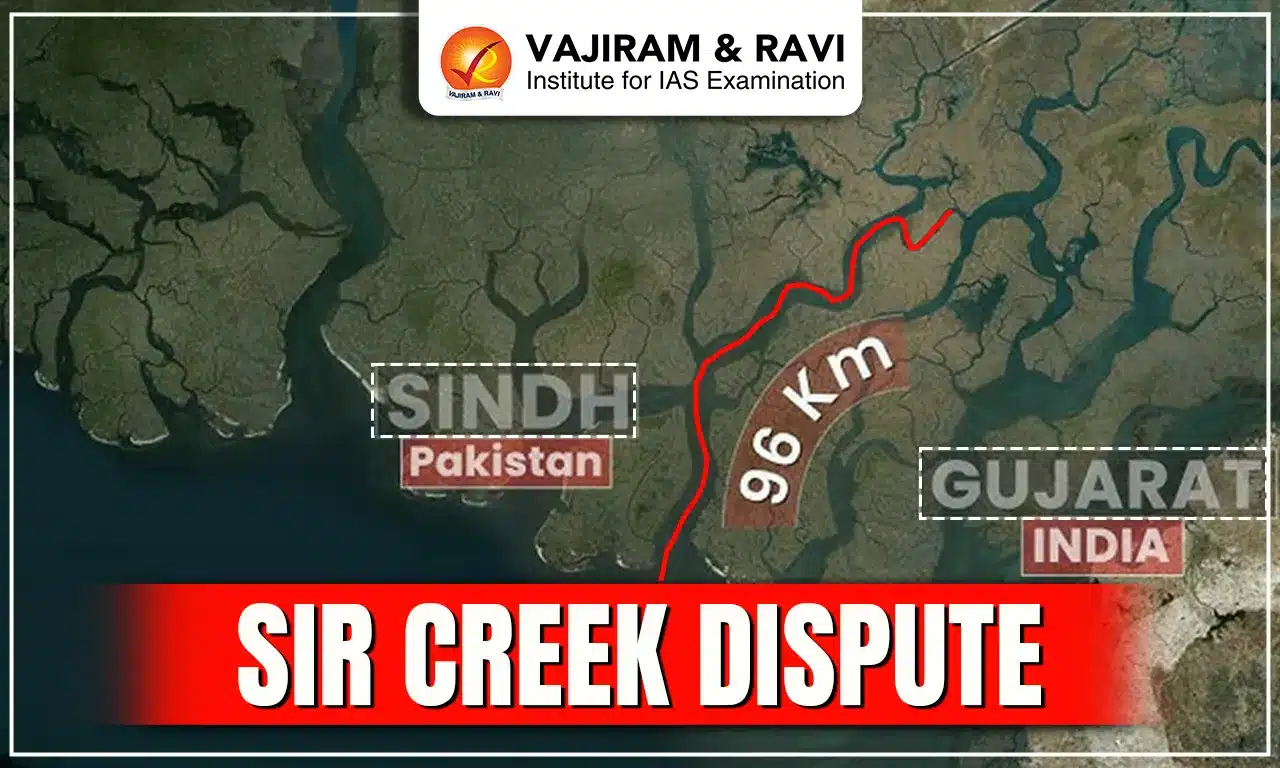
  • Sir Creek is a narrow, less than 100 km-long tidal estuary located between Gujarat’s Rann of Kutch (India) and Sindh (Pakistan). 
  • It forms the westernmost border between the two countries, but control over it remains unresolved due to conflicting interpretations of maritime boundaries.

Colonial Roots of the Dispute

  • The origins of the dispute trace back to pre-Independence India, when the Maharaja of Kutch ruled the region. 
  • Differing interpretations of colonial-era maps and agreements led to overlapping territorial claims after Partition, sowing the seeds of the present conflict.
  • India claims that the boundary should lie along the mid-channel of Sir Creek, effectively dividing the creek and adjacent marshlands equally. 
    • This claim is supported by a 1925 map and the Thalweg principle, which defines the border along the deepest navigable channel of a waterway.
  • Pakistan, however, cites a 1914 resolution between the Rao of Kutch and the Sindh government, asserting that the eastern bank of the creek marks the boundary—giving it greater access toward Gujarat’s coastal region. 
  • Pakistan also disputes India’s reliance on the Thalweg principle, arguing that Sir Creek is non-navigable and hence exempt from that rule.

An Unresolved Boundary

  • Despite multiple rounds of talks, the Sir Creek dispute remains unsettled, largely because resolving it would directly influence the maritime boundary and exclusive economic zone (EEZ) claims in the Arabian Sea.

Why Sir Creek Matters: Strategic and Economic Stakes for India and Pakistan

  • Though small in size, Sir Creek lies at the heart of an unresolved border dispute between India and Pakistan. 
  • Its strategic location and economic potential make it vital for both nations, preventing a lasting settlement despite decades of dialogue.

Strategic Importance: A Gateway to Karachi and Beyond

  • Defence Minister Rajnath Singh underscored Sir Creek’s strategic value, calling it critical to Pakistan’s defence of Karachi, the country’s economic and naval hub. 
  • Following Operation Sindoor, Pakistan has strengthened its military presence in the region by constructing bunkers, radars, and forward bases capable of launching drones and infantry operations.
  • India has responded by maintaining a strong defensive deployment to deter any misadventure. 
  • Beyond military concerns, Sir Creek poses a terrorism risk — the 2008 Mumbai attacks exposed vulnerabilities in coastal surveillance, as the attackers infiltrated India via sea routes from Pakistan.

Economic Importance: Energy, Fishing, and Maritime Rights

  • Sir Creek’s economic value further complicates the dispute. 
  • The region is believed to contain untapped oil and gas reserves, which could be crucial for both economies. 
  • For India, currently diversifying away from Russian oil, such reserves represent a strategic energy alternative.
  • The creek also supports rich fishing grounds, sustaining communities in Gujarat and Sindh. 
  • However, the absence of a defined boundary leads to frequent arrests of fishermen who unintentionally cross into each other’s waters, creating humanitarian and diplomatic tensions.

Impact on Maritime Claims

  • The definition of the Sir Creek boundary directly affects the delimitation of the Exclusive Economic Zones (EEZs) of both nations in the Arabian Sea. 
  • EEZs, extending 200 nautical miles (370 km) from a country’s coast, determine control over marine resources and seabed minerals. 
  • Hence, settling the Sir Creek dispute is not merely a territorial issue—it is key to defining sovereign maritime rights and accessing significant energy and resource wealth in the northern Arabian Sea.

Source: IE | NDTV | TH

Sir Creek Dispute FAQs

Q1: Where is Sir Creek located?

Ans: Sir Creek is a 100-km-long tidal estuary between Gujarat’s Rann of Kutch (India) and Sindh (Pakistan), marking the westernmost border.

Q2: What is the origin of the Sir Creek dispute?

Ans: The dispute stems from conflicting colonial-era maps and agreements — India cites a 1925 map, while Pakistan relies on a 1914 resolution.

Q3: Why is Sir Creek strategically important?

Ans: It’s crucial for Pakistan’s defence of Karachi and for India’s coastal security, given its proximity to sensitive maritime zones.

Q4: What is the economic significance of Sir Creek?

Ans: The region holds untapped oil and gas reserves and supports rich fishing grounds vital for local livelihoods in Gujarat and Sindh.

Q5: How does the dispute affect maritime boundaries?

Ans: Defining Sir Creek directly impacts both nations’ Exclusive Economic Zones (EEZs) and access to marine and seabed resources in the Arabian Sea.

India’s Nuclear Reforms Set Stage for Private-Led SMR Revolution

SMR in India

SMR in India Latest News

  • Six major private sector companies — Reliance Industries, Tata Power, Adani Power, Hindalco Industries, JSW Energy, and Jindal Steel & Power — have formally expressed interest in setting up small modular nuclear reactor (SMR) projects under the ‘Bharat Small Modular Reactors (BSMRs)’ initiative by Nuclear Power Corporation of India Ltd (NPCIL).
  • Around 16 sites across six statesGujarat, Madhya Pradesh, Odisha, Andhra Pradesh, Jharkhand, and Chhattisgarh — have been identified for these projects. 
  • The SMRs will be built and operated under NPCIL’s supervision, with the public sector retaining operational control and ownership, while private firms receive beneficial rights over the generated electricity for captive use.
  • The private partners will fully finance the projects, including capital and lifecycle costs, and reimburse NPCIL for its role in project execution and decommissioning. In exchange, they will secure long-term, reliable power supply for their energy-intensive industrial operations.

SMRs – The Future of Compact Nuclear Power

  • Small Modular Reactors (SMRs), typically ranging from 30 MWe to 300 MWe per unit, are emerging as a promising solution to make nuclear power commercially competitive amid growing delays in large-scale nuclear projects worldwide. 
  • With roughly one-third the capacity of conventional reactors, SMRs can still generate substantial low-carbon electricity, making them ideal for energy-intensive industries such as steel, aluminium, and cement
  • They also offer the flexibility to be installed at decommissioned thermal power plant sites, helping India reuse existing infrastructure while advancing its clean energy goals.

Global Momentum and Technological Interest

  • The global SMR ecosystem is steadily expanding, with two operational projects so far: 
    • Russia’s Akademik Lomonosov floating power unit (two 35 MWe modules, operational since May 2020) and 
    • China’s HTR-PM demonstration project, grid-connected in December 2021 and commercially operational by December 2023. 
  • Leading international players such as Holtec International (USA), Rolls-Royce SMR (UK), NuScale’s VOYGR SMR, Westinghouse Electric’s AP300, and GE-Hitachi’s BWRX-300 are actively developing and marketing SMR technologies.

Nuclear Power for the AI and Data Revolution

  • Globally, technology giants including Google and Microsoft are exploring nuclear power, including SMRs, to meet the massive and round-the-clock electricity demands of data centres driving the AI boom. 
  • While renewables remain their primary energy choice, intermittency issues—such as the lack of sunlight or wind—and insufficient grid-scale storage have limited scalability. 
  • SMRs, offering clean, reliable, and continuous power, could bridge this critical gap, complementing renewables in future power grids.

Commercial Viability and Ongoing Challenges

  • Despite their potential, SMRs remain largely unproven commercially, with high costs, complex regulatory hurdles, and public concerns over nuclear safety posing challenges to widespread adoption. 
  • Questions persist over whether these compact reactors can achieve economies of scale or attract sustained private investment. 
  • Yet, India’s recent policy shift—allowing private participation under NPCIL supervision in its proposed ‘Bharat Small Modular Reactor (BSMR)’ initiative—signals a significant step toward harnessing SMRs’ promise while cautiously managing associated risks.

India’s SMR Ambitions: A New Chapter in Nuclear Innovation

  • The Bharat Small Modular Reactor (BSMR) project marks India’s strategic move to enter the manufacturing and innovation value chain of small modular reactors (SMRs). 
  • India aims to leverage SMRs not only to advance its clean energy transition but also to position itself as a global technology leader, using nuclear innovation as a pillar of its foreign policy and industrial diplomacy.
  • New Delhi envisions SMRs as a technology of promise capable of driving industrial decarbonisation while offering baseload power essential for grid stability. 

Technological Limitations and the PHWR Challenge

  • Despite India’s proven capability in building small 220 MWe Pressurised Heavy Water Reactors (PHWRs), its existing reactor technology is increasingly seen as outdated. 
  • The PHWR design, based on natural uranium and heavy water, contrasts with the Pressurised Water Reactor (PWR) systems that now dominate global nuclear power. 
    • These PWRs, which use light water as both coolant and moderator, have become the international standard for efficiency, safety, and scalability. 
  • This technological gap underscores the need for India to upgrade its nuclear reactor designs to remain globally competitive and fully harness the promise of SMRs.

India’s SMR Technology Mix: Balancing Innovation and Self-Reliance

  • To address its technological limitations and align with global standards, India is developing a diverse mix of small modular reactor (SMR) designs under the Bhabha Atomic Research Centre (BARC).
  • The lineup includes three prototypes — the Bharat Small Modular Reactor (BSMR, 200 MWe), the Bharat Small Reactor (BSR, 220 MWe), and a smaller SMR-55 (55 MWe) unit.
    • The BSR continues India’s legacy of Pressurised Heavy Water Reactor (PHWR) technology.
    • However, both the BSMR and SMR-55 are based on Pressurised Water Reactor (PWR) or light-water designs, aligning India’s nuclear technology with the global mainstream. 

SMR in Union Budget 2025–26

  • A major announcement in the Union Budget 2025–26 was the launch of a Nuclear Energy Mission dedicated to advancing R&D of SMRs. 
  • The government has earmarked ₹20,000 crore for this initiative, with the goal of developing and commissioning at least five indigenously designed SMRs by 2033.

Source: IE | PIB

SMR in India FAQs

Q1: What are Small Modular Reactors (SMRs)?

Ans: SMRs are compact nuclear reactors generating 30–300 MWe, offering clean, reliable power for industries and balancing renewable energy’s limitations.

Q2: Which companies have shown interest in India’s SMR projects?

Ans: Reliance Industries, Tata Power, Adani Power, Hindalco, JSW Energy, and Jindal Steel & Power have expressed interest under NPCIL’s BSMR initiative.

Q3: What is the goal of India’s Nuclear Energy Mission?

Ans: The mission aims to develop five indigenously designed and operational SMRs by 2033, with a ₹20,000 crore government investment in R&D.

Q4: Why are SMRs important for India’s energy future?

Ans: SMRs can provide low-carbon baseload power, reduce dependence on fossil fuels, and support industrial decarbonisation and energy security.

Q5: What challenges do SMRs face globally?

Ans: High costs, safety concerns, and unproven commercial models make SMRs a promising yet complex path toward sustainable nuclear energy.

Enquire Now