

Indian Capital Must Refocus on Domestic Investment

Indian Capital

Indian Capital Latest News

  • Indian private capital is being urged to refocus on domestic investment as experts highlight that sustained economic growth now depends on strengthening internal demand, job creation, and innovation amid rising global uncertainties.

The Evolving Role of Indian Capital

  • Indian private capital has been a cornerstone of the nation’s economic progress, from building industries in the post-independence era to leading the globalisation wave after 1991. 
  • Liberalisation allowed Indian firms to expand abroad, acquire global assets, and compete internationally. However, this global focus must now recalibrate.
  • With rising geopolitical tensions, trade disruptions, and shrinking export demand, global markets are no longer as stable or rewarding as before. 
  • In this context, Indian capital must redirect its focus toward domestic investment to fuel internal growth, create jobs, and sustain India’s ambition of becoming a $10 trillion economy by 2036.

The Need to Refocus on Domestic Investment

  • India’s growth story today is largely being driven by public investment, while private sector capital expenditure remains sluggish
  • The government’s capital outlay rose from Rs. 3.4 lakh crore in FY20 to Rs. 10.2 lakh crore in FY25, growing at an impressive 25% annually. Yet, private investment as a share of GDP has remained stagnant, hovering around 22-23%.
  • Interestingly, Indian corporations have increased their outward foreign direct investment (FDI) at a faster rate, growing by over 12% annually in the last five years, while global FDI has slowed. 
  • This reflects a continued tendency among Indian firms to seek opportunities abroad rather than within India.
  • However, global economic fragmentation, coupled with India’s strong domestic fundamentals, robust infrastructure push, demographic dividend, and policy stability, makes domestic reinvestment a far more viable and strategic option.

Strengthening the Domestic Economic Base

  • Driving Inclusive Growth through Wage Expansion
    • Corporate profits in India are at a 15-year high, yet real wage growth has remained stagnant. This imbalance between profits and wages has constrained household demand, weakening one of the key engines of sustained growth.
    • As per recent estimates, real wages are projected to rise by only 6.5% in FY26, even as productivity and profits climb higher. The growing trend of contractualization in the formal sector further limits wage bargaining power.
    • For India’s growth to be inclusive and self-sustaining, businesses must ensure steady wage growth and job creation, especially in labour-intensive sectors like manufacturing, textiles, and services. 
    • Higher wages expand domestic demand, creating a virtuous cycle of consumption and investment, something India urgently needs amid a slowing global trade environment.
  • Boosting Private Investment and Innovation
    • Private investment has historically been the backbone of India’s industrialisation. However, in recent years, risk aversion, corporate deleveraging, and global uncertainties have led to a cautious investment stance.
    • Yet, the policy environment is now among the most favourable in decades:
    • The corporate tax rate has been reduced to 22% (15% for new manufacturing firms).
    • The Production-Linked Incentive (PLI) scheme covers 14 sectors, offering Rs. 1.97 lakh crore in incentives.
    • Significant improvements have been made in logistics, digital infrastructure, and ease of doing business.
  • Indian firms must seize these conditions to increase domestic capex, not just in core industries but also in emerging sectors such as green energy, semiconductors, electric mobility, and digital technologies.

Strengthening Innovation Ecosystem

  • India’s research and development (R&D) spending remains low at 0.64% of GDP, compared to 2-3% in advanced economies like the U.S., Japan, and South Korea. 
  • The private sector contributes only about 36% of India’s total R&D expenditure, while governments and public institutions account for the rest.
  • In contrast, in developed nations, over 70% of R&D spending is funded by private enterprises. 
  • To remain globally competitive, Indian companies must significantly increase their R&D investments in manufacturing, AI, biotechnology, and green technologies.
  • The success of economies like South Korea and China demonstrates that private innovation, supported by public policy, can transform a developing economy into a high-tech manufacturing hub.

Aligning Private Capital with National Priorities

  • India’s long-term growth will depend on how well private capital aligns with national economic objectives
  • The government has already built the foundation through infrastructure upgrades, fiscal discipline, and investment-friendly reforms. Now, the private sector must:
    • Reinvest domestically in manufacturing and innovation instead of pursuing offshore acquisitions.
    • Partner with public programs like the National Infrastructure Pipeline and green transition initiatives.
    • Support regional development by investing in emerging states and tier-2 cities to decentralise economic growth.
  • Public capital has carried India’s growth momentum so far, but for long-term sustainability, private capital must take the lead. By investing at home, Indian businesses can not only secure better returns but also help strengthen the country’s socio-economic foundation.

The Path Ahead

  • India’s economy is at a crucial inflection point. With steady GDP growth above 7%, strong foreign reserves, and rising infrastructure investment, the country is well-positioned for an economic leap. 
  • However, to maintain this trajectory, domestic private investment must accelerate and complement public spending.
  • Focusing on domestic markets will not only reduce vulnerability to external shocks but also enhance self-reliance, employment, and innovation. 
  • The private sector’s contribution to inclusive, sustainable growth will determine whether India’s economic rise remains resilient in an uncertain global environment.

Source: TH

Indian Capital FAQs

Q1: Why is Indian capital being urged to invest domestically?

Ans: Because global uncertainties and weak export demand make domestic investment vital for sustained economic growth.

Q2: How much of India’s GDP is currently spent on R&D?

Ans: India spends about 0.64% of its GDP on R&D, far below global averages.

Q3: What is the current trend in private sector investment in India?

Ans: Despite high profits, private investment remains subdued, while public investment has grown significantly.

Q4: How can wage growth support India’s economy?

Ans: Higher wages boost domestic consumption, which strengthens internal demand and drives industrial growth.

Q5: What sectors offer high potential for domestic investment?

Ans: Emerging sectors such as green energy, semiconductors, electric mobility, and digital infrastructure hold strong potential.

India–UK Relations Enter a New Growth Phase

India–UK Partnership

India–UK Partnership Latest News

  • British Prime Minister Keir Starmer will visit India for two days — his first official trip since taking office in July 2024
  • He will hold talks with Prime Minister Narendra Modi and attend the Global Fintech Summit in Mumbai.
  • The visit is reciprocal, following Modi’s trip to the UK in July when the two nations signed the India–UK Free Trade Agreement (FTA). 
  • The pact, which enjoys bipartisan support in the UK, reflects the strength and stability of India–UK relations.
  • Starmer and Modi have agreed to work toward the early completion of a mutually beneficial trade agreement, continuing the negotiations initiated under Boris Johnson in 2022.

India–UK: Reliable Partners in an Uncertain World

  • Amid global instability fuelled by US President Donald Trump’s disruptive policies, India and the UK have emerged as reliable, predictable partners
  • Experts note that the FTA is only the foundation of a much deeper partnership.
  • Despite facing political challenges at home, Prime Minister Keir Starmer continues to play an active global role — notably by rallying European and democratic allies, including Australia, Canada, and Japan, to form a Coalition of the Willing after Ukraine’s tense meeting with Trump.
  • This reinforces the UK’s leadership in global diplomacy.

India–UK ‘Living Bridge’ Strengthens Bilateral Partnership

  • The Indian diaspora, making up 2.6% of the UK’s population, plays a vital role in academia, business, politics, and innovation, owning over 65,000 UK-based companies that drive jobs and economic growth. 
  • This dynamic community serves as a “living bridge” connecting the two nations.
  • The India-UK relationship was recently elevated to a new level through two major diplomatic milestones. 
  • In May 2025, the two Prime Ministers announced the conclusion of the India-UK FTA (Free Trade Agreement) and the Double Contribution Convention, a pact aimed at simplifying social security contributions for professionals. 
  • This momentum was solidified in July 2025 during PM Modi's visit to the UK with the formal signing of the Comprehensive Economic and Trade Agreement (CETA), the long-term strategic blueprint Vision 2035 document, and a new Defence Industrial Roadmap
  • The Vision 2035 plan focuses on economic growth, education and skill development, technological innovation, and defence cooperation, charting a comprehensive path for the future of India–UK relations.

Economic Cooperation: Expanding Trade and Job Opportunities

  • The India–UK Free Trade Agreement (FTA) unites the world’s 5th and 6th largest economies, with bilateral trade in goods and services reaching USD 56 billion in 2024. 
    • Trade is projected to double by 2030.
  • The FTA gives Indian businesses better market access in key sectors like textiles, leather, gems and jewellery, etc. while over 650,000 people are employed by Indian and British companies in each other’s countries.
  • The Comprehensive Economic and Trade Agreement (CETA) allows duty-free access to 99% of Indian exports, supporting MSMEs and job creation. 
  • It also promotes growth in IT, finance, education, and professional services, creating high-skill employment.
  • Additionally, the Double Contribution Convention offers a three-year exemption from UK social security for Indian workers on temporary assignments, benefiting over 75,000 professionals and reducing costs for employers.

Defence Cooperation: Strengthening Strategic Collaboration

  • India and the UK have launched a Defence Industrial Roadmap to promote co-design and co-production of defence equipment, addressing growing domestic needs and exploring global export opportunities.
  • A major focus area is the development of jet engine technology. 
  • The partnership also spans joint military exercises, port calls, technological collaboration, exchange of defence experts, training, and defence education, deepening strategic and security cooperation between the two nations.

Education: Building Knowledge and Talent Bridges

  • Education is a key pillar of India–UK relations, with around 170,000 Indian students currently studying in the UK. 
  • Several UK universities, including the University of Southampton, are establishing campuses in India, marking a milestone under the New Education Policy.
  • A 2022 MoU on mutual recognition of academic qualifications ensures that UK degrees are officially recognised in India. 
  • Programmes like the Chevening Scholarships and the Young Professionals Scheme create study-to-work pathways, allowing 3,000 young professionals from each country to live and work in the other for up to two years.

Research and Innovation: Advancing Science and Sustainability Together

  • India and the UK hold a Science and Innovation Council (SIC) meeting every two years to strengthen collaboration in research, technology, and innovation. 
  • The UK is India’s second-largest research partner, with a joint programme worth £300–400 million.
  • A 2023 MoU expanded cooperation in quantum technology, clean energy, pandemic preparedness, and machine learning. 
  • The two nations are also setting up an India–UK Net Zero Innovation Virtual Centre to promote industrial decarbonisation and the use of green hydrogen as a renewable energy source, reinforcing their shared commitment to a sustainable future.

Culture: Strengthening Creative and Cultural Collaboration

  • India and the UK have updated their Film Co-production Framework, enabling producers to access incentives in both markets and boosting jobs in film, VFX, and post-production while helping stories reach global audiences.
  • A new Cultural Agreement promotes the growth of creative industries, supporting festivals, music labels, and artistic projects that create local employment for artists and technicians.

Connectivity: Expanding Links Between India and the UK

  • India and the UK are deepening people-to-people connectivity through improved services and transport links. 
  • New Indian Consulates in Manchester and Belfast now provide passport, OCI, and consular support to Indian communities in Northern England and Northern Ireland, extending access beyond traditional centres like London and Birmingham.
  • Air connectivity has also expanded. IndiGo will launch Delhi–Manchester services from November 15, and Air India continues robust operations connecting multiple Indian cities to London airports.

Source: IE | PIB

India–UK Partnership FAQs

Q1: Why is Keir Starmer visiting India?

Ans: The UK Prime Minister’s visit aims to strengthen bilateral ties, build on the Free Trade Agreement, and advance cooperation in trade, defence, and innovation.

Q2: What is the India–UK Vision 2035?

Ans: Vision 2035 outlines long-term collaboration in economic growth, education, technology, and defence, creating a strategic roadmap for deeper partnership between India and the UK.

Q3: How strong is the India–UK trade relationship?

Ans: Bilateral trade reached USD 56 billion in 2024 and is expected to double by 2030, supported by the Free Trade Agreement and Comprehensive Economic and Trade Agreement.

Q4: What are the key areas of cooperation between India and the UK?

Ans: The partnership spans trade, defence, education, innovation, and culture, with growing collaboration in quantum technology, clean energy, and high-skill workforce development.

Q5: How are India and the UK improving connectivity?

Ans: New Indian consulates in Manchester and Belfast and expanded air routes like Delhi–Manchester flights are enhancing people-to-people and business connectivity.

Nobel Physics 2025: How Quantum Circuits Became Real

Quantum Tunnelling

Nobel Physics 2025 Latest News

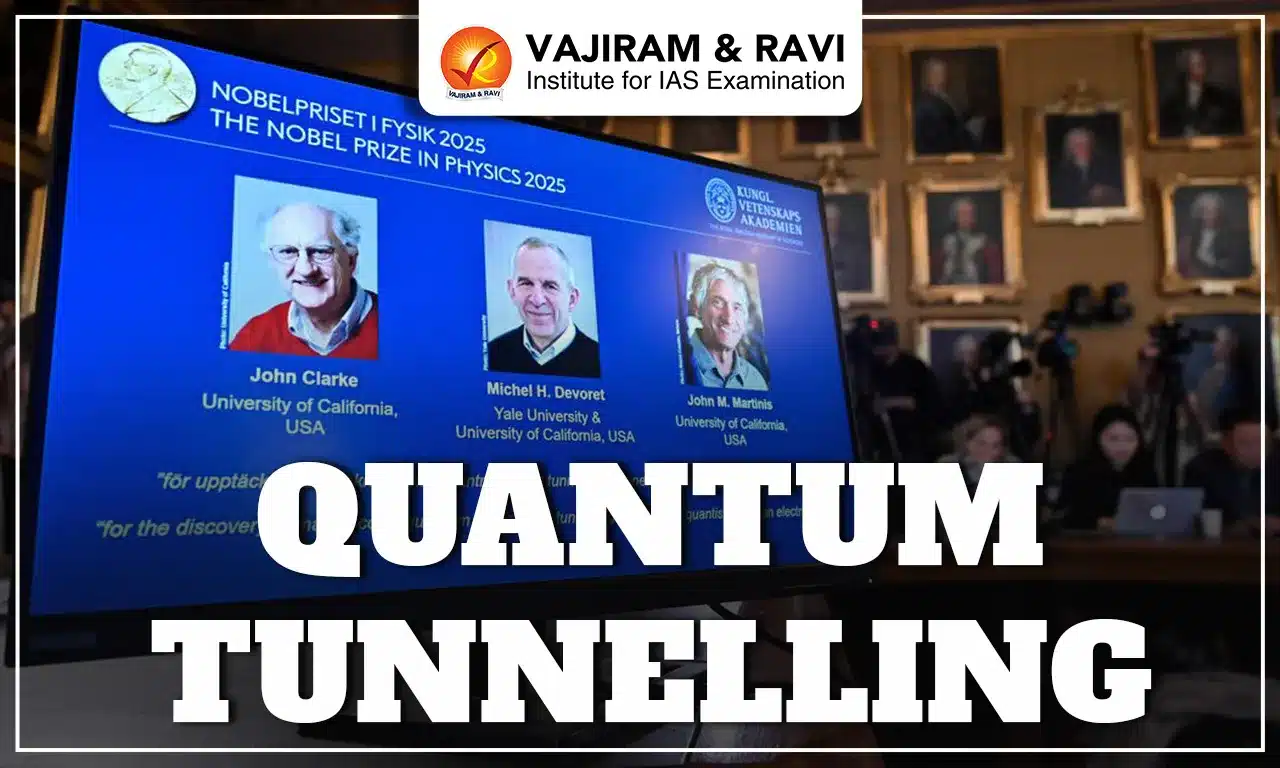
  • The 2025 Nobel Prize in Physics went to John Clarke, Michel Devoret, and John Martinis for demonstrating that quantum tunnellingwhere particles cross barriers they shouldn’t be able to — can occur not only in subatomic particles but also in macroscopic superconducting circuits. 
  • Their pioneering work proved that quantum phenomena, once thought to exist only at the atomic and subatomic scale, can also occur in man-made electrical circuits visible to the naked eye. 
  • It paved the way for technologies that could transform computing, sensing, and communication.

Quantum Tunnelling and Energy Quantisation Made Visible

  • The Nobel laureates — John Clarke, Michel Devoret, and John Martinis — demonstrated two of quantum physics’ defining principles, tunnelling and energy quantisation, in a macroscopic electric circuit.

The Josephson Junction: Heart of the Discovery

  • At the core of their experiments lies the Josephson junction, a device where two superconductors are separated by a thin insulating barrier
  • The researchers asked whether the phase difference — a measurable electrical property — across this junction could behave like a single quantum particle.
  • By sending current through the circuit, they observed that when it was small, electrons (in Cooper pairs) were trapped, producing no voltage. 
    • Cooper pairs are pairs of electrons bound together by an attractive force, mediated by lattice vibrations called phonons, that occurs at low temperatures in superconducting materials. 
    • These pairs, which have opposite spins and total zero spin, behave as a single quantum unit called a boson and can flow through the material without resistance, enabling superconductivity. 
  • But sometimes, the current “tunnelled” through the barrier, suddenly flowing freely and generating a measurable voltage. 
  • This confirmed macroscopic quantum tunnelling — a quantum leap happening in an entire electrical circuit.

Solving the Fragility Problem

  • Early efforts to detect quantum tunnelling failed because of environmental noise and microwave interference. 
  • The Berkeley team, led by Clarke, solved this by using special filters, shielding, and ultra-cold, stable setups to isolate the circuit.
  • When cooled to near absolute zero, the system behaved exactly as quantum theory predicted — the rate of tunnelling became independent of temperature, confirming it wasn’t due to thermal noise but a true quantum process.

Revealing Quantum Energy Levels

  • The team then looked for quantised energy states, a hallmark of quantum behaviour. 
  • By shining microwaves of varying frequencies on the junction, they saw that when the frequency matched the energy gap between two levels, the circuit “escaped” more easily from its trapped state.
  • This showed that the circuit absorbed and emitted discrete packets of energy, behaving like a macroscopic atom
  • For the first time, scientists saw quantum behaviour in a system visible to the naked eye.

Blueprint for Quantum Control

  • These experiments proved two key ideas:
    • Macroscopic electrical circuits can exhibit quantum properties when isolated from noise.
    • Their behaviour can be described using standard quantum mechanics.
  • The work also established methods for controlling and reading macroscopic quantum states using bias currents and microwaves — techniques that became the foundation for superconducting qubits and quantum measurement systems.

Bridging the Quantum and the Everyday World

  • For years, scientists questioned how large a system could be and still exhibit quantum effects. Normally, quantum behaviour disappears when many particles interact. 
  • But the Nobel laureates — John Clarke, Michel Devoret, and John Martinis — proved that with superconducting materials, extreme cooling, and precision engineering, even a visible electronic chip can display clear quantum phenomena.

Applications: From Quantum Chips to Sensors

  • The laureates’ findings underpin many modern quantum technologies:
    • Superconducting qubits: Circuits that act like artificial atoms and are the basis of quantum computers by Google, IBM, and others.
    • Quantum sensors: Devices capable of detecting tiny magnetic fields or gravitational variations, useful in medical diagnostics and geophysical exploration.
    • Quantum amplifiers: Boost faint signals without adding noise, vital for space exploration and dark matter detection.
    • Metrology: Josephson junctions now define electrical standards like the volt and ampere with quantum-level precision.
    • Microwave-to-optical converters: Link quantum processors to optical fibre networks for quantum communication.

Turning Fragility into Functionality

  • Ultimately, these devices are powerful because even minute external changes cause large, measurable shifts in the circuit’s quantum state. 
  • The laureates’ work transformed this sensitivity — once a limitation — into a defining feature, creating tools that bridge quantum theory and real-world technology.

Source: IE | TH | IE

Nobel Physics 2025 FAQs

Q1: Who won the 2025 Nobel Prize in Physics?

Ans: John Clarke, Michel Devoret, and John Martinis won for demonstrating quantum tunnelling and energy quantisation in superconducting circuits visible to the naked eye.

Q2: What is quantum tunnelling?

Ans: Quantum tunnelling is when particles cross barriers they lack the energy to climb — a key quantum effect observed by the laureates in superconducting circuits.

Q3: What role does a Josephson junction play?

Ans: A Josephson junction, two superconductors separated by a thin insulator, enables electron pairs (Cooper pairs) to tunnel across, exhibiting macroscopic quantum behaviour.

Q4: Why is this discovery important?

Ans: Their experiments proved that large, man-made circuits can display quantum properties, linking microscopic quantum theory to macroscopic technology like quantum computers and sensors.

Q5: What technologies emerged from their work?

Ans: Their discoveries power superconducting qubits, quantum sensors, amplifiers, and metrology tools, forming the foundation of modern quantum computing and precision measurement systems.

Enquire Now

