
Workers’ Rights Being Eroded in India – Explained

Workers’ Rights

Workers’ Rights Latest News

  • A series of fatal industrial accidents across India has reignited concerns over the erosion of workers’ rights and safety standards, especially amid policy shifts that weaken labour protections under the new labour codes.

The Erosion of Workers’ Rights in India

  • India’s industrial landscape is undergoing rapid transformation, but this growth has come at a high human cost. 
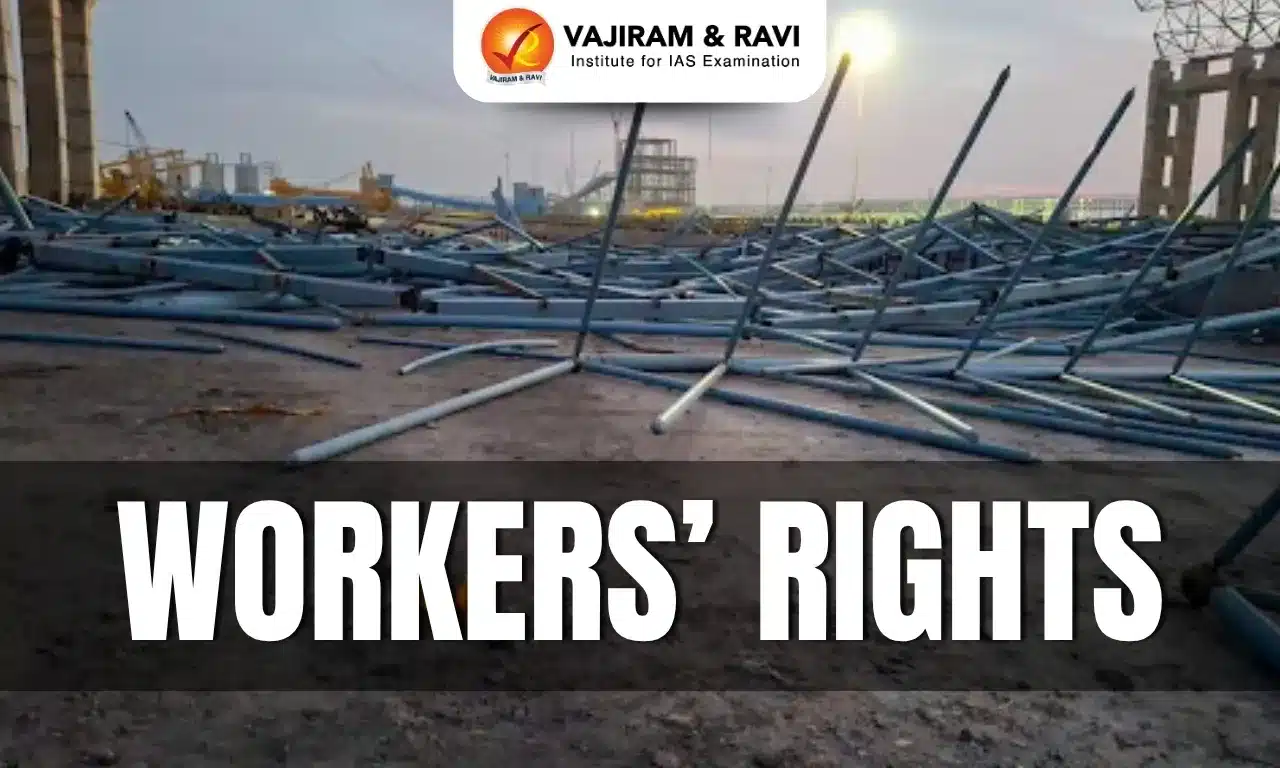
  • A series of deadly industrial accidents, such as the Sigachi Industries chemical explosion in Telangana (June 2025), the Gokulesh Fireworks blast in Sivakasi (July 2025), and the Ennore Thermal Power Station collapse in Chennai (September 2025), have reignited debate over the weakening of workplace safety and labour protection laws in India.
  • According to the British Safety Council, nearly one in four fatal workplace accidents worldwide occurs in India, though this is likely an underestimate due to widespread underreporting, especially among contract and informal workers. 

Causes Behind Industrial Accidents

  • Workplace accidents in India are not random or unavoidable; they are the result of preventable managerial neglect. Safety lapses often stem from outdated machinery, ignored maintenance schedules, and inadequate worker training.
  • In the Telangana reactor explosion, for instance, the equipment was operating at double the permissible temperature. No alarms were triggered, no safety officers intervened, and the mandatory on-site ambulance was missing. Many injured workers were transported to hospitals in a damaged company bus. 
  • The International Labour Organisation (ILO) has repeatedly emphasised that most industrial accidents occur because of cost-cutting practices and management negligence. 
  • Employers frequently attribute such incidents to “human error,” but the underlying causes lie in unsafe working hours, excessive workloads, lack of rest, and poor wages that push workers into double shifts.

Evolution of Labour Protection in India

  • India’s journey toward safer workplaces dates back to the Factories Act of 1881, which laid the foundation for regulating working conditions. 
  • Post-independence, the Factories Act, 1948, became the cornerstone of labour safety, covering licensing, machinery maintenance, working hours, and welfare facilities like canteens and crèches.
  • The Act was strengthened through amendments in 1976 and 1987, the latter prompted by the Bhopal Gas Tragedy. 
  • It provided mechanisms for inspection, licensing, and enforcement, allowing unionised workers to file complaints and compel corrective actions.
  • Compensation mechanisms were governed by laws like the Workmen’s Compensation Act (1923) and the Employees’ State Insurance Act (1948). 
  • These laws recognised workers’ right to compensation for injury or loss of income. However, enforcement was weak, and compensation often remained minimal. More critically, these laws rarely held employers criminally accountable.

The New Policy Framework and Its Implications

  • Since the 1990s, the liberalisation era has seen a steady dilution of labour rights, justified under the banner of “labour flexibility.” 
  • Employers have demanded the ability to hire and fire freely, and governments have responded by weakening inspection systems and branding safety regulations as bureaucratic hurdles.
  • In 2015, the Maharashtra government permitted employers to “self-certify” compliance with safety laws. This move, later emulated by other states under the Ease of Doing Business campaign, effectively reduced government oversight.
  • The Occupational Safety, Health and Working Conditions (OSHWC) Code, 2020, which aims to consolidate existing labour laws, represents a major shift. Once implemented, it will replace the Factories Act and potentially convert workers’ safety from a statutory right into an executive discretion.
  • This means that workplace safety will no longer be a legal obligation for employers but a matter of government enforcement will. At the same time, several states have extended working hours and reduced rest periods, a practice initially justified during the COVID-19 pandemic but now made permanent, as seen in Karnataka’s 2023 amendment.

The Broader Consequences of Weak Labour Protections

  • Eroding safety standards not only endanger lives but also undermine productivity and economic sustainability. 
  • Research by the ILO shows that safe workplaces correlate with higher efficiency, lower absenteeism, and greater job satisfaction. Yet, India’s prevailing industrial culture continues to prioritise short-term profit maximisation over long-term sustainability.
  • The lack of accountability has also weakened public trust. Trade unions and labour organisations have warned that unless the state restores workplace safety as a right and reinstates inspection as an enforcement mechanism, accidents will continue to claim lives.

Restoring the Balance Between Growth and Labour Justice

  • India’s pursuit of rapid industrialisation and economic growth cannot come at the expense of workers’ dignity and safety. The path forward lies in reaffirming labour rights as fundamental rights, not as regulatory burdens.
  • Reinforcing independent inspections, enhancing penalties for safety violations, and ensuring criminal liability for negligent employers are essential steps. The government must also expand social security coverage to include contract and gig workers, who now form a large portion of India’s workforce.
  • Sustainable industrial growth requires a social contract that values both productivity and human life. Restoring the integrity of labour protections will not only save lives but also foster a more equitable and resilient economy.

Source: TH

Workers' Rights FAQs

Q1: What recent incidents have highlighted the erosion of workers’ rights in India?

Ans: The Sigachi Industries explosion, Sivakasi fireworks blast, and Ennore power plant collapse have raised serious concerns about worker safety.

Q2: What does the ILO say about industrial accidents?

Ans: The ILO states that most industrial accidents are preventable and stem from employer negligence rather than random events.

Q3: What key law governed worker safety before the new Code?

Ans: The Factories Act, 1948 was the cornerstone of India’s labour safety regime before being replaced by the OSHWC Code, 2020.

Q4: How has the OSHWC Code, 2020 changed the framework of worker safety?

Ans: It shifts workplace safety from a statutory right to an executive discretion, reducing mandatory oversight.

Q5: What measures are needed to protect workers’ rights in India?

Ans: Strengthening inspections, criminalizing negligence, and extending protection to informal and contract workers are crucial steps.

2025 Chemistry Nobel Recognises Breakthrough in Metal–Organic Frameworks

Metal–Organic Frameworks

Metal–Organic Frameworks Latest News

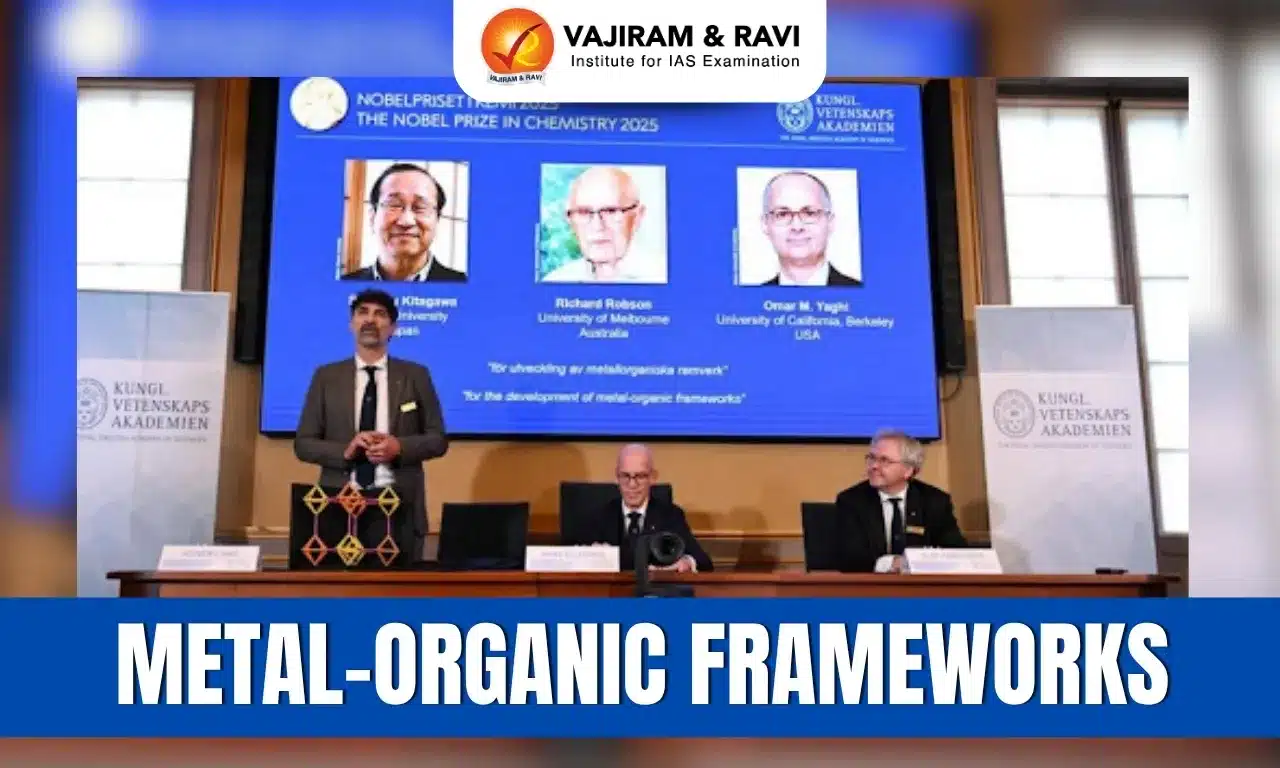
  • The 2025 Nobel Prize in Chemistry was awarded to Susumu Kitagawa, Richard Robson, and Omar Yaghi for developing metal–organic frameworks (MOFs) — intricate molecular structures with vast internal spaces that can host, store, or react with other molecules.
  • Their breakthrough transformed chemistry from merely creating individual molecules to designing three-dimensional frameworks, opening new possibilities in catalysis, gas storage, and material science.

About Metal–Organic Frameworks (MOFs)

  • Metal–Organic Frameworks (MOFs) are three-dimensional networks made of metal ions linked by organic molecules. 
  • These structures contain large, porous cavities through which gases and liquids can flow, making them extremely adaptable for diverse applications such as gas storage, filtration, and catalysis.

How MOFs Are Built

  • In a MOF, metal ions act as anchors or joints in a scaffold, while organic molecules serve as flexible linkers connecting them. 
  • These organic linkers can form rings or chains and can be chemically tailored to give the framework specific properties, allowing fine control over structure and function.

The Chemistry Behind the Design

  • At their core, MOFs are built on basic bonding principles — atoms form bonds to achieve stability, usually by completing eight electrons in their outer shell.
    • Atoms with fewer than four electrons tend to lose them.
    • Atoms with more than four try to gain electrons.
    • This process, determined by an element’s valency, governs how metal ions and organic molecules link together.
  • Carbon, the key element in organic compounds, can form stable rings and chains, enabling the creation of complex, customizable molecular frameworks that define MOFs.

How Robson and Kitagawa Pioneered Metal–Organic Frameworks

  • In the 1970s, Richard Robson of the University of Melbourne realised that the geometry of atomic connections could be scaled up to design larger molecular structures. 
  • In the 1980s, he combined copper ions (which bond tetrahedrally) with an organic molecule containing four nitrile arms, resulting in a diamond-like crystal lattice filled with porous cavities instead of dense atomic bonds. 
  • These frameworks could potentially trap ions, catalyse reactions, and filter molecules by size. However, Robson’s early structures were too fragile. 
  • Building on this idea, Susumu Kitagawa in Japan stabilised them, turning fragile lattices into functional porous materials. 
  • In 1997, he used cobalt, nickel, and zinc ions linked with 4,4’-bipyridine to create the first stable, three-dimensional MOF that allowed gases like methane, nitrogen, and oxygen to flow in and out without collapsing.
  • Kitagawa also discovered that some MOFs could be soft and flexible, expanding, contracting, or bending based on temperature, pressure, or the type of molecules inside — a property that made MOFs practical and versatile for real-world applications.

Omar Yaghi’s Breakthrough: Building Strong and Reproducible MOFs

  • In the 1990s, Omar Yaghi, working at Arizona State University, transformed metal–organic frameworks (MOFs) from fragile lab curiosities into strong, reproducible materials. 
  • Driven by a vision to design materials deliberately, Yaghi used metal ions as joints and organic molecules as struts to create extended, ordered structures.
  • In 1995, he developed the first two-dimensional frameworks using cobalt and copper ions, which could hold guest molecules without collapsing. 
  • His major breakthrough came in 1999 with MOF-5, a three-dimensional lattice made from zinc ions and benzene-dicarboxylate linkers. 
  • It was thermally stable up to 300°C, and just a few grams had an internal surface area equal to a football field.

Importance of Metal–Organic Frameworks (MOFs)

  • The appeal of metal–organic frameworks (MOFs) lies in: 
    • their extraordinary internal surface area — a small amount of material can expose an immense surface for chemical interactions — and 
    • their tuneable design, allowing chemists to customise them for countless applications.
  • In environmental uses, MOFs like CALF-20 capture carbon dioxide from factory exhausts, while MOF-303 extracts drinking water from desert air, and UiO-67 removes PFAS pollutants from water. 
    • MIL-101 and ZIF-8 accelerate pollutant breakdown and help recover rare-earth metals from wastewater.
  • In the energy and industrial sectors, NU-1501 and MOF-177 store hydrogen and methane safely at moderate pressures for clean-fuel vehicles.
  • Others are used to contain toxic gases or act as drug-delivery systems, releasing medicines in response to biological signals.
  • Together, these applications show how MOFs combine scientific ingenuity with real-world impact, addressing key challenges in energy, environment, and health.

Source: TH | IE

Metal–Organic Frameworks FAQs

Q1: Who won the 2025 Chemistry Nobel?

Ans: Susumu Kitagawa, Richard Robson, and Omar Yaghi were honoured for developing metal–organic frameworks, a revolutionary class of porous molecular structures.

Q2: What are Metal–Organic Frameworks (MOFs)?

Ans: MOFs are crystalline materials made of metal ions and organic linkers forming 3D porous networks that store, filter, or catalyse molecules.

Q3: What was Omar Yaghi’s contribution?

Ans: Yaghi built strong, reproducible MOFs like MOF-5, with vast surface area and thermal stability, enabling practical applications in gas storage and catalysis.

Q4: Why are MOFs important?

Ans: Their large surface area and tunable pores make MOFs useful for carbon capture, hydrogen storage, water purification, and drug delivery systems.

Q5: How do MOFs impact sustainability?

Ans: MOFs address global challenges by supporting clean-fuel storage, pollutant removal, and carbon capture — advancing energy efficiency and environmental protection.

Shram Shakti Niti 2025: India’s New Labour Policy for a Future-Ready Workforce

Shram Shakti Niti

Shram Shakti Niti Latest News

  • The Ministry of Labour and Employment has released the draft National Labour & Employment Policy — Shram Shakti Niti 2025 for public consultation, aligning with India’s Viksit Bharat @2047 vision.
  • Marking a shift from regulation to facilitation, the policy redefines the ministry’s role as an “employment facilitator” focused on creating a fair, inclusive, and technology-driven labour ecosystem. 
  • It seeks to promote collaboration among workers, employers, and training institutions through data-driven and integrated systems.

Shram Shakti Niti 2025: Blueprint for a Fair, Inclusive, and Future-Ready Workforce

  • Labour” as a subject is in the Concurrent List of the Constitution of India.
    • Hence, both the Central Government as well as State Governments can make rules/laws on this subject.
  • As a result, the Union Ministry of Labour and Employment has released the draft National Labour and Employment Policy — Shram Shakti Niti 2025 for public consultation.
  • Rooted in India’s civilisational ethos of “śrama dharma” — the dignity and moral value of work — the policy seeks to create a balanced framework that ensures protection, productivity, and participation for every worker while enabling enterprises to grow sustainably.

National Career Service (NCS): Digital Public Infrastructure for Employment

  • At the heart of the policy is the NCS, envisioned as India’s Digital Public Infrastructure for Employment.
  • The platform will offer:
    • AI-enabled job matching and career guidance
    • Credential verification and skill mapping
    • Cross-sectoral and regional employment linkages
  • The NCS will serve as a unified interface to connect employers, job seekers, and training providers through trusted digital systems.

Focus Areas and Core Objectives

  • The draft policy emphasizes creating a resilient, skilled, and inclusive workforce ready for emerging global challenges such as technological disruption, climate change, and evolving value chains.
  • Key focus areas include:
    • Universal social security and income protection
    • Occupational safety and health (OSH)
    • Women and youth empowerment
    • Green and technology-enabled jobs
    • Continuous skill development and lifelong learning

Unified Labour Stack: Integrated Digital Ecosystem

  • The policy proposes integrating major national databases — EPFO, ESIC, e-Shram, and NCS — into a unified labour stack.
  • This integration will enable:
    • Interoperable data systems for better policy coordination
    • Lifelong learning opportunities
    • Universal social protection and income security
    • Real-time labour market insights for evidence-based governance

Complementing Labour Law Reforms

  • The new policy complements the government’s recent consolidation of 29 central labour laws into four simplified labour codes, namely:
    • Code on Wages (2019)
    • Industrial Relations Code (2020)
    • Occupational Safety, Health and Working Conditions Code (2020)
    • Social Security Code (2020)
  • Together, these reforms aim to simplify compliance, improve worker protection, and foster formal employment.

Guiding Principles and Pillars

  • The policy is guided by four foundational pillars:
    • Dignity of labour
    • Universal inclusion
    • Cooperative federalism
    • Data-driven governance
  • It envisions a resilient institutional framework based on convergence across digital systems, ensuring policy coherence and long-term impact.

Seven Strategic Priorities

  • The draft policy identifies seven strategic priorities for achieving its goals:
    • Universal and portable social security
    • Occupational safety and health
    • Employment and future readiness
    • Women and youth empowerment
    • Ease of compliance and formalisation
    • Technology and green transitions
    • Convergence through good governance

Women and Youth Empowerment

  • The draft aims to increase women’s labour participation to 35% by 2030 and promote youth entrepreneurship and career guidance.
  • Key initiatives include:
    • Single-window digital compliance for MSMEs with self-certification and simplified returns
    • Expanded career services through the National Career Service (NCS) platform
    • Green jobs and just-transition pathways for workers adapting to new industries and technologies

Technology-Driven Governance and Data Integration

  • The policy envisions a unified national labour data architecture to ensure inter-ministerial coherence and transparent monitoring.
  • Key digital initiatives include:
    • AI-enabled safety systems
    • Predictive analytics for workforce planning
    • Real-time digital dashboards to track progress
    • Annual National Labour Report presented to Parliament
    • Labour & Employment Policy Evaluation Index (LPEI) to benchmark State performance

Implementation and Accountability Plan

  • Policy execution will proceed in three phases:
    • Phase I (2025–27): Institutional setup and integration of social-security systems.
    • Phase II (2027–30): Nationwide rollout of universal social-security accounts, skill-credit systems, and district-level Employment Facilitation Cells.
    • Phase III (Beyond 2030): Full paperless governance, predictive policy analytics, and continuous renewal mechanisms.
  • Progress will be monitored through real-time dashboards, the LPEI index, and third-party evaluations to ensure transparency and accountability.

Expected Outcomes

  • According to Union Labour Minister Mansukh Mandaviya, the policy envisions a resilient and inclusive labour ecosystem focused on both worker welfare and enterprise growth.
  • Expected outcomes include:
    • Universal worker registration
    • Social security portability
    • Near-zero workplace fatalities
    • Female labour-force participation at 35% by 2030
    • Reduction in informal employment through digital compliance
    • AI-driven labour governance in all states
    • Creation of millions of green and decent jobs
    • A unified “One Nation Integrated Workforce” ecosystem

Source: TH | LM

Shram Shakti Niti FAQs

Q1: What is Shram Shakti Niti 2025?

Ans: It is India’s draft National Labour & Employment Policy, focusing on fairness, inclusivity, technology, and social security to shape a future-ready workforce.

Q2: What are the main goals of the policy?

Ans: It seeks to provide universal social security, boost women’s workforce participation, ensure workplace safety, and promote green, tech-enabled jobs.

Q3: What digital initiatives are proposed?

Ans: A unified labour stack integrating EPFO, ESIC, e-Shram, and NCS will enable AI-driven governance, real-time dashboards, and interoperable social-security systems.

Q4: How will the policy be implemented?

Ans: It will roll out in three phases from 2025 to beyond 2030, focusing on social security integration, digital facilitation, and paperless governance.

Q5: When can public feedback be submitted?

Ans: Stakeholders and the public can share suggestions on the draft policy until October 27, 2025, through official labour ministry portals.

Enquire Now

