
Special Intensive Revision Process – Explained

Special Intensive Revision

Special Intensive Revision Latest News

  • The Election Commission of India has launched a Special Intensive Revision (SIR) of electoral rolls across the country, beginning with Bihar, to verify voter details and ensure clean and accurate electoral records ahead of upcoming elections.

The Electoral Roll and Its Importance

  • The electoral roll is the foundation of India’s democratic process. It ensures that every eligible citizen has the right to vote while preventing duplication and impersonation. 
  • The Election Commission of India maintains and updates the rolls regularly under the Representation of the People Act, 1950.
  • Recently, the ECI conducted a Special Intensive Revision (SIR) of electoral rolls in Bihar, with plans to extend it nationwide in a phased manner. 
  • The revision aims to improve accuracy in voter records, eliminate duplicates, and update demographic information before major elections. 
  • The process underscores the need for clean and updated electoral rolls, a key element in ensuring free and fair elections.

The Legal Basis of Electoral Roll Revisions

  • Section 21 of the Representation of the People Act, 1950, empowers the ECI to prepare and revise electoral rolls for each constituency. 
  • Typically, a summary revision occurs before every general or by-election. However, the Act also allows the Commission to carry out a special revision at any time it deems necessary.
  • In June 2025, the ECI issued an order launching a Special Intensive Revision across the country, starting with Bihar, where Assembly elections are due in November 2025. The Commission designated July 1, 2025, as the qualifying date for inclusion in the rolls.

Understanding the SIR Process

  • The SIR process is more detailed than routine revisions. It involves multiple stages:
  • Enumeration Forms Submission:
    • All registered voters must fill out the enumeration forms to confirm or update their details.
  • Document Verification:
    • Voters registered after 2003 must provide valid proof of citizenship. The Supreme Court, in its interim order, directed that Aadhaar be accepted as one of the valid identity proofs for this purpose.
  • Draft Roll Publication:
    • Based on the forms and verification, a draft electoral roll is published for public review.
  • Claims and Objections:
    • Citizens are allowed a specified period to file claims for inclusion or raise objections regarding inaccuracies.
  • Verification and Final Roll Publication:
    • The Electoral Registration Officers (EROs) verify all claims and objections. After this scrutiny, the final electoral roll is published, as was done in Bihar on September 30, 2025.
  • The ECI now plans to conduct similar SIR exercises in other states, aligned with their respective election schedules.

Overview of Electoral Forms in India

  • The Registration of Electors Rules, 1960 (RER) prescribes various forms for voter registration, correction, deletion, and transfer. 
  • Awareness of these forms is essential for citizens to participate meaningfully in the electoral process.
  • Form 6 - Used by new voters (above 18 years) or those shifting constituencies to apply for inclusion in the electoral roll.
  • Form 6A - Used by Overseas Electors (Indian citizens living abroad) to register their names in the electoral rolls of their home constituency.
  • Form 7 - Filed for deletion of a name from the electoral roll, for instance, in case of death, duplication, or change of residence.
  • Form 8 - Used to correct entries in the existing electoral roll, such as name spelling, address, or age.
  • Form 8A - Used for transposition of an elector’s name from one part of a constituency to another (for example, if a voter shifts residence within the same constituency).
  • Form 11 to 13D - Used by electoral officers and booth-level agents during verification and publication stages of the electoral roll.

Role of Citizens and Political Stakeholders

  • The success of the electoral revision process depends not only on the ECI but also on citizens’ active participation. Voters should:
    • Verify their names and details in the published draft rolls.
    • Use the correct electoral form to update their information or file claims.
    • Ensure that supporting documents, such as Aadhaar, passport, or voter ID, are properly attached to avoid rejections.
  • Political parties and civil society organisations play a crucial role in mobilising awareness, especially among marginalised communities, first-time voters, and migrant populations. Their involvement ensures inclusivity in the democratic process.

Significance of Clean Electoral Rolls

  • Maintaining accurate electoral rolls is central to the integrity of elections. Outdated or erroneous rolls can lead to disenfranchisement, bogus voting, or manipulation
  • A clean roll ensures that each legitimate vote is counted, and no illegitimate one is cast.
  • While critics argue that the SIR process might inconvenience voters due to short timelines, the broader goal remains the creation of a transparent and verifiable electoral base. 
  • The Supreme Court’s order to include Aadhaar as a valid document aims to strengthen identity verification, though privacy advocates caution against excessive reliance on biometric data.

Way Forward

  • The ECI’s move to roll out the SIR nationwide marks a significant effort to modernise and standardise voter registration. Future revisions could be made more efficient through:
    • Phased scheduling to prevent administrative overload.
    • Digital verification linked with Aadhaar and other databases.
    • Enhanced public awareness through local campaigns.
  • Ensuring inclusive participation, especially of women, youth, and migrant workers, will be vital to building a comprehensive and accurate electoral roll ahead of the 2029 general elections.

Source: TH

Special Intensive Revision FAQs

Q1: What is the Special Intensive Revision (SIR) of electoral rolls?

Ans: The SIR is a detailed process conducted by the Election Commission to verify, update, and clean electoral rolls across constituencies

Q2: Which law governs the preparation and revision of electoral rolls in India?

Ans: The process is governed by Section 21 of the Representation of the People Act, 1950.

Q3: What is Form 6 used for?

Ans: Form 6 is used for new voter registration or to include one’s name after shifting constituencies.

Q4: What did the Supreme Court direct during the SIR in Bihar?

Ans: The Court allowed Aadhaar to be used as valid proof of identity during the verification process.

Q5: How can citizens verify their electoral details online?

Ans: Citizens can verify and update details on the Voter Service Portal (voters.eci.gov.in) or through the Voter Helpline app.

India-U.K. Relations – Strengthening Strategic and Economic Ties

India-U.K. Relations

India-U.K. Relations Latest News

  • In a significant step towards deepening bilateral relations, Prime Minister Narendra Modi and U.K. Prime Minister Keir Starmer have signed multiple defence and investment agreements worth billions of pounds. 
  • These developments mark a renewed push in the India–U.K. Comprehensive Strategic Partnership, with a focus on defence technology, naval collaboration, education, and mutual investments.
  • These developments are the result of bilateral talks between the two PMs held in Mumbai during Starmer’s first visit to India after assuming office.

India-U.K. Relations - Shared Vision and Strategic Convergence

  • Natural partners in an unstable world:
    • The shared values of democracy, freedom, and rule of law are the core of bilateral relations.
    • Both support dialogue and diplomacy to resolve the Ukraine conflict and the Gaza crisis, underlining its consistent stance on peace-building efforts.
  • India’s global role:
    • Starmer recognized India as a global player, highlighting cooperation in Commonwealth, G20, and supporting India’s bid for a permanent UN Security Council seat.
    • The U.K. seeks to deepen engagement with India to build a rules-based international order and to leverage India’s leadership in the Global South.
  • Indo-Pacific region: Both reaffirmed their commitment to maritime security in the Indo-Pacific region, countering regional assertiveness and ensuring freedom of navigation.

Defence Cooperation - A New Phase

  • Missile procurement deal:
    • India signed a £350 million defence deal with the U.K. to procure Lightweight Multirole Missiles (LMMs) for the Indian Army.
    • The missiles will be U.K.-manufactured and built in Belfast, strengthening India’s tactical capabilities.
    • The agreement aims to lay the foundation for a “broader complex weapons partnership” between the two nations, promoting defence industrial collaboration and technology transfer.
  • Naval collaboration:
    • Both countries have agreed to advance cooperation on electric-powered engines for naval ships, worth an initial £250 million.
    • The Implementing Arrangement was signed to push this project to the next stage, aligning with global efforts for green and sustainable defence technologies.
  • A new military training agreement: Under which Indian Air Force (IAF) instructors will train at the Royal Air Force (RAF) in the U.K.

Expanding Economic Linkages

  • Massive U.K. trade delegation:
    • PM Starmer arrived in India with a record 126-member trade delegation, the largest ever from the U.K., comprising CEOs, entrepreneurs, and academic leaders.
    • The visit follows the signing of the India–U.K. Free Trade Agreement (CETA) in July 2025, aimed at boosting bilateral trade and technology transfer.
  • Indian investments in the U.K.:
    • 64 Indian companies have committed to invest £1.3 billion (₹15,430 crore) in the U.K., expected to create nearly 7,000 jobs.
    • Investment sectors include engineering, technology, clean energy, mobility, and creative industries.
  • Major Indian investments:
    • TVS Motor company: £250 million investment in Solihull to expand Norton Motorcycles and develop next-generation electric vehicles.
    • Cyient: £100 million investment in semiconductors, clean energy, and geospatial technologies, creating 300 jobs in the U.K.
    • Muthoot Finance UK Ltd.: £100 million to expand branch network to 20 locations.
    • Hero Motors: £100 million in e-mobility, e-bicycles, and aerospace divisions over the next five years.
  • Investment by the U.K. companies in India: For example, Rolls-Royce expressed interest in developing India as a key production hub, underscoring potential future collaboration in aerospace and defence manufacturing.

Critical Minerals and Supply Chain Cooperation

  • India will establish an Industry Guild and Supply Chain Observatory to strengthen cooperation on critical minerals, with a satellite campus at ISM Dhanbad.
  • This initiative aims to secure resilient global value chains and reduce dependency on single-source suppliers, aligning with the G7-led Mineral Security Partnership framework.

Technological Synergy

  • Synergy: Both nations have demonstrated a “win-win partnership” that blends the U.K.’s research and finance expertise with India’s scale and talent.
  • India–U.K. Technology Security Initiative: Emphasizing tech and innovation as new frontiers of cooperation in AI, advanced communications, etc.
  • Strengthening the Fintech Corridor:
    • The Indian PM announced the creation of a U.K.–India Fintech Corridor to connect startups, institutions, and innovation hubs.
    • The initiative will promote joint innovation, piloting of startups, and facilitate collaboration between the London Stock Exchange (LSE) and GIFT City (Gujarat International Finance Tec-City).

Educational Collaboration

  • U.K. universities enter India:
    • 9 U.K. universities will soon open campuses in India, including the University of Southampton in Gurugram, whose first batch has already been admitted.
    • This initiative aligns with India’s National Education Policy (NEP) 2020, which encourages the entry of foreign universities into India.
  • Industry-academia linkages: The move promotes educational diplomacy and facilitates cross-border knowledge exchange, boosting the India-U.K. education corridor.

Cultural Diplomacy

  • Starmer’s visit also had a cultural dimension—he toured Yash Raj Films Studio, where he announced that three Bollywood films will be shot in the U.K. beginning in 2026.
  • British Airways will add a third daily Delhi–London flight and IndiGo will launch a Delhi–Manchester route, enhancing people-to-people connectivity.

Strategic Significance

  • For India:
    • Enhances defence self-reliance (Atmanirbhar Bharat) through technology partnerships.
    • Boosts Make in India in defence and manufacturing.
    • Expands higher education infrastructure with global standards.
  • For the U.K.:
    • Strengthens post-Brexit trade and strategic partnerships.
    • Attracts major foreign direct investment (FDI) and job creation.
  • Reinforces its defence and technology export potential.

Way Forward

  • Finalise the Free Trade Agreement (FTA) implementation to unlock the full economic potential.
  • Institutionalise the Complex Weapons Partnership under structured defence cooperation.
  • Promote joint R&D and co-production in emerging sectors such as AI, clean energy, and maritime security.
  • Expand education and skill partnerships to cater to both Indian and U.K. labour market needs.

Conclusion

  • The 2025 India–U.K. defence and investment deals mark a turning point in bilateral relations, combining strategic defence cooperation with economic and educational partnerships. 
  • By fostering technology sharing, sustainable naval collaboration, and mutual investments, both nations are moving toward a comprehensive and future-oriented partnership aligned with global geopolitical and economic shifts.

Source: TH | IE

India-U.K. Relations FAQs

Q1: How does the recent Modi–Starmer summit reinforce India–U.K. relations?

Ans: The summit emphasized shared democratic values and cooperation in defence, trade, and technology.

Q2: What are the major outcomes of the recent India–U.K. defence cooperation agreements?

Ans: The agreements include a £350 million missile deal, a military training programme involving, and collaboration on electric naval propulsion systems.

Q3: How does the expansion of U.K. universities in India align with India’s NEP 2020?

Ans: The approval for nine U.K. universities to establish campuses in India enhancing access to world-class learning and research.

Q4: In what ways will the India–U.K. partnership in trade contribute to mutual economic growth?

Ans: Through India–U.K. Free Trade Agreement both commit to generate jobs and promote inclusive growth.

Q5: What objectives does the newly established Industry Guild and Supply Chain Observatory aim to serve?

Ans: The observatory will facilitate cooperation on critical minerals and resilient supply chains, supporting sustainable industrial growth in coordination with the U.K.

Assam–Meghalaya Border Clash Highlights Longstanding Boundary Dispute

Assam–Meghalaya Border Dispute

Assam–Meghalaya Border Dispute Latest News

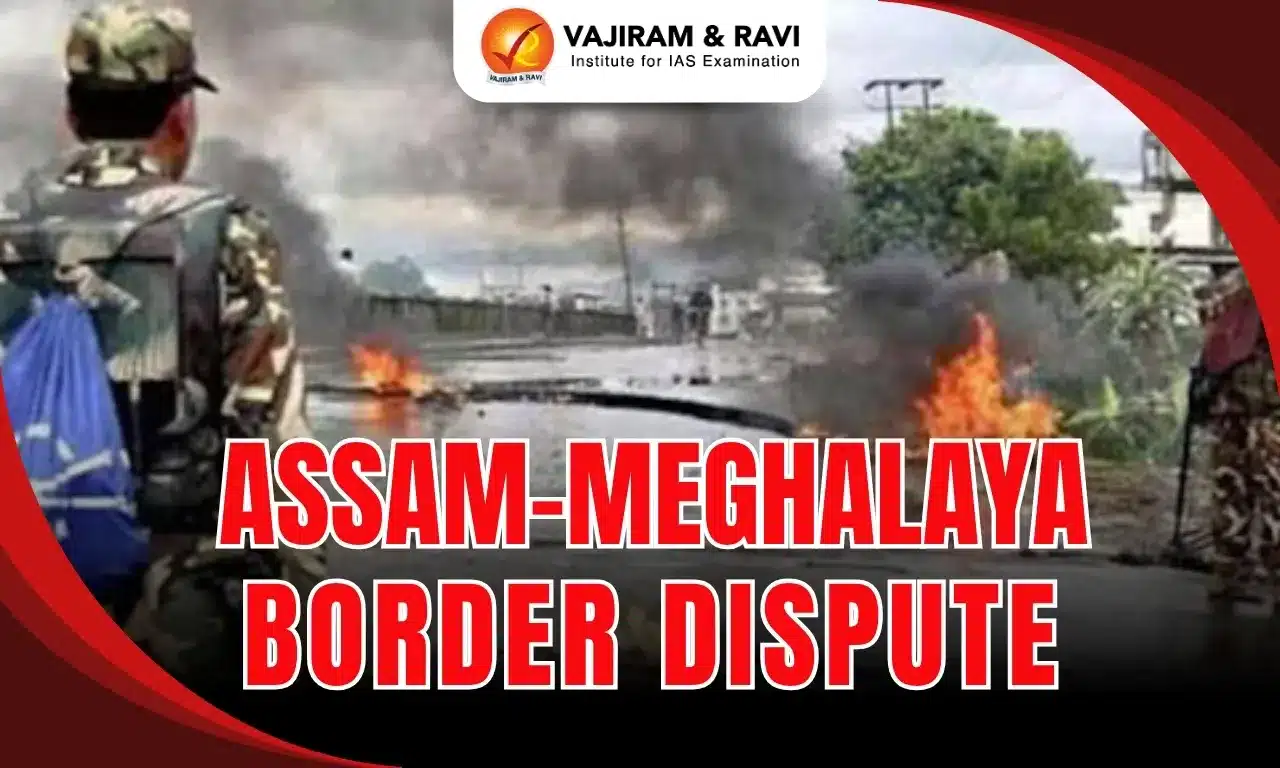
  • A 44-year-old man from Tapat village in Assam’s West Karbi Anglong, was killed during a clash between residents of Assam’s Tapat and Meghalaya’s Lapangap village in West Jaintia Hills, along a disputed stretch of the Assam-Meghalaya border.
  • Police said the violence erupted when villagers from Lapangap were harvesting paddy in the contested area, a practice followed “for generations.”
  • The site of the incident is among six unresolved areas along the 884-km Assam-Meghalaya border, where tensions persist despite a 2022 MoU settling disputes in six other zones. 
  • The same region witnessed the Mukroh firing incident in 2022, which killed six people.

Assam–Meghalaya Border Dispute: Historical Roots and Key Issues

  • The Assam–Meghalaya border dispute dates back to the colonial era, when undivided Assam included present-day Nagaland, Arunachal Pradesh, Meghalaya, and Mizoram.
  • When Meghalaya was carved out of Assam as an autonomous state in 1970 and later became a full-fledged state in 1972, boundary differences arose. 
  • The separation was formalised under the Assam Reorganisation (Meghalaya) Act of 1969, which Meghalaya refused to accept.

Reasons Behind Meghalaya’s Refusal to Accept the 1969 Act

  • The 1969 Act was based on the recommendations of a 1951 committee that sought to define the boundary between the two states.
  • According to these recommendations, parts of East Jaintia Hills, Ri-Bhoi, and West Khasi Hills (in present-day Meghalaya) were transferred to Assam’s Karbi Anglong and Kamrup districts.
  • After achieving statehood, Meghalaya contested these transfers, arguing that the areas historically belonged to indigenous tribal chieftains under its traditional governance system.

Assam’s Position

  • The Assam government has maintained that Meghalaya lacks documentary and archival evidence to substantiate its territorial claims.
  • Assam insists that the boundary defined in 1969 is legally valid and that Meghalaya’s claims are not supported by historical or administrative records.

Extent of the Dispute

  • Following years of claims and counterclaims, the boundary conflict was narrowed down to 12 disputed sectors in 2011, covering parts of West Khasi Hills, Ri-Bhoi, and Jaintia Hills in Meghalaya and adjoining districts of Assam.
  • These areas remain points of contention, occasionally triggering tensions and clashes between communities living along the border.

Efforts to Resolve the Assam–Meghalaya Border Dispute

  • Joint Official Committee (1983) - A joint official committee was established in 1983 to address the boundary dispute. It recommended that the Survey of India should re-delineate the border in consultation with both state governments.
  • Independent Panel (1985) - An independent commission, headed by Justice Y.V. Chandrachud, was formed in 1985 to examine the issue. However, Meghalaya rejected the panel’s report, citing disagreement with its findings.
  • Survey of India’s Role and Partial Demarcation (1991) - In 1991, around 100 km of the inter-state border was demarcated with the help of the Survey of India. Despite this technical effort, Meghalaya refused to accept the demarcation, keeping the dispute unresolved.

Central Intervention (2011)

  • In 2011, the Meghalaya Assembly passed a resolution seeking the Centre’s intervention and demanded the creation of a boundary commission.
  • The Union Government directed both states to appoint nodal officers to facilitate discussions and collect relevant records for negotiation.

Renewed Political Will (2021–2022)

  • In June 2021, Assam and Meghalaya adopted a give-and-take approach to advance talks and formed three regional committees each, headed by cabinet ministers, to examine ground realities and gather local inputs.
  • Based on the committees’ recommendations, a draft resolution was prepared in January 2022.
  • Subsequently, in March 2022, both states signed a historic Memorandum of Understanding (MoU) to resolve disputes in six of the 12 contested sectors, covering around 36.7 sq km.

2022 Border Pact

  • In March 2022, Assam and Meghalaya partially resolved their 50-year-old border dispute, settling differences in six of the 12 disputed sectors along their 884-km boundary. 
  • The pact marked a major milestone in inter-state cooperation in the Northeast.

Key Features of the Agreement

  • The agreement covers 36.79 sq. km of disputed land.
  • Assam will retain 18.51 sq. km, while Meghalaya will receive 18.28 sq. km.
  • Following the pact, around 70% of the boundary between the two states is now dispute-free.
  • Negotiations will continue over the remaining six areas, including Langpih, Borduar, and Block I & II regions, which are more sensitive and complex.

Source: IE | HT | GoA

Assam–Meghalaya Border Dispute FAQs

Q1: What caused the Assam–Meghalaya border clash?

Ans: The clash erupted when villagers from Meghalaya’s Lapangap and Assam’s Tapat fought over paddy harvesting in a disputed area, leading to one fatality.

Q2: How old is the Assam–Meghalaya border dispute?

Ans: The dispute dates back to Meghalaya’s creation in 1972, when boundary demarcations under the 1969 Reorganisation Act were contested by Meghalaya

Q3: What efforts have been made to resolve the dispute?

Ans: Multiple panels since 1983 have worked on the issue, culminating in a 2022 MoU resolving six of the 12 contested areas.

Q4: What is the Assam–Meghalaya border pact of 2022?

Ans: The 2022 agreement settled six sectors, dividing 36.79 sq km almost equally, making 70% of the border dispute-free.

Q5: What lies ahead for the remaining disputed areas?

Ans: Negotiations continue over the remaining six sectors, with the Centre overseeing talks for a peaceful and permanent settlement.

Punjab Floods Threaten Soil Health but Recovery Still Possible

Punjab Floods

Punjab Floods Latest News

  • Punjab faced one of its worst floods in recent years, with all 23 districts affected and nearly two lakh hectares of farmland inundated or waterlogged. 
  • As the state prepares for the wheat-sowing season, concerns have emerged over soil fertility and crop productivity.
  • However, experts believe the damage to soil health may be reversible, provided timely recovery measures such as drainage, soil treatment, and balanced fertiliser use are implemented to restore productivity.

Erosion and Silt: The Twofold Impact of Floods on Punjab’s Soil

  • Floods impact soil in multiple ways depending on their duration, intensity, and soil type
  • The two major consequences are erosion and silt deposition, both of which influence soil fertility and crop productivity differently.
  • Prolonged waterlogging leads to soil compaction, which reduces aeration and disrupts the nutrient balance. 
  • This limits root respiration and microbial activity, ultimately lowering soil productivity.

Erosion: Loss of Nutrient-Rich Topsoil

  • Floodwaters often erode the topsoil, stripping away the uppermost, nutrient-enriched layer that farmers painstakingly cultivate over time.
  • This topsoil is rich in phosphorus, nitrogen, and carbon, essential for healthy plant growth. 
  • Its loss directly affects soil fertility, leading to reduced crop yields and higher recovery costs.

Silt Deposition: A Mixed Blessing

  • Floods also deposit silt on the surface, especially in low-lying and riverbank areas. 
  • While excessive silt can block root growth and disrupt microbial activity, fine alluvial silt can actually enhance soil structure and replenish nutrients.
  • According to soil experts, if the silt layer is not too deep, it can be mixed with existing soil to restore fertility. 
  • Farmers near rivers have historically benefited from such natural nutrient replenishment following floods.

Soil Tests Show Manageable Impact of Floods on Punjab’s Farmlands

  • Soil sampling conducted by the Punjab Agricultural University (PAU), Ludhiana, across several flood-affected districts indicates that while flooding has impacted soil health, the situation remains manageable with timely intervention.
  • The tests revealed nutrient leaching, especially of nitrogen, and a temporary pH imbalance due to waterlogging. 
  • In areas where topsoil erosion occurred, nutrient levels dropped, but experts say this can be restored through deep ploughing, soil test–based fertilisation, and organic amendments.
  • Experts noted that although the floods have disrupted cropping cycles, timely soil management and coordinated testing can help farmers restore fertility and strengthen resilience.
  •  They are urging farmers to conduct individual soil tests before applying fertilisers to ensure targeted nutrient management and long-term recovery.

Post-Flood Recovery: Managing Silt and Restoring Punjab’s Fields

  • The recovery strategy for flood-affected farmland in Punjab depends on the depth of silt deposits and the type of soil.
  • In areas with 2–3 inches of silt, normal ploughing can mix it with native soil, while lighter soils can handle deposits up to 9 inches through deep chiselling. 
  • In heavy soils, where deep silt restricts root growth, mechanical or manual removal is advised. Adding compost or organic matter helps restore soil structure and fertility.
  • Experts emphasise early intervention to ensure fields are ready for the rabi crop, and warn farmers to control weeds brought by floodwaters.
  • The Punjab government’s policy, “Jisda Khet Usdi Ret” (the sand/silt belongs to the landowner), allows farmers to sell deposited sand or silt, helping them clear fields quickly without environmental clearances and recover some income.

Punjab Farmers Likely to Resume Normal Cropping Cycles This Rabi Season

  • Agricultural experts believe that most farmers in Punjab can resume their rabi cropping cycles on time, especially in areas with light or moderate silt deposits. 
  • Even in heavily affected regions, prompt field management can help align with the regular schedule.
  • For wheat, sown between late October and November 20, timely field preparation is crucial. 
  • Fields retaining residual flood moisture may not require pre-irrigation, while bed planting of wheat or transplanting gobhi and sarson is advised in low-lying or waterlogged areas.
  • In regions where fields were prepared early, short-duration crops like toria, potato, or maize can be grown before wheat. 
  • For fodder, combinations such as maize with cowpea or sorghum with cowpea are recommended to maximise land use and recovery.
  • Although floods disrupted farming in some zones, Punjab’s resilient farmers — with the support of scientists and government schemes — are expected to restore productivity and maintain soil fertility in the upcoming rabi season.

Source: IE

Punjab Floods FAQs

Q1: How have floods affected Punjab’s farmlands?

Ans: All 23 districts were flood-hit, with erosion and silt deposition damaging soil health across nearly two lakh hectares of farmland.

Q2: What are the main soil problems after floods?

Ans: Floods caused topsoil erosion, nutrient loss, silt deposits, and waterlogging, affecting aeration and microbial activity essential for soil fertility.

Q3: What do recent soil tests show?

Ans: Punjab Agricultural University found nutrient leaching and temporary pH imbalance but confirmed fertility can be restored with timely soil management.

Q4: How can farmers recover soil productivity?

Ans: Experts recommend deep ploughing, organic amendments, compost use, and silt removal or mixing, depending on soil type and silt depth.

Q5: Will Punjab farmers return to normal cropping cycles?

Ans: Yes. Most can resume rabi sowing on schedule with prompt recovery steps, aided by favourable soil moisture and scientific support.

Enquire Now