Green Crackers in Delhi: Between Eco-Friendly Promise and Pollution Reality

Green Crackers

Green Crackers Latest News

  • Recently, the Supreme Court signalled it may partially relax the firecracker ban in Delhi-NCR “on a trial basis,” seeking to balance environmental concerns and public sentiment — similar to its 2018 Arjun Gopal judgment, which had allowed only low-emission ‘green crackers’.
  • The case, which began in 2015 with a plea by three infants seeking protection from Delhi’s toxic air, has evolved into a decade-long legal battle over the right to breathe clean air.
  • Despite court orders, enforcement has been weak, and violations persist, worsening air quality each festive season.

A Decade of Judicial Action on Firecrackers: 2015–2025

  • The firecracker litigation began in 2015, when a petition by three infants sought protection from Delhi’s toxic air.
  • In October 2018, the SC delivered a landmark ruling, banning conventional firecrackers and permitting only “green” variants developed by CSIR, with fixed time slots for bursting them.
  • In November 2020, the National Green Tribunal (NGT) imposed an “absolute ban” on all firecrackers during the Diwali season in the NCR and other highly polluted cities, expanding restrictions beyond the SC’s earlier framework.

Annual Enforcement and Year-Round Ban (2021–2023)

  • Since 2021, the Delhi Pollution Control Committee (DPCC) has regularly banned the sale and use of firecrackers from September through winter each year.
  • In 2023, following Supreme Court directions, Delhi extended the prohibition to a year-round ban to control persistent air pollution.

Supreme Court’s Latest Observations (2024–2025)

  • In April 2024, the SC observed that a short-term ban around Diwali would not be effective and no relaxation for green crackers should be given without clear evidence of environmental benefit.
  • Later, in September 2025, while reviewing pleas to modify the ban, the Court allowed certified manufacturers to produce green crackers, but prohibited their sale in Delhi-NCR until further orders.

About Green Crackers

  • Green crackers are eco-friendly fireworks developed by the Council of Scientific & Industrial Research – National Environmental Engineering Research Institute (CSIR-NEERI) to reduce harmful emissions and air pollution.
  • These crackers are made with smaller shells, reduced raw material use, elimination of ash, and dust-suppressant additives, which help curb smoke and particulate emissions.
  • While combustion-based fireworks can never be entirely pollution-free, green crackers release 30–40% fewer pollutants than traditional ones.
  • They do not contain toxic substances such as barium nitrate, arsenic, or lead, and instead use alternative formulations that reduce smoke, particulate matter, and noise levels.

Variants Developed by CSIR-NEERI

  • Introduced in 2018, CSIR-NEERI created three key variants:
    • SWAS (Safe Water Releaser)
    • STAR (Safe Thermite Cracker)
    • SAFAL (Safe Minimal Aluminium)
  • These versions eliminate potassium nitrate and sulphur, helping cut gas and dust emissions significantly while maintaining festive brightness and sound within safer limits.

Concerns and Risks Surrounding Green Crackers

  • According to CSIR-NEERI, green crackers emit lower levels of nitrous oxide and sulphur dioxide compared to traditional fireworks. 
  • However, a 2022 Delhi Technological University study found that they still release high concentrations of ultra-fine particles — even more harmful than PM2.5 and PM10, posing serious health risks.

Identification and Regulation

  • Certified green crackers carry the CSIR-NEERI green logo and encrypted QR codes for authenticity
  • Only companies approved by NEERI and the Petroleum and Explosives Safety Organisation (PESO) can manufacture them, and licensed vendors are authorised to sell these products. 
  • Each cracker is traceable to its manufacturer through the QR code.
  • Despite the regulatory framework, Delhi lacks essential infrastructure — including testing labs, certification mechanisms, and inspection facilities — to ensure compliance. 
  • Experts warn that no facility currently exists to verify if the crackers being sold are truly “green.”
  • Moreover, the QR verification system, designed to prevent counterfeiting, has been cloned by unlicensed manufacturers, leading to widespread circulation of fake “green” crackers.

Source: IE | HT

Green Crackers FAQs

Q1: What are green crackers?

Ans: Green crackers are eco-friendly fireworks developed by CSIR-NEERI that emit 30–40% fewer pollutants by using cleaner formulations and smaller shells.

Q2: When did India start promoting green crackers?

Ans: The Supreme Court allowed green crackers in 2018 after banning conventional fireworks in the Arjun Gopal case to cut festive air pollution.

Q3: What are the main variants of green crackers?

Ans: CSIR-NEERI developed three types — SWAS, STAR, and SAFAL — eliminating toxic chemicals like sulphur and potassium nitrate for cleaner combustion.

Q4: Do green crackers truly reduce pollution?

Ans: Studies show they release fewer gases but still emit ultra-fine particles harmful to health, making their overall environmental benefit limited.

Q5: What challenges exist in enforcing green cracker regulations?

Ans: Delhi lacks testing labs and QR verification systems, allowing counterfeit “green” crackers to flood the market and worsen air quality.
DGCA Probes Air India Boeing 787 After Unusual RAT Deployment During Birmingham Landing

RAT Deployment

RAT Deployment Latest News

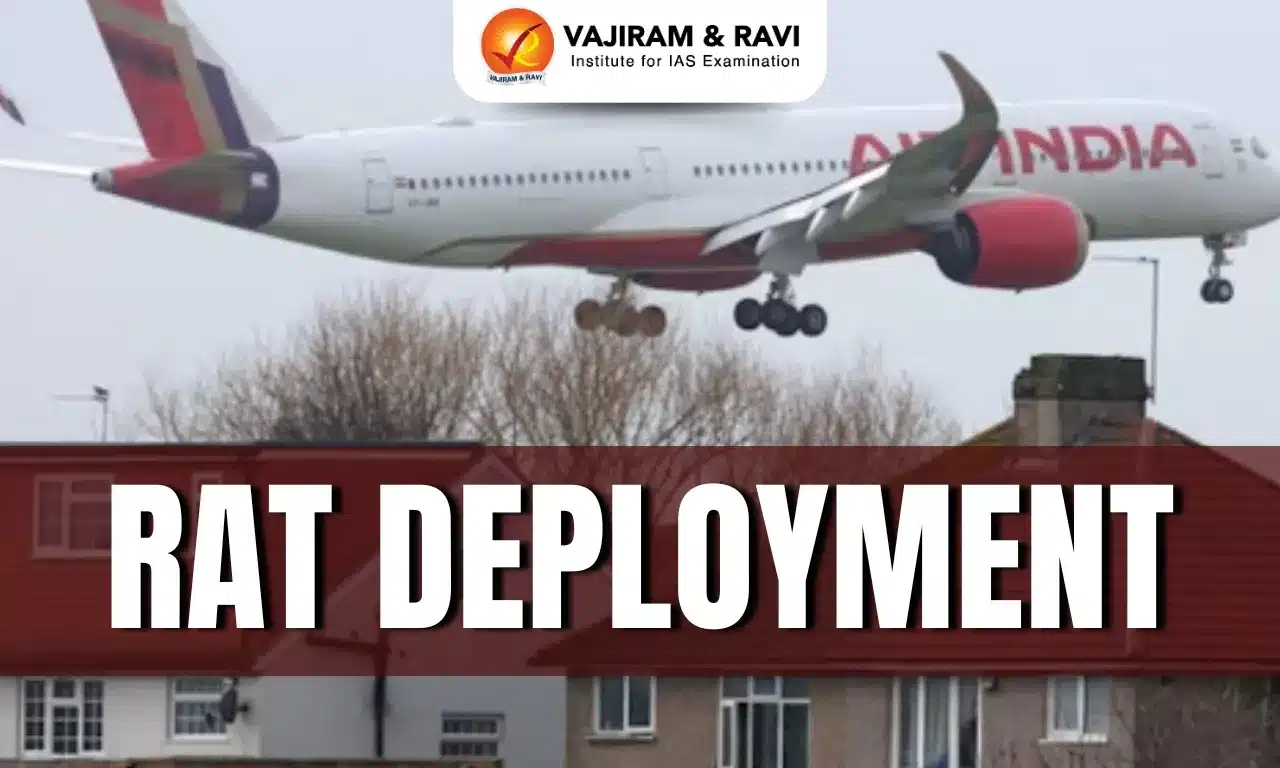
  • An Air India Boeing 787-8 (flight AI-117) flying from Amritsar to Birmingham experienced an unexpected deployment of its Ram Air Turbine (RAT) — a last-resort emergency power system — during final approach, despite all electrical and hydraulic systems functioning normally. 
  • The aircraft landed safely and was grounded for inspection, but no technical anomalies were found. The Directorate General of Civil Aviation (DGCA) has launched a formal investigation into the incident. 
  • The Federation of Indian Pilots (FIP) has called on the regulator to inspect all Boeing 787s operating in India, suggesting the malfunction could indicate underlying electrical system issues possibly linked to the June 12 Ahmedabad crash that killed 260 people.

Last-Resort Power: How the Ram Air Turbine (RAT) Works on Aircraft

  • The Ram Air Turbine (RAT) is a small propeller-like device designed to automatically deploy only in severe emergencies such as dual engine failure or total power loss. 
  • Its unexpected activation is extremely rare and typically indicates a technical malfunction.
  • The RAT harnesses airflow pressure generated by the aircraft’s speed to produce power. 
  • A similar RAT deployment occurred during the June 12 Ahmedabad crash involving an Air India Boeing 787-8 Dreamliner, which tragically claimed 241 lives, underscoring the system’s role as a last-resort emergency power source.

How It Generates Power

  • The RAT functions like a mini wind turbine, using ram pressure — created by the aircraft’s forward motion — to generate electricity. 
  • The power produced sustains essential flight systems such as flight controls, navigation, and communication equipment.
  • In the brief window before RAT deployment, the aircraft’s batteries keep critical instruments running.
  • Designed as a last line of defence, the RAT is most effective at high speeds or cruising altitudes, when airflow can generate enough power for emergency operation. 
  • It allows pilots to maintain control and glide toward a safe landing, though it cannot replace engine power.
  • According to experts, this emergency system has helped save over 2,400 lives worldwide over the past five decades, preventing several major aviation disasters by keeping aircraft operational during total power failures.

RAT Deployment on Air India Flight to Birmingham

  • During the landing of Air India flight AI117, a Boeing 787 (VT-ANO) flying from Ahmedabad to Birmingham, the aircraft’s Ram Air Turbine (RAT) unexpectedly deployed at just 400 feet, despite no signs of technical abnormality. 
  • Following comprehensive checks and Boeing-recommended maintenance procedures, no discrepancies were found.
  • Boeing confirmed the aircraft was structurally and functionally sound. The plane has since resumed regular operations.
  • However, given the highly unusual nature of the uncommanded RAT deployment, the Directorate General of Civil Aviation (DGCA) has ordered a detailed probe. 
  • Aviation experts suggest the incident may have resulted from a system malfunction, but the exact cause will be known only after further investigation.

Fresh Concerns Over Boeing 787 Systems After Birmingham Incident

  • The unexpected RAT deployment on Air India’s Boeing 787 during landing at Birmingham has reignited safety concerns about the aircraft model, occurring just four months after the Ahmedabad crash that killed 260 people.
  • In that crash, the RAT had deployed moments after takeoff, when both engines shut down due to fuel control switches shifting from ‘RUN’ to ‘CUTOFF’. 
    • A detailed technical investigation is still underway.
  • The Federation of Indian Pilots (FIP), representing 5,500 pilots, suspects that an electrical fault may have triggered the RAT deployment in the Birmingham flight.
    • The FIP suggested the Birmingham incident could be linked to the Ahmedabad crash, arguing that potential electrical system failures were not fully investigated.
  • It warned that the Birmingham event could be a pointer to systemic issues, urging immediate regulatory action in the interest of air safety.
  • Since its commercial debut in 2011, the Boeing 787 Dreamliner has experienced occasional technical issues, such as battery malfunctions and electrical glitches.
  • However, it maintained a strong safety record until June 12, 2025 — the first-ever fatal crash and hull loss of the model worldwide.

Source: IE | HT | ToI

RAT Deployment FAQs

Q1: What happened to Air India’s Boeing 787 during its Birmingham flight?

Ans: The aircraft’s emergency RAT deployed at 400 feet without warning, despite normal systems. DGCA has launched an investigation into the unusual incident.

Q2: What is a Ram Air Turbine (RAT)?

Ans: The RAT is a small propeller-like turbine that automatically deploys during total power failure to generate electricity for flight controls and instruments.

Q3: Why is the DGCA investigating the Air India 787 incident?

Ans: Since the RAT deployed without cause, the DGCA suspects a system fault and is examining all Boeing 787 aircraft for possible electrical issues.

Q4: How is this case linked to the Ahmedabad crash?

Ans: The Ahmedabad crash also saw RAT activation before engine shutdown, suggesting potential electrical faults in Boeing 787 aircraft systems.

Q5: What action has been taken after the Birmingham incident?

Ans: DGCA has ordered a detailed probe; Boeing found the aircraft safe post-checks, but pilots’ associations demand broader system inspections.

Pradhan Mantri Dhan Dhaanya Krishi Yojana – Explained

Krishi Yojana

Krishi Yojana Latest News

  • Prime Minister Narendra Modi launched two major agricultural initiatives, the PM Dhan Dhaanya Krishi Yojana and the Mission for Aatmanirbharta in Pulses, worth Rs. 35,440 crore to boost productivity, cut imports, and make Indian agriculture globally competitive.

Introduction

  • Prime Minister Narendra Modi on October 11, 2025, launched two landmark agricultural initiatives, the PM Dhan Dhaanya Krishi Yojana (PMDDKY) and the Mission for Aatmanirbharta in Pulses, with a total outlay of Rs. 35,440 crore
  • Announced during the birth anniversary of Jayaprakash Narayan, the schemes aim to transform India’s agricultural landscape by enhancing productivity, improving self-reliance in pulses, and increasing farmer incomes.

PM Dhan Dhaanya Krishi Yojana (PMDDKY)

  • Overview and Objective
    • The scheme carries an outlay of Rs. 24,000 crore and focuses on transforming 100 low-performing agricultural districts across India. 
    • These districts have been identified based on three criteria:
    • Low productivity,
    • Moderate crop intensity, and
    • Below-average access to agricultural credit.
    • The scheme aims to bridge developmental gaps by integrating 36 schemes from 11 different departments, ensuring convergence in efforts and efficient resource utilisation.
  • According to official details, the 100 districts are spread across multiple states: Uttar Pradesh (12 districts), Maharashtra (9), Madhya Pradesh and Rajasthan (8 each), Bihar (7).
  • The scheme will promote crop diversification, better irrigation, sustainable practices, and enhanced farmer access to institutional finance. It will be implemented from the Rabi season of 2025-26 and continue till 2030-31.

Mission for Aatmanirbharta in Pulses

  • Objective and Implementation
    • The Mission for Aatmanirbharta in Pulses, with an outlay of Rs. 11,440 crore, seeks to reduce India’s dependence on pulse imports and make the country self-sufficient by 2030-31. The mission targets:
    • Expanding the area under pulse cultivation to 310 lakh hectares,
    • Increasing total production to 350 lakh tonnes, and
    • Raising the average yield to 1,130 kg per hectare.
  • The mission will emphasise the adoption of high-yielding seed varieties, research-led farming practices, and the expansion of irrigation facilities, aiming to empower farmers and stabilise domestic prices.
  • Strategic Importance
    • India remains one of the largest consumers and importers of pulses globally. 
    • The mission will not only reduce import dependency but also improve farmer profitability by focusing on climate-resilient crops such as tur (pigeon pea), urad, and masoor (lentils).

Complementary Announcements

  • Alongside these major schemes, PM Modi inaugurated:
    • 1,054 completed projects worth Rs. 3,650 crore under the Agriculture Infrastructure Fund (AIF),
    • 17 animal husbandry projects worth Rs. 1,166 crore,
    • 16 fisheries projects worth Rs. 693 crore under the PM Matsya Sampada Yojana, and
    • 11 food processing projects worth Rs. 808 crore under the PM Kisan Sampada Yojana and the PLI Scheme for Food Processing Industries.
  • These projects collectively aim to strengthen agricultural logistics, storage capacity, value addition, and rural infrastructure, thereby increasing income opportunities for farmers.

Government’s Broader Vision for the Agricultural Sector

  • PM Modi’s speech highlighted the transformation in Indian agriculture since 2014, noting that reforms from “seed to market” have boosted production and improved farmers’ financial resilience. 
  • The Prime Minister further highlighted recent GST reductions on farm machinery and animal husbandry products, noting that such measures lower operational costs for farmers, for example, tractors have become cheaper by nearly Rs. 40,000 post-GST reforms.

Significance of the New Schemes

  • Targeted Development: Focus on low-productivity districts to reduce regional imbalances.
  • Import Reduction: The Pulses mission to curb imports and enhance self-reliance.
  • Integrated Policy Approach: Convergence of 36 central schemes for better efficiency.
  • Rural Employment Boost: Increased infrastructure and production capacity will create more jobs in the agri value chain.
  • Global Market Linkages: Encouragement to farmers for export-oriented production.

Source : IE | TOI | TH

Krishi Yojana FAQs

Q1: What are the two agriculture schemes launched by PM Modi?

Ans: PM Modi launched the PM Dhan Dhaanya Krishi Yojana and the Mission for Aatmanirbharta in Pulses, together worth Rs. 35,440 crore.

Q2: What is the objective of PM Dhan Dhaanya Krishi Yojana?

Ans: It aims to develop 100 low-performing agricultural districts by improving productivity and access to resources.

Q3: What is the goal of the Mission for Aatmanirbharta in Pulses?

Ans: It seeks to make India self-sufficient in pulses by 2030–31, targeting 350 lakh tonnes of production.

Q4: How will these schemes help farmers?

Ans: They will enhance productivity, reduce input costs, promote irrigation, and create export opportunities.

Q5: What additional projects were inaugurated during the event?

Ans: PM Modi inaugurated 1,054 projects under the Agriculture Infrastructure Fund and other schemes worth over Rs. 5,450 crore.

Greenhouse Gas Emission Intensity Target Rules – Explained

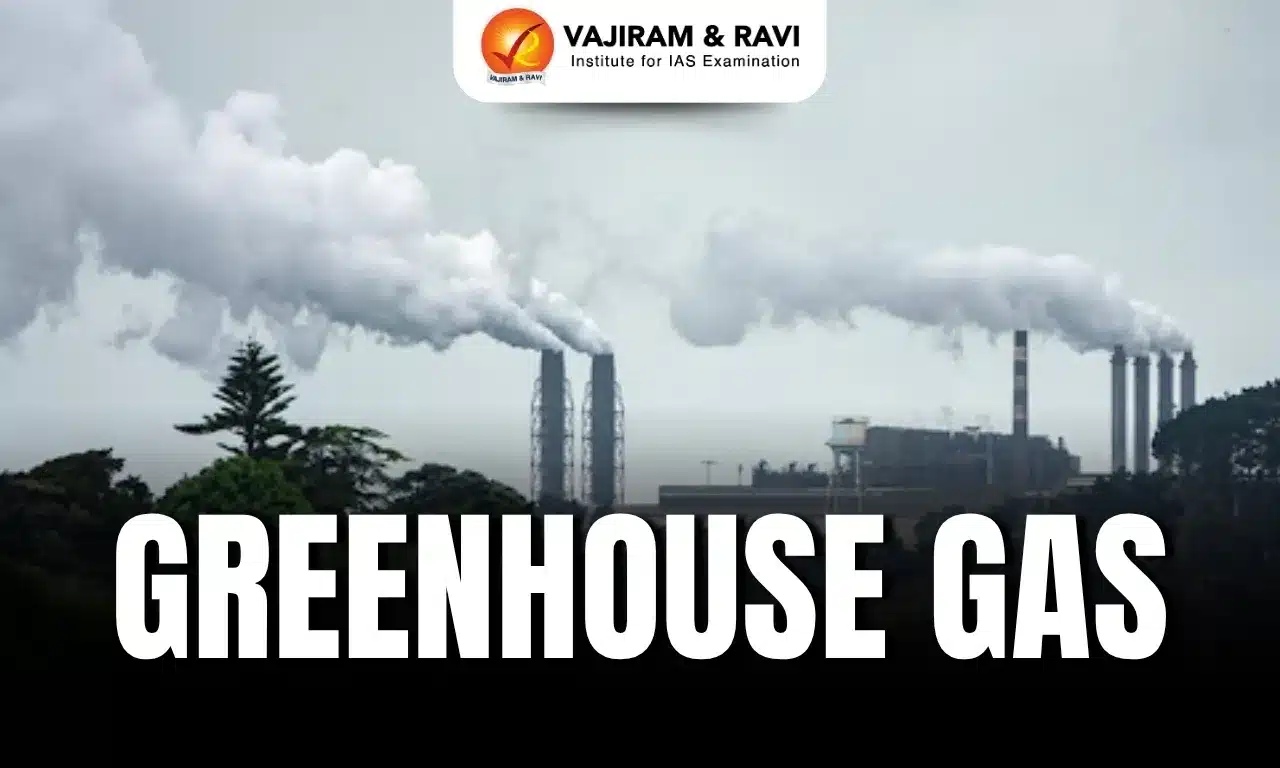
Greenhouse Gas

Greenhouse Gas Latest News

  • The Government of India has notified the Greenhouse Gas Emission Intensity (GEI) Target Rules, 2025, setting legally binding emission reduction targets for four key industrial sectors.

About the Greenhouse Gas Emission Intensity Target Rules, 2025

  • In a landmark move toward enforcing India’s climate commitments, the Ministry of Environment, Forest and Climate Change (MoEFCC) has notified the Greenhouse Gas Emission Intensity (GEI) Target Rules, 2025.
  • This sets the country’s first legally binding emission reduction targets for four major industries: cement, aluminium, pulp & paper, and chlor-alkali.
  • These Rules are a critical step toward operationalising the Carbon Credit Trading Scheme (CCTS), 2023, which established India’s domestic carbon market. 
  • The initiative supports India’s larger pledge to reduce the emissions intensity of its GDP by 45% by 2030, compared to 2005 levels, under the Paris Climate Agreement (2015).

Coverage and Scope of the GEI Rules

  • The notified Rules apply to 282 high-emission industrial units across the country, broken down as follows:
    • 186 cement units
    • 13 aluminium units
    • 30 chlor-alkali units
    • 53 pulp and paper units
  • Each unit is assigned specific emission reduction targets for two compliance periods, 2025-26 and 2026-27
  • The emission intensity, or GEI, measures the amount of greenhouse gases emitted per unit of production output, expressed in tonnes of CO₂ equivalent (tCO₂e) per tonne of product (for example, per tonne of cement or aluminium).
  • Implementing Agency: Bureau of Energy Efficiency (BEE)

Linking GEI Targets with the Carbon Credit Market

  • The GEI Rules create a direct link between industrial emission performance and carbon market participation.
    • Compliant Units: Industries that meet or exceed their emission intensity targets will earn carbon credits, which they can trade in the domestic carbon market for monetary value.
    • Non-Compliant Units: Those that fail to meet their targets must either purchase credits from the market to offset their shortfall or pay environmental compensation, enforced by the Central Pollution Control Board.
  • This mechanism encourages companies to invest in cleaner technologies and energy-efficient production systems, transforming emission reduction into an economic opportunity rather than a regulatory burden.

Targets and Sectoral Impact

  • The GEI targets require industries to progressively reduce emissions intensity as follows:
    • 2025-26: 2-3% average reduction
    • 2026-27: Up to 7.5% reduction compared to baseline levels
  • Sector-specific goals include:
    • Cement: Reduction between 4.7% and 7.6% depending on the type of cement (e.g., Ordinary Portland Cement).
    • Pulp and Paper: Reduction targets as high as 15% over two years.
    • Aluminium and Chlor-Alkali: Moderate but steady reduction requirements to ensure process efficiency.

Transition from PAT to CCTS Framework

  • Before the Carbon Credit Trading Scheme (CCTS), India introduced the Perform, Achieve, Trade (PAT) scheme under the National Mission on Enhanced Energy Efficiency (NMEEE) in 2012. 
  • The PAT mechanism allowed energy-intensive industries to improve efficiency and trade “energy saving certificates.”
  • However, the PAT scheme lacked a carbon market component, focusing solely on energy savings. 
  • The CCTS, by contrast, incorporates a market-based carbon trading system, aligning India’s domestic framework with global carbon markets.

Importance of the GEI Rules for India’s Climate Commitments

  • Operationalising the Domestic Carbon Market
    • The GEI Rules are the first practical step in establishing India’s carbon trading system. 
  • Supporting Net-Zero Transition
    • India’s target of achieving net-zero emissions by 2070 relies heavily on emission reductions from industrial sectors. 
  • Encouraging Technological Innovation
    • By monetising efficiency improvements, the framework incentivises the adoption of green manufacturing technologies, renewable energy integration, and carbon capture solutions.
  • Aligning with Global Best Practices
    • The model mirrors frameworks in the EU Emissions Trading System (ETS) and China’s national carbon market, positioning India as a future leader in Asia’s carbon economy.
  • Driving Accountability and Enforcement
    • For the first time, emission intensity reduction targets are legally binding. Non-compliance will trigger penalties and compensation, introducing stronger environmental governance in India’s industrial ecosystem.

Challenges in Implementation

  • Accurate Measurement and Reporting: Industrial units will need robust systems to monitor and verify emissions data.
  • Capacity Gaps: Smaller industries may lack the technical or financial capacity to comply immediately.
  • Market Liquidity: The success of the carbon credit trading mechanism depends on sufficient market participation.
  • Regulatory Coordination: Effective collaboration between BEE, CPCB, and MoEFCC is essential for smooth enforcement.
  • To address these concerns, the government plans to expand the CCTS to include more sectors, strengthen monitoring, reporting, and verification (MRV) protocols, and promote digital carbon registries for transparent trading.

Source : IE | TH

Greenhouse Gas FAQs

Q1: What are the Greenhouse Gas Emission Intensity (GEI) Target Rules, 2025?

Ans: They are India’s first legally binding emission reduction targets for industries, focusing on reducing greenhouse gas emissions per unit of production.

Q2: Which sectors are covered under the GEI Rules, 2025?

Ans: The Rules apply to the cement, aluminium, chlor-alkali, and pulp & paper sectors.

Q3: How do industries benefit from meeting GEI targets?

Ans: Industries that meet or exceed their targets earn carbon credits, which can be traded in the domestic carbon market.

Q4: What happens if industries fail to meet their targets?

Ans: Non-compliant industries must buy carbon credits or pay environmental compensation as enforced by the CPCB.

Q5: How does the GEI framework support India’s climate goals?

Ans: It operationalises the domestic carbon market and helps India achieve its target of reducing emissions intensity by 45% by 2030.

Enquire Now