Rare Earths: The New Flashpoint in the US-China Trade War

Rare Earths

Rare Earths Latest News

  • The ongoing China–US trade conflict has intensified over rare earth minerals, a critical component for high-tech industries.
  • China recently tightened restrictions on rare earth exports, prompting US President Donald Trump to threaten 100% tariffs in retaliation.

Rare Earths: Abundant in Nature, Critical in Technology, and Dominated by China

  • Rare earths refer to 17 metallic elements — from lanthanum (57) to lutetium (71), plus scandium (21) and yttrium (39) — known for their high density, conductivity, and thermal resistance.
  • They are divided into light and heavy rare earths, based on atomic weight, and form an essential subset of critical minerals vital to modern industries.

Why They Matter

  • These elements are indispensable, even in trace quantities, for a wide array of technologies — from smartphones, wind turbines, and electric vehicles to weapons systems, robotics, MRI scanners, and cancer treatment equipment.
  • Their unique properties make them irreplaceable components in both civilian and defence applications, underpinning the global clean energy and digital revolutions.
  • Rare earths typically occur in low concentrations, making extraction and refining expensive and environmentally complex.
  • This high cost limits the number of countries that can profitably mine and process them.

China’s Global Dominance

  • According to the International Energy Agency (IEA):
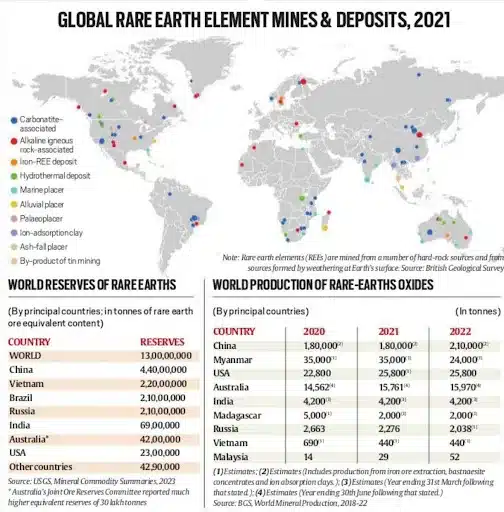
    • Over 60% of rare earth mining occurs in China.
    • More than 90% of global processing and refining capacity is also controlled by Beijing.
  • This near-monopoly gives China strategic leverage in global supply chains, making rare earths a central weapon in trade and geopolitical rivalries, especially with the United States.
Global Reserves, Limited Production

  • While Brazil, Australia, and India hold substantial rare earth reserves, their production remains minimal.
  • The reasons include:
    • Low economic viability due to high extraction costs, and
    • Environmental concerns, as rare earth mining is highly polluting and requires complex waste management systems.

China’s Rare Earth Dominance: Weaponising Trade Through Rare Earths

  • Beijing has pursued a deliberate industrial strategy to achieve near-total control over the mining and processing of these critical minerals, integrating them into its long-term economic and geopolitical planning.
  • China’s export restrictions, particularly on heavy rare earths like terbium (65) and dysprosium (66) — essential for defence and high-tech manufacturing — are part of a policy to use rare earths as a strategic trade weapon.
  • In response to US tariffs under President Donald Trump, Beijing has used its dominance in rare earths to gain leverage and escalation control in the ongoing US-China trade war.
  • China’s decades-long investment in rare earth mining, refining, and technology has created a complete supply chain monopoly.

New Restrictions on Rare Earth Exports and Impact on India

  • China has expanded its export control list to include five additional rare earth elements — holmium, erbium, thulium, europium, and ytterbium — along with related magnets and materials, bringing the total number of restricted elements to 12.
  • The Ministry of Commerce also added refining technologies to the control list and announced that foreign producers using Chinese rare earths must now comply with its new export rules.

Limited Impact on India—for Now

  • India’s exposure to rare earth supply disruptions is relatively limited, owing to low domestic consumption.
  • According to the Ministry of Mines, India imported 2,270 tonnes of rare earth elements in 2023–24, up 23% from 2019–20, with 65% sourced from China and 10% from Hong Kong.
  • The auto sector (particularly EVs) and the electronics industry have felt the sharpest impact from earlier Chinese restrictions in April.

India’s Domestic Initiatives and Future Plans

  • India’s rare earth production remains modest, led by state-owned IREL Ltd, which operates a processing unit with a capacity of over 10,000 tonnes per annum, compared to China’s 200,000 tonnes in 2023.
  • However, India is actively expanding its footprint:
    • Seven seabed blocks in the Andaman Sea have been auctioned for exploration and mining of polymetallic nodules and crusts that may contain heavy rare earths.
    • The Department of Atomic Energy has cleared plans for a Rare Earths Theme Park to establish pilot plants across the value chain.
    • Two major projects — the Rare Earth Permanent Magnet Park in Visakhapatnam and the Rare Earth and Titanium Theme Park in Bhopal — are being developed with central funding to strengthen India’s presence in this strategic sector.

Global Shifts Beyond China

  • Globally, efforts to diversify the rare earth supply chain are gaining traction:
    • The US is preparing an executive order to stockpile deep-sea metals from the Pacific seabed, reducing reliance on China for battery minerals and rare earths.
    • Japan, which faced Chinese curbs in the early 2010s, has since rebuilt its rare earth supply chains, offering a potential model for India and Western economies seeking independence from Beijing’s control.

Source: IE | IT

Rare Earths FAQs

Q1: Why are rare earths central to the US-China trade conflict?

Ans: China dominates global rare earth production and refining, giving it leverage over the US, which relies on these minerals for defence and high-tech industries.

Q2: What new export restrictions has China imposed?

Ans: Beijing added five new rare earths and key refining technologies to its export control list, tightening global supply ahead of upcoming trade talks with Washington.

Q3: How does this impact India?

Ans: India’s impact is limited due to low consumption, but auto and electronics sectors face pressure. India imports 65% of rare earths from China.

Q4: What steps is India taking to reduce reliance on China?

Ans: India has auctioned seabed blocks in the Andaman Sea and is developing rare earth theme parks in Vizag and Bhopal to expand domestic refining.

Q5: How are other countries responding to China’s dominance?

Ans: The US plans to stockpile seabed metals, while Japan has rebuilt its rare earth supply chain to diversify away from Beijing’s near-monopoly.

Google’s $15 Billion AI Data Centre in Andhra Pradesh: Powering India’s Digital Future

AI Data Centre

AI Data Centre Latest News

  • Google has announced a $15 billion investment over five years to establish an AI data centre in Visakhapatnam, Andhra Pradesh — its largest investment in India so far. 
  • Partnering with the Adani Group and Airtel, the project will include the development of a new international subsea gateway to strengthen digital connectivity.
  • The facility will become part of Google’s global network of AI data centres across 12 countries, supporting advanced computing and cloud services. 
  • The investment comes amid strained India–US relations and the government’s push for swadeshi (local) technology adoption. 
  • The initiative also raises policy questions about whether India should incentivise large compute infrastructure to bolster its AI ecosystem and digital sovereignty.

How AI Data Centres Differ from Traditional Ones

  • An AI data centre is different from a traditional data centre in terms of it being specifically tailor-made to support AI applications. 
  • Traditional data centres that rely on CPU-based servers for hosting websites, storage, and business applications.
  • However, AI data centres are designed to handle massive data processing and compute-intensive tasks like image generation, video analysis, and generative AI.
  • They are powered by high-performance GPUs, requiring stronger power infrastructure and advanced cooling systems, making them far more energy-intensive than conventional facilities.
  • According to an analysis, the new AI hub is expected to add $15 billion to US GDP (2026–2030) through increased AI and cloud adoption.
  • It will create economic and technological opportunities for both India and the US, marking a transformative leap in global AI capability.

Google’s AI Hub: Collaboration to Build India’s Clean-Energy Data Centre

  • Google’s AI data hub in Visakhapatnam, Andhra Pradesh is being developed with AdaniConneX and Airtel. 
  • The facility will use the same infrastructure that powers Google’s global services such as Search, Workspace, and YouTube.
  • AdaniConneX, a joint venture between Adani Enterprises and EdgeConneX, will lead the construction and operation of the data centre network across India and provide 100% green energy for the AI hub.

Subsea Gateway and Connectivity Expansion

  • A major component of Google’s investment is the construction of a new international subsea gateway on India’s eastern coast.
  • Multiple international subsea cables will land in Visakhapatnam, connecting to Google’s global network of over two million miles of terrestrial and subsea cables.
  • Airtel will assist Google in developing this connectivity backbone to enhance international data flow and latency performance.

Sustainability and Energy Infrastructure

  • The project includes co-investments in new transmission lines, renewable power generation, and energy storage systems in Andhra Pradesh.
  • Both companies emphasised their commitment to clean energy and grid resilience, stating that the initiative will:
    • Support the AI data centre’s clean energy operations,
    • Strengthen India’s electricity grid, and
    • Promote energy security and sustainable infrastructure development in the region.

Strategic Impact

  • The partnership positions India as a key player in global AI infrastructure, combining Google’s technological expertise, Adani’s green energy leadership, and Airtel’s telecom reach.
  • It underscores a shared commitment to sustainability, digital capacity expansion, and innovation-driven growth within India’s evolving AI ecosystem.

India’s Data Centre Boom: Growth Potential, Energy Challenges, and the Nuclear Option

  • India’s data centre market is valued at around $10 billion, generating $1.2 billion in FY24.
  • A report projects an addition of 795 MW of new capacity by 2027, raising total capacity to 1.8 GW.
  • The sector is poised for robust growth driven by cloud computing, AI adoption, and digital infrastructure investments.

Policy Concerns Over Incentives and Job Creation

  • Despite its promise, policymakers are debating whether to offer incentives for data centres due to their high energy demand and capital intensity with limited employment potential.
  • However, experts claimed that Google’s AI data centre in Visakhapatnam will create 1.88 lakh direct and indirect jobs, signalling strong regional economic benefits.

Energy Demand and Cost Pressures

  • AI data centres are exceptionally energy-intensive. 
  • The International Energy Agency (IEA) projects that global data centre power usage could double by 2026, posing challenges to achieving net-zero or carbon-negative goals by 2030.
  • Power infrastructure dominates operational economics:
    • 40% of total capex goes toward electrical systems.
    • 65% of operating costs stem from electricity consumption.
    • Setting up 1 MW of data centre capacity in India costs between ₹60–70 crore, highlighting the need for cost-efficient and sustainable energy sources.

The Renewable and Nuclear Debate

  • While most firms rely on renewable energy, it faces limitations—intermittent generation and inadequate storage capacity.
  • This has led policymakers to explore nuclear energy as a clean, round-the-clock power source capable of meeting AI-era electricity demands.
  • The Indian government is reportedly open to using nuclear power for data centres, mirroring emerging trends in the United States, where AI-led data centre growth is accelerating reliance on nuclear-backed power grids.

Conclusion

  • India’s data centre expansion represents a balancing act between digital transformation goals, energy security, and environmental commitments.
  • The next phase of policy will determine whether India can become a global AI infrastructure hub while ensuring sustainable, reliable, and cost-effective energy to power its growing digital economy.

Source: IE | BBC | ToI

AI Data Centre FAQs

Q1: What is Google building in Andhra Pradesh?

Ans: Google is investing $15 billion to build an AI data centre in Visakhapatnam, partnering with Adani and Airtel to power it entirely with clean energy.

Q2: How are AI data centres different from traditional ones?

Ans: AI data centres use GPU-powered systems to process massive data for generative AI, requiring stronger power, cooling, and higher energy efficiency than CPU-based traditional centres.

Q3: What is Google’s partnership with Adani and Airtel about?

Ans: AdaniConneX will build and operate the green data hub, while Airtel will assist in developing subsea connectivity linking Visakhapatnam to Google’s global cable network.

Q4: What are the sustainability goals of the project?

Ans: The data hub will run on 100% renewable power, co-invest in new transmission lines, and strengthen India’s electricity grid for sustainable infrastructure growth.

Q5: Why is nuclear energy part of India’s data centre debate?

Ans: Given the high power needs of AI hubs, India is exploring nuclear as a clean, round-the-clock energy source to complement intermittent renewable generation.

Fiscal Federalism and the Crisis of Municipal Finance in Urban India

Fiscal Federalism

Fiscal Federalism Latest News

  • Urban India contributes nearly two-thirds of the national GDP, yet its municipalities control less than 1% of the country’s tax revenue
  • This mismatch highlights a fundamental flaw in India’s fiscal architecture, where centralisation of taxation powers has weakened municipal autonomy. 
  • Understanding this issue is crucial, as it touches upon governance, decentralisation, urbanisation, and fiscal federalism.

The Fiscal Paradox of Urban India

  • Urban contribution vs fiscal control:
    • Indian cities are economic powerhouses but remain fiscally handicapped.
    • Municipalities depend heavily on State and Central transfers, loans, and schemes.
    • This has created an inversion of democracy — power is centralised while responsibilities are decentralised.
  • Post-GST revenue loss:
    • Introduction of GST (2017) led to the subsuming of octroi, entry tax, and local surcharges, resulting in an average 19% loss of municipal revenues.
    • Compensation mechanisms have not reached the municipal level effectively.
    • The result is the fiscal uncertainty and dependence on higher governments.

Municipal Bonds - Promise and Pitfalls

  • Policy push:
    • NITI Aayog and recent urban reforms promote municipal bonds as the next frontier of city finance.
    • However, credibility and uptake remain low due to systemic flaws.
  • Challenges in creditworthiness:
    • Credit rating agencies assess cities narrowly on their “own revenue,” ignoring grants and transfers which form a legitimate and recurring income stream.
    • This misjudgment reflects an ideological bias, treating cities as dependent entities rather than equal tiers of governance envisaged under the 74th Constitutional Amendment.
  • The property tax trap:
    • Property tax reforms, though vital, contribute only 20–25% of total revenue potential.
    • Over-reliance on the “user-pays” model shifts the burden of urban finance onto citizens, especially the urban poor, turning public goods into private commodities.
    • Services like water, sanitation, public lighting, and mobility are collective entitlements, not market goods.

The Constitutional and Ideological Dimensions

  • 74th Amendment and fiscal equality:
    • The 74th Constitutional Amendment (1992) envisioned urban local bodies (ULBs) as institutions of self-government.
    • However, the absence of fiscal devolution has reduced them to dependent implementers of centrally designed schemes.
  • Need for fiscal justice:
    • Recognising grants and shared taxes as rights, not favours, align with the spirit of cooperative federalism.
    • Urban fiscal empowerment is not a technical reform but a moral and political imperative.

The Way Forward

  • Democratise the fiscal contract:
    • Adopt a Scandinavian model where cities have the right to levy and collect local taxes, including income taxes in some cases.
    • This promotes accountability, transparency, and a direct link between citizens and governance.
  • Reimagine fiscal federalism: Ensure predictable, adequate, and untied transfers to cities. Recognise municipal grants as part of a shared fiscal ecosystem, not as discretionary handouts.
  • Reform the municipal bond framework:
    • Recognise grants and shared taxes as part of city income.
    • Include governance indicators (transparency, audit compliance, citizen participation) in city credit ratings.
    • Allow cities to use GST compensation or State tax shares as collateral for borrowing.
  • Strengthen local revenue mechanisms: Improve property tax coverage, digitise assessment systems. Diversify revenue sources — land value capture, service charges, and urban transport levies.
  • Restructure urban fiscal framework: Tackling urban challenges — from waste management and housing to climate resilience and infrastructure, and grounded in cooperative federalism, predictability, and autonomy.

Conclusion

  • India’s urban future depends on fiscal justice. Municipal finance is not merely a bookkeeping exercise, but a reflection of democratic and moral values.
  • Cities should not be viewed as cost centres but as engines of national prosperity.
  • For India to achieve sustainable urbanisation and inclusive growth, the fiscal relationship between the Centre, States, and cities must be rebalanced — restoring trust, autonomy, and resources to the grassroots.

Source: TH

Fiscal Federalism FAQs

Q1: Why are Indian municipalities facing a fiscal crisis?

Ans: Due to centralisation of taxation powers, over-dependence on intergovernmental transfers, and loss of traditional revenue sources.

Q2: How did the introduction of the GST impact municipal finances in India?

Ans: It subsumed local taxes such as octroi, entry tax, and surcharges, causing municipalities to lose nearly 19% of their own revenue sources.

Q3: What are the major limitations of the current municipal bond framework in India?

Ans: Municipal bonds suffer from low credibility as city credit ratings are narrowly based on their own revenue performance.

Q4: How can India democratise its fiscal contract to strengthen municipal governance?

Ans: By granting municipalities predictable and untied revenues, recognising grants as entitlements, and allowing local taxation powers.

Q5: Why is municipal finance in India described as a moral and political issue?

Ans: Because municipal finance reflects fiscal justice and democratic accountability, and cities must be treated as equal tiers of governance.

India-Middle East-Europe Economic Corridor – Explained

Economic Corridor

Economic Corridor Latest News

  • The India–Middle East–Europe Economic Corridor is in focus as geopolitical tensions in West Asia and Red Sea disruptions have raised concerns over its future viability and strategic implementation.

About India-Middle East-Europe Economic Corridor (IMEC)

IMEC Corridor

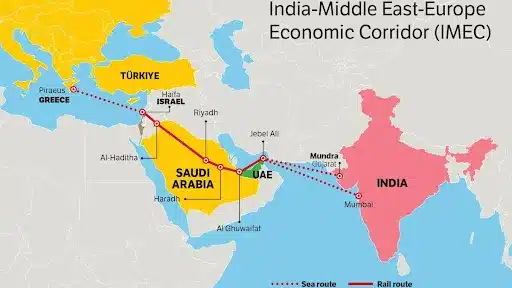
  • The India-Middle East-Europe Economic Corridor (IMEC) is a major connectivity initiative designed to strengthen trade and transport linkages between India, the Arabian Peninsula, and Europe
  • Conceived as part of the G20 Summit in New Delhi in 2023, IMEC aims to provide a seamless multimodal network combining maritime and railway infrastructure to enhance economic integration and reduce logistical costs.
  • The corridor envisions a maritime route connecting Indian ports to those in the UAE, followed by a high-speed rail network stretching across Saudi Arabia, Jordan, and Israel to reach the Haifa Port, from where goods would be transported onward to European destinations
  • Apart from transportation, IMEC also plans to establish an electricity grid, hydrogen pipeline, and undersea digital connectivity, making it a comprehensive economic corridor integrating energy, technology, and trade systems.

Historical and Geopolitical Background

  • The geopolitical atmosphere in 2023 was favourable for the launch of IMEC. The Abraham Accords, agreements normalising relations between Israel and several Arab nations, had created optimism about stability in West Asia. 
  • Building upon these developments, discussions began on creating a railway network linking Haifa in Israel to Jordan and the Gulf region.
  • At the same time, India’s relations with the UAE and Saudi Arabia reached unprecedented levels of strategic trust, strengthened by growing energy trade, defence cooperation, and investment partnerships. 
  • Moreover, the formation of the I2U2 grouping (India, Israel, the UAE, and the U.S.) further consolidated regional cooperation on trade, technology, and infrastructure.
  • In this context, the IMEC was announced during the G20 Leaders’ Summit in New Delhi (September 2023) with the endorsement of the U.S., European Union, France, Germany, Italy, Saudi Arabia, and the UAE
  • The project was widely seen as a strategic counter to China’s Belt and Road Initiative (BRI) and as a step toward creating resilient global supply chains.

Challenges and Geopolitical Complexities

  • Within weeks of IMEC’s announcement, the October 7, 2023, Hamas attacks on Israel and the ensuing conflict in Gaza dramatically altered the regional geopolitical landscape. 
  • The escalation of violence between Israel and Hamas strained diplomatic relations between Israel and several Arab states, disrupting the fragile regional cooperation that had initially made IMEC feasible.
  • The security situation in West Asia remains volatile, with maritime threats in the Red Sea posed by Houthi groups disrupting global trade routes. 
  • Many shipping companies have diverted vessels around the Cape of Good Hope, increasing transit times and costs. These uncertainties underscore the vulnerability of regional logistics and the importance of alternative trade routes like IMEC.
  • Moreover, climate-induced developments such as the opening of Arctic shipping lanes due to melting ice are also influencing global trade. 
  • Countries like Russia, the U.S., and China are now exploring the Northern Sea Route as a faster, cheaper path between Asia and Europe. 
  • For Mediterranean economies such as Italy and France, both IMEC signatories, this presents a challenge, making the success of IMEC even more critical to maintain their relevance in maritime trade.

Strategic and Economic Importance for India

  • For India, IMEC represents a strategic opportunity to diversify trade routes and reduce dependence on chokepoints such as the Suez Canal
  • The corridor enhances India’s ability to access European markets via the Mediterranean, offering an alternative to China-dominated trade networks under the BRI.
  • Currently, the European Union (EU) is India’s largest trading partner, with bilateral trade crossing $136 billion in 2024
    • Given Europe’s high per capita income and technological advancements, building stronger connectivity through IMEC could significantly expand India’s export competitiveness.
  • IMEC also complements India’s ‘Act West’ policy, deepening its engagement with the Middle East, a region crucial for India’s energy security, remittances, and diaspora
  • Moreover, enhanced economic interaction through IMEC could help counterbalance Pakistan’s efforts to forge strategic alliances in the region, particularly with Gulf countries.

Infrastructure and Technological Vision

  • IMEC goes beyond a physical transport network. It integrates multiple domains, energy, technology, and sustainability, through the establishment of:
    • A clean hydrogen pipeline connecting India and Europe via the Middle East, supporting global energy transition goals.
    • An electricity grid to facilitate cross-border power trade, particularly renewable energy.
    • A digital connectivity network, including high-speed undersea cables, to boost digital trade and data infrastructure.
    • Upgraded logistics and ports to ensure seamless cargo movement between maritime and rail networks.
  • Such multidimensional infrastructure makes IMEC a 21st-century corridor, aligning with India’s green growth and digital transformation objectives.

Way Forward

  • While the political and security challenges are significant, India and partner nations must view IMEC as a long-term strategic project rather than a short-term commercial venture. The corridor’s flexibility allows for expansion, including potential integration of Saudi and Egyptian ports, which could make it more resilient to regional disruptions.
  • For IMEC to succeed, member countries need to:
    • Establish a permanent joint coordination mechanism to ensure implementation continuity.
    • Attract public-private partnerships and multilateral financing for infrastructure projects.
    • Build consensus on security guarantees for trade routes.
    • Synchronise with global frameworks like the EU’s Global Gateway and the U.S.-led Partnership for Global Infrastructure and Investment (PGII).

Source: TH

Economic Corridor FAQs

Q1: What is the India–Middle East–Europe Economic Corridor (IMEC)?

Ans: IMEC is a multimodal transport and infrastructure corridor connecting India, the Middle East, and Europe via maritime and rail routes.

Q2: When was IMEC announced?

Ans: IMEC was announced during the G20 Leaders’ Summit in New Delhi in September 2023.

Q3: What countries are part of the IMEC initiative?

Ans: The corridor includes India, the UAE, Saudi Arabia, Jordan, Israel, the European Union, and the U.S.

Q4: What are the main objectives of IMEC?

Ans: IMEC aims to enhance connectivity, promote clean energy through hydrogen pipelines, and strengthen trade between Asia, the Middle East, and Europe.

Q5: What are the current challenges facing IMEC?

Ans: Regional instability in West Asia, Red Sea trade disruptions, and geopolitical tensions have delayed its implementation.

Enquire Now