
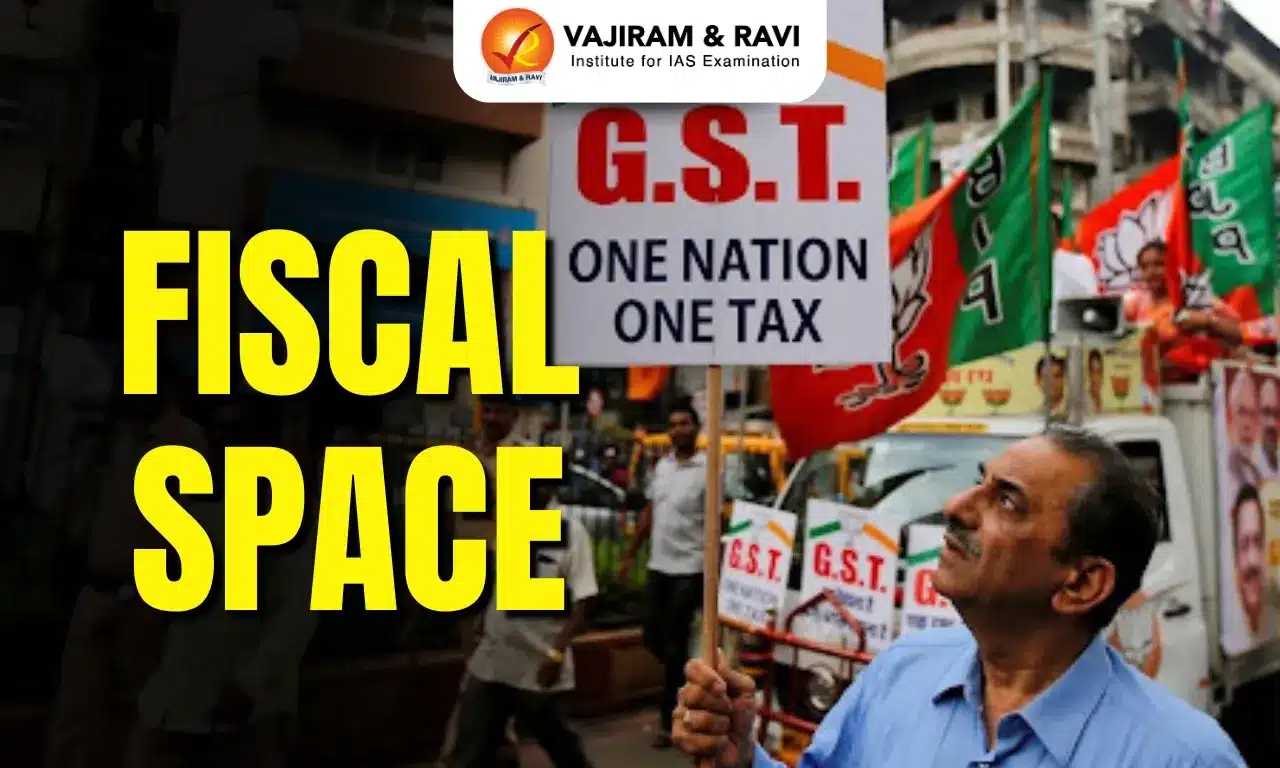
Restoring Fiscal Space for the States in India – Explained

Fiscal Space

Fiscal Space Latest News

  • The growing fiscal imbalance between the Centre and States has reignited debates on restoring fiscal autonomy and equitable tax devolution to States.

Changing Fiscal Dynamics in India

  • India’s fiscal architecture is built upon a multi-tiered system of governance, where the Centre and States share both taxation powers and expenditure responsibilities
  • However, this balance has been steadily shifting toward centralisation, particularly after the introduction of the Goods and Services Tax (GST) in 2017.
  • While GST simplified indirect taxation and improved tax efficiency, it also altered the resource autonomy of States
  • The abolition of the GST compensation cess, a five-year mechanism that ensured States were reimbursed for potential revenue losses, has intensified debates on the erosion of fiscal space available to States.
  • The restructuring of GST slabs in 2025, expected to pass on over Rs. 2 lakh crore in tax benefits to consumers, has further strained State finances. 
  • Although it may boost consumption and tax revenue indirectly, States argue that no proper estimation of revenue loss has been made, and the abolition of the compensation system leaves them fiscally vulnerable.

Fiscal Federalism and Constitutional Framework

  • Fiscal relations between the Centre and the States are governed by Articles 268 to 293 of the Constitution. These provisions delineate taxation powers through the Union and State Lists, with the residuary power resting with Parliament. 
  • The Finance Commission, established under Article 280, determines the principles of tax devolution and grants-in-aid.
  • Historically, India’s fiscal system has evolved from tax-by-tax sharing to a global sharing principle, which allocates a fixed percentage of the Centre’s gross tax revenue to the States. 
  • The 80th Constitutional Amendment (2000) initiated this system, with the 11th Finance Commission recommending a 29.5% devolution to States. 
    • The share was successively raised, 30.5% (12th FC), 32% (13th FC), and 42% (14th FC), before being revised to 41% after the reorganisation of Jammu and Kashmir.
  • However, the actual devolution has often fallen short due to the Centre’s increasing reliance on cesses and surcharges, which are excluded from the divisible pool of revenue. 
  • In FY 2025-26, cesses and surcharges are projected at Rs. 4.23 lakh crore, giving the Union government additional fiscal leverage while limiting the States’ shareable resources.

The Impact of GST on States’ Fiscal Autonomy

  • Before GST, States had independent authority to levy taxes such as Value Added Tax (VAT), octroi, and entry taxes, which provided them significant control over their own revenues. 
  • With GST, taxation powers have been pooled into a common system, jointly managed by the GST Council, where the Centre holds greater voting weight.
  • GST also introduced a destination-based tax model, replacing the earlier origin-based system, meaning revenues accrue to the State where goods are consumed rather than where they are produced. 
  • This shift adversely affects industrialised States such as Maharashtra, Tamil Nadu, and Gujarat, which were traditionally net producers and major revenue contributors.
  • While studies show that the compensation mechanism initially benefited all States, the post-compensation regime has reignited concerns about revenue adequacy and fiscal dependence. 
  • The cess and surcharge system, which allows the Centre to mobilise non-divisible revenue, further accentuates asymmetry in fiscal power.

Declining Fiscal Independence and Central Transfers

  • Central transfers constitute around 44% of total State revenue receipts, varying from 72% for Bihar to 20% for Haryana
  • Wealthier and industrialised States, including Maharashtra, Tamil Nadu, Karnataka, and Gujarat, receive substantially less, underscoring unequal fiscal dependence.
  • Comparing the pre- and post-GST periods also reveals a stagnation in fiscal balance:
    • The Centre collected 67% of total tax revenue, while the States collected 33%, both before and after GST.
    • Expenditure responsibilities, however, remained skewed, with States accounting for over 52% of total public spending, primarily in areas like health, education, agriculture, and local governance.
  • This imbalance, coupled with increasing Centrally Sponsored Schemes (CSS) that often overlap with State subjects, reduces fiscal flexibility. 
  • States have expressed frustration over delayed fund transfers, conditional grants, and political bias in allocations, particularly in opposition-ruled regions.

Rethinking Fiscal Devolution and Autonomy

  • Many States and economists advocate revisiting the principles of fiscal federalism. One proposal suggests sharing the personal income tax base with States, akin to GST revenue sharing. 
  • If States were allowed a 50:50 share of the personal income tax base (estimated at Rs. 13.57 lakh crore for FY 2025-26), their fiscal dependence on central transfers could be significantly reduced.
  • Alternatively, States could be empowered to ‘top-up’ income tax rates, allowing them to mobilise additional revenue without altering the central tax structure. Such measures would:
    • Strengthen States’ fiscal capacity and liquidity.
    • Reward progressive and high-performing States for their revenue generation.
    • Enhance accountability by aligning tax collection with expenditure responsibilities.
  • Another suggested model, inspired by Canada’s federal structure, envisions the Centre collecting 46% of total revenue and spending 40%, while sub-national governments collect 54% and spend 60%.

Way Ahead

  • The erosion of fiscal space for States is not merely a financial issue; it strikes at the core of India’s cooperative federalism
  • With rising developmental aspirations and expanding welfare responsibilities, States require greater financial autonomy to deliver efficient public services.
  • Going forward, reforms should focus on:
    • Incorporating cesses and surcharges into the divisible pool.
    • Revising Finance Commission criteria to balance equity with efficiency.
    • Strengthening GST Council deliberations to ensure parity in decision-making.
    • Encouraging fiscal innovations, such as State bonds and public-private partnerships.

Source: TH

Fiscal Space FAQs

Q1: What does fiscal federalism mean in India?

Ans: Fiscal federalism refers to the financial relationship between the Centre and the States, including the division of taxation powers and revenue sharing.

Q2: What led to the loss of fiscal autonomy for States after GST?

Ans: The pooling of tax powers under the GST Council and the abolition of independent State taxes reduced fiscal control for States.

Q3: Why are States demanding inclusion of cesses and surcharges in the divisible pool?

Ans: Because these revenues are not shared with States, leading to reduced actual devolution despite higher constitutional recommendations.

Q4: What is the Finance Commission’s role in fiscal devolution?

Ans: It recommends how Central tax revenues should be distributed among States and provides grants to correct fiscal imbalances.

Q5: What reforms can enhance States’ fiscal autonomy?

Ans: Sharing personal income tax, merging cesses with shareable taxes, and empowering States to levy top-up taxes can strengthen fiscal independence.
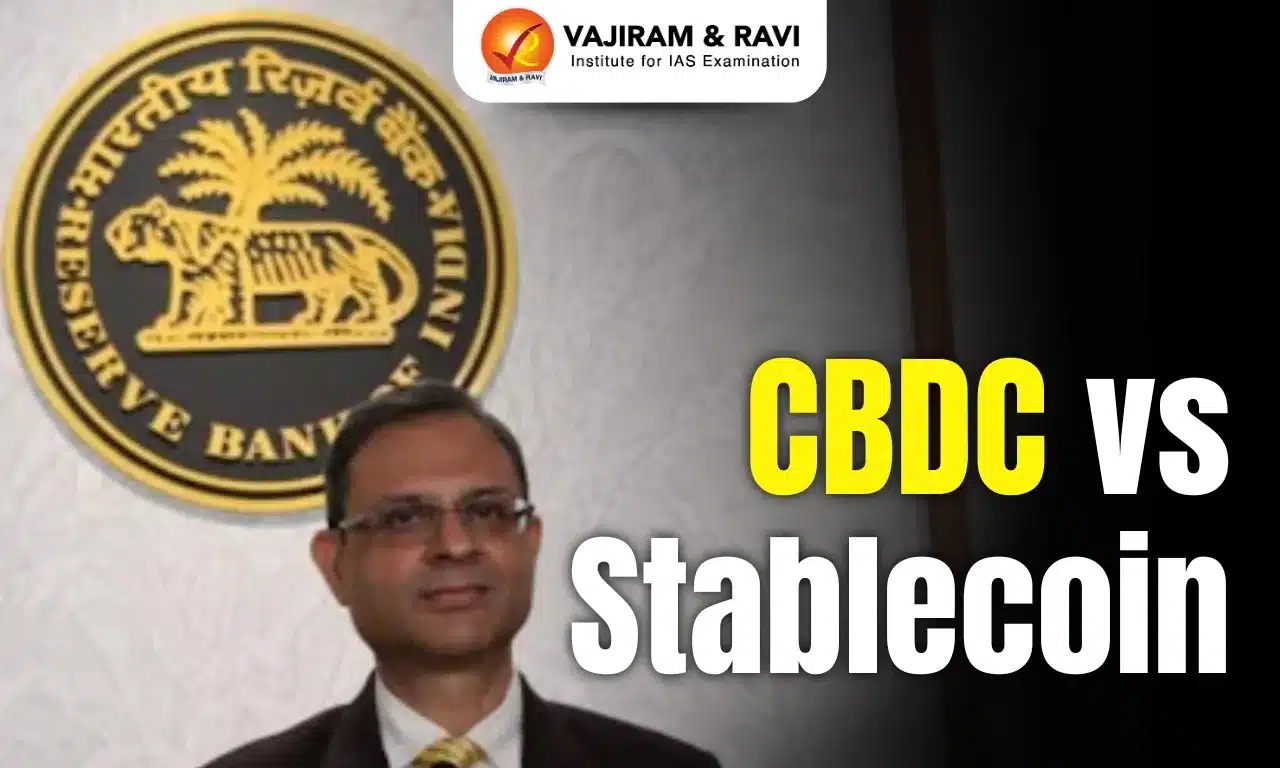

RBI Governor Advocates CBDCs Over Stablecoins for Safer Global Payments

CBDC vs Stablecoin

CBDC vs Stablecoin Latest News

  • RBI Governor Sanjay Malhotra urged global central banks to adopt and promote Central Bank Digital Currencies (CBDCs) over stablecoins for cross-border payments. 
  • Speaking at the World Bank–IMF annual meeting in Washington, DC, he reiterated India’s caution on cryptocurrencies, citing risks to monetary policy, capital flows, and financial integrity, including money laundering concerns.

Stablecoins

  • Stablecoins are a type of cryptocurrency designed to maintain a stable value by being pegged to a reserve asset such as a fiat currency (like the US dollar), a commodity (like gold), or a basket of assets.

Key Features

  • Aim to reduce price volatility common in cryptocurrencies like Bitcoin or Ethereum.
  • Backed by collateral reserves, algorithms, or a combination of both.
  • Enable faster and cheaper transactions across borders compared to traditional banking systems.

Types of Stablecoins

  • Fiat-backed Stablecoins: Backed by reserves of fiat currency (e.g., Tether (USDT), USD Coin (USDC)).
  • Crypto-backed Stablecoins: Collateralised by other cryptocurrencies (e.g., DAI).
  • Algorithmic Stablecoins: Maintain value through algorithms that control supply and demand (e.g., UST – now defunct).

Risks and Concerns

  • Regulatory uncertainty and lack of global standards.
  • Reserve transparency and liquidity risks if not fully backed.
  • Potential for financial instability and “dollarisation” in developing countries.

Central Bank Digital Currency (CBDC)

  • CBDC is the legal tender issued by a central bank in a digital form.
    • E.g., CBDC of India is the digital form of the Indian rupee, issued and regulated by the Reserve Bank of India (RBI).
  • It represents sovereign currency in an electronic form and is backed by the full faith and credit of the government, just like physical cash.

Types of CBDC in India

  • Retail CBDC (e₹-R)
    • Meant for use by the public, including individuals and businesses.
    • Functions as a digital alternative to cash for everyday transactions.
    • Pilot launched in December 2022 in select cities.
  • Wholesale CBDC (e₹-W)
    • Designed for financial institutions to settle interbank transfers and securities transactions efficiently.
    • Aims to improve the speed, transparency, and cost-effectiveness of large-value payments.
    • Pilot project to use digital rupee in the wholesale market for secondary trade in government securities (G-secs) was launched in November 2022.

Objectives

  • To reduce dependence on physical cash and printing costs.
  • To enhance payment efficiency and financial inclusion.
  • To support cross-border payments and improve monetary policy transmission.
  • To provide a secure, sovereign alternative to private cryptocurrencies and stablecoins.

Promoting CBDCs 

  • Speaking at the IMF–World Bank annual meeting, RBI Governor urged central banks worldwide to promote Central Bank Digital Currencies (CBDCs) over stablecoins to facilitate international payments.
  • He argued that CBDCs, being fiat-backed and tokenisable, offer the benefits of stability, monetary integrity, and the singleness of money — advantages that private stablecoins cannot ensure.
  • He emphasised that global adoption was crucial for realising CBDCs’ full potential in cross-border transactions and urged coordinated promotion among central banks.
    • The RBI is currently conducting pilot projects for both retail and wholesale CBDCs, focusing on their potential to ease cross-border settlements, as domestic payment systems in India are already efficient.
  • RBI Governor reiterated India’s longstanding caution on cryptocurrencies, warning that their use could affect monetary policy, capital flows, and financial integrity, particularly through money laundering risks.

Shift in Government’s Tone on Stablecoins

  • RBI Governor’s remarks come soon after Finance Minister Nirmala Sitharaman indicated a more open stance toward stablecoins.
  • Recently, she said stablecoins and similar innovations were transforming global finance and forcing nations to adapt or risk exclusion from evolving monetary systems.
  • She noted that while countries may differ in response, none could insulate themselves from systemic change in global finance.

Rising Global Acceptance of Stablecoins

  • Across major economies, stablecoins — private digital currencies pegged to fiat currencies like the US dollar — are gaining regulatory acceptance:
    • In June 2025, the US Senate passed the GENIUS Act to regulate stablecoins.
    • South Korea’s National Assembly introduced the Digital Asset Basic Act, allowing firms to issue won-backed stablecoins.
    • Hong Kong passed a stablecoin licensing law in May 2025 for local issuers.
  • Governments see such frameworks as ways to strengthen their currencies’ global roles. 
  • US govt argued that stablecoins could boost demand for US Treasuries, lower borrowing costs, and reinforce dollar dominance.
    • Currently, Tether and USDC, both pegged to the US dollar, command 90% of the $285 billion global stablecoin market.

RBI’s Concerns

  • The RBI has consistently warned that widespread use of US dollar-backed stablecoins could lead to the dollarisation of India’s economy, reducing the rupee’s role in domestic transactions.
  • Such a shift could weaken India’s monetary sovereignty, as the RBI and government would lose control over the supply and circulation of the US dollar in domestic markets.

Source: IE | RBI | CNBC

CBDC vs Stablecoin FAQs

Q1: What did RBI Governor Sanjay Malhotra advocate?

Ans: He urged global central banks to promote CBDCs instead of stablecoins, citing their stability, transparency, and role in improving cross-border payments.

Q2: What is a Central Bank Digital Currency (CBDC)?

Ans: A CBDC is the digital form of a nation’s fiat currency, issued and regulated by its central bank as a secure, legal tender.

Q3: Why is the RBI cautious about stablecoins?

Ans: The RBI warns that widespread use of US dollar-backed stablecoins could cause dollarisation, weaken monetary control, and threaten India’s financial sovereignty.

Q4: How is India developing its CBDC?

Ans: India is piloting retail and wholesale digital rupee projects to enhance payment efficiency, cross-border settlements, and reduce reliance on physical cash.

Q5: How are stablecoins gaining global acceptance?

Ans: The US, South Korea, and Hong Kong have passed laws to regulate stablecoins, viewing them as tools to strengthen national currencies’ international roles.

India’s Taliban Policy: Pragmatic Engagement Without Recognition

India Taliban Engagement

India Taliban Engagement Latest News

  • Afghanistan’s Foreign Minister Amir Khan Muttaqi’s eight-day visit to New Delhi marks the highest-level Taliban engagement with India since the group seized power in 2021.
  • During the visit, India announced plans to re-establish its Embassy in Kabul, which has operated as a “technical mission” since June 2022 to oversee humanitarian aid and development projects.
  • India’s approach mirrors that of other nations and global institutions — engaging the Taliban only on practical, humanitarian, and security grounds, without offering diplomatic recognition or political endorsement.

India’s ‘Engagement Without Recognition’ Policy Toward the Taliban Government

  • Under international law, the acts of recognising a government and establishing diplomatic relations are separate processes.
    • Recognition implies acceptance of a government’s legitimacy and lawful authority (de jure).
    • Diplomatic engagement, however, allows communication with a de facto authority without conferring formal legitimacy.
  • If India were to officially recognise the Taliban-led Islamic Emirate, it would effectively validate the violent overthrow of the elected Afghan government in 2021 as a legitimate transition — a politically sensitive stance.
  • India had done something similar once before, in the 1980s, when it became the only country to recognise the Soviet-backed Democratic Republic of Afghanistan established after the 1978 coup.
  • However, under the Vienna Conventions on Diplomatic (1961) and Consular Relations (1963), nations are permitted to maintain or establish diplomatic contact with a de facto regime without extending formal recognition.
    • These conventions only codify the functions and rights of diplomatic missions, not the legitimacy of governments.

Managing the Afghan Embassy in New Delhi: A Diplomatic Compromise

  • Following the Taliban’s return to power, the Afghan Embassy in New Delhi became a focal point of the legitimacy tussle between the former Republic’s diplomats and the Taliban authorities.
  • Throughout 2023, both sides reached a practical compromise that allowed the Embassy to function without resolving the question of formal representation.
  • The MEA informed Parliament in December 2023 that the Afghan Embassy “continues to function”, with remaining diplomats maintaining essential operations even after some officials departed.
  • By October 2025, Afghan Foreign Minister Amir Khan Muttaqi confirmed that “even those from the former government now work with us,” signalling de facto coordination between the Taliban and existing Afghan diplomats in India.

India’s Broader ‘Engagement Without Recognition’ Strategy

  • India’s approach to Afghanistan is part of a broader foreign policy model of engagement without recognition.
  • This strategy allows India to protect strategic and humanitarian interests while avoiding the political implications of formal recognition.
  • Similar approaches are seen in India’s dealings with:
    • Taiwan, which operates through the Taipei Economic and Cultural Centre in New Delhi; and
    • Myanmar, where the junta-appointed diplomats continue to manage the Embassy following the 2021 military coup.

UN’s Stand: No Recognition Yet

  • The United Nations remains the benchmark for legitimacy, and recognition by it is the Taliban’s top foreign policy goal.
  • To gain recognition, the Taliban must ensure:
    • An inclusive government,
    • Dismantling terror networks, and
    • Respecting human rights, especially of women and girls.
  • Having failed to meet these conditions, the UN General Assembly Credentials Committee has rejected the Taliban’s claim to Afghanistan’s UN seat for the fourth consecutive year in November 2024.

Divergent Global Approaches

  • Russia became the first country to formally recognise the Taliban government in July 2025.
  • China (2023) was the first to send an Ambassador and accept a Taliban-appointed envoy.
  • The UAE and Uzbekistan soon followed, accepting Taliban ambassadors.
  • Despite strained relations, Pakistan upgraded its diplomatic ties in May 2025, appointing an Ambassador to Kabul, with the Taliban reciprocating by sending one to Islamabad.

India’s Evolving Taliban Strategy: Pragmatism, Pakistan Rift, and Economic Leverage

  • The Taliban’s full control over Afghanistan and the absence of foreign-backed resistance have enabled India to adopt a more pragmatic approach than in the 1990s, when New Delhi supported the Northern Alliance.
  • Today, three key factors underpin India’s growing comfort with “engagement without recognition.”

Taliban’s Proactive Outreach and Anti-Terror Assurances

  • Unlike its 1990s predecessor, the Taliban has sought foreign engagement, lobbying for India’s re-entry even as New Delhi’s missions remained closed.
  • It has promised not to shelter anti-India groups, addressing India’s long-standing security concerns rooted in the IC-814 hijacking.
  • The Taliban’s condemnation of the Pahalgam terror attack in May 2025 was viewed as a significant gesture of goodwill.
  • This move helped India see the Taliban as distinct from Pakistan-backed terror networks, reinforcing cautious trust.

Pakistan-Afghanistan Rift: A Strategic Opening for India

  • Ties between Pakistan and the Taliban have deteriorated sharply since 2021, reversing early optimism in Islamabad.
  • The Taliban refuses to recognise the Durand Line as the official border and maintains ties with the Tehreek-e-Taliban Pakistan (TTP), whose attacks in Pakistan have surged.
  • This breakdown has created diplomatic space for New Delhi to expand engagement with Kabul while watching Pakistan’s influence wane.

Economic Leverage: India’s Re-Entry Through Development

  • India remains one of Afghanistan’s largest development partners, with over $3 billion in past investments across infrastructure, healthcare, and education.
  • Following the Trump administration’s withdrawal of foreign aid, the Taliban now seeks regional investment, particularly from India.
  • In New Delhi, Muttaqi invited Indian companies to invest in Afghanistan’s mining sector and reiterated support for projects like the TAPI gas pipeline and Chabahar port connectivity.

Conclusion

  • India’s renewed engagement with the Taliban is driven by security pragmatism, Pakistan’s diminishing influence, and economic opportunity
  • By carefully balancing outreach without formal recognition, New Delhi aims to protect its strategic interests while retaining flexibility in Afghanistan’s uncertain geopolitical environment.

Source: IE

India Taliban Engagement FAQs

Q1: Why is India engaging with the Taliban now?

Ans: With the Taliban’s full control and no effective resistance, India has shifted to a pragmatic engagement model to safeguard strategic, economic, and security interests.

Q2: What does ‘engagement without recognition’ mean?

Ans: It allows India to interact with the Taliban government for practical purposes without formally recognising its legitimacy, aligning with international diplomatic norms.

Q3: How has the UN responded to Taliban recognition requests?

Ans: The UN has repeatedly rejected Taliban claims to Afghanistan’s seat due to lack of inclusivity, ongoing terrorism, and human rights violations against women and minorities.

Q4: What role does Pakistan’s rift with the Taliban play?

Ans: Strained Pakistan-Taliban relations over border disputes and rising TTP attacks have opened diplomatic space for India to engage Kabul more confidently.

Q5: What are India’s economic objectives in Afghanistan?

Ans: India aims to re-enter Afghanistan through development projects, mining investments, and connectivity initiatives like TAPI and Chabahar to strengthen its regional foothold.

Enquire Now

