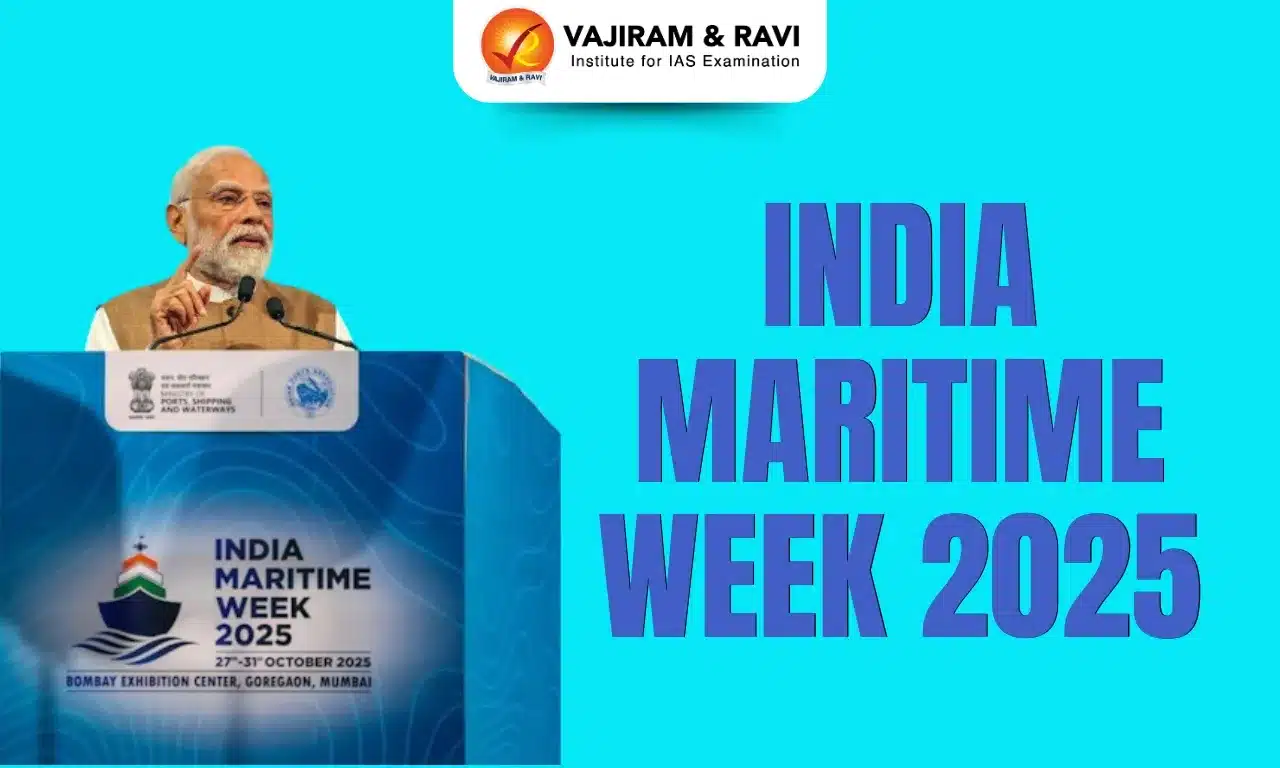
PM Modi Unveils India’s Maritime Vision at Global Maritime Leaders Conclave 2025

India Maritime Week 2025

India Maritime Week 2025 Latest News

  • PM Modi addressed the Maritime Leaders Conclave and chaired the Global Maritime CEO Forum at India Maritime Week 2025 in Mumbai. 
  • He welcomed participants from over 85 countries, noting the event’s evolution from a national forum in 2016 to a global summit. 

India’s Maritime Strength and Economic Potential

  • India’s 11,000 km-long coastline and 13 coastal states and Union Territories contribute nearly 60% of the national GDP
  • The nation’s 23.7 lakh sq km Exclusive Economic Zone (EEZ) attracts global investors, supporting 800 million residents in maritime regions.
  • The 38 countries of the Indian Ocean Region (IOR) account for about 12% of global exports.

India Maritime Week 2025 – A Global Maritime Showcase

  • India Maritime Week (IMW) 2025, held recently in Mumbai, is India’s premier global maritime event under the theme “Uniting Oceans, One Maritime Vision.”
  • The event aims to showcase India’s roadmap to becoming a global maritime hub and a leader in the Blue Economy.
  • This was the fourth edition of the summit. In 2016, the maiden India Maritime Week was held in Mumbai itself. Now, it has become a global summit. 
  • It served as a global convergence point for shipping, ports, shipbuilding, cruise tourism, and blue economy finance, driving collaboration for a sustainable maritime future.

PM Modi’s Address at India Maritime Week 2025: Key Highlights

  • PM Modi addressed the Maritime Leaders Conclave and chaired the Global Maritime CEO Forum at India Maritime Week 2025 in Mumbai.
  • During his address he highlighted India’s maritime transformation, global partnerships, and future ambitions for the blue economy.
  • Several MoUs worth lakhs of crores were signed, reflecting global confidence in India’s maritime capabilities.

India’s Vision for its Maritime Transformation

  • India is committed to transform its maritime sector through the Maritime Amrit Kaal Vision 2047.
  • This long-term vision rests on four strategic pillars:
    • Port-led development
    • Shipping and shipbuilding
    • Seamless logistics
    • Maritime skill-building
  • The goal is to position India as a leading global maritime power.

Major Achievements in India’s Maritime Sector (2024–25)

  • Vizhinjam Port, India’s first deep-water international trans-shipment hub, became operational, hosting the world’s largest container vessel.
  • Kandla Port launched India’s first megawatt-scale indigenous green hydrogen facility.
  • JNPT doubled its capacity with the start of Phase 2 of the Bharat Mumbai Container Terminal, marking the largest FDI in India’s port infrastructure.
  • India’s major ports handled record cargo volumes, showcasing unprecedented efficiency.

Next-Generation Reforms in Maritime Governance

  • Outdated colonial-era shipping laws replaced with modern legislation empowering State Maritime Boards, promoting digitization, and enhancing safety and sustainability.
  • The new Merchant Shipping Act aligns Indian regulations with global conventions, improving trust, ease of business, and investment climate.
  • The Coastal Shipping Act simplifies trade, ensures supply chain security, and promotes balanced coastal development.
  • Introduction of One Nation, One Port Process to standardize port procedures and reduce documentation.

Decade of Transformation under Maritime India Vision

  • Over 150 new initiatives launched under the Maritime India Vision.
  • Major ports’ capacity doubled, turnaround time reduced, and cruise tourism expanded.
  • Inland waterway cargo movement rose by 700%, and operational waterways increased from 3 to 32.
  • The net annual surplus of ports grew ninefold in ten years.

Efficiency and Global Recognition

  • Indian ports now rank among the most efficient in the developing world, outperforming many in the developed world.
  • Container dwell time reduced to under 3 days, and vessel turnaround time cut from 96 to 48 hours.
  • India improved its position in the World Bank’s Logistics Performance Index.
  • The number of Indian seafarers increased from 1.25 lakh to over 3 lakh, making India one of the top three seafaring nations globally.

Focus on Blue Economy and Green Growth

  • Emphasis on Blue Economy, sustainable coastal development, green logistics, and coastal industrial clusters.
  • Government prioritizing shipbuilding as a national growth driver, with a ₹70,000 crore investment to boost shipyard capacity, greenfield/brownfield projects, and maritime employment.
  • Large ships have been granted infrastructure asset status, enabling easier financing and reduced interest costs.

Visionary Maritime Heritage and New Port Projects

  • PM Modi recalled Chhatrapati Shivaji Maharaj’s maritime legacy, emphasizing that seas should be seen as gateways to opportunity.
  • Announced construction of a new mega port at Vadhavan, Maharashtra, part of India’s effort to quadruple port capacity and increase containerized cargo share.

Global Cooperation and Strategic Role of India

  • India aims to strengthen global supply chain resilience and become a “steady lighthouse” amid global uncertainty.
  • Highlighted India–Middle East–Europe Economic Corridor as a project redefining trade routes and promoting clean energy logistics.
  • Reaffirmed India’s commitment to empowering Small Island Developing States and Least Developed Countries through technology, training, and infrastructure.

Source: TH | PIB | IE

India Maritime Week 2025 FAQs

Q1: What is India Maritime Week 2025?

Ans: A premier global summit held in Mumbai to showcase India’s maritime progress, with over 85 countries participating under the theme “Uniting Oceans, One Maritime Vision.”

Q2: What did PM Modi announce at the Maritime Leaders Conclave?

Ans: He announced major reforms, new port projects, and a ₹70,000 crore investment to boost shipbuilding, green ports, and maritime employment.

Q3: What are India’s major achievements in the maritime sector?

Ans: India launched Vizhinjam Port, a green hydrogen facility at Kandla, expanded JNPT, and achieved record cargo handling at major ports.

Q4: What are the key reforms in maritime governance?

Ans: Outdated colonial laws were replaced with modern acts promoting digital port management, safety, sustainability, and ease of doing business.

Q5: What is India’s long-term maritime vision?

Ans: The Maritime Amrit Kaal Vision 2047 focuses on port-led growth, shipbuilding, seamless logistics, and skill-building to make India a leading maritime power.
China’s WTO Complaint Against India’s PLI Scheme – Explained

PLI Scheme

PLI Scheme Latest News

  • China has filed a formal complaint against India at the World Trade Organisation (WTO), alleging that India’s Production-Linked Incentive (PLI) schemes for batteries, automobiles, and electric vehicles violate global trade rules by favouring domestic products.

China’s WTO Complaint Against India’s PLI Scheme

  • China has formally filed a complaint with the World Trade Organisation (WTO) against India, alleging that several of India’s Production-Linked Incentive (PLI) schemes violate global trade rules. 
  • Beijing claims that these schemes, aimed at promoting the manufacturing of advanced chemistry cell (ACC) batteries, automobiles, and electric vehicles (EVs), provide subsidies contingent on the use of domestic goods, thereby discriminating against imported products, including those from China.
  • This dispute marks one of the most significant trade confrontations between India and China within the WTO framework in recent years, highlighting the broader tension between industrial policy ambitions and international trade rules.

Understanding the PLI Scheme

  • Launched in 2020, India’s Production-Linked Incentive (PLI) scheme is a flagship initiative designed to strengthen domestic manufacturing, attract global investment, and integrate India into global value chains (GVCs).
  • The scheme provides financial incentives to companies based on incremental sales of goods manufactured in India, aiming to make domestic industries globally competitive while fostering innovation and employment generation.
  • The three PLI schemes challenged by China are:
    • PLI for Advanced Chemistry Cell (ACC) Batteries: Encourages giga-scale battery manufacturing for EVs and energy storage systems.
    • PLI for the Automobile and Auto Components Sector: Promotes the development of Advanced Automotive Technology (AAT) products, including EV components.
    • PLI for the Electric Vehicle (EV) Ecosystem: Aims to attract major global EV manufacturers and reduce import dependence.

China’s Allegations Against India

  • China’s central argument rests on the claim that these PLIs amount to prohibited subsidies under the WTO’s Subsidies and Countervailing Measures (SCM) Agreement.
  • Beijing contends that:
    • The PLI schemes are “Import Substitution (IS) subsidies”, as they encourage companies to use domestically produced goods over imported ones.
    • For example, the PLI for the auto sector mandates a 50% Domestic Value Addition (DVA) requirement, while the ACC battery scheme stipulates a 25% DVA threshold for eligibility.
    • These conditions, China argues, discriminate against foreign inputs and are inconsistent with WTO rules that prohibit subsidies contingent upon the use of domestic over imported goods.
  • China maintains that such subsidies distort market competition and hinder its exports to India, particularly in sectors like EV batteries and automotive components, where Chinese manufacturers are global leaders.

WTO Rules on Subsidies and Trade Measures

  • Under WTO law, countries have the sovereign right to provide subsidies for industrial development. However, the SCM Agreement ensures that such subsidies do not cause unfair trade distortions.
  • Classification of Subsidies under WTO Law
    • Prohibited Subsidies: Those contingent upon export performance or on the use of domestic goods over imported goods.
    • Actionable Subsidies: Permitted subsidies that may still be challenged if they cause adverse effects on other WTO members.
    • Non-Actionable Subsidies: Subsidies for legitimate public objectives such as R&D or environmental protection (currently lapsed).
  • Import substitution (IS) subsidies fall under the prohibited category, as outlined in Article 3.1(b) of the SCM Agreement.
  • Additionally, India’s PLI schemes may also be examined under:
    • Article III.4 of GATT (National Treatment Principle): Prohibits countries from treating imported goods less favourably than domestic goods.
    • Article 2.1 of the Trade-Related Investment Measures (TRIMs) Agreement: Prohibits investment measures that are inconsistent with national treatment obligations, such as local content requirements.
  • However, experts point out that India’s PLI schemes link incentives to value addition, not necessarily to the use of domestic goods. 
  • Value addition can occur through innovation, local assembly, or supply chain integration, making China’s claims legally complex and open to interpretation.

India’s Likely Defence

  • Non-Contingency on Local Content: The Domestic Value Addition (DVA) benchmarks do not explicitly mandate the use of Indian goods; instead, they assess value creation within India, which can include imported components that undergo processing or transformation.
  • Developmental Objective: The schemes are part of India’s broader industrial and climate strategy, promoting green mobility, battery storage, and self-reliance — areas considered essential for sustainable growth.
  • Compliance with WTO Principles: India may argue that the subsidies are non-actionable, as they promote innovation, environmental sustainability, and technology diffusion — consistent with the WTO’s broader developmental objectives.

The WTO Dispute Process and Next Steps

  • Under WTO rules, the first step in dispute resolution is consultations between the parties. India and China will attempt to resolve the issue through diplomatic discussions.
  • If these consultations fail, the case will proceed to a WTO dispute panel for adjudication. 
  • However, the WTO’s Appellate Body, the final authority for appeals, has been non-functional since 2019 due to a U.S. veto on judge appointments.
  • This means that even if the WTO panel issues a ruling against India and India appeals, the case will remain in legal limbo, allowing India to maintain its PLI policies until the appellate system is restored.

Broader Implications for India’s Industrial Policy

  • The dispute highlights a broader tension between industrial policy and global trade rules
  • As countries increasingly adopt state-led incentives to promote manufacturing,  especially in sectors like semiconductors, EVs, and clean energy, disputes of this nature are likely to rise.
  • India’s PLIs are central to its “Make in India” and “Atmanirbhar Bharat” initiatives, aimed at reducing import dependence and building competitive domestic capabilities. 
  • Similar subsidy-driven strategies are being used by other economies, including the U.S. (CHIPS and Science Act) and the EU Green Industrial Plan.
  • Therefore, this WTO case will test how global trade rules adapt to the new age of industrial competitiveness and green technology promotion.

Source: TH

PLI Scheme FAQs

Q1: What has China complained about at the WTO?

Ans: China alleges that India’s PLI schemes for batteries, automobiles, and EVs provide prohibited subsidies favoring domestic goods.

Q2: Which specific PLI schemes are under dispute?

Ans: China has challenged India’s PLIs for ACC batteries, Advanced Automotive Technology products, and Electric Vehicle manufacturing.

Q3: What WTO laws does China claim India violated?

Ans: China cites violations of the SCM Agreement, GATT’s national treatment clause, and the TRIMs Agreement.

Q4: How might India defend its PLI schemes?

Ans: India is likely to argue that DVA requirements are not local content mandates and that the schemes promote sustainable industrial development.

Q5: What happens if the WTO panel rules against India?

Ans: India can appeal, but since the Appellate Body is non-functional, the dispute may remain unresolved, allowing India to continue its PLI schemes.

Global Investors Reimagine India’s Financial Sector

India’s Financial Sector

India’s Financial Sector 2025 Latest News

  • India’s financial landscape is undergoing a major transformation as global giants — from Emirates NBD, Blackstone, Zurich Insurance, SMBC, Abu Dhabi’s IHC to Bain Capital — are acquiring significant stakes in Indian banks, insurers, and NBFCs. 
  • This marks a new phase of foreign capital infusion into a sector once considered over-regulated and closed, highlighting a strategic shift amid capital liberalisation.

Evolution of India’s Financial Sector

  • From protectionism to liberalisation:
    • Historically, India’s financial sector was tightly regulated with limited foreign participation.
    • Gradual policy reforms by the Reserve Bank of India (RBI) and the government have allowed greater foreign ownership - 
      • Up to 100% in insurance companies.
      • Up to 74% in private banks (with approval).
  • Examples
    • Fairfax (Canada) was given special approval to hold a majority stake in CSB Bank for five years — a deviation from the 40% foreign cap, considering it a strategic revival investment.
    • Foreign portfolio investors (FPIs) hold 48.39% stake in HDFC Bank, the second largest bank in the country. 

Recent Big-Ticket Investments

  • Blackstone Inc, the world’s largest alternative asset manager, has acquired a minority stake of 9.99% in Federal Bank Ltd for Rs 6,196 crore.
  • Bain Capital will be investing Rs 4,385 crore to acquire an 18.0% stake on a fully diluted basis via preferential allotment of equity and warrants in Manappuram Finance.
  • Dubai-based Emirates NBD announced a $3 billion acquisition of a 60% stake in RBL Bank, making it one of the largest foreign takeovers in India’s financial sector. 
  • Japan’s SMBC acquired about 25% in Yes Bank, investing over $1.6 billion.
  • Zurich Insurance bought a 70% majority stake in Kotak General Insurance for $670 million. 
  • Abu Dhabi’s International Holding Company also entered the fray with a nearly $1 billion investment in Sammaan Capital (formerly Indiabulls Housing), an NBFC.
  • These deals mark the largest wave of foreign takeovers in India’s financial history.

Why Global Giants Are Investing

  • Robust growth fundamentals:
    • India’s economy is growing at 6.8% (RBI estimate).
    • The banking sector generated $46 billion net income (2024) with 31% YoY growth — higher than global average (McKinsey report).
    • Credit growth is driven by small businesses, retail and housing sectors.
  • Structural strengths:
    • Low corporate leverage and focus on secured retail lending.
    • India presents a vast, untapped and rapidly expanding financial market with over 400 million underbanked population, and a vast informal credit system.
    • Digital infrastructure (UPI, Aadhaar, Jan Dhan) enables penetration and cost-efficient service delivery.
  • Global context:
    • Stagnation in developed markets (US, Europe).
    • China’s tightening regulations and geopolitical risks have diverted capital toward India.
    • India offers scale, political stability, demographic advantage, and credible regulation.

Regulatory Approach and Market Valuation

  • The RBI maintains a “positive but cautious” stance, ensuring fit-and-proper ownership and domestic control.
  • Despite high performance, Indian banks remain undervalued — indicating market scepticism about long-term sustainability.
  • The measured liberalisation of ownership ensures capital inflow while keeping regulatory sovereignty intact.

Post-Crisis Sector Cleanup

  • Past decade challenges: IL&FS and DHFL collapse, Yes Bank rescue, and NBFC liquidity crisis.
  • Reforms implemented:
    • Insolvency and Bankruptcy Code (IBC) for resolution.
    • RBI’s supervisory tightening and bad-loan cleanup.
  • Result: Mid-sized banks and NBFCs have become stable and attractive acquisition targets.

Opportunities and Strategic Advantages

  • Global investors gain immediate access to licenses, branch networks, and customer bases — saving years of setup.
  • For India, it brings foreign capital, innovation, and best practices in risk management and governance.
  • Aids India’s march toward becoming a $7 trillion economy by early 2030.

Risks and Concerns

  • Financial sovereignty: Majority foreign ownership could shift strategic control offshore. Policy alignment during crises may not match domestic priorities.
  • Exposure to global shocks:
    • Rising global interest rates or liquidity tightening could lead to capital withdrawal, straining domestic credit flows.
    • Lehman Brothers collapse (2008) serves as a reminder of global contagion risk.
  • Competitive distortions: Foreign-owned entities may access cheaper global capital, disadvantaging domestic banks under tighter norms.
  • Need for regulatory clarity: Larger and complex deals call for clearer frameworks on foreign control thresholds and compliance protocols.

Way Forward

  • Maintain calibrated liberalisation — attract capital while preserving regulatory autonomy.
  • Develop a comprehensive framework for foreign ownership limits and voting rights.
  • Strengthen macroprudential oversight to insulate from global volatility.
  • Encourage domestic capital formation through sovereign and retail participation.
  • Promote financial inclusion to reduce reliance on foreign investors in credit delivery.

Conclusion

  • India’s financial sector stands at a turning point — transitioning from protectionism to global integration. 
  • The surge in foreign investments underscores international confidence in India’s macroeconomic fundamentals, digital infrastructure, and regulatory credibility.
  • However, balancing openness with sovereignty will define India’s success in becoming a $7-trillion, financially independent economy.
  • The challenge for policymakers lies in ensuring that this capital inflow strengthens, rather than compromises, India’s financial stability and autonomy.

Source: IE

India’s Financial Sector FAQs

Q1: What does the recent wave of foreign acquisitions in India’s banking and insurance sectors reflect?

Ans: It marks India’s transition from protectionism to a globally integrated financial system, balancing capital inflow with regulatory sovereignty.

Q2: What factors attract global financial institutions to invest in India’s banking and NBFC sectors?

Ans: Robust GDP growth, digital infrastructure, underbanked population, post-crisis sector cleanup, and strong regulatory oversight.

Q3: What are the risks to India’s financial sovereignty arising from increasing foreign ownership in domestic banks and insurers?

Ans: Majority foreign stakes can shift strategic control offshore, expose India to global liquidity shocks, and distort competition.

Q4: What role does the RBI play in maintaining a balance between foreign capital inflow and financial sector stability?

Ans: RBI ensures a cautious liberalisation approach through fit-and-proper clearances, ownership disclosure, capital adequacy enforcement, and oversight.

Q5: In what ways can India leverage foreign investment in financial services?

Ans: By channeling foreign capital toward inclusion, innovation, and credit expansion while strengthening domestic regulation.

Property Rights of Minors in India

Property Rights of Minors

Property Rights of Minors Latest News

  • Recently, the Supreme Court ruled that a person can reject a property sale made by their guardian after turning 18 if it was done without court approval.
  • The court said this can be done either by filing a case or through actions—for example, reselling the property—within the legal time limit.
  • The bench of Justices Pankaj Mithal and Prasanna B. Varale clarified that a formal lawsuit is not always necessary, reaffirming that a minor’s property rights can be protected by their clear conduct showing refusal of the sale.

Laws Governing Property Rights of Minors

  • Property transactions involving minors are regulated by three key laws:
    • The Indian Contract Act, 1872
    • The Hindu Minority and Guardianship Act, 1956
    • The Guardians and Wards Act, 1890

Minors Cannot Enter into Contracts

  • Under Section 11 of the Indian Contract Act, only adults of sound mind can enter into valid contracts.
  • Any contract made by a minor is void from the beginning (void ab initio). This means it cannot be enforced by or against the minor.
  • Exceptions:
    • If the contract benefits the minor or provides necessities like food or education, the cost may be recovered from the minor’s property.
    • A guardian can enter into a contract only if it benefits the minor.
    • A minor cannot be a business partner but may receive profit shares under a valid agreement.

Restrictions on Guardian’s Power to Sell Property

  • Under Section 8 of the Hindu Minority and Guardianship Act, 1956, a natural guardian can manage a minor’s property only for their benefit.
    • The guardian cannot sell, mortgage, gift, or lease immovable property without court approval.
    • If such a sale happens, Section 8(3) makes it “voidable at the instance of the minor”, meaning the minor can cancel it after turning 18.
  • Similarly, Section 29 of the Guardians and Wards Act, 1890 also says a guardian needs court permission to dispose of a ward’s property.

How a Minor Can Challenge the Sale After Majority

  • When a guardian sells property without permission, the law allows the now-adult person to challenge it.
  • Traditionally, courts held that a formal case must be filed to cancel such a sale.
  • However, in Abdul Rahman v. Sukhdayal Singh (1905), the court ruled that filing a suit is not always necessary — a clear act of repudiation, like reselling the property, is enough to show rejection.

Time Limit for Challenging Such Sales

  • According to the Limitation Act, 1963, the person has three years after turning 18 to challenge or reject a property sale made by their guardian without court approval.

Background of the Case

  • The dispute involved two small plots (No. 56 and 57) in Davanagere, Karnataka, bought in 1971 by a father in the names of his three minor sons. 
  • Acting as their natural guardian, he later sold both plots without obtaining mandatory court approval.
  • After turning 18, the sons resold both plots to another person, leading to two separate ownership disputes.

What Happened in the Lower Courts

  • In the Plot 56 case, the High Court (2003) ruled that the sons’ resale amounted to a valid rejection of their father’s earlier sale. The ruling became final as it was not challenged.
  • In the Plot 57 case, the buyer filed a case in 1997 claiming ownership. 
  • The trial court dismissed the suit, holding that the father’s sale was voidable and had been repudiated when the sons sold it after reaching adulthood.

Appeals and High Court Ruling

  • The first appellate court and the High Court later reversed the trial court’s decision, saying the sons’ later sale was invalid because they had not filed a formal case to cancel their father’s sale.
  • The High Court declared the buyer as the rightful owner of Plot 57.

Supreme Court Appeal

  • This decision was challenged before the Supreme Court, which was asked to decide whether a person who was a minor at the time of sale must file a formal case to cancel the sale or can reject it by conduct after attaining majority.

Supreme Court on How Minors Can Reject Property Sales

  • The Supreme Court clarified how a person can repudiate (reject) a property sale made by their guardian without court approval once they become an adult.
  • The Court ruled that a minor, after turning 18, can reject such a sale in two ways:
    • By filing a formal case (suit) to cancel the sale deed, or
    • By clear conduct that shows they do not accept the earlier sale — for example, reselling the property or taking actions inconsistent with the guardian’s sale.
  • The Court said that once the person rejects the sale, it becomes void from the beginning, and the buyer gains no rights over the property.

Application in This Case

  • The Court observed that the sons, after becoming adults, sold the same property within three years — the period allowed under law. 
  • Their names still appeared in the revenue records, and the earlier buyers had never taken possession.
  • This conduct was enough to prove that the sons had repudiated their father’s sale, so no separate case was needed.

Source: IE

Property Rights of Minors FAQs

Q1: What did the Supreme Court rule about minors’ property rights?

Ans: Minors can reject a guardian’s unauthorized sale after turning 18, either through legal action or by actions showing clear disapproval.

Q2: Which laws govern property rights of minors in India?

Ans: The Indian Contract Act, 1872, Hindu Minority and Guardianship Act, 1956, and Guardians and Wards Act, 1890 regulate minors’ property transactions.

Q3: Can a guardian sell a minor’s property without permission?

Ans: No. Such sales without court approval are voidable, and the minor can cancel them upon attaining majority.

Q4: What is the time limit for challenging such sales?

Ans: Under the Limitation Act, 1963, a person has three years after turning 18 to repudiate a guardian’s unauthorized property sale.

Q5: How can a sale be repudiated without a court case?

Ans: The Supreme Court said clear acts—like reselling the property—within the limitation period are enough to show rejection of the guardian’s sale.

Enquire Now