Strengthening India’s Statistical Ecosystem – Explained

Statistical Ecosystem

Statistical Ecosystem Latest News

  • The Ministry of Statistics and Programme Implementation has announced plans to use data from the Annual Survey of Unincorporated Sector Enterprises and the Periodic Labour Force Survey to develop a District Domestic Product (DDP) framework for more accurate, district-level economic estimation.

MoSPI to Use ASUSE and PLFS Surveys for Accurate District Domestic Product Estimation

  • The Ministry of Statistics and Programme Implementation (MoSPI) has announced a significant step toward improving India’s statistical architecture by integrating two major datasets to calculate the District Domestic Product: 
    • The Annual Survey of Unincorporated Sector Enterprises (ASUSE) and 
    • The Periodic Labour Force Survey (PLFS)
  • This initiative aims to provide more accurate, district-level economic data and empower states to make evidence-based policy decisions.

Context: Strengthening India’s Statistical Ecosystem

  • At present, India’s national and state-level GDP data often fail to capture regional variations within districts. 
  • Most District Domestic Product (DDP) estimates rely on top-down allocation methods, proportionately distributing state GDP based on outdated demographic indicators like population.
  • This approach has long been criticised by experts who highlighted that the current method results in “near-identical growth rates for districts,” thus masking true inter-district disparities.
  • Recognising this data gap, MoSPI announced that beginning January 2025, the ministry will work with state governments to introduce a bottom-up estimation model using detailed datasets from ASUSE and PLFS.

About ASUSE and PLFS

  • Annual Survey of Unincorporated Sector Enterprises (ASUSE)
    • ASUSE captures detailed data on India’s vast unincorporated non-agricultural sector, covering manufacturing, trade, and services enterprises, including households, micro, and small units. 
    • This survey provides insights into the economic and operational characteristics of establishments that often remain outside the formal sector’s purview.
    • Earlier released annually, ASUSE now provides quarterly data for enhanced frequency and granularity. It serves as a critical input for understanding local enterprise activity, investment, and value addition patterns.
  • Periodic Labour Force Survey (PLFS)
    • PLFS is conducted by the National Statistical Office (NSO) to measure employment, unemployment, and labor market participation across rural and urban areas. 
    • The survey is now conducted monthly, capturing dynamic trends in workforce participation, earnings, and occupational structures.
    • By combining ASUSE (enterprise data) and PLFS (labour data), the government aims to create a comprehensive database of district-level economic activities, bridging the enterprise and employment dimensions of local economies.

Purpose and Methodology for Estimating DDP

  • The integration of ASUSE and PLFS will allow policymakers to capture real economic activity at the district level rather than relying on extrapolated state averages.
  • Key features of the initiative include:
    • Bottom-up estimation: District-level data will be aggregated upward to form state and national accounts, reversing the current top-down allocation model.
    • Dual-sector coverage: The approach accounts for both enterprise activity (ASUSE) and labour participation (PLFS), ensuring holistic measurement of economic output.
    • Policy collaboration: MoSPI is working closely with state governments to align data collection frameworks with local administrative and planning needs.
    • Inclusion of informal sector: Since unincorporated enterprises and household-level activities form a large share of India’s economy, the new methodology ensures that informal sector output is adequately represented.

Complementary Statistical Initiatives

  • The effort to refine DDP estimation is part of MoSPI’s broader agenda to modernise India’s statistical system. Several related initiatives are underway:
    • Annual Survey of Service Sector Enterprises (ASSSE): To be launched in January 2026, this will capture the dynamics of incorporated services such as IT, financial services, and logistics.
    • National Household Income Survey (NHIS): Scheduled for February 2026, it aims to measure income distribution, wealth, and inequality, complementing consumption and employment data.
    • Expanded data accessibility: MoSPI has identified over 250 datasets for improved public access, including data from GST, E-Vahan, and trade statistics, to enrich national accounts and research capacity.

Significance of District Domestic Product (DDP)

  • The DDP represents the gross value added (GVA) within a district’s geographical boundaries. 
  • It serves as a microeconomic counterpart to the state’s Gross State Domestic Product (GSDP).
  • An accurate DDP framework can enable:
    • Targeted policy interventions by identifying lagging districts.
    • Evidence-based fiscal planning at local levels.
    • Better assessment of regional inequality and employment trends.
    • Alignment with decentralised planning under India’s federal structure.
  • The move also aligns with the government’s vision of Viksit Bharat @2047, where data-driven governance is seen as central to inclusive development.

Challenges and the Way Forward

  • While the initiative is promising, implementing district-level GDP estimation faces several challenges:
    • Data reliability: Unincorporated sector data can be difficult to capture consistently.
    • Coordination with states: States vary in statistical capacity and infrastructure.
    • Avoiding double-counting: Integrating enterprise and labour datasets requires precise harmonisation.
  • Nonetheless, experts consider this reform a crucial step toward improving the granularity, reliability, and timeliness of economic data in India. 
  • With states like Maharashtra, Tamil Nadu, and Karnataka already experimenting with DDP frameworks, MoSPI’s bottom-up model may soon standardise district-level measurement across the country.

Source: IE | FE

Statistical Ecosystem FAQs

Q1: What is the purpose of calculating the District Domestic Product (DDP)?

Ans: DDP measures a district’s economic output, helping identify local growth trends and policy needs.

Q2: Which datasets will MoSPI use to calculate DDP?

Ans: MoSPI will integrate data from the Annual Survey of Unincorporated Sector Enterprises (ASUSE) and the Periodic Labour Force Survey (PLFS).

Q3: How will the new DDP estimation differ from the existing approach?

Ans: The new model uses a bottom-up approach based on real district-level data, unlike the current allocation-based system.

Q4: When will the new DDP estimation begin?

Ans: MoSPI will begin generating district-level estimates from January 2025 in collaboration with state governments.

Q5: What other surveys has MoSPI planned to enhance data accuracy?

Ans: Upcoming initiatives include the Annual Survey of Service Sector Enterprises (ASSSE) and the National Household Income Survey (NHIS).
MoSPI Proposes Overhaul in CPI Housing Index

CPI Housing Index

CPI Housing Index Latest News

  • The Ministry of Statistics and Programme Implementation (MoSPI) has proposed key methodological reforms in the Consumer Price Index (CPI), specifically in the compilation of the housing index
  • These reforms aim to make inflation measurement more accurate, representative, and transparent, reflecting post-pandemic changes in rental markets and including rural housing data for the first time.

Background - CPI and Housing Index

  • The Consumer Price Index (CPI) is India’s main measure of retail inflation.
  • The MoSPI is revising the CPI base year to 2024 from 2012, with item weights based on the 2023-24 Household Consumption Expenditure Survey (HCES).
  • Currently, housing data is collected biannually and only for urban areas.
  • The weight of housing in the CPI basket is 21.67% for urban areas and 10.07% at the all-India level.
  • According to data released last month, housing inflation accelerated to 3.98% in September from 3.09% in August. Overall, India's retail inflation eased to 1.5% from 2.1% over the same period.
  • Economists have long criticized the inclusion of employer-provided dwellings and use of House Rent Allowance (HRA) as a rent proxy.

Proposed Methodological Changes

  • Monthly rent data collection:
    • Rent data will be collected monthly instead of every six months.
    • Coverage expanded to both rural and urban areas, marking a major shift.
    • The dwelling type weight will be based on Census 2011.
    • Exclusion of employer-provided housing: Government and employer-provided accommodations will be excluded to avoid distortions since they don’t reflect market transactions.
  • Expanded sample and IMF guidance:
    • Rent data to be collected from all selected dwellings every month (earlier one-sixth sample).
    • International Monetary Fund (IMF) technical experts recommended refining India’s panel approach to improve representativeness.
    • The revised formula ensures “like-for-like” comparison and avoids downward bias in rent index computation.

Inclusion of Rural Sector through HCES 2023-24

  • The HCES 2023-24 has, for the first time, captured rural house rent and imputed rent for owner-occupied dwellings.
  • This enables compilation of a rural housing index, absent in the HCES 2011-12 series.
  • The new series will therefore represent comprehensive national housing dynamics.

Transparency and Consultation Process

  • MoSPI released the third discussion paper as part of its base revision exercise of the CPI. Previous papers focused on ‘Treatment of Free Public Distribution System (PDS) Items in CPI Compilation’.
  • The Ministry plans to hold data conferences and stakeholder consultations to enhance transparency and inclusiveness.
  • Feedback on the housing index changes has been invited till November 20, 2025.

Way Forward

  • The proposed CPI revision will align India’s methodology with global statistical best practices.
  • Continuous data collection from rural and urban areas will improve the robustness of inflation measurement.
  • Exclusion of non-market housing will enhance accuracy in assessing true inflationary pressures.
  • The exercise will also help policy-makers, RBI, and households better understand the impact of housing costs on inflation and real income.

Conclusion

  • The overhaul of the housing index methodology marks a significant reform in India’s CPI framework. 
  • By integrating monthly, all-India rent data and removing distortionary elements, MoSPI aims to create a more representative and credible inflation index. 
  • This reform is crucial in the context of post-pandemic rental surges, rural-urban housing disparity, and the need for data-driven economic policymaking in a rapidly evolving economy.

Source: IE

CPI Housing Index FAQs

Q1: What is the significance of revising the housing index methodology in the CPI?

Ans: The revision ensures accurate reflection of market-based rental trends by including rural data, collecting monthly rents, etc.

Q2: Why is the inclusion of rural housing data in the new CPI series considered a major methodological improvement?

Ans: It incorporates the housing expenditure of rural households, previously excluded due to lack of imputed rent data, thereby making the CPI more representative.

Q3: What is the rationale behind excluding government and employer-provided accommodations from the CPI housing index?

Ans: These accommodations do not represent market transactions, and using HRA as a rent proxy leads to mismeasurement of inflation.

Q4: What role did the IMF play in the proposed changes to the CPI housing index?

Ans: IMF experts advised on improving India’s panel survey approach, suggesting like-for-like comparisons and expanded sample coverage.

Q5: How does the CPI housing index impact monetary and fiscal policy formulation?

Ans: Its accurate measurement directly influences inflation targeting by the RBI and welfare-linked fiscal decisions by the government.

Xi–Trump Meeting: Key Takeaways and What It Means for India

Xi–Trump Meeting

Xi–Trump Meeting Latest News

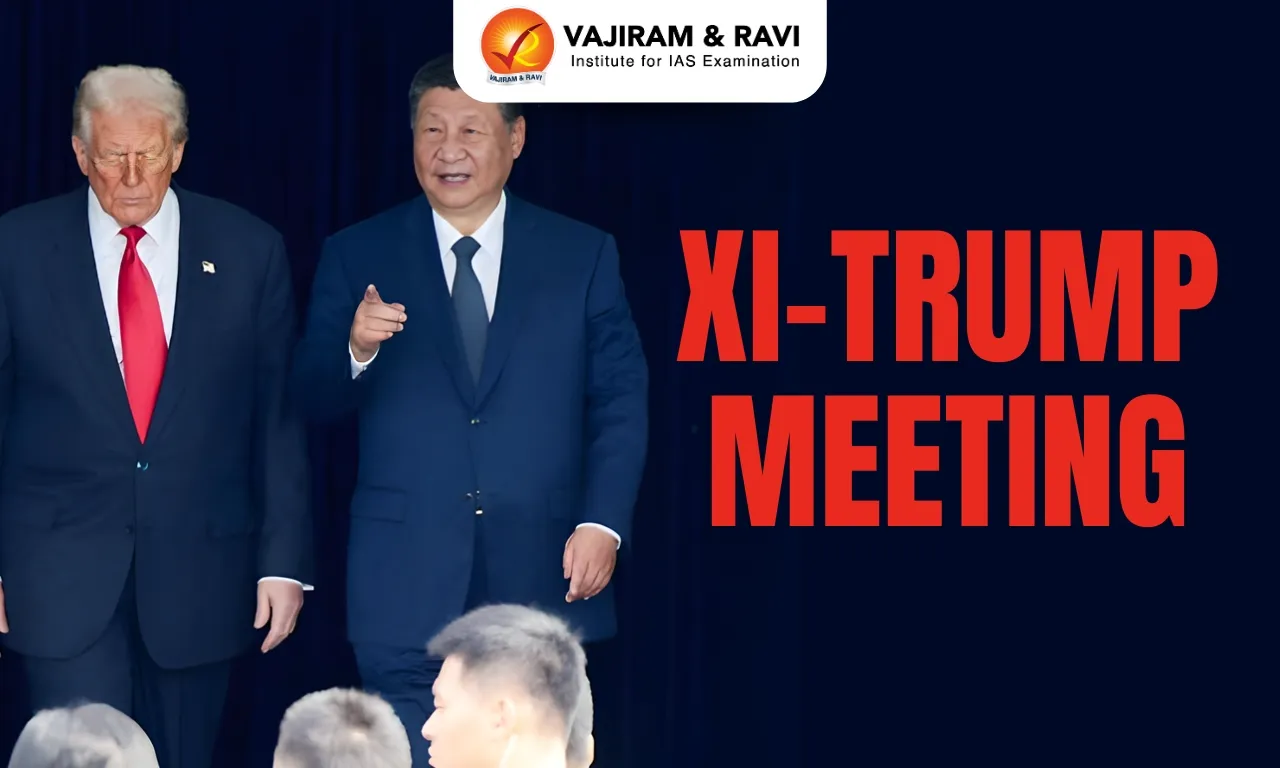
  • At the Asia-Pacific Economic Cooperation (APEC) summit in South Korea, US President Donald Trump and Chinese President Xi Jinping met for the first time since Trump’s return to office.
  • Trump announced that China agreed to maintain global exports of rare earth minerals under a one-year deal, calling it a “worldwide solution.” He said this would remove supply worries for industries dependent on these materials.
  • Additionally, the US will reduce tariffs on China—cutting the penalty on fentanyl-related trade from 20% to 10%, bringing the overall tariff rate down from 57% to 47%.

Key Highlights of the Xi-Trump Meeting

  • The meeting was its carefully managed optics. Unlike his usual confrontational style, President Trump adopted a polite and diplomatic tone, showing awareness of China’s global influence.
  • Interestingly, China did not immediately release an official account of the meeting, highlighting its cautious approach.

Trump’s Recognition of China’s Power

  • Trump referred to the meeting as “G-2”, equating the US–China relationship to elite global groupings like the G-7 and G-20.
  • This was seen as a symbolic recognition of China’s global power, something no previous US president had done publicly — a clear diplomatic win for Beijing.

Controlled Diplomacy Over Confrontation

  • Both leaders showed mutual deference and restraint, a departure from Trump’s usual brashness.
  • Their conduct reflected a shared understanding of the delicate balance between the world’s two largest economies and the global impact of their relationship.

Deal on Rare Earth Exports

  • The key takeaway from the Trump–Xi meeting was about rare earth exports.
  • President Trump announced that China had agreed to continue exporting rare earth minerals for one year — a relief for global industries that depend on them.
  • In return for China’s cooperation, Trump cut tariffs on Chinese goods by 10%, lowering total US tariffs from 57% to 47%.
  • This move was meant to ease pressure on Chinese businesses and encourage Beijing to compromise.
  • While the agreement eased tensions, it only postponed the core issue — China still dominates the rare earth supply chain.
  • The deal gives the US and its allies more time to diversify sources and reduce dependency on China.

Implication for India in the G-2 world

  • In his first term (2017), Trump took a hard stance on China, calling it a strategic rival, strengthening alliances, and supporting frameworks like the Quad and Indo-Pacific strategy, where India played a central role.
  • Now, in his second term, Trump’s approach is commercial, focusing on trade deals and domestic investments, even pressuring allies like Japan and South Korea to invest heavily in the US.
  • After the meeting, US President left behind a sense of uncertainty about America’s future with China — the world’s two largest powers.
  • Calling his meeting with Xi Jinping a “G-2” summit, Trump sparked concern among allies that the US is leaning toward a China-first, business-focused policy.

Implications for India and the Region

  • For India, the message was clear: the US focus remains on managing China.
  • The question now is whether Trump prefers working with allies like India, Japan, and Australia (under the Quad) or handling China alone.
  • For India and other Asian nations, this marks a new phase in US–China relations — a mix of competition and cooperation.

Trade Disadvantage for India

  • After Trump reduced tariffs on China to 47%, India now has the highest tariff rate at 50%, putting it at a trade disadvantage.
  • This makes a US–India trade deal more urgent, especially since Trump said one could be finalized en route to South Korea.
  • Until then, a US rival (China) enjoys better trade terms than a US partner (India).

India’s Strategic Path Forward

  • As Trump’s trade-driven strategy reshapes the region, India must rethink its assumptions about both American intent and Chinese ambition, while identifying space for its own strategic autonomy.
  • For India, the challenge is to navigate this shifting US–China balance with agility.
  • Delhi must:
    • Engage the US where interests align,
    • Explore economic opportunities with China where possible, and
    • Deepen partnerships with Asia and Europe to strengthen its independent position.

Source: TH | IE | IE

Xi–Trump Meeting FAQs

Q1: What was the key outcome of the Xi–Trump meeting?

Ans: China agreed to continue rare earth exports for a year, while the US reduced tariffs on Chinese goods by 10%.

Q2: Why is the rare earth deal significant?

Ans: It temporarily eases global supply concerns but leaves China’s dominance in critical minerals largely intact.

Q3: How did Trump describe the meeting?

Ans: He called it “G-2,” signaling acknowledgment of China’s global power — a symbolic win for Beijing.

Q4: What does this meeting mean for India?

Ans: India must adapt to a new US–China balance of competition and cooperation, rethinking its strategic and trade assumptions.

Q5: Why are allies cautious about Trump’s approach?

Ans: His business-first stance and reduced tariffs for China create doubts about America’s reliability as a strategic partner in Asia.

US Secondary Sanctions: Why Indian Refiners May Cut Russian Oil Imports

Secondary Sanctions

Secondary Sanctions Latest News

  • India has consistently opposed unilateral economic sanctions, but has often complied with US-imposed restrictions to avoid fallout.
  • In the past, Indian refiners stopped importing oil from Iran and Venezuela after the US sanctioned those countries. Now, with new US sanctions on Russian oil giants Rosneft and Lukoil, a similar situation looms.
  • India avoids dealing with sanctioned entities mainly due to the risk of US secondary sanctions, which could penalize third-party countries or companies doing business with the targeted nations. 

Understanding Secondary Sanctions

  • Secondary sanctions extend beyond the direct targets of US restrictions.
  • Primary sanctions stop American citizens and companies from dealing with blacklisted entities (like Rosneft and Lukoil).
  • On the other hand, secondary sanctions aim to discourage foreign countries and companies — over whom the US has no legal authority — from engaging with them.
  • These measures act as “anti-circumvention tools”, forcing other nations to comply indirectly by threatening penalties.
  • Because they apply outside US borders, secondary sanctions are often seen as extraterritorial and questionable under international law.

Why Countries Fear US Secondary Sanctions

  • The US dollar’s dominance in global trade and the central role of the American financial system make US sanctions highly influential worldwide.
  • Any company or country engaged in international trade needs access to US markets and banks — losing that access can cripple business.
  • Secondary sanctions don’t always impose fines; instead, they block foreign entities from the US financial system if they act against Washington’s foreign policy interests.
  • Because of this, India’s refiners and banks are expected to cut back on Russian oil imports, fearing penalties.
  • The US Treasury’s warning that secondary sanctions could hit buyers of Russian crude has already had an impact — experts predict an immediate drop in India’s Russian oil imports, which currently account for over 35% of total imports.

Why US Sanctions Matter for India

  • US sanctions carry real weight because they make banks, insurers, and investors cautious, cutting off access to funding and financial systems.
  • Most Indian refiners — including Reliance Industries (RIL) and public sector companies — rely heavily on the US market, banking network, and technology partners. Losing that access would seriously impact their global operations.

India’s Heavy Exposure to the US

  • RIL, which buys nearly half of India’s Russian oil, has subsidiaries, partnerships, and investments in the US with firms like Google, Meta, and Intel.
  • Public sector refiners also depend on dollar-based payments and the American banking system to buy crude oil, pay shippers, and insurers.
  • Any disruption in US dollar transactions could severely hurt India’s refining sector.

Impact on Russian Oil Imports

  • To avoid secondary sanctions, Indian refiners and banks are expected to act with extreme caution, likely leading to a sharp drop in Russian oil imports.
  • Government-owned refiners are already reviewing compliance risks, and RIL has said it will fully follow government guidance.
  • Some refiners may try to buy Russian oil through third-party traders not directly targeted by sanctions.
  • However, experts warn this loophole may not last, as the US could extend sanctions to these intermediaries if it wants to curb Russian oil flows more effectively.

India’s Official Stand

  • The Indian government has reiterated that it will buy oil from wherever it gets the best price, as long as the oil itself is not under sanctions.
  • However, the new US restrictions on Rosneft and Lukoil — which supply over two-thirds of India’s Russian oil — could seriously limit India’s access to cheap Russian crude in the near term.

Source: IE | IE | NYT

Secondary Sanctions FAQs

Q1: What are US secondary sanctions?

Ans: They are measures that penalize foreign entities for dealing with sanctioned countries or firms, extending the reach of US restrictions beyond its borders.

Q2: Why are secondary sanctions powerful?

Ans: Because of the dominance of the US dollar and financial system, entities risk losing access to US markets if they ignore these sanctions.

Q3: Why do US sanctions matter for India?

Ans: Indian refiners and banks rely on US financial networks for trade, funding, and technology, so violating sanctions could disrupt their global operations.

Q4: How will sanctions affect India’s Russian oil imports?

Ans: Refiners are expected to act cautiously, likely cutting Russian oil imports significantly to avoid secondary sanctions and financial risks.

Q5: Can India continue buying Russian oil indirectly?

Ans: Some may buy through third-party traders, but experts warn the US could soon sanction intermediaries too, closing this route.

Enquire Now