
Modern Terrorism and Digital Tradecraft – Insights from the Red Fort Blast Investigation

Modern Terrorism and Digital Tradecraft

Modern Terrorism and Digital Tradecraft Latest News

  • The investigation into the recent (November 10) Red Fort car explosion in Delhi — one of the deadliest attacks in recent years — has revealed the evolving nature of terrorism in India. 
  • The module behind the attack allegedly leveraged encrypted communication platforms, dead-drop email techniques, and high operational discipline, reflecting trends discussed in global counter-terrorism research. 
  • The case highlights critical gaps in India’s digital surveillance and counter-terrorism architecture.

Background of the Incident

  • The attack:
    • A car exploded near Gate No. 1 of the Red Fort Metro Station on November 10, killing 15 and injuring over 30.
    • Treated as a terrorist attack under counter-terrorism laws; investigation handed to the NIA.
  • Key suspects: Three doctors (Dr. Umar Un Nabi, Dr. Muzammil Ganaie, Dr. Shaheen Shahid) linked to Al Falah University (Faridabad) - alleged deep involvement in planning and operational support.

Major Findings of the Investigation

  • Use of encrypted communication:
    • Primary communication through Threema, a Swiss-based end-to-end encrypted (E2EE) app with -
      • No phone number/email needed
      • Random user IDs
      • No metadata retention
      • Two-end message deletion
    • Suspected use of a private Threema server, possibly offshore.
  • Spy-style ‘Dead-Drop’ email technique: Use of a shared email account accessed via unsent drafts. Leaves almost no digital transmission footprint, complicating forensics.
  • Physical reconnaissance and explosive stockpiling:
    • Multiple recce missions across Delhi before the attack.
    • Ammonium nitrate stockpiling traced to a red EcoSport vehicle.
    • Use of familiar vehicles to avoid suspicion.
  • Operational discipline and external linkages:
    • Dr. Umar, who was reportedly the driver of the car that caused the blast, “switched off his phones” and cut digital ties after the arrest of his associates, a sophisticated tactic to limit exposure.
    • Possible connection with Jaish-e-Mohammed (JeM) or a JeM-inspired module.
    • Reflects high operational security and training.

Academic Scholarship Alignment

  • Patterns consistent with counter-terrorism research: 
    • Growing use of E2EE platforms, VPNs, private servers by extremist groups.
    • Use of digital dead-drops, blending old spycraft with new technologies.
    • Adoption of multi-domain operational security: phygital (physical + digital).
  • Challenge for States: Traditional surveillance tools (phone tapping, metadata scraping, email intercepts) are becoming ineffective.

Implications for National Security

  • Traditional surveillance offers limited insights: Encrypted apps and decentralised servers bypass law enforcement touchpoints.
  • App bans are insufficient: Threema, banned in India under Section 69A of the IT Act, still accessible via VPNs.
  • Need for advanced technical capabilities: Device seizure alone is insufficient without memory forensics, server tracking, and reverse engineering capabilities.
  • Potential transnational handlers: Possible JeM link indicates cross-border operational networks.

Challenges

  • Lack of specialised cyber forensics: Limited expertise in analysing encrypted servers, private-network communication.
  • Regulatory gaps: No clear framework for self-hosted communication infrastructure.
  • Detection of digital dead-drop methods: Existing intercept systems cannot detect draft-based email communication.
  • Radicalisation in professional spaces: Highly educated individuals (doctors, academics) are harder to monitor.
  • Weak international coordination: Terror cells exploit jurisdictional limitations of foreign apps and servers.

Way Forward

  • Build dedicated digital forensics units: Special teams for E2EE platform analysis, server forensics, memory dumps. Monitoring of VPN exit nodes and anonymisers.
  • Regulate self-hosted communication servers: Mandate lawful access compliance for privately hosted servers. Strengthen cooperation with tech companies under judicial oversight.
  • Update counter-terrorism laws:
    • Explicitly recognise threats from decentralised networks, encrypted communication, dead-drop techniques.
    • Train investigators to detect shared accounts and draft-only communication.
  • Strengthen institutional counter-radicalisation: Early-warning systems in educational institutions. Focused programs for highly educated professionals.
  • Deepen international intelligence cooperation:
    • Collaboration on encrypted infrastructure, server access, and cross-border funding.
    • Pursue tech diplomacy with countries hosting encrypted-app servers.
  • Public awareness: Educate citizens on evolving terror methodologies and reporting mechanisms.

Conclusion

  • The Red Fort blast underscores a critical reality - terrorism in the 21st century is driven as much by encrypted code as by physical logistics. 
  • Modern terror cells blend digital anonymity tools with traditional reconnaissance and ideological networks. 
  • For India, this incident is a stark reminder that counter-terrorism must evolve toward multidisciplinary intelligence, advanced cyber-forensics, stronger legal tools, and international cooperation.
  • To protect society, security agencies must be equipped to combat threats not only on the ground but also within the encrypted, decentralised digital ecosystems where modern terror thrives.

Source: TH

Modern Terrorism and Digital Tradecraft FAQs

Q1: How encrypted communication platforms have altered the landscape of counter-terrorism in India?

Ans: They reduce the effectiveness of traditional surveillance tools, compelling law enforcement to adopt advanced digital forensics.

Q2: What is the relevance of digital ‘dead-drop’ techniques in modern terror operations?

Ans: It allows terrorists to communicate via unsent drafts, leaving almost no digital footprint and evading conventional interception mechanisms.

Q3: How does the Red Fort blast highlight the challenge of detecting radicalisation among highly educated individuals?

Ans: It shows that radicalisation can occur in professional spaces that are typically under-monitored, making early detection more complex.

Q4: What are the implications of private, self-hosted servers for India’s cyber security framework?

Ans: They bypass national regulatory controls, necessitating new legal frameworks enabling lawful access while balancing privacy concerns.

Q5: Why is international cooperation essential in countering technologically sophisticated terror networks?

Ans: Encrypted apps, cross-border funding create transnational operational chains that can only be addressed through intelligence sharing and tech diplomacy.
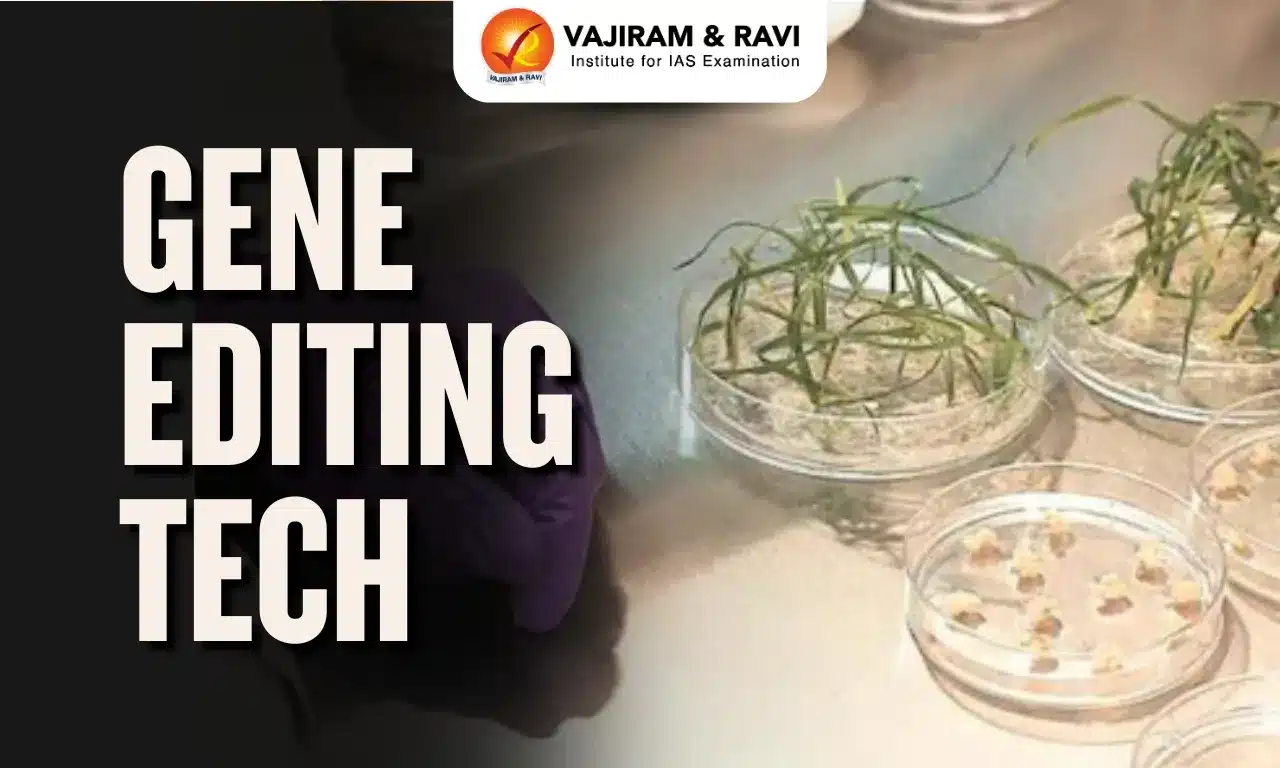
Indigenous Gene Editing Technology to Make GE Crops Cheaper in India

Gene Editing Tech

Gene Editing Tech Latest News

  • Indian scientists have created a homegrown, “miniature” alternative to the globally patented CRISPR-Cas system for precise genome editing in plants. 
    • CRISPR-Cas is a natural bacterial defense system adapted for genome editing. 
    • It uses a guide RNA to lead a Cas enzyme, such as Cas9, to a specific DNA sequence. 
    • The Cas enzyme cuts the DNA at that exact spot, and the cell’s repair machinery is then used to insert, delete, or modify genes with precision.
  • The new technology, recently patented by the Indian Council of Agricultural Research (ICAR), uses TnpB — transposon-associated proteins — to cut and modify plant DNA. 
  • This development strengthens India’s ability to produce genome-edited (GE) crops at lower cost while reducing dependence on foreign proprietary tools.

Gene Modification Vs Gene Editing

  • Gene Modification - GM introduces foreign DNA from a different species into an organism.
    • Process: A new gene from another organism is inserted into the target organism’s genome.
    • Outcome: Produces a genetically modified organism (GMO) containing genetic material from multiple species.
    • Analogy: Like inserting a new chapter from another author into a book.
    • Example: Adding a gene from another plant species to make a crop disease-resistant. 
  • Gene Editing - Gene editing makes precise, targeted changes to an organism’s existing DNA without adding foreign genes.
    • Process: Small changes—such as deletions, corrections, or replacements—are made at specific DNA sites. It uses Molecular scissors (Cas/TnpB) and Guides RNA to direct cuts at precise DNA locations.
    • Outcome: Produces a genetically edited organism (GEO) with modified original DNA.
    • Analogy: Like correcting or deleting a word in a document.
    • Example: Removing a gene to stop an unwanted protein or correcting a mutation causing a genetic disorder.

India’s First GE Rice Varieties

  • ICAR announced two CRISPR-edited rice varieties:
    • Samba Mahsuri (IIRR) – Edited cytokinin oxidase 2 gene using CRISPR-Cas12a → higher yield.
    • MTU-1010 (IARI) – Edited DST gene using CRISPR-Cas9 → drought & salinity tolerance.
  • These varieties face commercialisation hurdles due to CRISPR patent restrictions.

Indigenous Breakthrough in Genome Editing

  • Indian scientists have developed a “miniature alternative” to CRISPR-Cas technologies using TnpB proteins, offering a fully indigenous genome-editing (GE) tool for plants. 
  • The technology, recently patented by ICAR, enables precise DNA cutting and modification to improve crop traits.

What Makes TnpB Technology Different

  • The new tool uses Transposon-associated TnpB proteins that function like Cas9/Cas12a as molecular scissors.
  • Key advantages:
    • Much smaller size (400–500 amino acids) compared to Cas9 (1,000–1,400) and Cas12a (1,300).
    • Compact size allows easy delivery via viral vectors, avoiding tissue-culture-based delivery.
    • Uses Deinococcus radiodurans-derived TnpB, enabling efficient gene editing.
      • Deinococcus radiodurans is a bacterium that can survive in extremely harsh conditions.
      • The bacterium is harmless to humans. It is useful in bioremediation and can help clean up radioactive waste.

Why TnpB-Based Editing Is a Game Changer

  • The indigenous tool allows:
    • Freedom from foreign IP control
    • Lower costs for GE crop development
    • Easier DNA delivery due to the protein’s small size
    • Potential to address NGO concerns about foreign companies dominance

Why India Needed an Alternative to CRISPR

  • CRISPR-Cas technologies are controlled globally by:
    • Broad Institute – patents for CRISPR-Cas12a
    • Corteva Agriscience – joint licensing for CRISPR-Cas9 in agriculture
  • Indian scientists can use CRISPR for research but commercial release of GE varieties requires licensing fees. 
  • Indigenous TnpB systems eliminate such IP restrictions, making GE crop development affordable and scalable.
  • ICAR has been negotiating with Broad Institute and Corteva since July 2025. They permit research use but may charge licensing fees for commercial GE crop cultivation.
    • India has requested fee waivers for small and marginal farmers.

Source: IE | AFS

Gene Editing Tech FAQs

Q1: What is the new indigenous gene-editing technology developed in India?

Ans: India’s new genome editing tool uses miniature TnpB proteins as molecular scissors, offering a compact, IP-free alternative to CRISPR for precise plant DNA modification.

Q2: How is TnpB different from CRISPR-Cas systems?

Ans: TnpB proteins are much smaller than Cas9/Cas12a, enabling easier delivery through viral vectors without tissue culture, lowering costs and simplifying genome editing.

Q3: Why does India need an alternative to CRISPR?

Ans: CRISPR tools are patented by foreign institutions, requiring license fees for commercial GE crop use. Indigenous systems avoid IP barriers and reduce dependence.

Q4: What advantages does the TnpB-based tool offer crop breeders?

Ans: It allows precise DNA editing, simpler delivery into plant cells, lower development costs, and independence from global CRISPR patents for commercial applications.

Q5: What is the future potential of India’s TnpB genome-editing tool?

Ans: Successful adoption by plant breeders can accelerate affordable GE crop development, improve yield and resilience traits, and strengthen India’s agricultural biotechnology ecosystem.

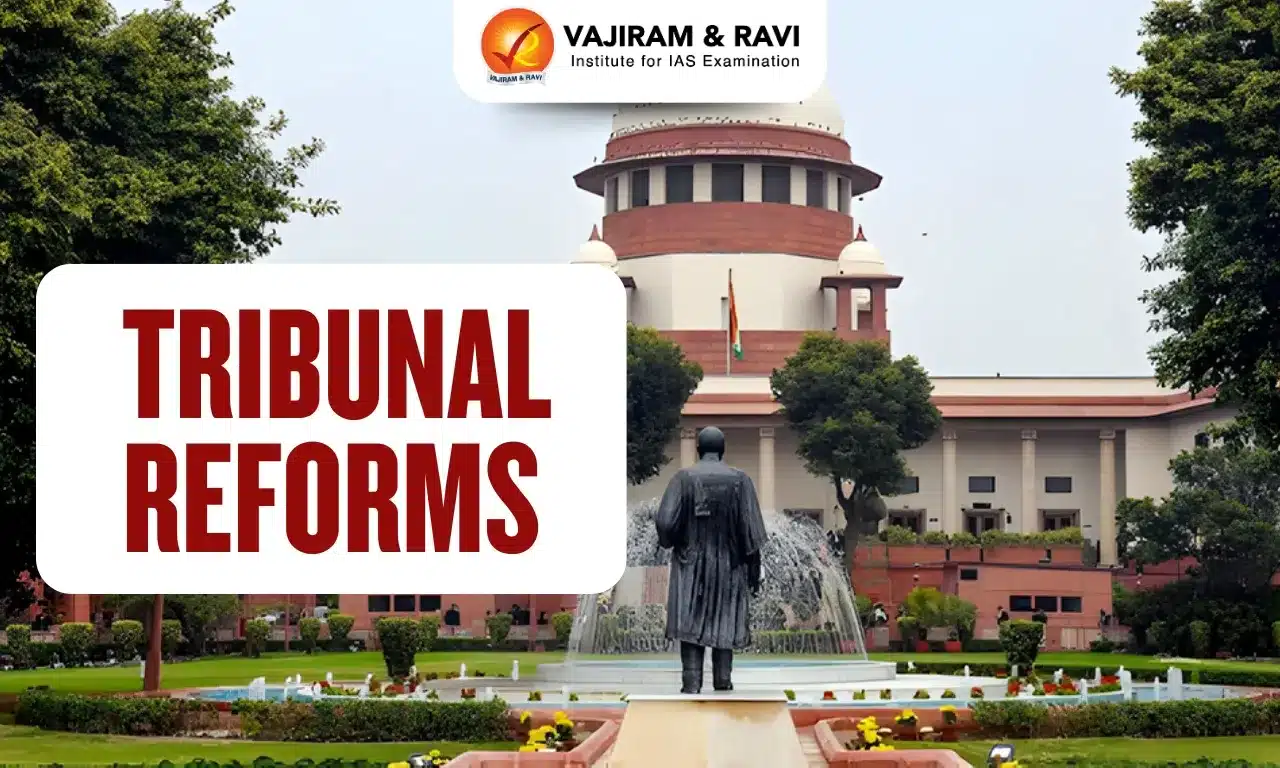
Supreme Court Strikes Down Provisions of Tribunal Reforms Act

Tribunal Reforms

Tribunal Reforms Latest News

  • The Supreme Court has struck down multiple provisions of the Tribunal Reforms Act, 2021, ruling that they violate the principles of judicial independence and separation of powers
  • The Court also directed the Union Government to establish the long-pending National Tribunal Commission within four months to ensure transparency and independence in tribunal appointments and administration. 

Overview of the Tribunal Reforms Act, 2021

  • The Tribunal Reforms Act, 2021 sought to restructure the functioning of tribunals, alter appointment procedures, and allow the government a greater say in fixing tenure, salary, service conditions, and administrative control over tribunal members.
  • Key provisions included:
    • Minimum age of 50 years for appointment of tribunal members,
    • A four-year tenure, which could be renewed,
    • A search-cum-selection committee that included two central government secretaries, whose ministries often appear as litigants before tribunals,
    • Powers given to the Centre to frame rules regarding appointments and service conditions.
  • These provisions were previously challenged and struck down in a 2021 judgment, yet were reintroduced with minor tweaks in the new legislation.

Supreme Court’s Core Findings

  • The Bench of Chief Justice B.R. Gavai and Justice K. Vinod Chandran held that the 2021 Act was an attempt to “repackage” the very provisions earlier invalidated
  • The Court noted that Parliament cannot circumvent judicial directions by re-enacting an unconstitutional provision in slightly modified form. The Court anchored its reasoning in three pillars:
  • Judicial Independence
    • Tribunals discharge judicial functions, and executive dominance over appointments undermines impartiality. The Court reiterated that executive involvement must be minimal, especially as the government is a litigant in most tribunal cases.
  • Separation of Powers
    • Any law affecting the structure or functioning of the judiciary must respect the constitutional limits placed on legislative power. Parliament cannot “override” or “contradict” judicial pronouncements.
  • Constitutional Supremacy
    • The Bench emphasised that the Constitution, not Parliament or the executive, is supreme, and judicial review is a basic feature safeguarding constitutionalism.
  • “The Constitution is what the Court says it is, Parliament cannot merely restate or repackage the invalidated provision,” the Court observed. 
  • The Court found the 2021 Act to be a “legislative override” that consciously defied earlier judgments relating to tribunal autonomy.

Key Provisions Struck Down

  • The Supreme Court invalidated provisions that:
    • Allowed the Centre to control tenure and age limits of tribunal members,
    • Included government secretaries on the selection committee,
    • Limited tenure to four years, undermining institutional stability,
    • Granted excessive rule-making powers to the executive over tribunals.
  • These provisions collectively weakened tribunal independence by giving the government disproportionate control over adjudicatory bodies.

Direction to Establish National Tribunal Commission

  • The Court reiterated its earlier order to create a National Tribunal Commission (NTC), an independent body envisioned to:
    • Oversee the appointments of tribunal members,
    • Regulate service conditions,
    • Ensure institutional autonomy,
    • Oversee administration and infrastructure,
    • Standardise functioning of tribunals across India.
  • The Court stressed that the NTC is an “essential structural safeguard”, especially given the government’s repeated attempts to influence tribunal design. 

Issues with the 2021 Act Highlighted by Petitioners

  • The petitions argued that the Act:
    • Attempted a “sly revival” of provisions already struck down,
    • Allowed government dominance over tribunals, where the Centre is often the biggest litigant,
    • Was passed without adequate parliamentary debate,
    • Abolished nine specialised tribunals and transferred their workloads to already overburdened High Courts.
  • These arguments were largely accepted by the Supreme Court.

Significance of the Judgment

  • The ruling strengthens the architecture of tribunal independence, which has been the subject of multiple landmark decisions since 2010. Its key implications include:
    • Reinforcing judicial checks on legislative overreach,
    • Ensuring tribunals remain neutral adjudicatory bodies,
    • Avoiding conflict of interest arising from executive involvement,
    • Protecting citizens’ access to independent and efficient justice.
  • The judgment also sends a strong message to Parliament that non-compliance with constitutional judgments is unacceptable.

Challenges Ahead

  • Even as the judgment lays down clear constitutional limits, several challenges remain:
    • Establishing the National Tribunal Commission may require extensive coordination between ministries,
    • High Courts may face increasing burdens until tribunal vacancies are filled through a constitutionally valid process,
    • Ensuring that future amendments align fully with judicial precedent will require strict legislative discipline.
  • Nonetheless, the ruling marks a major step toward restoring institutional balance between the three branches of government.

Source: TH | IE

Tribunal Reforms FAQs

Q1: What did the Supreme Court strike down in the Tribunal Reforms Act, 2021?

Ans: Provisions relating to age limits, tenure, selection committees, and executive control over tribunals were declared unconstitutional.

Q2: Why were these provisions invalidated?

Ans: They violated judicial independence and separation of powers by giving the executive excessive control.

Q3: What is the National Tribunal Commission?

Ans: An independent body mandated to oversee appointments, administration, and functioning of tribunals.

Q4: What constitutional principles did the Court emphasise?

Ans: Judicial independence, separation of powers, and constitutional supremacy.

Q5: What deadline has the Court given the Centre?

Ans: The Centre must establish the National Tribunal Commission within four months.

Revised Royalty Rates Aim to Ease India’s Critical Mineral Bottlenecks

Royalty Rates

Royalty Rates Latest News

  • The Union Government has revised royalty rates for four key critical minerals — graphite, caesium, rubidium, and zirconium — essential for green energy technologies. 
  • The move aims to boost domestic exploration, reduce import dependence, and strengthen supply-chain security.
  • Graphite has shifted from a fixed per-tonne royalty to an ad valorem system. High-grade graphite (80%+ fixed carbon) will now incur a 2% royalty on the Average Sale Price (ASP), while lower-grade graphite attracts 4%. 
  • Caesium and rubidium will each have a 2% royalty, and zirconium’s rate has been sharply reduced to 1% from the previous 12% uniform levy. 

Why India Shifted to Ad Valorem Royalty for Critical Minerals

  • ASP (Average Sale Price) reflects the weighted average ex-mine price of minerals from non-captive mines, published monthly by the Indian Bureau of Mines (IBM). 
  • For minerals lacking domestic pricing, IBM relies on United States Geological Survey (USGS) data converted into INR.
  • Experts say shifting to ad valorem royalties makes the system market-responsive and attractive to investors. 
  • As sale prices rise with global demand, state revenues increase proportionally, ensuring fair value. 
  • The reform also comes amid China’s prolonged export restrictions on key minerals. 
  • With China controlling 90% of global critical mineral processing, supply-chain disruptions have pushed India and other countries to diversify sources and stabilise domestic production.

Rising Demand and India’s Critical Mineral Dependency

  • India’s renewable energy and EV ambitions will sharply raise demand for critical minerals, many of which the country imports entirely. 
  • India remains 100% import-dependent for cobalt, lithium, nickel, REEs and silicon — all vital for batteries, solar, semiconductors and advanced electronics.
  • The government expects revised royalty rates to attract more bidders and unlock associated minerals such as lithium, tungsten, REEs and niobium. 
  • However, progress has been limited: since auctions began in 2023, only 34 of 81 critical mineral blocks have received successful bids. 
  • Despite having sizable reserves, India’s mining and processing capacity remains restricted by policy gaps, technical limitations and insufficient investments.

Revised Royalty Rates: What They Mean for India’s Critical Mineral Push

  • India classifies 30 minerals as “critical,” though caesium and rubidium — included in the latest royalty revision — are not part of India’s list, even though countries like the US, Canada and South Korea consider them critical.
  • The revised rates are part of a continuing series of royalty reforms, following earlier revisions in 2022, 2023 and early 2024 covering minerals such as cobalt, indium, titanium, tungsten, molybdenum, and REEs. 
  • Under the MMDR Act’s Second Schedule, most minerals follow an ad valorem royalty structure linked to ASP, while only six, including graphite, previously followed per-tonne rates.

Why the Shift Was Needed

  • Earlier, graphite’s per-tonne royalty system made mining unviable during price falls or for lower-grade deposits. 
  • Moving to ad valorem rates aligns royalties with real market prices, improving commercial viability.
  • Caesium, rubidium and zirconium were previously subject to the default 12% ASP rate, despite lacking defined ASPs or domestic production. 
  • This discouraged bidders and limited exploration.

Expected Impact

  • The newly lowered and transparent ad valorem rates are expected to:
    • Provide predictable royalty obligations for bidders
    • Improve auction participation
    • Encourage domestic mining and production of key minerals
    • Reduce import dependence and strengthen India’s supply-chain resilience

India’s Critical Mineral Bottleneck: Mining More Isn’t Enough

  • India’s critical mineral ecosystem faces structural weaknesses that cannot be solved by royalty revisions alone. 
  • A study identified regulatory gaps, low private-sector incentives, limited technical expertise, and inadequate financial capacity as major barriers to mining, explaining the modest response to critical mineral auctions.

Weak Processing Capacity: The Core Constraint

  • A far deeper challenge lies in mineral processing, where India remains heavily import-dependent. 
  • The analysis highlights three connected limitations:
    • Low processing scale,
    • Difficulty securing raw materials, and
    • Relatively small domestic demand.
  • Even in minerals like copper — where India has significant smelting capacity — the country contributes just 3% of global processed output
  • For rare earth elements, private participation was historically restricted because they were categorised as atomic minerals.

The Way Forward

  • Expanding mining alone will not bring self-reliance unless India also builds the ability to convert raw minerals into high-purity materials needed for batteries, semiconductors, optics and advanced manufacturing.
  • For true strategic autonomy in EVs, electronics and green technologies, India must develop a full domestic value chain — mining and processing — to reduce import dependence and strengthen supply-chain security.

Source: IE | TH

Royalty Rates FAQs

Q1: Why did India revise royalty rates for critical minerals?

Ans: The government aims to encourage exploration, attract bidders in auctions, strengthen domestic supply chains, and lower import dependence for minerals needed in clean energy technologies.

Q2: What major changes were introduced in the royalty structure?

Ans: Graphite shifted to ad valorem rates, while caesium, rubidium and zirconium saw sharply reduced royalties, creating a more transparent and investor-friendly pricing framework.

Q3: How will lower royalty rates help critical mineral mining?

Ans: Reduced and predictable royalties make mining commercially viable, especially for minerals lacking established domestic prices, thereby improving auction participation and investor interest.

Q4: What challenges still constrain India’s critical mineral sector?

Ans: Weak regulatory frameworks, low private exploration incentives, limited technical expertise, and poor processing capacity significantly restrict mining growth and value-chain development.

Q5: Why is processing capacity a major bottleneck?

Ans: India lacks large-scale refining facilities for key minerals, forcing reliance on imports of high-purity materials required for batteries, semiconductors, EVs and advanced manufacturing.

Enquire Now