CISF to Oversee Security at 250 Indian Seaports Under New Unified Framework

CISF

CISF Latest News

  • The Union Government has appointed the CISF as the security regulator for more than 250 seaports to strengthen coastal security. 
  • The move aims to bring private cargo-handling ports under a single, sovereign security framework and ensure a uniform, standardised security architecture across India’s maritime infrastructure.

Seaport Security in India: A Brief Overview

  • Seaport security in India is a critical component of national security, economic stability, and international trade, particularly as the ports handle a vast majority of the country's international trade.

Key Framework and Organisation

  • International Ship and Port Facility Security (ISPS) Code: India's port security measures are largely compliant with the mandatory ISPS Code, a global framework established after 9/11 to safeguard ships and port facilities from terrorism and other threats.
  • Central Industrial Security Force (CISF) - The New Regulator: In a significant recent reform, the Government of India has designated the Central Industrial Security Force (CISF) as the Recognised Security Organisation (RSO) for ports.

Challenges to Port Security

  • The security environment in the maritime domain presents several ongoing challenges:
    • Non-standardised Security: Historically, security arrangements at many non-major ports lacked uniformity and expert oversight, which the new CISF mandate aims to address.
    • Transnational Threats: Ports remain vulnerable to non-traditional threats, including:
      • Maritime Terrorism
      • Smuggling and Drug Trafficking (Ports are often routes for large hauls of narcotics).
      • Cyberattacks on port IT infrastructure and systems.
    • Infrastructure Gaps: Ensuring uniform, high-quality infrastructure and sufficient skilled manpower across over 250 ports remains an operational challenge.

Centre Brings All Seaports Under Uniform Security Oversight

  • To strengthen coastal security, the Union Government has appointed the CISF as the central security regulator for more than 250 seaports, including private cargo-handling ports. This brings all ports under a unified security architecture.
  • In the first phase, 80 export-import (EXIM) ports will be placed under CISF control for access management, cargo screening, and waterfront patrolling. 
  • CISF will function as a “sovereign security force” at these sites.

CISF to Conduct New Security Assessments

  • For all EXIM ports CISF will carry out:
    • Port Facility Security Assessments (PFSA)
    • Port Facility Security Plans (PFSP)
  • This will ensure compliance with global standards and eliminate vulnerabilities.

Hybrid Security Model for Port Operations

  • A new multi-layered model has been proposed:
    • CISF → core security roles (access control, patrolling, screening)
    • State Police / SISF / Private Security → non-core duties (traffic, gate operations)
  • This ensures uniformity while optimising manpower across port ecosystems.

Mandatory CISF-Led Training for Private Port Security

  • A structured training programme—modeled on aviation security—will be implemented.
  • CISF will train and certify all private security staff deployed at EXIM ports.
  • The government plans to create a specialised Port Security Training Institute to build long-term capacity, standardise certifications, and professionalise the port security workforce.

Why the Change Matters

  • India has over 250 seaports, including 80 EXIM ports that handle international trade through customs clearance, cargo movement, storage and logistics. 
  • Until now, security across non-major ports was fragmented and inconsistent.
  • Many ports currently rely on private security agencies or local police, resulting in uneven security standards. 
    • CISF already secures the 13 major ports across multiple coastal states.
  • By expanding CISF’s mandate to regulation, assessment, planning and training, India aims to build secure, efficient and globally compliant EXIM gateways, boosting economic competitiveness and supporting its growing maritime footprint.

Source: TH | HT

CISF FAQs

Q1: Why has the government assigned CISF to secure over 250 seaports?

Ans: The government aims to establish a uniform, sovereign security architecture to address security gaps at private and non-major ports, improving accountability, assessment, and oversight nationwide.

Q2: What will CISF’s role be at the 80 EXIM ports?

Ans: CISF will manage core functions such as access control, cargo screening, and waterfront patrolling while conducting fresh security assessments and preparing Port Facility Security Plans.

Q3: What is the hybrid security model for ports?

Ans: Under this model, CISF manages core security duties, while State Police, SISF, or private agencies handle non-core tasks like traffic operations, improving efficiency and layered security.

Q4: Why is mandatory CISF-led training being introduced?

Ans: Training ensures uniform skill standards for private security personnel deployed at ports, following an aviation-style certification system to uphold national and international security norms.

Q5: How will this reform strengthen India’s maritime security?

Ans: By standardising procedures, assessments, and training across 250+ seaports, India builds a cohesive, high-quality security system vital for coastal protection and global trade competitiveness.


New Guidelines to Define Obscenity in Online Content

Online Content

Online Content Latest News

  • The Union government has proposed new guidelines defining “obscenity” and other prohibited content for digital platforms under the Information Technology Rules, 2021
  • The proposal aims to introduce explicit definitions and expand the Code of Ethics to cover social media platforms, OTT streaming services, and digital news platforms.

Background of the Proposed Amendment

  • The Supreme Court, while hearing a case arising from a controversy surrounding comedian Samay Raina and content featuring an explicit joke, had asked the government to devise guidelines that balance free speech under Article 19(1)(a) with reasonable restrictions under Article 19(2). 
  • In response, the Ministry of Information and Broadcasting submitted a detailed note proposing new regulatory measures.
  • These proposals come amid rising concerns over sexual content, deepfakes, harmful speech, and digital misinformation, prompting the government to strengthen oversight of online platforms.

Key Features of the Proposed Obscenity Guidelines

  • Introducing a New Definition of “Obscene Digital Content”
    • The amendment seeks to explicitly define obscenity for the first time within the IT Rules. The definition incorporates elements from:
      • Section 67 of the IT Act,
      • Cable TV Programme Code,
      • Indian Penal Code (now Bharatiya Nyaya Sanhita).
    • This would mark one of the most sweeping shifts in online content regulation, extending traditional broadcast-like restrictions to digital spaces.
  • Expansion of the Code of Ethics
    • The proposal adds a comprehensive “Obscenity” chapter under the Code of Ethics applicable to curated content (OTT platforms) and digital news platforms. Online platforms would be required to avoid content that:
      • Offends “good taste or decency”,
      • Depicts indecent, vulgar, suggestive, repulsive, or offensive themes,
      • Presents criminality as appealing,
      • Shows visuals or words reflecting a snobbish or slandering attitude toward regional, ethnic, or linguistic groups.
    • A total of 17 such restrictions are proposed. 
  • Alignment with Cable Television Standards
    • Digital rights advocates note that the government has transposed the Cable TV Programme Code, originally meant for regulated broadcast TV, onto digital platforms.
  • Requirement for OTT Compliance with the Cinematograph Act
    • OTT platforms may be required to ensure content is fit for “public exhibition”, similar to films certified under the Cinematograph Act, 1952.
    • Although officials claim this applies only to OTTs, the draft amendment does not explicitly make this distinction.
  • Revival of IT Rules 9(1) and 9(3)
    • Rules 9(1) and 9(3), which enforce the Code of Ethics, were stayed by the Bombay High Court.
    • Despite this, the note seeks to revive and expand these rules, raising constitutional concerns.
  • Application of the “Community Standards Test”
    • The Supreme Court’s test from Aveek Sarkar v. State of West Bengal would be used to assess obscenity. Content would pass this test if:
      • A reasonable person with contemporary community standards does not find that it appeals to lustful or voyeuristic interests, and
      • The content has literary, scientific, artistic, or political value.
    • Digital rights advocates, however, warn that the broad nature of the proposed rules could lead to overreach and arbitrary censorship.

Criticism

  • Digital rights organisations have flagged several risks:
    • Overbroad Definitions: The proposed language could classify a wide range of content as obscenity.
    • Executive Overreach: Critics argue that the government is attempting to expand its regulatory powers through the IT Rules rather than parliamentary amendments.
    • Impact on Free Speech: Ambiguous standards like “good taste” may violate free speech protections.
    • Overlap with Pending Court Cases: Several parts of the IT Rules are already stayed or under judicial scrutiny.

Implications for Digital Platforms

  • If approved by the Court:
    • Platforms will need stricter content moderation and compliance processes.
    • OTT platforms may face film-like certification requirements.
    • Social media platforms may need to filter content deemed indecent, vulgar, or objectionable proactively.
    • Digital publishers could face increased regulatory oversight affecting news and commentary.
  • The amendment could sharply reshape India’s digital content ecosystem, bringing it closer to a broadcast-style regulatory framework.

Source: TH | IE

Online Content FAQs

Q1: What prompted the government to propose new obscenity guidelines?

Ans: A Supreme Court directive during a case involving objectionable online content led the government to draft detailed guidelines.

Q2: Which platforms will the new rules apply to?

Ans: Social media platforms, OTT streaming services, and digital news publishers.

Q3: What laws influence the new definition of obscenity?

Ans: Section 67 of the IT Act, Cable TV Programme Code, and provisions of the IPC/Bharatiya Nyaya Sanhita.

Q4: Will OTT platforms require film-like certification?

Ans: The proposal suggests OTT content must align with the Cinematograph Act, though officials claim this will apply selectively.

Q5: What test will be used to judge obscene content?

Ans: The Community Standards Test from the Supreme Court’s Aveek Sarkar judgment.

India’s Agriculture Exports Surge Despite U.S. Tariff Barriers

Agriculture Exports

Agriculture Exports Latest News

  • India’s agricultural exports have grown significantly faster than its overall merchandise exports. 
  • In April–September 2025, farm exports rose by 8.8%, reaching $25.9 billion, compared to $23.8 billion in the same period of 2024. 
  • This growth far outstripped the 2.9% increase in total goods exports during the same period.
  • The trend is consistent with the previous financial year (2024–25), when agricultural exports increased by 6.4% (from $48.8 billion to $52 billion), while overall merchandise exports saw only a marginal 0.1% rise.

Key Drivers of India’s Export Growth

  • Strong Performance by Major Agri-Export Segments - India’s agricultural export growth in 2025-26 has been led by non-basmati rice, buffalo meat, marine products, coffee, and fruits & vegetables — each surpassing or nearing previous record levels.
  • Non-Basmati Rice: Growth After Lifting of Export Curbs - Export buoyancy is largely due to the removal of restrictions imposed in 2022–23 to contain food inflation. With good monsoons and high government stocks, non-basmati rice exports are on track to exceed the record $6.5 billion achieved last year.
  • Buffalo Meat: Set to Break Decade-Old Record - Buffalo meat exports may surpass the 2014-15 peak of $4.8 billion, supported by rising demand in key markets.
  • Marine Products: Rising Despite Trump Tariffs - Marine product exports rose 17.4% in April–September 2025 and could exceed the historic $8.1 billion (2022-23). Despite the 58% U.S. tariff, exports grew from $3.4 billion to $4 billion, as exporters diversified into China, Vietnam, Japan, Thailand, EU, and Canada.
  • Coffee Exports: Driven by High Global Prices - Coffee exports more than doubled from $739 million (2019-20) to $1.8 billion (2024-25) and may exceed $2 billion this year. The rise is driven mainly by soaring global prices as ending stocks fall to a 25-year low, rather than higher volumes.
  • Fruits & Vegetables: Consistent Growth in Fresh and Processed Form - Both fresh and processed fruits & vegetables continue steady export growth.

Global Food Prices as the Main Driver

  • The FAO Food Price Index declined from 119.1 (2013-14) to 90 (2015-16), stayed below 100 until 2019-20, then shot up to 102.4, 133.1, and 140.6 in the next three years.
  • As global prices softened afterward, India’s farm exports also dipped to $48.8 billion (2023-24) and $52 billion (2024-25).
  • Export clampdowns on wheat, rice, sugar, onions, and de-oiled rice bran — imposed to control domestic inflation — further contributed to the fall in shipments.

Outlook for 2025–26: Prices and Tariffs to Shape Performance

  • Export performance for the second half of 2025-26 will hinge on:
    • Global Commodity Prices
      • FAO index in October 2025 was 126.4, far below the 2022 post-Ukraine peak of 160.2.
      • Subindices for cereals (103.6) and sugar (94.1) hit multi-year lows.
      • Low global prices usually depress India’s agri-export value.
    • Trump Tariffs
    • US tariffs have begun to hurt: Marine products (26.9%); Spices (45.1%); Basmati rice (17.8%) (September YoY to the US).
  • Signs of Improvement: Tariff Rollback and Possible Trade Deal
    • There are positive developments:
      • A potential India–US trade deal may materialise before year-end.
      • The US President has rolled back tariffs on several food products — including spices, coffee, tea, and fresh fruits — directly benefiting Indian exporters.

Rising Farm Imports Outpace Overall Import Growth

  • India’s agricultural imports grew 5.9% in April–September 2025 (from $18.4 bn to $19.5 bn), outpacing overall imports, which rose 4.5% during the same period.
  • Unlike exports, India’s farm imports are not diversified and remain dominated by just a few commodities, primarily:
    • Vegetable oils
    • Pulses
    • Fresh fruits
    • Raw cotton

Vegetable Oils: India’s Top Import Item

  • Vegetable oil imports soared 13.5% in April–September 2025.
  • Imports are likely to approach the record $20.8 bn level of 2022–23.
  • This remains India’s single largest agricultural import.

Pulses: Imports Decline After Previous Surge

  • Pulses imports hit an all-time high of $5.5 bn in 2024–25.
  • In 2025–26, they have fallen sharply due to:
    • A bumper domestic crop
    • Reimposition of import duties lifted earlier during high inflation.

Fresh Fruit Imports Expand Rapidly

  • Fresh fruit imports crossed $3 bn in 2024–25.
  • April–September 2025 imports were $1.5 bn.
  • The US is now the dominant supplier, accounting for 50.4%, thanks to high demand for:
    • Almonds
    • Pistachios
    • Walnuts
    • Other dry fruits

Raw Cotton: India Turns Net Importer

  • India has shifted from being a net exporter to a net importer of raw cotton.
  • Imports are expected to exceed $1.5 bn this fiscal.
  • The key reason: domestic yield stagnation due to the absence of new technologies post-Bt cotton.

Source: IE

Agriculture Exports FAQs

Q1: Why are India’s agricultural exports outperforming overall merchandise exports?

Ans: Strong growth in non-basmati rice, buffalo meat, seafood, coffee, and fruits & vegetables has pushed agricultural exports ahead of total exports despite global price volatility.

Q2: How did exporters manage U.S. tariff pressures?

Ans: Seafood exporters diversified to China, Vietnam, Japan, Thailand, EU, and Canada, offsetting the sharp tariff shock from the U.S. while sustaining overall export momentum.

Q3: What role did global food prices play in the export trend?

Ans: A surge in global food prices boosted export values earlier, but recent price declines have moderated growth, especially for commodities linked to international price cycles.

Q4: How have India’s coffee exports doubled in five years?

Ans: Rising global prices due to low ending stocks, rather than higher volumes, drove the value of India’s coffee exports from $739 million to $1.8 billion.

Q5: Which agricultural imports have grown the fastest in recent years?

Ans: Vegetable oils, fresh fruits, and raw cotton have driven import growth, with India becoming a major U.S. market for dry fruits and shifting to net cotton imports due to yield stagnation.

Four Labour Codes Implemented – A Transformative Shift in India’s Labour Landscape

Four Labour Codes

Four Labour Codes Latest News

  • The Government of India notified all Four Labour Codes, consolidating 29 Central labour laws into a simplified, modern regulatory framework. 
  • This marks one of the most significant labour reforms since Independence, aimed at improving labour welfare, social security, workplace safety, and ease of doing business.

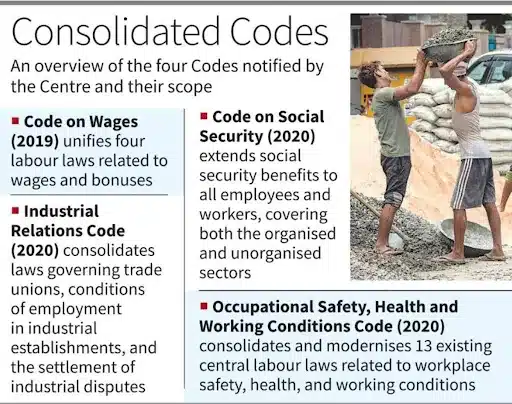
consolidated codes

Background

  • Four labour codes: Code on Wages, 2019; Industrial Relations (IR) Code, 2020; Code on Social Security, 2020; and the Occupational Safety, Health and Working Conditions (OSHWC) Code, 2020.
  • Pending implementation: These codes were pending implementation due to protests by Central Trade Unions (CTUs). Despite resistance, the Centre has now operationalised them.
  • Systemic reforms introduced:
    • Gender-neutral work policies
    • Uniform safety standards
    • Streamlined contract labour regulation
    • India-wide ESIC and EPFO coverage
    • National floor wages
    • Move towards formalisation of labour market

Key Features of the Four Labour Codes

  • Universal social security and expanded coverage:
    • First-time statutory recognition of gig workers, platform workers, and aggregators.
    • ESIC expanded to all districts, including hazardous units.
    • Aadhaar-linked Universal Account Number (UAN) - fully portable benefits for migrant workers.
    • Accident compensation extended to commuting accidents.
    • Social security contributions - aggregators to contribute 1–2% of annual turnover (capped at 5%).
  • Wages, minimum pay and timely payment:
    • National Floor Wage introduced.
    • Mandatory timely wage payments across establishments.
    • Wage structure redefined to increase basic pay component, enhancing provident fund and gratuity provisioning.
  • Women workers’ rights and safety:
    • Women allowed to work night shifts, underground mines, heavy machinery operations—with consent and safety conditions.
    • Equal pay for equal work mandated.
    • Free annual health check-up for workers aged over 40.
  • Fixed term employment (FTE):
    • Workers can be hired for a fixed duration without compromising benefits.
    • FTE employees get - same wages as permanent workers; medical, leave, and social security benefits; and gratuity eligibility after one year (earlier 5 years).
  • Simplifying compliance and improving Ease of Doing Business:
    • Single registration, licence and return system.
    • Inspector-cum-facilitator model for supportive compliance.
    • Two-member tribunals for faster dispute resolution.
    • National OSH Board to harmonise safety standards.

Stakeholder Responses

  • Government:
    • Most comprehensive labour-oriented reform since Independence.
    • Codes will formalise employment, ensure global alignment, and improve worker protections.
  • Industry: CII welcomed the Codes as a “historic milestone," aiding a predictable labour regime and boosting economic growth.
  • Trade unions (CTUs):
    • Termed the Codes: “Anti-worker, pro-employer”, “Declaration of war on working masses”
    • Concern areas - FTE misuse, restrictions on the right to strike, retrenchment norms.
    • Nationwide protests planned for 26 November.
  • Bharatiya Mazdoor Sangh (BMS): Partially supportive - backs Codes on Wages & Social Security but wants changes in OSHWC and IR Codes.

Challenges and Concerns

  • CTUs: Oppose curtailment of strike rights, retrenchment rules, and fear dilution of worker protections.
  • Implementation capacity: Labour is a Concurrent Subject—requires State cooperation. Many States are still finalising rules; implementation asymmetry is likely.
  • Risk of FTE misuse: Fear that employers may replace permanent jobs with fixed-term contracts.
  • Gig worker social security: Turning provisions into effective schemes remains a challenge. Past initiatives like e-Shram saw poor follow-through.
  • Clarity on wage floor: National Floor Wage requires new methodology and agreements across States.

Way Forward

  • Strengthening consultation mechanisms: Revive the Indian Labour Conference (ILC) for consensus-building. Continuous dialogue with unions, employers and States.
  • Capacity building for States: Technical and financial support to implement new digital compliance systems.
  • Clear scheme design for gig workers: Transparent rules for aggregator contribution. Seamless portability using UAN.
  • Monitoring and preventing misuse of FTE: Strong checks to avoid replacing permanent jobs with FTE roles.
  • Awareness campaigns: Workers, especially in informal sectors, need awareness of new rights.

Conclusion

  • The implementation of the Four Labour Codes represents a historic restructuring of India’s labour governance framework. 
  • By consolidating 29 outdated laws, the Codes aim to create a future-ready labour ecosystem that promotes worker welfare, social security, gender equality, and ease of doing business.
  • However, implementation challenges, trade union resistance, and risks of misapplication remain significant. 
  • Effective stakeholder engagement and transparent rule-making will be crucial for the Codes to fulfil their objective of creating an inclusive, formalised, and equitable labour market in India.

Source: TH | IE

Four Labour Codes FAQs

Q1: What is the significance of the Four Labour Codes?

Ans: It consolidated 29 archaic laws into a unified framework to enhance social security, formalisation, worker safety, and ease of doing business.

Q2: How the Labour Codes aim to extend social security to gig and platform workers?

Ans: The Social Security Code provides first-time statutory recognition to gig/platform workers and mandates aggregator contributions.

Q3: What are the concerns raised by trade unions regarding the Labour Codes?

Ans: Trade unions argue that the Codes dilute worker rights through restrictive strike provisions, flexible retrenchment norms, etc.

Q4: How does the introduction of Fixed Term Employment (FTE) impact labour market flexibility and worker welfare?

Ans: FTE offers employers flexibility while ensuring workers receive benefits equal to permanent staff, including gratuity after one year.

Q5: What is the role of the National Floor Wage under the Code on Wages?

Ans: The National Floor Wage sets a nationwide minimum benchmark, reducing inter-state wage disparities and ensuring timely, uniform wage payments.

Enquire Now