The Constitution (131st Amendment) Bill 2025 – Chandigarh Under Article 240?

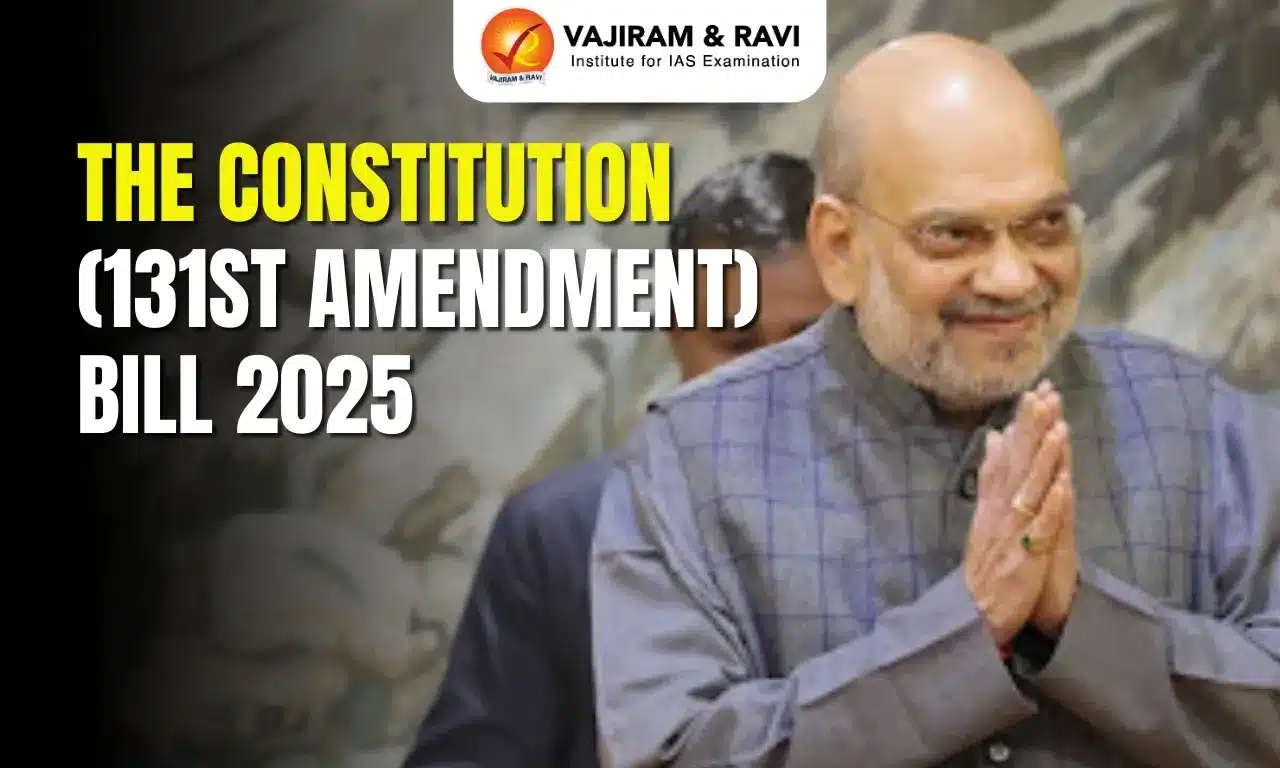
The Constitution (131st Amendment) Bill 2025

The Constitution (131st Amendment) Bill 2025 Latest News

  • The Union Home Ministry has clarified that the Central Government has no intention of introducing the Constitution (131st Amendment) Bill 2025 in the Winter Session of Parliament to bring Chandigarh under Article 240.
  • The proposal triggered sharp political backlash in Punjab, reviving long-standing tensions related to Chandigarh’s status, rooted in the Punjab Reorganisation Act, 1966.
  • Chandigarh is a Union Territory (UT), but is also the shared capital of Punjab and Haryana. The Governor of Punjab currently holds additional charge as the Administrator of the UT of Chandigarh.

Proposed Change

  • Parliament bulletin:
    • Lok Sabha bulletin (Nov 21) listed the Constitution (131st Amendment) Bill 2025 for introduction.
    • Objective: Include Chandigarh under Article 240, allowing the President to make regulations for the UT.
    • Effect: Enable appointment of an independent Administrator/Lieutenant Governor.
  • Article 240:
    • Empowers the President to frame regulations for certain UTs - Andaman & Nicobar Islands, Lakshadweep, Dadra & Nagar Haveli and Daman & Diu, Puducherry (when Assembly is dissolved/suspended).
    • Presidential regulations can override Acts of Parliament applicable to that UT.
  • If applied to Chandigarh:
    • Chandigarh would come under direct administrative control of the Centre, similar to other UTs without legislatures.
    • Punjab Governor would no longer serve as Administrator.

Centre’s Clarification

  • Government’s statement:
    • Proposal only aimed at simplifying the Central government’s law-making process for Chandigarh. 
    • However, no decision has been finalized yet. No change intended in the current governance structure. No Bill will be introduced in the 2025 Winter Session.
  • Stakeholder consultation: Decision will be taken only after adequate consultations with Punjab, Haryana, Chandigarh administration, other stakeholders.

Punjab Opposing the Move

  • Historical significance:
    • Post-partition: Lahore went to Pakistan in 1947. Chandigarh was envisioned as the modern capital of Punjab.
    • Planned city: Designed by Le Corbusier. Inaugurated by President Rajendra Prasad in 1953.
    • Punjab Reorganisation Act, 1966: Creation of Haryana. Chandigarh made joint capital with property division in 60:40 ratio (Punjab:Haryana). Chandigarh became a UT under Centre’s control.
    • 1970: Centre declared that Chandigarh would go to Punjab. Announcement influenced by Punjabi Suba movement leader Fateh Singh.
    • Haryana’s temporary arrangement: Allowed to share secretariat and legislature buildings for five years. Given financial assistance to build new capital (₹10 crore grant + ₹10 crore loan). No separate capital built till date.
  • Punjab’s current position: Views Chandigarh as its undisputed rightful capital. Asserts that the city was built by “uprooting Punjabi villages”. CM Bhagwant Mann (AAP) opposed the Bill, calling it a conspiracy to weaken Punjab’s claim.
  • Political reactions: Opposition parties criticised the Centre’s move as “FAST approach — First Announce, Second Think.”

Key Constitutional and Administrative Issues

  • Sensitive federal question: Chandigarh’s status is historically linked to state reorganisation and linguistic federalism. High political stakes for both Punjab and Haryana.
  • Administrative implications: Changing role of Administrator from Punjab Governor to LG shifts decision-making, Centre–State power dynamics, control over land, policing and administration.
  • Inter-State power balance: Haryana continues to operate from Chandigarh without setting up its own capital.
  • Political symbolism: Chandigarh represents Punjabi identity, legacy of reorganisation, incomplete implementation of 1970 promise.
  • Historical commitments: Transfer promises made in 1970 remain unfulfilled, complicating any new move.
  • Governance stability: Risk of administrative friction if the governance model is altered abruptly.
  • Legal and constitutional complexity: Bringing Chandigarh under Article 240 may require nuanced constitutional interpretation.

Way Forward

  • Stakeholder consultation: Mandatory structured dialogue among Centre, Punjab, Haryana, Chandigarh UT administration.
  • Federal consensus: A political–administrative consensus model on Chandigarh’s status is essential.
  • Revisit past commitments: Review the 1970 declaration and explore realistic, time-bound solutions.
  • Balanced administrative framework: Any law-making reform must protect local governance, federal balance, and the interests of both states.
  • Transparent communication: Avoid ambiguity in legislative bulletins to prevent political escalation.

Conclusion

  • The controversy over including Chandigarh under Article 240 highlights the deep-rooted historical, political and constitutional sensitivities surrounding the city. 
  • The episode reflects the need for careful federal negotiation and respect for long-standing commitments made to Punjab and Haryana. 
  • A balanced, consultative approach remains essential to ensure administrative efficiency without disturbing the delicate inter-state equilibrium.

Source: TH | IE

The Constitution (131st Amendment) Bill 2025 FAQs

Q1: What are the constitutional implications of bringing Chandigarh under Article 240?

Ans: It would empower the President to frame regulations for the UT and allow appointment of an independent Administrator/LG.

Q2: Why does Punjab strongly oppose any attempt to alter Chandigarh’s administrative status?

Ans: Punjab views Chandigarh as its rightful capital built on its villages, reinforced by the 1970 Centre’s commitment to transfer it entirely to Punjab.

Q3: What is the historical evolution of Chandigarh’s status since the Punjab Reorganisation Act, 1966?

Ans: Chandigarh became a UT and joint capital of Punjab and Haryana with a 60:40 asset division.

Q4: What are the political and federal sensitivities involved in modifying Chandigarh’s governance structure?

Ans: Any alteration impacts Centre–State relations, Punjab–Haryana territorial claims, and the unresolved 1970 promise to transfer Chandigarh to Punjab.

Q5: How has the Central Government addressed concerns regarding the proposed Bill?

Ans: The Centre assured that Chandigarh’s governance structure will remain unchanged unless stakeholder consultations justify modifications.

Mid-Cap Stocks Rally: Why Inflows Are Surging in 2025

Mid-Cap Stock Inflows

Mid-Cap Stock Inflows Latest News

  • Mid-cap stocks continue to attract strong inflows as investors chase the high double-digit returns these stocks have generated in recent years. 
  • The Nifty midcap indices recently hit record highs, supported by steady retail SIP inflows and robust earnings growth. Over the last two-and-a-half months, mid-caps have significantly outperformed the Nifty 50. 
  • However, analysts are cautioning investors against excessive optimism, warning that stretched valuations and herd behaviour could lead to risks if the momentum reverses.

Mid-Cap Stocks

  • Mid-cap stocks, as defined by SEBI, are companies ranked 101 to 250 by market capitalisation, typically valued between ₹5,000 crore and ₹20,000 crore. 
  • They offer higher return potential than large-cap stocks but come with greater risk.
  • Investor interest in mid-caps remains strong, with Nifty Midcap 50, 100, and 150 hitting record highs in November 2025. 
  • Since the beginning of 2025, mid-cap indices have delivered 8–11% returns, outpacing the 6.5% return of the Nifty 50.
  • Retail investors pumped ₹8,892 crore into mid-cap funds between September–October 2025, driving mid-cap AUM (assets under management) to ₹4.55 lakh crore, surpassing large-cap AUM at ₹4.1 lakh crore.
  • This indicates a clear shift in preference toward mid-cap equities.

Factors Driving Mid-Cap Stock Inflows

  • Mid-cap inflows are being fuelled by strong domestic institutional buying, especially through mutual funds and SIPs, alongside robust quarterly earnings from many mid-cap companies. 
  • Analysts note that overall market sentiment remains bullish, pushing investors to seek value outside large-caps, particularly as the Nifty trades near record highs.
  • Several mid-cap stocks — including BSE, Federal Bank, Muthoot Finance, Biocon, NALCO, BHEL and Vodafone Idea — have attracted heavy buying due to positive news and improved financial performance. 
  • With mid-caps being more sensitive to earnings cycles, recent upgrades have triggered sharp price movements.
  • A shift in investor behaviour is also driving inflows: after years of strong returns (2020–2024), retail investors expect the momentum to continue, leading to higher allocations towards mid-cap equities. 
  • Additionally, fund managers are rotating from large-caps to mid-caps in search of better growth opportunities.

Investor Sentiment: Bullish but Cautious

  • Investor confidence in mid-cap stocks remains strong. 
  • As long as broader indices like the Nifty and Sensex trend positively, stock-specific buying in the mid-cap segment is expected to continue. 
  • Robust liquidity from domestic institutions is also sustaining long-term value buying.

Elevated Valuations Raise Red Flags

  • Mid-cap valuations have become stretched.
  • The P/E ratio for mid- and small-caps is around 33, compared to 22 for large-caps, which traditionally command higher valuations due to safety and stability.
    • The P/E ratio, or price-to-earnings ratio, is a stock valuation metric that indicates how much investors are willing to pay for each dollar of a company's earnings.
    • This ratio shows how a company's stock price compares to its earnings, helping investors determine if it is overvalued or undervalued.
  • Analysts warn of structural misallocation toward mid- and small-caps driven more by sentiment than fundamentals.
  • They call the current inflows “irrational exuberance”.

Retail Investors Must Exercise Caution

  • Experts advise that retail investors should:
    • Be selective in stock picking
    • Enter positions gradually
    • Limit position sizes
    • Prefer high-quality stocks or professional active management
  • For most retail investors, especially beginners, the mutual fund route is considered safer for diversified exposure to mid-cap companies.

Source: IE | LM

Mid-Cap Stock Inflows FAQs

Q1: Why are mid-cap stocks seeing strong inflows?

Ans: Mid-caps are benefiting from robust SIP contributions, domestic institutional buying, strong quarterly earnings and investor rotation from large-caps in search of better growth.

Q2: How does SEBI define mid-cap stocks?

Ans: Mid-caps are companies ranked 101–250 by market capitalisation, typically valued between ₹5,000 crore and ₹20,000 crore, offering higher returns but greater risk.

Q3: What has driven mid-cap indices to record highs?

Ans: Positive sentiment, steady liquidity, corporate earnings upgrades and attractive valuations relative to large-caps have pushed Nifty Midcap indices to all-time highs.

Q4: What risks do mid-cap investors face now?

Ans: Mid-cap valuations are stretched, with P/E ratios far above large-caps, signalling possible overvaluation and irrational exuberance driven more by sentiment than fundamentals.

Q5: How should retail investors approach mid-caps?

Ans: Experts recommend staggered investments, controlled exposure, focus on quality companies, and using mutual funds for safer diversified access to mid-cap opportunities.

Reforming State Public Service Commissions – Explained

Public Service Commission

Public Service Commissions Latest News

  • The 2025 National Conference of State Public Service Commissions (PSCs), hosted by the Telangana State PSC, has brought renewed focus on the longstanding challenges affecting State PSCs. 

Evolution of Public Service Commissions in India

  • Public Service Commissions have their origins in India’s struggle for self-governance. 
  • According to the historical overview, the demand for merit-based entry into civil services was central to the early nationalist movement. This led to:
    • The Montagu-Chelmsford Reforms, which proposed an independent office regulating service matters,
    • Establishment of the first Public Service Commission in 1926,
    • Provisions in the Government of India Act, 1935, mandating PSCs for each province, which the Constitution later retained; today, we have the UPSC and State PSCs

Structural Differences Between UPSC and State PSCs

  • UPSC’s Strong Governance Framework
    • The UPSC operates in a politically insulated environment, ensuring independence and professionalism. Members generally:
      • Are above 55 years of age,
      • Have rich experience in public administration,
      • Come from diverse zones of the country.
    • The Union government further institutionalised recruitment processes by creating the Ministry of Personnel, Public Grievances and Pensions (1985), enabling regular manpower planning and timely declaration of vacancies. 
  • State PSCs’ Politicised Environment
    • In contrast, State PSCs function in a “politically osmotic environment”, where:
      • Appointments tend to reflect political proximity rather than experience,
      • States lack dedicated personnel ministries,
      • Vacancies are declared irregularly due to fiscal constraints,
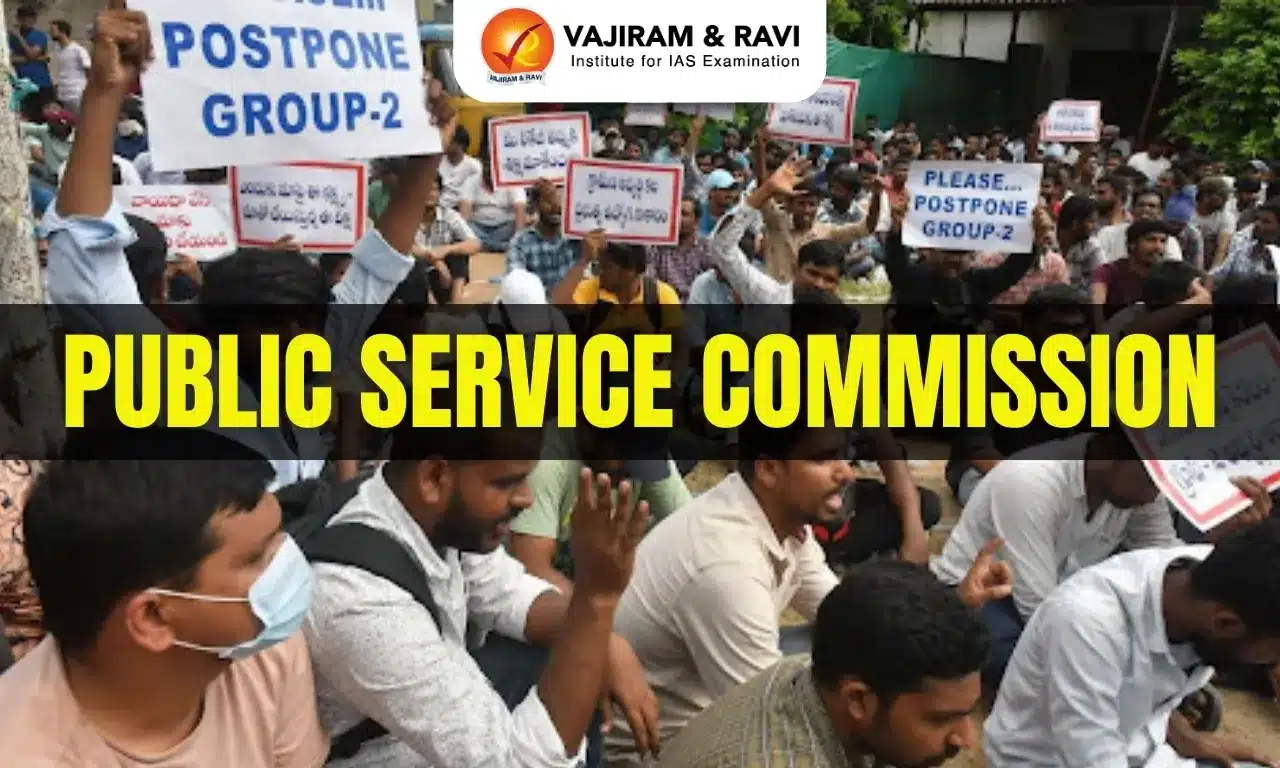
      • Exams are conducted infrequently, leading to widespread litigation and delays.
    • These structural factors form the foundation of the credibility crisis facing State PSCs.

Procedural Challenges Undermining State PSC Efficiency

  • Irregular Syllabus Updates and Academic Limitations
    • Unlike the UPSC, which periodically appoints committees of academicians, civil servants, and experts, State PSCs do not frequently update their syllabi. They also:
      • Depend heavily on limited academic resources within the State,
      • Struggle to ensure objective evaluation due to weak moderation mechanisms. 
  • Complex Reservation and Regional Quota Calculations
    • State PSCs face significant challenges in applying:
      • Vertical reservations,
      • Horizontal reservations,
      • Regional (zonal) reservations are especially visible in States like Telangana and Andhra Pradesh. This often leads to errors and legal disputes.
  • Recurring Examination Controversies
    • Paper leaks,
    • Frequent judicial interventions,
    • Errors in evaluation and translation,
    • Lack of confidentiality protocols. 
  • As a result, aspirants increasingly claim they “have lost faith in State Commissions” and express a preference for UPSC-like centralised examinations.

Reform Measures to Strengthen State PSCs

  • Institutional and Manpower Reforms
    • Institutionalise manpower planning,
    • Provide a five-year roadmap of vacancies,
    • Ensure predictable exam cycles. 
  • Constitutional Amendments for Professional Appointments
    • The 41st Constitutional Amendment (1976) raised the PSC member age limit from 60 to 62. Experts suggest further modifications:
      • Minimum age: 55 years,
      • Maximum age: 65 years,
      • Mandatory qualifications, e.g., former State Secretary for official members, 10 years’ professional experience for non-officials,
      • Consultation with the Leader of the Opposition, ensuring bipartisan selection.
    • Such criteria would help constitute panels of individuals with proven integrity, expertise, and independence. 
  • Exam Reforms for Fairness and Transparency
    • Periodic syllabus revision with public consultation,
    • Objective-type testing for State-specific subjects,
    • Mixed question formats (objective + descriptive) in mains,
    • Improved translation processes using technology plus human verification,
    • Frequent changes in question patterns to reduce overreliance on AI tools by candidates. 
  • Strengthening Administrative Leadership
    • The Secretary of State PSC should be a senior officer with experience in school or intermediate education boards.
    • This would enhance oversight of examination processes and replicate UPSC’s emphasis on balanced confidentiality and transparency.

Source: TH

Public Service Commission FAQs

Q1: Why do State PSCs face frequent controversies?

Ans: Irregular recruitment cycles, politicised appointments, and procedural lapses trigger repeated disputes.

Q2: What historical development led to PSC creation?

Ans: The Montagu-Chelmsford Reforms proposed independent, merit-based recruitment bodies.

Q3: Why is UPSC more efficient than State PSCs?

Ans: UPSC benefits from political insulation, expert appointments, and regular manpower planning.

Q4: What key structural reform is recommended for States?

Ans: Establishing a dedicated Ministry of Personnel for scientific workforce planning.

Q5: What exam reforms are suggested for State PSCs?

Ans: Periodic syllabus updates, mixed-format exams, better translation processes, and public consultation.

Sheikh Hasina Death Verdict: Bangladesh’s Political Crisis Explained

Sheikh Hasina Death Verdict

Sheikh Hasina Death Verdict Latest News

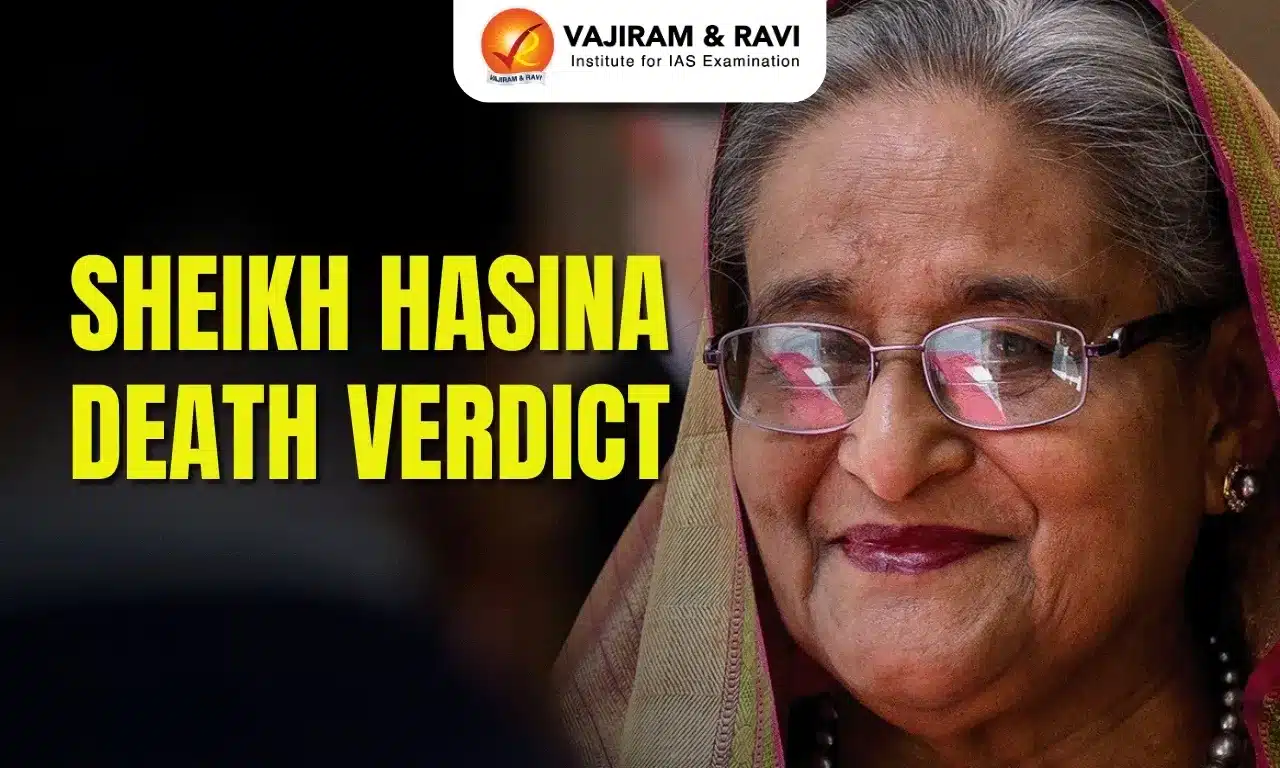
  • Bangladesh’s former Prime Minister Sheikh Hasina has been sentenced to death by the International Crimes Tribunal for crimes against humanity committed during the 2024 student-led protests. 
  • Living in India since her government collapsed in August 2024, Hasina was convicted for ordering the killing of 12 unarmed protesters in Dhaka and Ashulia on August 5, 2024. Five of the victims were burned after death, and one was allegedly burned alive.
  • She also received a life-term sentence for inciting violence, directing the use of lethal weapons, and authorising attacks using helicopters and drones.
  • The verdict has triggered intense political reactions across Bangladesh and is expected to shape the run-up to the February 2026 national elections.

International Crimes Tribunal 

  • The International Crimes Tribunal (ICT) is a special Bangladeshi court established in 2009 by then PM Sheikh Hasina to try individuals accused of committing atrocities during the 1971 Liberation War. 
  • Hasina had promised during the 2008 election campaign to bring “war criminals” — especially those who allegedly collaborated with Pakistan — to justice.
  • Once set up, the ICT aggressively prosecuted many individuals, often from the Jamaat-e-Islami, the country’s largest Islamist political party.
  • However, the tribunal faced strong criticism from international rights groups. Human Rights Watch, in 2012, described the trials as “deeply problematic”, raising concerns about political bias, judicial independence, and fairness.

Hasina’s Fate: Exiled, Convicted, and Politically Isolated

  • Former PM Sheikh Hasina, now living in India since August 5, has dismissed her death sentence as politically motivated. 
  • The verdict, tied to her brutal 2024 protest crackdown that killed 1,400 people, seals her political future for now. 
  • Her return to Bangladesh appears impossible, effectively removing her from national politics.

Awami League in Leadership Crisis

  • Hasina left Bangladesh without establishing a successor, creating deep uncertainty within the Awami League. 
  • The party, currently banned from elections, is struggling without a clear strategy or leadership, and many leaders feel abandoned amid widespread public hostility.

Yunus’s Rise: Interim PM and Symbol of Justice

  • Interim leader Muhammad Yunus, who returned during the 2024 chaos, has positioned himself as a reformist figure. 
  • He welcomed the verdict as a signal that “no one is above the law.” 
  • While the Army and political parties grow impatient over delayed elections, the ruling strengthens his image as a leader delivering justice and stabilising the nation.

BNP’s Position: Seeking Political Revival

  • The Bangladesh Nationalist Party (BNP) hailed the verdict as justice served. 
  • After decades of political marginalisation and legal battles, BNP sees an opportunity to regain power in upcoming elections. 
  • However, internal challenges remain—particularly how Khaleda Zia will project her exiled son Tarique Rahman as the party’s PM candidate.

Jamaat-e-Islami’s Unexpected Strategy

  • Jamaat-e-Islami, gaining momentum after major student union victories, has surprisingly demanded Hasina’s return from India—a move aimed at pressuring New Delhi and strengthening its nationalist credentials. 
  • The party aims to emerge as a powerful force in the 2026 election, either allying with BNP or becoming the primary opposition.

India’s Calculated and Cautious Stand on the Hasina Verdict

  • New Delhi responded by saying it has “noted the verdict” issued by the International Crimes Tribunal of Bangladesh against former PM Sheikh Hasina. 
  • The Ministry of External Affairs (MEA) refrained from condemning or endorsing the ruling, signalling a carefully calibrated position.

Commitment to Bangladesh’s People — Not Its Current Regime

  • India emphasised its commitment to the “best interests of the people of Bangladesh” — focusing on peace, democracy, inclusion, and stability.
  • The wording is significant: India did not echo support for the Bangladesh government but referenced the broader population. 
  • The term “inclusion” implicitly signals India’s preference for allowing the Awami League to participate in the coming elections.

Shelter for Hasina, No Extradition Signals

  • India continues to shelter Sheikh Hasina — as it did earlier from 1975–1981 after Sheikh Mujibur Rahman’s assassination.
  • Despite growing calls within Bangladesh for Hasina’s extradition, India has not yielded. 
  • Delhi views the case as political and has legal grounds to deny extradition on concerns of fairness and the political nature of the charges.

Non-Interference: Framing It as Bangladesh’s Internal Issue

  • While India sees Hasina as a long-time ally who curbed radicalism and supported strong bilateral ties, it does not want to intervene in Bangladesh’s domestic political battles
  • The MEA’s restrained response signals that Delhi considers the developments an internal matter for Bangladesh.

Strategic Calculus: No Gain in Sending Hasina Back

  • Delhi believes that extraditing Hasina would not improve its standing with Bangladesh’s current political establishment. 
  • Therefore, turning her over offers no strategic benefit. Under these circumstances, India remains the safest refuge for her.

Source: IE | FP | IE

Sheikh Hasina Death Verdict FAQs

Q1: Why is the Sheikh Hasina death verdict significant?

Ans: It marks a dramatic political turning point in Bangladesh, removing Hasina from future politics, reshaping party dynamics and influencing the run-up to the 2026 elections.

Q2: What is the International Crimes Tribunal?

Ans: A special Bangladeshi court formed in 2009 by Hasina to try 1971 war criminals, but often criticised for political bias and questionable judicial independence.

Q3: How does the verdict affect the Awami League?

Ans: The party faces a leadership vacuum, internal confusion, and declining public support, with no clear successor or electoral strategy after Hasina’s exile.

Q4: What role is Muhammad Yunus playing now?

Ans: As interim leader, Yunus is positioning himself as a reformist bringing justice and stability, though political parties and the Army are impatient over delayed elections.

Q5: How is India responding to the situation?

Ans: India has “noted” the verdict, continues sheltering Hasina, avoids direct interference, and stresses peace, democracy and inclusion for Bangladesh’s future stability.

Enquire Now