India’s Q2 FY26 GDP Growth Accelerates to 8.2%

GDP Growth

GDP Growth Latest News

  • India’s GDP growth for Q2 FY26 (July-September 2025) surged to 8.2%, marking a six-quarter high, driven by strong performance in manufacturing, construction, and financial services.

Overview of India’s GDP Performance in Q2 FY26

  • India’s economy outpaced expectations, recording 8.2% real GDP growth, significantly higher than the consensus forecast of around 7.3%. 
  • This marks the fourth consecutive quarter of acceleration, signalling robust economic momentum despite global uncertainties. 
  • The government attributed this growth to a combination of pro-growth reforms, elevated public investment, strong services activity, and rising private consumption, particularly after the recent GST rate cuts that boosted discretionary spending. 

Sectoral Performance Driving GDP Expansion

  • Manufacturing and Industry Rebound
    • Manufacturing GVA rose by 9.1% in Q2, the fastest in six quarters, reflecting higher industrial output, improved capacity utilisation, and resilient demand. 
    • This compares to 7.7% in Q1 and just 2.2% in the same quarter of the previous fiscal. 
    • Industry as a whole grew 7.7%, supported by robust construction activity (7.2% growth). Mining was the only laggard, contracting due to monsoon disruptions. 
  • Services Sector Continues Dominance
    • The services sector expanded by over 9% for the second consecutive quarter, led by:
      • Financial, Real Estate & Professional Services: 10.2%
      • Public Administration, Defence & Other Services: 9.7% 
    • These components played a pivotal role in pushing overall GDP beyond forecasts.
  • Agriculture Shows Mild Improvement
    • Agriculture GVA grew 3.5%, supported by stable food inflation and better kharif output, though still lower than industry and services contributions. 

Consumption and Investment Trends

  • Private Consumption Strengthens
    • Private Final Consumption Expenditure (PFCE) grew 7.9%, up from 7% in Q1, driven by:
    • Lower food inflation
    • GST rationalisation
    • Moderation in interest rates
    • Improvement in rural demand
    • Economists highlighted that lower inflation boosted discretionary spending, reinforcing consumption-led growth. 
  • Investment Activity Supported by Capex
    • Gross Fixed Capital Formation (GFCF) grew 7.3%, aided by:
      • A 31% rise in government capital expenditure
      • Early signs of revival in private investment
      • Stronger credit flow to the industry 
    • Economists noted, however, that private investment remains sensitive to global risks, especially higher U.S. tariffs. 

Fiscal and Nominal Growth Concerns

  • Despite strong real growth, India’s nominal GDP growth slipped to 8.7%, a four-quarter low. Economists warned that low nominal growth could strain fiscal math, as tax revenues rose only 4% in the first seven months of FY26. 
  • To meet the budget target of 12.5% gross tax revenue growth, revenues must grow 22.3% in the remaining months of FY26, an ambitious requirement. 

Revised Growth Outlook

  • The Chief Economic Advisor revised India’s FY26 GDP growth projection to at least 7%, up from 6.3-6.8% previously. 
  • The RBI may also revise its 6.8% projection upward as the Q2 figure far exceeded expectations, especially ahead of the Monetary Policy Committee’s meeting.
  • However, economists expect growth to moderate to 6.1% in the second half of FY26 due to normalisation of capital expenditure and global headwinds. 

Macroeconomic Implications

  • Monetary Policy
    • With retail inflation at 0.25% in October, the lowest on record, the RBI was widely expected to initiate a rate cut. The strong GDP print may influence the central bank’s rate trajectory, but does not diminish easing expectations. 
  • Demand-Side Resilience
    • The combined effect of falling inflation, consumption revival, and government spending indicates durable economic momentum.
  • Global Risks
    • Persistent uncertainties, global slowdown, geopolitical tensions, and tighter trade conditions could weigh on export-linked sectors.

Source : TH | IE

GDP Growth FAQs

Q1: What was India’s GDP growth rate in Q2 FY26?

Ans: India recorded 8.2% GDP growth, the highest in six quarters.

Q2: Which sectors drove the Q2 GDP surge?

Ans: Manufacturing (9.1%), services (9%+), and construction (7.2%) led the growth.

Q3: What boosted private consumption in Q2 FY26?

Ans: Lower inflation and GST cuts significantly lifted consumer spending.

Q4: Why is nominal GDP growth a concern?

Ans: Nominal growth slowed to 8.7%, raising challenges for tax revenue targets.

Q5: What is the revised GDP outlook for FY26?

Ans: The government now expects at least 7% growth for the full fiscal year.
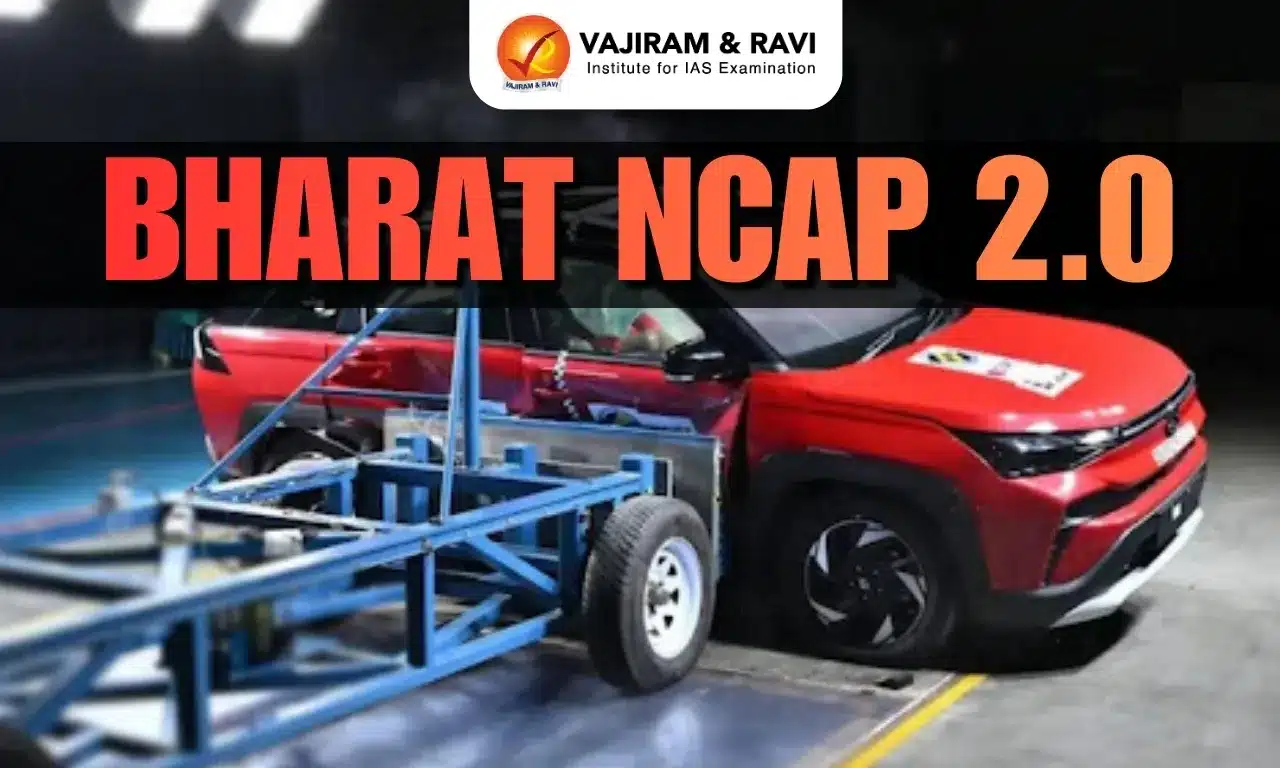
Bharat NCAP 2.0: New Safety Rules, Crash Tests & Stricter Star Ratings Explained

Bharat NCAP 2.0

Bharat NCAP 2.0 Latest News

  • The Ministry of Road Transport and Highways has released a revised draft of the Bharat New Car Assessment Programme (Bharat NCAP), updating the 2023 version that is valid until September 2027. 
  • The new draft significantly broadens the programme’s scope by adding new mandatory crash tests, revised scoring criteria, and expanded assessment verticals.
  • A major shift in the draft is the inclusion of vulnerable road user (VRU) protection tests, especially for pedestrians, who make up over 20% of road accident fatalities in India. 
  • For the first time, vehicles will be evaluated on pedestrian safety features such as impact protection, braking systems, and design elements that reduce injury risks.
  • Overall, the revised Bharat NCAP aims to enhance road safety by encouraging manufacturers to produce vehicles with higher crashworthiness and better protection for both occupants and pedestrians.

Bharat NCAP: India’s Vehicle Crashworthiness Rating System

  • Bharat New Car Assessment Programme (Bharat NCAP) is a voluntary vehicle safety rating system that evaluates cars based on crashworthiness, going beyond basic roadworthiness requirements. 
  • Cars are tested using India-specific crash protocols, and those performing best receive a five-star safety rating.
  • Designed to give Indian consumers clearer safety information, Bharat NCAP aligns with global NCAP models but adapts them to Indian conditions and technologies. 
  • Manufacturers can voluntarily submit vehicles for testing and use the ratings in marketing. 
  • The Central Institute of Road Transport (CIRT), Pune, is the authorised agency for issuing Bharat NCAP ratings.

Key Changes Proposed in Bharat NCAP 2.0

  • Bharat NCAP 2025 broadens its evaluation method. 
  • Instead of the earlier three verticals — AOP (Adult Occupant Protection), COP (Child Occupant Protection), and SAT (Safety Assist Technologies) — the new programme rates vehicles across five assessment areas:
    • Safe Driving – 10%
    • Accident Avoidance – 10%
    • Crash Protection – 55%
    • Vulnerable Road User Protection – 20%
    • Post-Crash Safety – 5%
  • This gives a more holistic picture of a vehicle’s overall safety performance.

More Comprehensive Crash Tests

  • The earlier version required three crash tests.
  • Bharat NCAP 2.0 increases this to five mandatory crash tests:
    • 64 km/h frontal impact against a deformable barrier
    • 50 km/h lateral impact with a mobile deformable barrier
    • 32 km/h oblique side impact against a rigid pole
    • 50 km/h frontal impact against a full-width rigid barrier
    • 50 km/h rear impact against a mobile rigid barrier
  • These tests help assess injury risk in real-world crash scenarios.

Enhanced Injury Assessment

  • Using Anthropomorphic Test Devices (ATDs) (crash-test dummies), the new draft evaluates injury risk for:
    • Adult occupants
    • Driver, front passenger and rear-seat occupants
    • Child occupants
  • This ensures a more precise measurement of protection across all seating positions.

Protection for Vulnerable Road Users

  • For the first time, Bharat NCAP incorporates tests to assess:
    • Pedestrian injury risk
    • Cyclist safety measures
  • This addresses India’s high share of pedestrian fatalities.

Vulnerable Road User Protection: Key Safety Measures in Bharat NCAP 2.0

  • Bharat NCAP 2025 introduces a dedicated Vulnerable Road User Protection vertical with 20% weightage, assessing how well vehicles protect pedestrians, cyclists, and motorcyclists during crashes.

Mandatory Impact Tests

  • Pedestrian legform impact on the vehicle bumper
  • Adult headform impact on the bonnet/windshield
  • Child headform impact on the bonnet/windshield
  • These tests evaluate how vehicle design minimizes injury during collisions.

Optional AEBS Assessments

  • Performance of Autonomous Emergency Braking Systems (AEBS) is assessed for:
    • Child pedestrian detection
    • Adult pedestrian detection
    • Car-to-motorcyclist rear-end scenarios

Accident-Avoidance Technologies

  • This new vertical focuses on driver-assist technologies that help prevent crashes before they occur.
  • Key Requirements
    • Electronic Stability Control (ESC): Mandatory for eligibility under Bharat NCAP 2.0
      • ESC helps maintain vehicle stability, especially during skids or sudden manoeuvres.
    • AEBS: Optional but encouraged to enhance star ratings

Post-Crash Safety Measures

  • A new vertical ensures vehicles help protect occupants after a crash.
    • Mandatory Evaluations
      • Energy Management for Fire & Electrical Hazards - Ensures protection from electric shocks, especially in EVs
      • Occupant Extrication Assessment - Checks ease of door opening; Evaluates seatbelt buckle release after collision.
  • These measures ensure emergency responders can rescue occupants quickly.

Revised Star Rating System Under Bharat NCAP 2.0

  • Bharat NCAP 2.0 introduces a stricter star-rating structure to enhance vehicle safety standards. 
  • The thresholds for 4-star and 5-star ratings have been raised to 65 and 80 points, up from 60 and 70 in the 2023 framework. 
    • The thresholds for 1-star, 2-star, and 3-star ratings are fixed at 30, 40, and 50 points, respectively.
  • A minimum Adult Occupant Protection (AOP) score of 55% within the Crash Protection vertical is mandatory to qualify for 3 stars or above. Falling short results in a 1-star penalty.

Additional safeguards include

  • A 5-star vehicle cannot score zero in any assessment vertical; otherwise, its rating is capped at 4 stars.
  • No injury values in the red zone for adult or child ATDs (Anthropomorphic Test Device — commonly known as a crash test dummy) are permitted in a 5-star rating before modifiers are applied.

Source: IE | NDTV

Bharat NCAP 2.0 FAQs

Q1: What is Bharat NCAP 2.0?

Ans: Bharat NCAP 2.0 is an updated Indian crashworthiness rating system that expands safety assessments, adds new crash tests, and emphasises pedestrian protection to enhance road safety.

Q2: What are the new assessment areas introduced?

Ans: The updated framework evaluates vehicles across five areas: safe driving, accident avoidance, crash protection, vulnerable road user protection, and post-crash safety.

Q3: How many crash tests are now mandatory?

Ans: Bharat NCAP 2.0 increases mandatory crash tests from three to five, adding full-width frontal and rear-impact assessments for more realistic crash evaluation.

Q4: How does the programme protect pedestrians and cyclists?

Ans: It adds mandatory headform and legform impact tests and optional AEBS evaluations to reduce injuries to pedestrians, cyclists, and motorcyclists.

Q5: What changes affect the star rating system?

Ans: The threshold for 4- and 5-star ratings is higher, requiring minimum AOP scores and prohibiting zero vertical scores for a top rating.

Sirpur UNESCO Bid: India’s Plan to Transform the 5th Century Heritage Site

Sirpur UNESCO Bid

Sirpur UNESCO Bid Latest News

  • Sirpur, a 5th–12th Century archaeological site in Chhattisgarh, is undergoing a major upgrade as the government seeks UNESCO World Heritage status. 
  • A recent joint inspection by the Archaeological Survey of India (ASI) and the Sirpur Special Area Development Authority (SADA) marks a significant step in advancing its nomination.
  • Located two hours from Raipur on the banks of the Mahanadi, Sirpur hosts 34 Hindu, Jain, and Buddhist monuments. 
  • The planned facelift includes battery-operated golf carts, digital exhibits, and immersive storytelling modules to enhance visitor experience and strengthen the site’s UNESCO credentials.

UNESCO World Heritage Tag

  • The UNESCO World Heritage tag is an international recognition awarded to cultural or natural sites of “outstanding universal value” — places considered important for all humankind, transcending national boundaries. 
  • Sites may include ancient monuments, historic cities, natural landscapes, ecosystems, or mixed cultural-natural heritage.
  • The designation is given by the UNESCO World Heritage Committee, which evaluates nominations submitted by member countries. 
  • Once inscribed, a site gains global visibility, higher tourism potential, and improved opportunities for funding and technical assistance. 
  • Importantly, the tag also obligates governments to ensure stronger protection, conservation, and sustainable management of the site.
  • Overall, the UNESCO tag serves as a powerful tool for safeguarding heritage while boosting international prestige, research interest, and local development.

Sirpur’s Historical Significance

  • Sirpur — also known as Shripur or Sripura — was a vibrant multi-religious urban centre first documented in 1882 by Alexander Cunningham, ASI’s first Director-General.
  • Excavations from the 1950s to the 2000s uncovered a rich tapestry of monuments dating back to the 5th Century AD, showcasing the city’s cultural and architectural splendour.

A Multi-Religious Heritage Hub

  • The site contains 22 Shiva temples, five Vishnu temples, 10 Buddhist viharas, and three Jain viharas.
  • It flourished as the capital of Dakshina Kosala under the Panduvanshi and Somavamshi dynasties.
  • Archaeological remains include palace complexes, markets, residences, stupas, brick temples, meditation cells, and ancient water systems.

Remarkable Monuments and Architecture

  • Lakshmana Temple (7th Century) is one of India’s finest brick temples, dedicated to Vishnu.
  • Surang Tila stands on a high terrace with a steep staircase of 37 steps and features a dramatic panchayatana layout.
    • The Panchayatana layout is a temple architectural style featuring a central shrine surrounded by four smaller subsidiary shrines at each corner of a square, making a total of five shrines
  • Large Buddhist viharas and stupas point to Sirpur’s role as a major Buddhist centre, including the Tivaradeva Mahavihara with its notable Buddha statue.

A Sacred Riverine Cultural Landscape

  • Sirpur’s location along the Mahanadi River enhances its spiritual and cultural significance. 
  • The presence of ghats, temples, and ancient settlements forms a rich riverine landscape that aligns with UNESCO’s vision of combined natural and cultural heritage — strengthening Sirpur’s case for World Heritage status.

What the Govt Plans To Do

  • Tourists currently spend nearly three hours navigating scattered village tracks to see Sirpur’s monuments. 
  • The Chhattisgarh government plans to reduce this by an hour through paved heritage pathways and battery-operated vehicles, enabling smoother and eco-friendly movement across the site.

Thematic Clusters and Integrated Pathways

  • Sirpur naturally divides into four heritage zones:
    • Buddhist Monastic Cluster
    • Hindu Temple Cluster
    • Civic–Administrative Zone
    • Riverine Sacred Landscape
  • A primary pathway will link all four thematic clusters, while a secondary pathway will provide last-mile access to each monument, ensuring a coherent visitor experience.

Land Transfer for Unified Site Management

  • To strengthen conservation and streamline administration, the ASI has requested 30 hectares of state land around the site. 
  • This includes land near major monuments, approach routes, buffer zones, and areas needed for heritage management infrastructure.
  • Identified archaeological mounds and zones with high potential will undergo fresh surveys and excavations, allowing ASI to uncover more structures and strengthen Sirpur’s bid for UNESCO World Heritage status.

Source: IE | UNESCO

Sirpur UNESCO Bid FAQs

Q1: Why is Sirpur being upgraded?

Ans: Sirpur is undergoing major restoration, accessibility improvements, and visitor experience enhancement as part of India’s effort to secure UNESCO World Heritage status.

Q2: What makes Sirpur historically significant?

Ans: Sirpur hosts 34 Hindu, Jain, and Buddhist monuments, including Lakshmana Temple, Surang Tila, ancient markets, viharas, and a rich 5th–12th century urban landscape.

Q3: How does a UNESCO tag benefit Sirpur?

Ans: A UNESCO tag enhances tourism, global recognition, conservation funding, and international support while mandating improved protection and sustainable management.

Q4: What are the government’s key development plans?

Ans: Plans include paved heritage pathways, battery-operated carts, thematic clusters, improved site management, and new excavations to strengthen Sirpur’s nomination.

Q5: How will visitor movement be improved?

Ans: Integrated primary and secondary pathways will cut travel time by one hour and provide seamless access to monuments across all four thematic clusters.

Enquire Now