India-Russia Summit Latest News
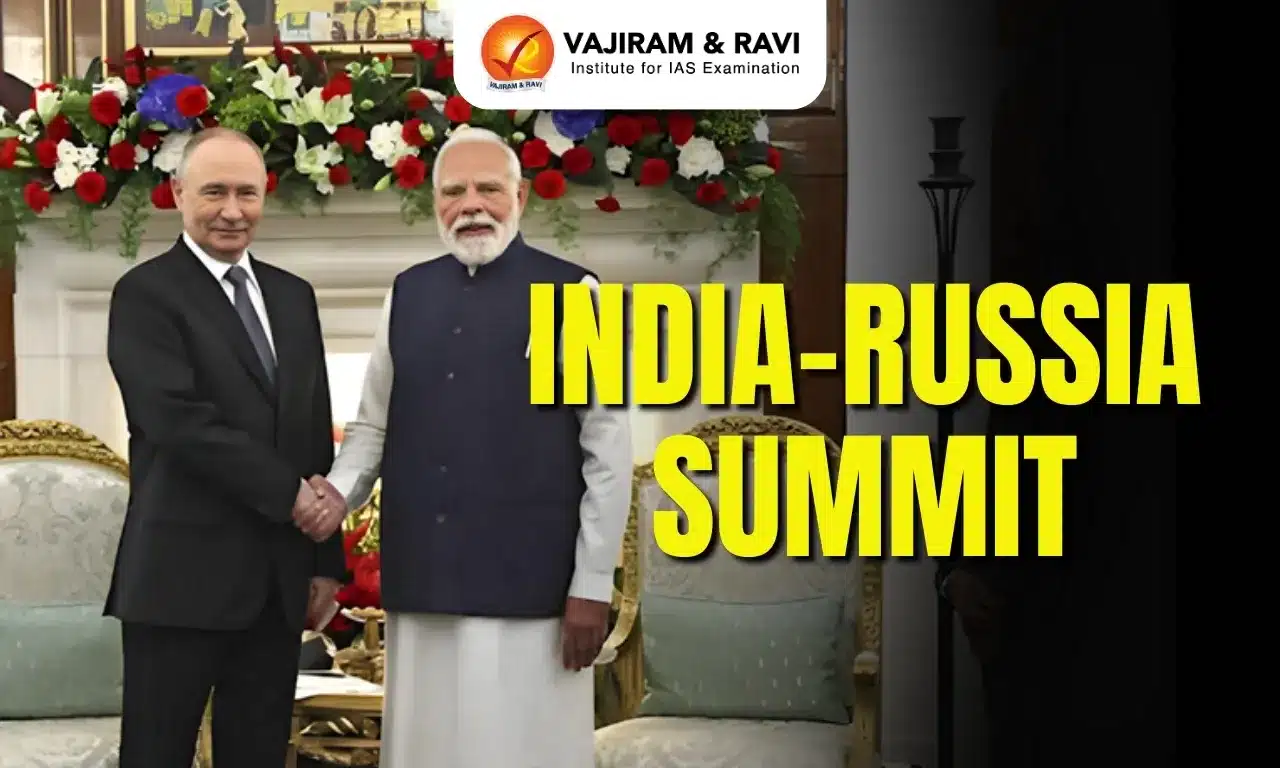
- Russian President Vladimir Putin’s official state visit to India has resulted in major breakthroughs in areas like labour mobility, trade expansion, nuclear energy cooperation, defence manufacturing and tourism.
India-Russia Strategic Partnership
- India and Russia share a long-standing strategic partnership built on defence cooperation, energy security, and technological collaboration.
- The 2025 summit reaffirmed the relevance of this relationship amid shifting global geopolitics.
- Despite Western sanctions on Russia, bilateral trade between the two nations crossed USD 65 billion in 2024, driven largely by discounted Russian crude oil imports.
- The summit aimed to rebalance trade, diversify cooperation, and build long-term frameworks that benefit India’s economic and strategic interests.
Key Announcements from the India-Russia Summit
- New Labour Mobility Pathway
- One of the most significant outcomes of the summit was the signing of a labour mobility agreement, enabling Indian workers, particularly from construction, healthcare and services sectors, to take up jobs in Russia under regulated frameworks. This initiative is expected to
- provide safer migration pathways,
- address Russia’s labour shortages, and
- generate new employment opportunities for Indian youth.
- The agreement mirrors India’s wider strategy of formalising migration channels with key partner nations.
- One of the most significant outcomes of the summit was the signing of a labour mobility agreement, enabling Indian workers, particularly from construction, healthcare and services sectors, to take up jobs in Russia under regulated frameworks. This initiative is expected to
- Advancement in Nuclear Energy Cooperation
- India and Russia are committed to expanding cooperation in the nuclear energy sector, including:
- joint development of small modular reactors (SMRs),
- progress on additional units at Kudankulam, and
- collaboration in fuel supply, nuclear safety, and training.
- SMRs are seen as central to India’s long-term low-carbon energy strategy, making Russia a valuable technological partner.
- India and Russia are committed to expanding cooperation in the nuclear energy sector, including:
- Boost to Defence Production and Technology Sharing
- Defence remained a core pillar of the summit. Major takeaways included:
- proposals for the co-production of military equipment in India,
- discussions on supply chain stabilisation for spare parts, and
- a roadmap for long-term defence industrial cooperation.
- With India diversifying its procurement sources, Russia emphasised readiness for deeper technology sharing and joint manufacturing under ‘Make in India’.
- Defence remained a core pillar of the summit. Major takeaways included:
- Focus on Expanding Bilateral Trade
- Both leaders acknowledged that trade remains heavily skewed in Russia’s favour due to oil imports. To correct this imbalance, the summit saw discussions on:
- expanding Indian exports of pharmaceuticals, textiles, machinery, automotive parts and food products,
- establishing a bilateral payment settlement mechanism insulated from geopolitical disruptions,
- promoting direct shipping routes via the Chennai-Vladivostok maritime corridor.
- Industry bodies noted that the agreements could unlock new market opportunities for textiles, engineering goods, FMCG and agritech companies.
- Both leaders acknowledged that trade remains heavily skewed in Russia’s favour due to oil imports. To correct this imbalance, the summit saw discussions on:
India Announces Free 30-Day e-Tourist Visa for Russians
- A major policy announcement was India’s decision to grant a free 30-day, double-entry e-tourist visa to all Russian nationals. Expected Benefits:
- Increased Russian tourist inflow to India’s coastal and wellness destinations.
- Strengthening people-to-people ties amid rising Russian outbound travel.
- Support to India’s hospitality and retail sectors.
- The move comes at a time when visa-friendly tourism policies are becoming a tool of economic diplomacy.
- Russia is also expected to ease travel norms for Indian tourists as part of reciprocal arrangements.
Technology, Space and Energy-Sector Outcomes
- Technology Collaboration
- India and Russia discussed joint projects in cybersecurity, digital public infrastructure, and artificial intelligence. Russian firms expressed interest in collaborating with Indian IT and fintech start-ups.
- Space Cooperation
- The summit reaffirmed cooperation in space research, satellite navigation, and training of Indian astronauts, continuing a decades-long partnership.
- Energy Security
- Beyond nuclear energy, both sides reviewed:
- long-term crude oil supply agreements,
- LNG procurement possibilities, and
- Indian investments in Russian petroleum projects.
- Beyond nuclear energy, both sides reviewed:
- Energy remains the backbone of bilateral engagement and a critical factor in India’s economic strategy.
Geopolitical Significance of the Summit
- The India-Russia summit showcased India’s strategic autonomy. India continues to maintain strong ties with Russia while deepening relations with the United States, Europe and East Asia.
- The agreements signalled:
- India’s need for stable energy access,
- Russia’s search for reliable economic partners, and
- A shared interest in building multipolar global institutions.
India-Russia Summit FAQs
Q1: What is the major labour-related outcome of the India–Russia summit?
Ans: A regulated labour mobility pathway allowing Indian workers to take up jobs in Russia.
Q2: What new visa facility has India announced for Russians?
Ans: A free 30-day, double-entry e-tourist visa.
Q3: Which energy sector cooperation was emphasised?
Ans: Expansion of nuclear energy collaboration, including small modular reactors.
Q4: What defence cooperation was discussed?
Ans: Co-production of military equipment and long-term defence industrial integration.
Q5: Why is the summit significant for trade?
Ans: It aims to diversify and rebalance trade while creating secure payment and logistics channels.