Sabka Bima Sabki Raksha Bill 2025 – Strengthening Insurance Regulation

Insurance Regulation

Insurance Regulation Latest News

  • The Union government has introduced the Sabka Bima Sabki Raksha (Amendment of Insurance Laws) Bill, 2025, in the Lok Sabha.

Background: India’s Insurance Sector

  • India’s insurance sector plays a critical role in financial security, risk mitigation, and long-term savings. 
  • Despite steady growth in insurance penetration, the sector has faced persistent challenges such as mis-selling of policies, opaque commission structures, weak enforcement against intermediaries, and delays in grievance redressal.
  • Insurance distribution has expanded rapidly through agents, brokers, banks, NBFCs, fintech platforms, and web aggregators. 
  • However, regulatory capacity has not always kept pace with this expansion, creating gaps in supervision. 
  • The new Bill seeks to address these gaps by strengthening IRDAI’s legal authority and enforcement mechanisms.

Overview of the Sabka Bima Sabki Raksha Bill, 2025

  • The Bill proposes amendments to existing insurance laws to give IRDAI stronger supervisory, investigative, and enforcement powers
  • It marks a shift from a largely compliance-based regulatory model to a more proactive enforcement-driven framework.
  • The proposed changes apply not only to insurance companies but also to a wide range of insurance intermediaries, including agents, brokers, corporate agents (such as banks and NBFCs), web aggregators, third-party administrators (TPAs), surveyors, and insurance marketing firms. 

Expanded Search and Seizure Powers

  • A key feature of the Bill is granting the IRDAI Chairperson the authority to order searches, seizures, and inspections
  • These powers can be exercised when there is reason to believe that regulated entities are:
    • Withholding or concealing information,
    • Failing to produce the required documents, or
    • Attempting to tamper with or destroy records.
  • The Chairperson may authorise senior officers to enter premises, inspect documents, seize records, and even break open locks if keys are unavailable. 
  • This brings IRDAI’s powers closer to those already exercised by regulators such as SEBI. 

Stronger Enforcement and Penalty Framework

  • The Bill also empowers IRDAI to disgorge wrongful gains made by insurers or intermediaries through illegal practices such as excess commissions, rebates, or mis-selling.
  • Further, IRDAI will have enhanced authority to issue binding directions to insurers in the public interest. 
  • These directions may be aimed at protecting policyholders, preventing mismanagement, or ensuring sound corporate governance. 
  • While insurers will be given an opportunity to be heard, compliance with such directions will be mandatory. 

Regulation of Commissions and Intermediaries

  • Another significant provision relates to tighter control over commissions and remuneration paid to agents and intermediaries. IRDAI will be empowered to:
    • Prescribe commission limits,
    • Mandate disclosure norms, and
    • Regulate payment structures.
  • The objective is to curb mis-selling driven by high commissions and ensure that policyholder interests remain central to insurance distribution. 
  • This is particularly important in the context of growing digital and fintech-led insurance platforms. 

Significance for Policyholders and Governance

  • For policyholders, the Bill promises stronger safeguards against fraud, mis-selling, and unfair practices. 
  • Enhanced enforcement powers are expected to improve trust in the insurance system and strengthen grievance redressal mechanisms.
  • From a governance perspective, the Bill reinforces IRDAI’s role as a modern financial regulator capable of proactive supervision rather than post-facto action. 
  • It aligns insurance regulation with global best practices in financial sector oversight.

Challenges and Way Forward

  • While the Bill strengthens regulation, concerns may arise regarding excessive concentration of powers and the need for safeguards against arbitrary use. 
  • Effective implementation will depend on transparency, due process, and institutional capacity within IRDAI.
  • Going forward, regulatory reforms must be complemented by consumer awareness, digital literacy, and faster dispute resolution mechanisms to ensure inclusive insurance growth.

Source: IE | Fortune

Insurance Regulation FAQs

Q1: What is the Sabka Bima Sabki Raksha Bill, 2025?

Ans: It is an amendment Bill aimed at strengthening IRDAI’s regulatory and enforcement powers in the insurance sector.

Q2: Which authority gains search and seizure powers under the Bill?

Ans: The Insurance Regulatory and Development Authority of India (IRDAI).

Q3: Who are covered as insurance intermediaries under the Bill?

Ans: Agents, brokers, banks, NBFCs, fintech platforms, web aggregators, TPAs, surveyors, and insurance marketing firms.

Q4: Why does the Bill regulate commissions more strictly?

Ans: To curb mis-selling and protect policyholder interests.

Q5: How does the Bill benefit insurance consumers?

Ans: It strengthens oversight, reduces unfair practices, and enhances consumer protection.
Revising India’s GDP Framework – Phasing Out ‘Discrepancies’ for Greater Statistical Credibility

Revising India’s GDP Framework

Revising India’s GDP Framework Latest News

  • As part of the ongoing revision of India’s GDP data series, the Ministry of Statistics and Programme Implementation (MoSPI) has proposed eliminating the contentious ‘discrepancies’ component from GDP estimates. 
  • This reform is outlined in MoSPI’s discussion paper on methodological improvements and coincides with the new GDP base year of 2022–23, scheduled for launch on 27 February 2026. 
  • The GDP back series under the revised base year is expected by February 2027.

‘Discrepancies’ in GDP

  • GDP compilation methods: Production (value-added/income) approach; expenditure approach.
  • Reason for discrepancies:
    • Due to differences in data sources, coverage, valuation methods, and time lags, GDP estimates from these two approaches often do not match.
    • This difference is recorded as ‘discrepancies’ under the expenditure-side GDP, which is considered relatively less accurate.
  • Interpretation:
    • Positive discrepancy: Production-side GDP is higher than Expenditure-side GDP
    • Negative discrepancy: Expenditure-side GDP is higher than Production-side GDP

Why are Discrepancies Problematic

  • They obscure the true drivers of GDP growth, complicating macroeconomic analysis. Large discrepancies can lead to significant future revisions in GDP growth rates.
  • Example (July–September quarter):
    • Real GDP growth: 8.2%
    • Discrepancies: ₹1.63 lakh crore (3.3% of GDP) in real terms
    • In nominal terms: (–)₹2.46 lakh crore ([–]2.9% of GDP)
  • The post-pandemic period has seen volatile swings, e.g., (–)3% of GDP (Jan–Mar 2023), +3.3% of GDP (Apr–Jun 2023).

Proposed Reform - Removing Discrepancies

  • MoSPI plans to integrate Supply and Use Tables (SUTs) with annual national accounts. Use SUTs to ensure that total supply is equal to total use for every good and service.
  • It aims to limit discrepancies in early GDP estimates, eliminate them entirely in final estimates once full data becomes available.
  • SUTs:
    • Map domestic production and imports against intermediate consumption, final consumption, capital formation, and exports.
    • Follow System of National Accounts (SNA) accounting constraints.

Expert Opinion

  • Economists view the move positively:
    • Eliminating discrepancies will improve transparency and interpretability of GDP data.
    • Persistent or rising discrepancies in past revisions have undermined confidence in growth estimates.
  • However, concerns remain about data quality, especially reliance on outdated survey data (over a decade old).

Challenges and Way Forward

  • Inherent complexity: Of GDP estimation in a large, informal, and diverse economy. Improve institutional capacity for national accounts compilation.
  • Outdated surveys and data gaps: Particularly in services and informal sectors. Regularly update surveys and base-year datasets.
  • Time lags and uneven quality of administrative data: Strengthen administrative data systems and real-time data collection.
  • Transparency concerns
    • Risk that eliminating discrepancies may involve judgement-based adjustments, raising transparency concerns. 
    • Ensure methodological transparency while adjusting data to remove discrepancies. Align closely with international best practices under SNA.

Conclusion

  • The proposed removal of ‘discrepancies’ from India’s GDP estimates marks a significant methodological reform aimed at enhancing statistical credibility, consistency, and policy relevance. 
  • While integration of Supply and Use Tables can improve accuracy, the success of this reform ultimately depends on robust, updated data sources and transparent statistical practices. 
  • For policymakers, investors, and analysts, a cleaner GDP framework will enable better interpretation of India’s growth dynamics.

Source: IE

Revising India’s GDP Framework FAQs

Q1: What are ‘discrepancies’ in India’s GDP estimates and why do they arise?

Ans: Discrepancies arise due to differences in data sources, coverage, valuation and time lags between the production and expenditure approaches to GDP estimation.

Q2: Why has MoSPI proposed the elimination of ‘discrepancies’ from GDP calculations?

Ans: Because large and volatile discrepancies distort interpretation of growth drivers and lead to significant revisions in GDP estimates.

Q3: How will the integration of Supply and Use Tables (SUTs) help improve GDP estimation in India?

Ans: SUTs ensure balance between total supply and total use of goods and services, thereby limiting and eventually eliminating discrepancies in GDP estimates.

Q4: What risks do large GDP discrepancies pose for economic policymaking?

Ans: Large discrepancies undermine data credibility, obscure sectoral growth trends, and can result in sharp future revisions affecting policy decisions.

Q5: What structural challenges in India’s GDP estimation remain?

Ans: Dependence on outdated survey data, data gaps in the informal sector, etc.

MGNREGS and Farm Labour Availability: What the Data Really Shows

MGNREGS and Farm Labour

MGNREGS and Farm Labour Latest News

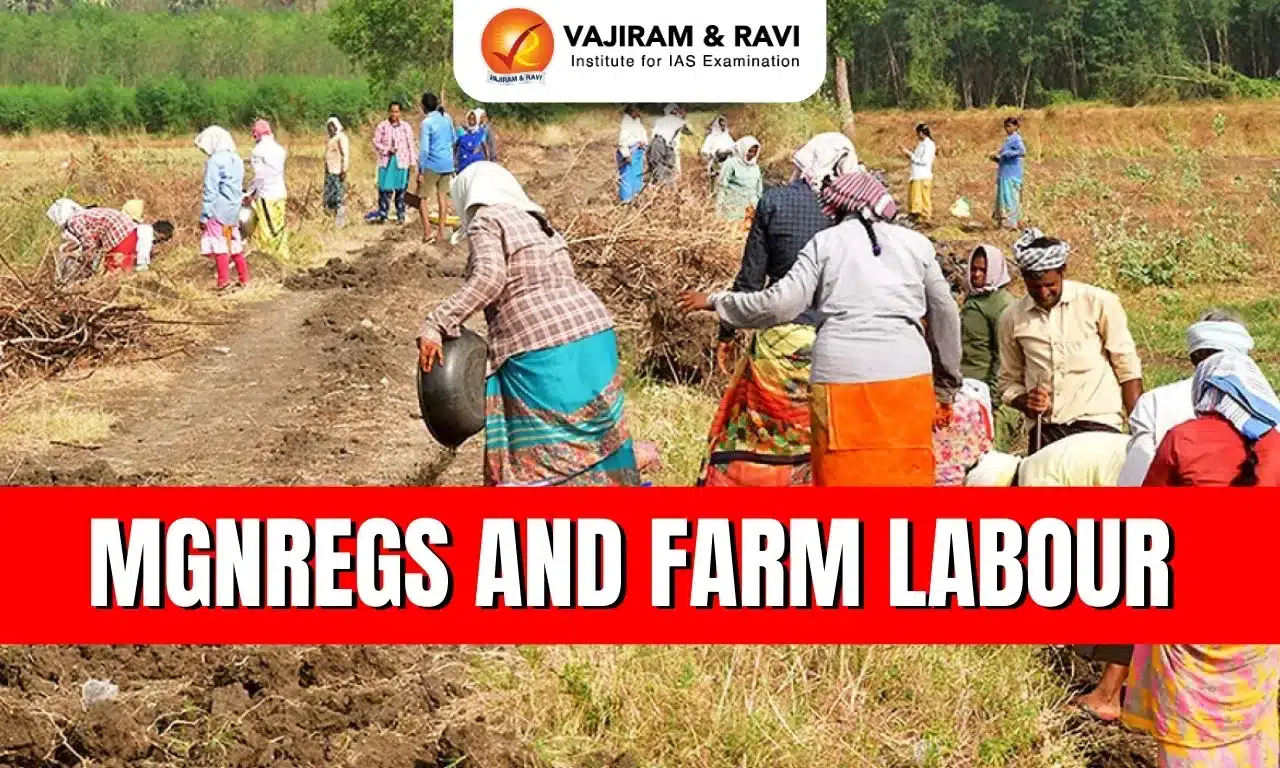
  • The Viksit Bharat-Guarantee for Rozgar and Ajeevika Mission Gramin (VB-G RAM G) Bill proposes a 60-day pause on rural employment works during peak sowing and harvesting seasons. 
  • Notified in advance by States, the measure aims to ensure adequate farm labour availability. 
  • The Bill seeks to replace MGNREGA, which has long been criticised for contributing to agricultural labour shortages, a concern earlier raised even by former Agriculture Ministers.

Rural Wages Under MGNREGA: What the Data Show

  • MGNREGA is often credited with tightening rural labour markets and strengthening workers’ bargaining power. 
  • However, this has not translated into a strong or sustained rise in wages.
  • Labour Bureau data covering 25 occupations across 20 States show that all-India rural wage growth for male workers ranged between 3.6% and 6.4% annually over the past decade.
  • In four of the ten years (2015-16, 2019-20, 2021-22 and 2022-23), nominal rural wage growth lagged behind consumer price inflation, implying a fall in real wages. 
    • Real wage growth exceeded 1% only in 2017-18.
  • Agricultural wages grew faster than overall rural wages in eight out of ten years. Only in 2015-16 and 2019-20 did non-farm rural wages grow faster.

Limited Gains Despite MGNREGA

  • Even agricultural wages merely kept pace with inflation, showing no significant surge over the past decade. 
  • Overall, the data suggest that despite MGNREGA, rural wage growth under the current government has remained modest and often inflation-adjusted stagnant.

Why Rural Wage Growth Has Remained Modest

  • A key factor behind tepid rural wage growth is the sharp rise in women’s participation in the rural workforce. 
  • According to the Periodic Labour Force Survey, rural female LFPR rose from 24.6% in 2017-18 to 47.6% in 2023-24 — almost doubling in seven years, significantly expanding labour supply.
    • Labour Force Participation Rate (LFPR) measures the share of people aged 15+ who are working or seeking work.

Role of Government Welfare Schemes

  • The Economic Survey 2023-24 attributes this rise to schemes like Ujjwala, Har Ghar Jal, Saubhagya and Swachh Bharat, which reduced women’s unpaid household burdens by improving access to LPG, water, electricity and sanitation.

Expansion of Rural Labour Supply

  • By freeing women’s time for paid work, these schemes increased the size of the rural workforce. Economically, this “rightward shift” in labour supply exerted downward pressure on wages.

Questioning the Farm Labour Shortage Narrative

  • The data weakens the claim that MGNREGA created a widespread labour shortage. Increased female participation, especially in nearby farm work, may have offset workers drawn into MGNREGA.
  • While farmers face seasonal labour shortages, directly blaming MGNREGA — and justifying work curbs during peak seasons — requires stronger, ground-level evidence rather than broad assumptions.

Alternative Causes of Farm Shortage

  • Low Farm Wages: Agricultural wages are often lower than both MGNREGS wages and non-farm wages, making farm work less attractive.
  • Poor Working Conditions: Farm labourers frequently suffer from health issues like musculoskeletal disorders due to harsh working conditions. MGNREGS work is often perceived as less toilsome with less supervision.
  • Out-migration: A significant cause of labour shortage is the long-standing trend of rural out-migration to urban areas for better-paying jobs and opportunities, a trend that predates the implementation of NREGS.
  • Increased Bargaining Power: MGNREGS has provided a baseline of employment security, increasing the bargaining power of rural workers for better wages in both the farm and non-farm sectors, which some farmers interpret as a "shortage".

Conclusion

  • Policy discussions have explored improved alignment with farm cycles, including temporary work suspensions during peak seasons or permitting MGNREGS activities on private farms for specific agricultural operations.
  • While some farmers attribute labour shortages to MGNREGS, broader evidence points to deeper structural issues in agriculture and the availability of better work options for rural labourers.

Source: IE

MGNREGS and Farm Labour FAQs

Q1: Does MGNREGS significantly increase rural wages?

Ans: Data show rural wage growth remained modest, often below inflation, with real wages declining in several years despite MGNREGS, indicating no major wage surge.

Q2: Why have agricultural wages not risen sharply under MGNREGS?

Ans: Agricultural wages largely tracked inflation, as rising labour supply—especially from increased female participation—offset any tightening effect caused by MGNREGS.

Q3: How has women’s labour force participation affected rural wages?

Ans: Rural female LFPR nearly doubled since 2017–18, expanding labour supply and exerting downward pressure on wages, limiting real wage growth.

Q4: Is MGNREGS the main reason for farm labour shortages?

Ans: Evidence suggests otherwise; structural issues like low farm wages, migration, and working conditions play a larger role than MGNREGS.

Q5: What policy solutions are being discussed?

Ans: Options include aligning MGNREGS work with lean seasons, temporary peak-season pauses, or permitting limited work on private farms for agriculture-related activities.

Post-Maoist India and the Next Phase of Governance in Scheduled Areas

Post-Maoist India

Post-Maoist India Latest News

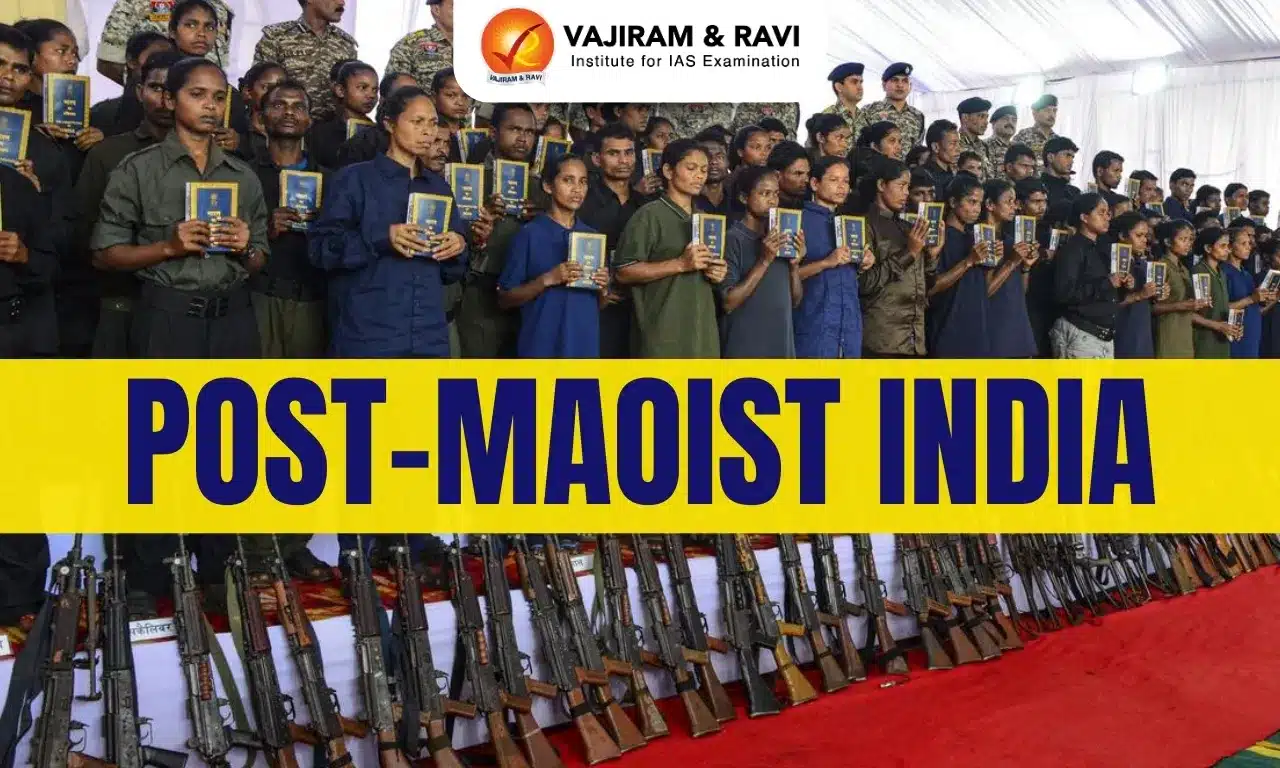
  • Discussions on the rise of the Maoist movement in the 1990s and early 2000s have largely focused on underdevelopment and structural socio-economic deprivation in India’s Red Corridor. 
  • Most official and scholarly analyses traced the insurgency to poverty and marginalisation, prompting the State to adopt a two-pronged strategy combining security operations with development initiatives. 
  • While governance and justice delivery have occasionally featured in policy debates, there has been limited effort to systematically examine how governance failures, weak institutions, and poor grievance redressal mechanisms deepened and sustained cycles of Maoist insurgency.

Governance Failures in Scheduled Areas

  • The contemporary Maoist insurgency is largely concentrated in Fifth Schedule areas of central and eastern India, regions with significant tribal populations. 
  • These areas were envisaged by the Constitution as a special social contract for Adivasis, recognising their distinct needs and vulnerabilities.

Promise of the Fifth Schedule

  • The Fifth Schedule created a dedicated governance framework for tribal regions.
  • This included Tribal Advisory Councils with substantial Adivasi representation, financial support through the Tribal Sub-Plan, and discretionary powers for Governors to prevent land alienation and safeguard tribal interests.

Reality of State Neglect and Exploitation

  • Despite these safeguards, tribal communities experienced persistent discrimination, exploitation, and marginalisation. 
  • The Planning Commission’s Expert Committee (2008) highlighted how resource-rich regions were reduced to extreme poverty due to weak governance and state neglect. 
  • Social and economic indicators for tribal populations remained far below national averages, with multidimensional poverty levels worse than Sub-Saharan Africa.

Land Alienation and Dispossession

  • The gravest challenge for Adivasis has been the loss of land and forest rights. 
  • Despite constitutional protections, millions were dispossessed, particularly after economic liberalisation. 
  • Studies show that tribal land alienation has been at its highest in the post-liberalisation period.

Structural Governance Deficit

  • Successive governments failed to build governance structures suited to tribal realities. 
  • Colonial-era administrative systems, complex legal processes, and inaccessible justice mechanisms were retained in Scheduled Areas, leaving low-literacy tribal communities unable to effectively assert their rights or benefit from constitutional protections.

Alienation Through Administrative Exclusion

  • A key factor deepening Adivasi alienation in Fifth Schedule areas has been the near-total absence of local representation in administrative structures. 
  • Officials implementing tribal safeguards were overwhelmingly outsiders, often carrying social bias and limited understanding of local realities.

Institutional Failure to Protect Tribal Interests

  • Constitutional and statutory bodies such as the Ministry of Tribal Welfare, the National Commission for Scheduled Tribes, and State Governors—formally entrusted with safeguarding tribal rights—largely failed in practice. 
  • The Mungekar Committee (2009) observed that these institutions did little to curb exploitation, while Governors rarely exercised their discretionary powers in Scheduled Areas. 
  • Weak service delivery in health, education, policing, revenue administration, and the judiciary compounded these failures.

PESA: Promise and Persistent Violations

  • The Panchayat Extension to Scheduled Areas (PESA) Act, 1996, was a notable exception, aiming to promote tribal self-governance and empower Gram Sabhas over land, resources, and livelihoods. 
  • While PESA improved political representation at the grassroots, its core provisions—especially those related to land acquisition—were routinely violated, as highlighted by the Planning Commission’s Expert Committee (2008).

Governance Deficits and Maoist Mobilisation

  • Chronic governance failures, weak grievance redressal, and low political priority accorded to the Fifth Schedule created fertile ground for Maoist mobilisation. 
  • Adivasi frustrations and distrust in state institutions drove many to support Maoist ideology, which promised justice, land rights, and dignity under the slogan Jal, Jungle, Zameen.

Parallel Governance Structures

  • In regions like Dandakaranya, persistent underdevelopment enabled Maoists to establish parallel administrations.
  • They started offering basic services such as healthcare, schooling, food distribution, and swift—though extrajudicial—justice. 
  • These “Janatana Sarkars” filled governance vacuums left by the state, further entrenching Maoist influence.

Reimagining Governance in Post-Maoist Regions

  • Recent years have seen improvements in welfare delivery and core infrastructure—roads, electricity, telecom—across Maoist-affected Fifth Schedule areas, aided by digital platforms and direct benefit transfers. 
    • However, critical institutions—justice, health, education, policing, and revenue—remain weak and understaffed, limiting effective governance.

Structural Bottlenecks and Under-Representation

  • A core paradox persists: local Adivasi under-representation in administration. 
  • Despite quotas at local levels, real power and finances remain with a largely non-tribal permanent bureaucracy, rendering representation largely symbolic and undermining trust.

Erosion of Rights-Based Frameworks

  • Key protective laws face dilution:
    • Forest Rights Act (FRA): Central to Adivasi and forest-dweller livelihoods, its implementation has been weakened by violations, amendments, and judicial interventions.
    • CAF Act, 2016: Expanded compensatory afforestation has diluted safeguards and harmed forest-based livelihoods.
    • PESA: Despite its promise of self-governance, States—especially mineral-rich ones like Chhattisgarh—have undermined Gram Sabha consent powers, particularly for mining and land acquisition.

Political Push Needed

  • Revitalising FRA and PESA requires strong political will from the Centre and States to restore original mandates and enforce safeguards against land alienation and resource extraction without consent.

Toward a New Governance Charter

  • Post-Maoist governance must reverse political and administrative under-representation, empower local institutions with real autonomy and finances, and rebuild trust. 
  • Adapting elements from Sixth Schedule models—Autonomous District/Zonal Councils—could offer a viable path.

Source: TH

Post-Maoist India FAQs

Q1: Why is governance central to understanding Maoist insurgency?

Ans: Beyond poverty, weak institutions, poor justice delivery, and administrative exclusion in Fifth Schedule areas deepened alienation and sustained Maoist mobilisation.

Q2: What was the original promise of the Fifth Schedule?

Ans: It aimed to protect tribal rights through special governance, land safeguards, Tribal Advisory Councils, and Governor oversight, but failed in implementation.

Q3: How did land alienation affect Adivasi communities?

Ans: Despite constitutional protections, large-scale land dispossession—especially post-liberalisation—undermined livelihoods and intensified distrust in state institutions.

Q4: What role did PESA play, and why did it fall short?

Ans: PESA promised tribal self-governance via Gram Sabhas, but routine violations—especially in land acquisition—eroded its effectiveness.

Q5: What reforms are needed in post-Maoist regions?

Ans: India needs a new governance charter focusing on local representation, stronger FRA and PESA enforcement, and possibly adapting Sixth Schedule-style autonomy models.

Enquire Now