India’s Quest for 100% Literacy – Bihar’s Reluctance and the ULLAS Challenge

ULLAS

ULLAS Latest News

  • India has set an ambitious target of achieving 100% literacy by 2030, in line with the National Education Policy (NEP) 2020 and UN Sustainable Development Goals (SDG-4: Quality Education). 
  • To realise this, the Union Government launched the ULLAS - Understanding Lifelong Learning for All in Society.
  • However, the non-participation of Bihar—one of India’s least literate states—has emerged as a major obstacle.

Overview of the ULLAS Scheme

  • Launched: It was launched in 2022 by the Union Education Ministry in line with the NEP 2020.
  • Target group: Non-literate persons above 15 years of age.
  • Methodology to identify beneficiaries:
    • Door-to-door identification of non-literates
    • Training in basic literacy and numeracy (Class 3 level)
    • Online/offline learning modes
    • Mandatory assessment and certification
  • Expanded definition of literacy (as per August 2024 guidelines):
    • Reading, writing, and numeracy with comprehension
    • Digital literacy, financial literacy, and life skills
  • Benchmark: 95% literacy treated as equivalent to 100% literacy.

Progress so Far

  • Declared fully literate States/UTs: Himachal Pradesh, Mizoram, Goa, Tripura, Ladakh.
  • Likely to join soon: At least two southern states and one UT.
  • Assessment of impact: Gains likely to reflect in upcoming Census data.

Bihar - A Major Concern

  • Literacy statistics:
    • PLFS 2023–24: 
      • Bihar literacy rate was 74.3% (2nd lowest after Andhra Pradesh – 72.6%), with male literacy of 82.3%, and female literacy of 66.1%.
      • Non-literates (15–59 age group): Nearly 2 crore, including 1.32 crore women.
    • Historical trend: Census 2011 literacy rate was 61.8% (lowest in India).
  • Financial and administrative issues:
    • Funds released under ULLAS (2023–24): A total amount of about Rs 35 crore was approved (Central share: ₹21 cr; State: ₹14 cr). The first instalment of 75% of the approved amount–Rs 16 crore–was released as the central share to Bihar in 2023.
  • Issues flagged by Centre:
    • Funds not transferred to Single Nodal Agency (SNA)
    • No annual plan submitted
    • Non-utilisation of funds
    • 7% interest penalty applicable on delayed transfers (as per Department of Expenditure norms)

Bihar’s Stand - Akshar Anchal Scheme

  • It is a State-run literacy programme in operation for about 15 years.
  • Focus groups:
    • Dalits, Mahadalits, minorities
    • Extremely Backward Classes (EBCs)
    • Women (15–45 age group)
  • Features:
    • Ensuring schooling for children in the 6-14 age group, and basic literacy and numeracy among women in the 15-45 age group. 
    • Women of the targeted groups take a test on basic literacy organised by the state every six months.
  • State’s argument:
    • The scheme attracts larger financial outlay than ULLAS.
    • The existing institutional mechanism makes ULLAS redundant.

Key Challenges and Way Forward

  • Centre–State coordination deficit: Union Education Minister urged Bihar CM to take immediate action, emphasised Bihar’s role in achieving national literacy goals, and directed Bihar to utilise released funds.
  • Duplication vs integration of literacy schemes: Convergence of schemes - Align Akshar Anchal with ULLAS framework.
  • Gender gap in literacy, especially in Bihar: Focus on female literacy as a multiplier for social development.
  • Underutilisation of central funds: Incentivise participation through performance-linked funding.
  • Political and administrative inertia: Strengthen cooperative federalism in education governance.
  • Monitoring and outcome-based evaluation: Digital and community-based learning models to reach adult learners. Robust monitoring mechanism with third-party assessments.

Conclusion

  • The success of India’s mission to achieve 100% literacy by 2030 critically depends on bringing laggard states like Bihar on board. 
  • A cooperative, flexible, and outcome-oriented approach—rooted in NEP 2020’s vision of lifelong learning—is essential to transform literacy from a statistical target into a social reality.

Source: IE

ULLAS

Q1: How does the ULLAS scheme operationalise the goal of 100% literacy envisaged under the NEP 2020?

Ans: ULLAS operationalises NEP 2020 by identifying non-literates above 15 years through surveys, imparting basic literacy, numeracy and life skills, etc.

Q2: Why is Bihar’s non-participation in the ULLAS scheme a major challenge to India’s literacy goals?

Ans: Because it has one of the highest illiteracy loads, with nearly 2 crore non-literates and a female literacy rate far below the national average.

Q3: What is the significance of redefining ‘literacy’ under the ULLAS programme?

Ans: By including digital, financial and life skills, ULLAS shifts literacy from mere alphabet knowledge to functional literacy.

Q4: What are the Centre–State coordination issues highlighted by the implementation of the ULLAS scheme in Bihar?

Ans: Delayed fund transfer, non-submission of annual plans and preference for a parallel state scheme reflect coordination gaps.

Q5: How is the ULLAS scheme linked to global development commitments?

Ans: ULLAS aligns India’s literacy mission with SDG-4 (Quality Education) by targeting universal and lifelong learning outcomes by 2030.
CAG Findings on Pradhan Mantri Kaushal Vikas Yojana

Kaushal Vikas Yojana

Kaushal Vikas Yojana Latest News

  • The Comptroller and Auditor General (CAG) has flagged serious implementation gaps in the Pradhan Mantri Kaushal Vikas Yojana (PMKVY) in an audit report tabled in Parliament.

Pradhan Mantri Kaushal Vikas Yojana: An Overview

  • The Pradhan Mantri Kaushal Vikas Yojana (PMKVY) is the flagship skill development scheme of the Government of India, launched in July 2015 under the Skill India Mission. 
  • The scheme is implemented by the Ministry of Skill Development and Entrepreneurship (MSDE) through the National Skill Development Corporation (NSDC).
  • The core objective of PMKVY is to enable Indian youth to acquire industry-relevant skills, improve employability, and address the problem of educated unemployment. 
  • The scheme focuses on short-term training, Recognition of Prior Learning (RPL), certification, and placement support.
  • PMKVY has been implemented in three phases:
    • PMKVY 1.0 (2015-16)
    • PMKVY 2.0 (2016-20)
    • PMKVY 3.0 (2021-22)
  • Across these phases, the scheme aimed to provide skill training and certification aligned with the National Skills Qualification Framework (NSQF).

Key Features of PMKVY

  • PMKVY provides free skill training to eligible youth across a wide range of sectors such as construction, manufacturing, healthcare, electronics, retail, and services. 
  • Training is conducted through approved Training Centres and Industry Partners.
  • A distinctive feature of the scheme is outcome-based funding, where payments to training partners are linked to certification and placement. 
  • Each certified candidate is eligible for a monetary reward of Rs. 500, transferred through Direct Benefit Transfer (DBT).
  • The scheme also emphasises digital monitoring through the Skill India Portal (SIP), Aadhaar-based authentication, and third-party assessments to ensure transparency.

Achievements of the Scheme

  • Since its launch, PMKVY has emerged as one of the largest skill development programmes in the world. 
  • Between 2015 and 2022, the scheme had a cumulative financial outlay of approximately Rs. 14,450 crore.
  • According to official data, around 1.32 crore candidates were targeted for training and certification, out of which about 1.1 crore candidates were certified across the three phases. 
  • PMKVY has helped expand the skill ecosystem by:
    • Creating a nationwide network of training centres
    • Standardising skill certification through NSQF
    • Promoting Recognition of Prior Learning for informal workers
    • Integrating skill development with Digital India and DBT mechanisms
  • The scheme plays a crucial role in India’s demographic dividend strategy, especially when youth unemployment in the 15-29 age group remains high.

News Summary: CAG Findings on PMKVY

  • A recent CAG audit report, tabled in the Lok Sabha, has highlighted serious deficiencies in the implementation of PMKVY between 2015 and 2022.
  • One of the most glaring findings was the use of invalid bank account numbers, including entries such as “11111111111”, blank fields, or repeated account numbers for multiple beneficiaries. 
  • The audit found that over 94% of candidate records lacked reliable bank account details, raising concerns about beneficiary identification.
  • The CAG also flagged that payouts to more than 34 lakh certified candidates were pending, even years after completion of training. 
  • Despite the ministry’s claim that Aadhaar-linked DBT would resolve payment issues, only 18.44% of candidates received successful DBT payments under PMKVY 2.0 and 3.0.
  • Additionally, the audit revealed shut training centres, instances where training was shown as ongoing even when centres were physically closed, and the reuse of identical photographs for multiple beneficiaries across states such as Bihar, Uttar Pradesh, Maharashtra, and Rajasthan.
  • The CAG also questioned the credibility of “Best-in-Class” employers involved in skill certification and highlighted weak monitoring of training quality and outcomes.

Government Response and Corrective Measures

  • In response to the audit, the Ministry of Skill Development and Entrepreneurship stated that the scheme has since been significantly strengthened. Measures include:
    • Aadhaar-authenticated e-KYC
    • Face authentication and geo-tagged attendance
    • QR-coded digital certificates
    • Enhanced inspections through Kaushal Samiksha Kendras
    • Penalty framework, blacklisting, and recovery from non-compliant entities
  • The government claims that these reforms aim to ensure transparency, accountability, and better beneficiary tracking.

Source: IE

Kaushal Vikas Yojana FAQs

Q1: What is the objective of Pradhan Mantri Kaushal Vikas Yojana?

Ans: It aims to provide industry-relevant skill training and certification to enhance youth employability.

Q2: Which ministry implements PMKVY?

Ans: The Ministry of Skill Development and Entrepreneurship.

Q3: How many phases of PMKVY have been implemented so far?

Ans: Three phases between 2015 and 2022.

Q4: What major issues did the CAG highlight in PMKVY?

Ans: Invalid bank details, pending payments, closed training centres, and weak monitoring.

Q5: Why is PMKVY important for India’s economy?

Ans: It supports skill development, employment generation, and utilisation of the demographic dividend.

SHANTI Bill 2025 Explained: Private Entry, Nuclear Liability Reform and Transparency Concerns

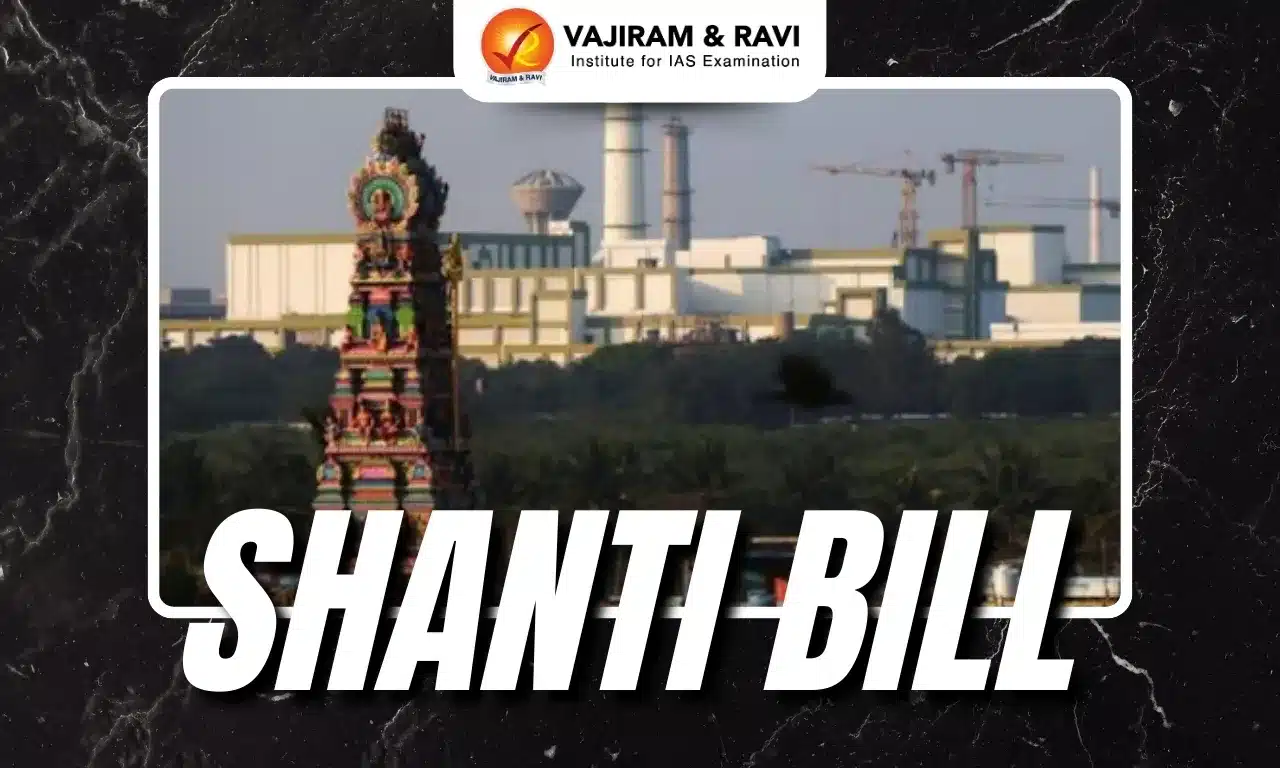
SHANTI Bill

SHANTI Bill Latest News

  • The Sustainable Harnessing and Advancement of Nuclear Energy for Transforming India (SHANTI) Bill, 2025, passed by Parliament, marks a fundamental shift in India’s nuclear power regime by allowing private players to participate in nuclear power plant operations.
  • Once notified, the law will replace the Atomic Energy Act, 1962 and the Civil Liability for Nuclear Damage Act, 2010, redefining rules on who can build and operate nuclear plants, how accident liability is capped, the role of the safety regulator, and mechanisms for dispute resolution and compensation.
  • The Centre argues that the reform is essential to attract investment and achieve India’s target of 100 GW of nuclear capacity by 2047.

Private Sector Entry into India’s Nuclear Power Sector under SHANTI Bill, 2025

  • The SHANTI Bill allows both public and private companies to set up nuclear power plants.
  • They can engage in activities such as the transport, storage, import and export of nuclear fuel, technology, equipment and minerals—areas earlier reserved exclusively for public sector entities.

Strict Safety and Regulatory Oversight

  • Despite opening the sector, the law retains a stringent safety regime.
  • All entities must obtain mandatory safety authorisation from the Atomic Energy Regulatory Board (AERB).
  • Authorisation is required for the manufacture, possession, use, transport, import, export and disposal of radioactive substances, radiation-generating equipment, and for establishing, operating or decommissioning radiation facilities.

Foreign Investment: Conditional and Indirect

  • The Bill does not explicitly permit foreign direct investment in nuclear power.
  • Section 3(e) allows participation by “any other person” expressly permitted by the Central Government through notification.
  • Detailed clarity is expected through subsequent rules, with government sources indicating alignment with DPIIT foreign equity guidelines applicable across sectors.

Activities Reserved for the Central Government

  • Certain critical and sensitive functions remain under exclusive central control, including:
    • Enrichment and isotopic separation of radioactive substances
    • Reprocessing and management of spent fuel and high-level radioactive waste
    • Production and upgradation of heavy water

Question of Accountability under the SHANTI Bill, 2025

  • The Opposition has raised concerns—particularly over the dilution of provisions fixing liability on equipment suppliers in the event of a nuclear accident.

Removal of Supplier Liability (‘Right of Recourse’)

  • A major and contentious change in the SHANTI Bill is the dilution of the operator’s “right of recourse” against equipment suppliers in the event of a nuclear accident.
  • Under Section 17 of the Civil Liability for Nuclear Damage Act (CLNDA), 2010, operators could seek compensation from suppliers if an accident resulted from defective equipment, sub-standard services, or supplier negligence.
  • The new law retains:
    • Contractual recourse if explicitly provided in writing; and
    • Personal criminal liability for acts done with intent to cause nuclear damage.
  • However, it omits the provision covering supplier fault due to patent or latent defects, shielding equipment vendors from long-term and uncertain liability exposure.

Shift to Graded Liability Caps

  • The SHANTI Bill departs from the earlier flat liability cap of ₹1,500 crore for reactors of 10 MW thermal capacity or above.
  • It introduces graded liability caps, linked to the size and capacity of nuclear installations, aiming to better reflect varying risk profiles.

Insurance and Financial Security

  • The obligation to maintain insurance or other financial security to cover nuclear liability applies only to private operators.
  • Central government–owned installations are exempt from this requirement.
  • However, the law authorises the Centre to create a Nuclear Liability Fund to meet its compensation obligations in the event of a nuclear incident.

Strengthened Penalty Framework

  • The SHANTI Bill introduces a two-tier penalty system:
    • Monetary penalties for less serious violations (a provision absent in earlier laws).
    • Imprisonment for grave offences, reinforcing accountability and deterrence.

SHANTI Bill and the Transparency Challenge

  • The SHANTI Bill, 2025 has sparked concern for explicitly overriding the Right to Information (RTI) Act, 2005 through Section 39
  • This provision allows the Central government to declare wide categories of nuclear-related information as “restricted”, including data on nuclear materials, plant design, operations, siting, and regulatory submissions. 
  • Once notified, such information is completely exempt from disclosure under the RTI Act, as Section 39 applies “notwithstanding anything” in the RTI law.

How This Differs from Existing RTI Exemptions

  • The RTI Act already permits withholding sensitive information related to national security, strategic interests, commercial confidence, and personal data. 
  • Crucially, these exemptions are conditional, subject to justification, appeals, and a public interest override under Section 8(2).

Why Section 39 Raises Red Flags

  • Section 39 removes these safeguards entirely. There is no balancing test, appeal mechanism, or scope for public interest review. 
  • Critics warn this could institutionalise secrecy, weaken accountability, deter whistleblowing, and limit independent scrutiny—especially significant as private players enter the nuclear sector.

Source: IE | IE

SHANTI Bill FAQs

Q1: What is the main objective of the SHANTI Bill, 2025?

Ans: The Bill aims to expand nuclear capacity to 100 GW by 2047 by allowing private participation and streamlining India’s nuclear regulatory framework.

Q2: How does the SHANTI Bill change private sector participation?

Ans: It permits private companies to build and operate nuclear plants, though critical functions like fuel reprocessing remain under central government control.

Q3: Why is supplier liability controversial under the new law?

Ans: The Bill removes automatic supplier liability for defective equipment, limiting operators’ right of recourse and raising concerns about accountability after nuclear accidents.

Q4: What changes does the Bill make to nuclear liability caps?

Ans: It replaces the earlier flat ₹1,500 crore cap with graded liability limits based on plant size, while mandating insurance only for private operators.

Q5: Why has Section 39 of the SHANTI Bill drawn criticism?

Ans: Section 39 overrides the RTI Act by permanently exempting “restricted” nuclear information, eliminating appeals and public-interest review, raising transparency concerns.

Why the Indian Rupee Is Weakening Against the Dollar Despite Strong Fundamentals

Declining Rupee

Declining Rupee Latest News

  • Recently, the Reserve Bank of India sold large amounts of US dollars, boosting dollar supply and leading to a nearly 1% appreciation of the rupee. 
  • However, despite this intervention, the rupee has generally been weakening against the dollar over recent months.

A Year of Persistent Rupee Weakness

  • Despite the intervention, the broader trend over recent months has been rupee depreciation. 
  • Over the past year, the rupee has lost nearly 6% of its value against the US dollar, indicating sustained pressure on the Indian currency.

Why the Weakness Is Puzzling

  • Strong Domestic Fundamentals - On paper, the rupee should have strengthened. India remains the fastest-growing major economy, inflation is under control, and external sector indicators such as trade deficit and external debt are relatively stable.
  • Weakening Despite a Soft Dollar - Earlier, the rupee’s fall could be attributed to a globally strong dollar, as other currencies were also depreciating. However, in recent months, the dollar itself has weakened, yet the rupee has continued to slide.
  • Clear Signs of Currency Pressure - The rupee’s depreciation even during phases of dollar weakness removes the argument that global factors alone are responsible. This points to specific pressures on the Indian currency, underlining deeper challenges beyond temporary market interventions.

Why the Rupee Is Weakening Despite Global Currency Strength

  • The rupee’s depreciation stands out at a time when most major and emerging-market currencies are strengthening. 
  • Multiple economic and financial factors explain this divergence.
  • Persistent Trade Deficit Pressures - India continues to import more than it exports in value terms. Higher imports raise demand for US dollars relative to the rupee, pushing down the rupee’s exchange rate.
  • Impact of High US Tariffs on Indian Exports - The US has imposed some of the highest tariffs on Indian goods, making them less competitive abroad. Reduced export demand lowers demand for rupees, further weakening the currency.
  • Uncertainty Over the India–US Trade Deal - The prolonged uncertainty surrounding the India–US trade agreement, despite official optimism of resolution in 3–4 months, discourages investors. Diplomatic tensions that triggered punitive tariffs amplify this risk aversion.
  • Weak Capital Inflows and Investor Apathy - Global investors have largely avoided Indian markets in favour of others. Data show strong gains elsewhere—US indices up 17–23%, China 16–27%, Japan 22–27%, FTSE 18%, Euro area 16%, Hong Kong 27%, Korea 72%—while India’s Sensex rose only about 8%.
    • This suggests investors view Indian equities as either overvalued or less profitable compared to global peers.
  • Role of RBI’s Forex Interventions - The Reserve Bank of India’s buying and selling of dollars significantly influences the rupee’s exchange rate. Such interventions can affect currency movements independent of underlying macroeconomic fundamentals.

Key Determinants of the Rupee’s Movement

  • A recent Bank of Baroda (BoB) study examined the key factors influencing the rupee’s exchange rate using monthly data from October 2020 to November 2025.
  • The study found that three factors explain most of the rupee’s exchange rate fluctuations:
  • RBI’s Spot Market Intervention
    • Direct buying or selling of dollars by the RBI affects short-term currency movements.
    • However, its impact is less significant than forward market operations.
  • RBI’s Position in Forward Contracts
    • Changes in the RBI’s forward dollar positions play a more influential role than spot interventions.
    • Forward market intervention sends a strong signal to markets, making it a more effective tool when the rupee is under pressure.
  • Foreign Portfolio Investment (FPI) Flows
    • In the immediate term, FPI inflows or outflows are a major driver of the rupee’s movement.
    • Investor sentiment and capital flows significantly affect exchange rate dynamics.

Why Trade Deficit Matters Less Than Expected

  • Surprisingly, the trade deficit showed little direct impact on short-term rupee movements.
  • This is because trade data reflect accounting entries rather than actual dollar flows in the same period.
  • Exporters are allowed to retain dollar earnings overseas for a stipulated time before repatriation, weakening the immediate link with exchange rates.

Limits of Economic Variables

  • No single factor explained more than 13–14% of the total variation in the rupee’s exchange rate.
  • This indicates that non-economic factors—such as market psychology, geopolitical developments, and policy signals—also play a significant role.
  • While RBI interventions and forward positions matter, foreign portfolio flows dominate short-term rupee movements, and exchange rates are influenced by factors beyond traditional economic fundamentals.

Source: IE

Declining rupee FAQs

Q1: Why did the RBI intervene in the forex market recently?

Ans: The RBI sold large amounts of US dollars to increase dollar supply, temporarily strengthening the rupee by nearly 1%, amid sustained depreciation pressures.

Q2: Why is the rupee’s weakness considered puzzling?

Ans: India has strong growth, controlled inflation, and stable external metrics, yet the rupee has weakened even when the US dollar itself has softened.

Q3: How do foreign portfolio investors affect the rupee?

Ans: FPI inflows and outflows significantly influence short-term exchange rates, with investor exit from Indian markets putting downward pressure on the rupee.

Q4: Does India’s trade deficit directly drive rupee depreciation?

Ans: Surprisingly, studies show the trade deficit has limited short-term impact because trade data don’t always reflect immediate dollar flows.

Q5: What did the Bank of Baroda study conclude?

Ans: The study found RBI’s forward interventions and FPI flows matter most, but non-economic factors also play a large role in rupee movements.

Enquire Now