India’s Seafood Exports – Growth, Diversification and Emerging Markets

Seafood Exports

Seafood Exports Latest News

  • India’s seafood exports recorded strong growth in FY 2025-26 despite higher tariffs in the U.S., reflecting a shift towards diversified global markets.

India’s Seafood Sector - Scale, Structure and Export Profile

  • India has one of the largest and most diverse seafood sectors in the world, supported by a long coastline of over 7,500 km, extensive inland water resources, and a strong aquaculture base. 
  • The sector plays a critical role in employment generation, rural livelihoods, foreign exchange earnings, and food security.

Production and Resource Base

  • India is the 3rd largest fish producer globally and the 2nd largest producer of aquaculture products. 
  • Marine fisheries are concentrated along the eastern and western coasts, while inland fisheries rely on rivers, reservoirs, ponds, and wetlands. 
  • Aquaculture, particularly shrimp farming, has emerged as the dominant contributor to export volumes and value.

Export Composition

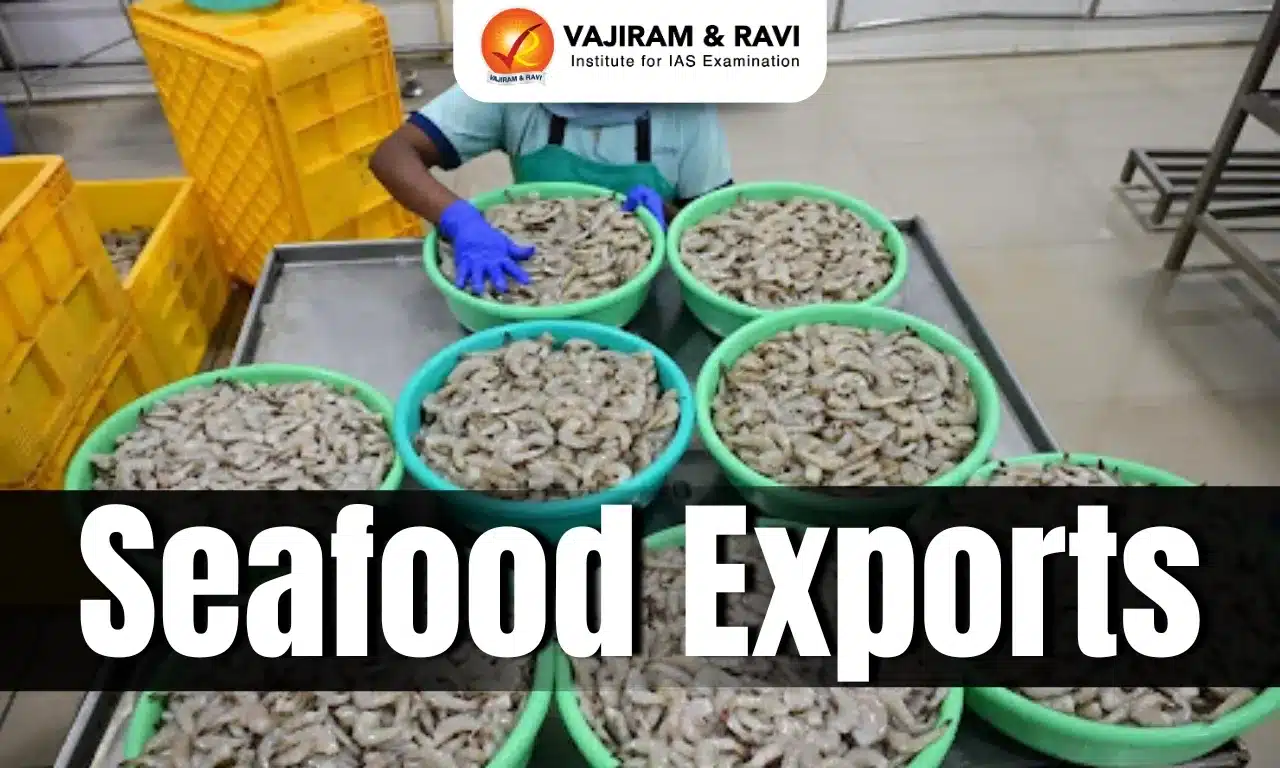
  • Shrimp accounts for the largest share of India’s seafood exports, especially frozen shrimp varieties such as Vannamei
  • Other exported products include frozen fish, cuttlefish, squid, crabs, and value-added marine products. 
  • Export orientation has increased steadily over the last decade, driven by improved cold-chain infrastructure and compliance with international food safety standards.

Major Export Markets

  • Traditionally, the United States has been India’s largest seafood export destination, followed by China, Japan, the European Union, and Southeast Asian countries. 
  • However, recent years have seen a strategic push towards market diversification to reduce over-dependence on a single region.

Institutional Support

  • The Marine Products Export Development Authority (MPEDA), under the Ministry of Commerce, plays a key role in export promotion, quality control, traceability, and market access. 
  • Government initiatives such as the Pradhan Mantri Matsya Sampada Yojana (PMMSY) have strengthened infrastructure, processing capacity, and sustainability in fisheries.

News Summary

  • Recent official data show that India’s marine product exports increased by 16% in value and 12% in volume during April-October of FY 2025-26 compared to the same period last year. 
  • Export earnings rose from $4.19 billion to $4.87 billion, while export volumes expanded from 9.62 lakh metric tonnes to 10.73 lakh metric tonnes.
  • This growth is notable because it occurred despite higher tariffs imposed by the United States, traditionally India’s largest seafood market. 
  • During the same period, exports to the U.S. declined marginally in both value and quantity, reflecting the impact of tariff-related trade barriers.
  • However, Indian exporters successfully compensated for this decline by expanding shipments to alternative markets. Countries such as China, Vietnam, Belgium, Malaysia, and Germany recorded sharp increases in imports of Indian seafood. 
  • Exports to China rose to $845.67 million, indicating China’s growing importance as a destination market.
  • Vietnam emerged as a standout market, registering over 100% growth in value and over 90% growth in volume, while Belgium also saw nearly 90% growth in imports. 
  • This eastward and European pivot reflects a deliberate diversification strategy adopted by exporters and policymakers.
  • Government departments, including the Fisheries and Commerce Ministries, have held regular consultations with exporters and MPEDA to identify new markets, resolve non-tariff barriers, and strengthen compliance with importing countries’ standards. 
  • Officials have described the sector’s performance as a sign of resilience, adaptability, and improved export competitiveness.
  • Despite the U.S. market contraction, it remains India’s single largest seafood destination, underlining the importance of balancing diversification with market retention. 
  • Overall, the data suggest that India’s seafood sector is increasingly less vulnerable to single-market shocks and better positioned to navigate global trade uncertainties.

Source: IE | FE

Seafood Exports FAQs

Q1: Which product dominates India’s seafood exports?

Ans: Shrimp, especially frozen Vannamei shrimp, forms the largest share of India’s seafood exports.

Q2: What was the growth rate of India’s seafood exports in FY 2025–26 (April–October)?

Ans: Exports grew by 16% in value and 12% in volume during this period.

Q3: Why did seafood exports to the U.S. decline recently?

Ans: Higher tariffs imposed by the U.S. reduced export value and volume.

Q4: Which countries saw the highest growth in Indian seafood imports?

Ans: Vietnam, Belgium, China, Malaysia, and Germany recorded significant increases.

Q5: Which agency promotes India’s marine product exports?

Ans: The Marine Products Export Development Authority (MPEDA) under the Ministry of Commerce.
US Intervention in Venezuela and the Monroe Doctrine

US Intervention in Venezuela

US Intervention in Venezuela Latest News

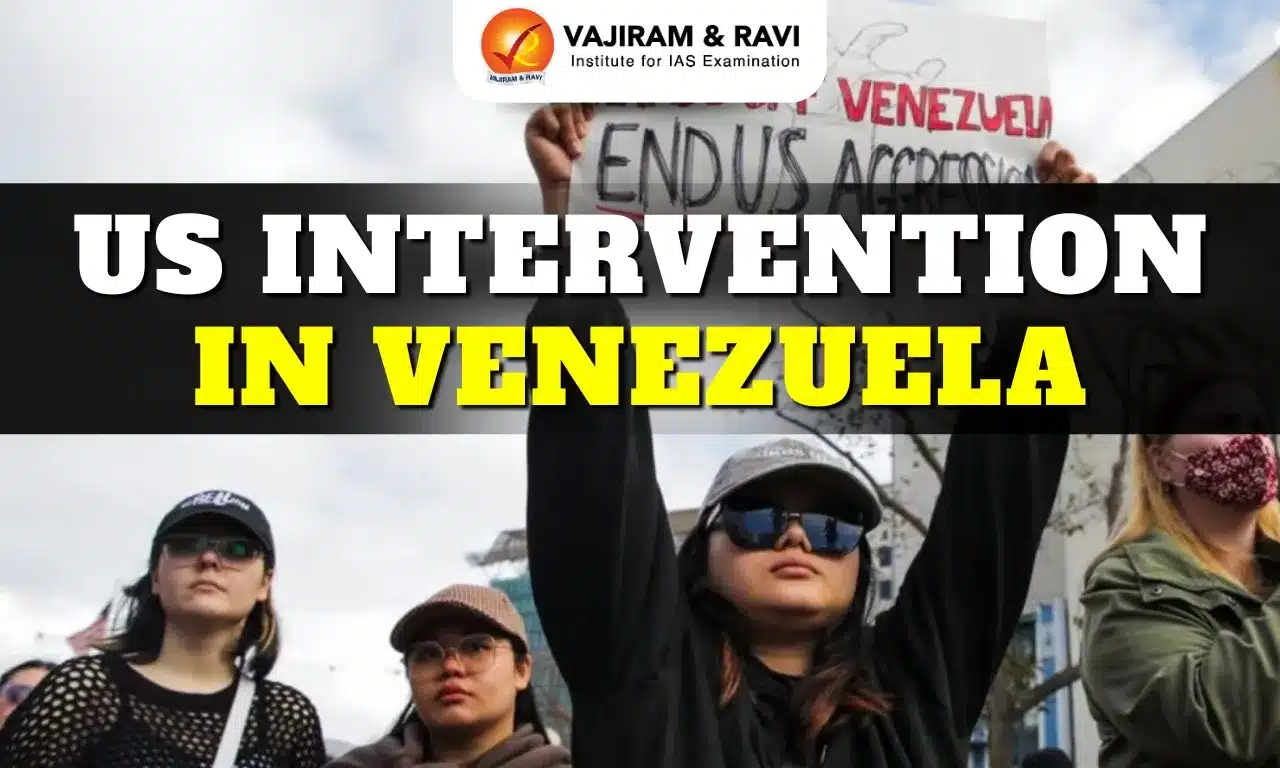
  • The capture of Venezuela’s President Nicolás Maduro by US forces on January 3 has reignited debate over a return of overt US interventionism, raising concerns about doctrine-driven military action and its global implications.
  • The episode recalls former US Secretary of State Colin Powell’s famous caution — “If you break it, you own it” — coined during the 2003 Iraq War. 
  • The audacious operation underscores the risks of ownership that follow forceful regime interventions.

Trump’s Policy U-Turn

  • US President Donald Trump, once a critic of the Iraq invasion and a self-proclaimed peacemaker upon taking office a year ago, has reversed course. 
  • He justified the operation as being in line with an over 200-year-old foreign policy agenda set under the Monroe Doctrine of 1823, which warned European powers not to interfere in the affairs of the Western Hemisphere.
  • Trump has reasserted this doctrine—recently rebranded by him—as a guiding principle, marking a sharp departure from decades of US administrations that kept it largely dormant. 
  • The shift was signalled in the new US security strategy released last month.

Pattern of Escalating Military Action

  • The Maduro operation fits a broader trend over the past year of expanded US military assertiveness:
    • Airstrikes ordered in Syria and Nigeria
    • Threats of intervention amid protests in Iran
    • Earlier 2025 actions targeting Iranian nuclear facilities, drug-trafficking boats in the Caribbean, Houthi forces in Yemen, militants in Somalia, and Islamic groups in Iraq
  • Together, these moves point to a worrying reassertion of unilateral military power, with Venezuela’s intervention serving as the clearest signal yet that US interventionism is back—this time with oil and hemispheric dominance at its core.

Why Venezuela: The Oil Factor

  • Venezuela holds the largest proven crude oil reserves in the world—over 300 billion barrels, roughly one-fifth of global reserves, according to the US Energy Information Administration (EIA). 
  • Despite this, Venezuela produces only ~1 million barrels per day, about 0.8% of global output, highlighting a stark gap between potential and realisation.
  • Chevron is the only foreign oil major with exposure to Venezuelan crude, positioning US interests uniquely within the country’s energy sector.

Trump’s Oil-Centric Agenda

  • US President Donald Trump has made oil central to his rationale.
  • He stated that the US would take control of Venezuela’s reserves and deploy American companies to invest “billions of dollars” to refurbish broken oil infrastructure and ramp up production.

Criticism and Allegations

  • Critics say the intervention is mainly about taking control of Venezuela’s oil resources.
  • They have described the move as “straight up theft,” arguing that ignoring Venezuela’s massive oil reserves hides the real reason behind the action.
  • Some analysts also believe the move may help shift attention away from domestic political problems in the US, while allowing Washington to assert control over a valuable energy asset.

The Monroe Doctrine: From Anti-Colonial Principle to Interventionist Tool

  • Named after former US President James Monroe, the Monroe Doctrine began as a symbolic 19th-century declaration opposing new or expanded European involvement in the Americas after colonial rule
  • Over time, the United States broadened its interpretation, treating Latin America as a strategic sphere of influence.
  • This shift turned the doctrine into a key justification for US political and military interventions across South and Central America for decades—often criticised by scholars as an alibi for meddling in the region’s internal affairs.
  • While recent US administrations had largely distanced themselves from this approach, President Donald Trump has revived and reinforced it, aligning with right-leaning governments such as Argentina’s and opposing left-wing leadership in countries like Brazil.
  • Historically, the doctrine’s legacy is stark: between 1898 and 1994, the US intervened to change governments in Latin America at least 41 times, ostensibly to protect American interests and counter communism.

MAGA Pushback: Disquiet Over Renewed US Interventionism

  • US President Donald Trump’s move against Venezuela has triggered unease within his Make America Great Again (MAGA) base, which supported him on the promise of ending “never-ending wars” and avoiding new overseas entanglements.
  • Trump’s assertion that a US team would work with Venezuelans to effectively “run the country” until a transition is achieved has raised fears of prolonged American involvement, contradicting core MAGA expectations.

Venezuela’s Uncertain Endgame

  • It remains unclear whether the US will occupy Venezuela or back a US-approved leadership in Caracas. 
  • While President Donald Trump hinted at cooperation from interim President Delcy Rodríguez, she quickly denounced the US action. 
  • The survival of the post-Maduro government, the absence of US troops on the ground, and deep political divisions complicate any transition—especially with oil at stake. 
  • The disputed 2024 election, claims of victory by Edmundo González, and the sidelining of María Corina Machado add to uncertainty. The coming weeks will be decisive.

Source: IE | TG

US Intervention in Venezuela FAQs

Q1: What does the current US Intervention in Venezuela represent?

Ans: This US Intervention in Venezuela marks a return to overt regime change. US Intervention in Venezuela utilizes the Monroe Doctrine. US Intervention in Venezuela reshapes regional foreign policy.

Q2: How is the Monroe Doctrine linked to US Intervention in Venezuela?

Ans: The doctrine justifies US Intervention in Venezuela against foreign influence. Through US Intervention in Venezuela, the US asserts regional control. US Intervention in Venezuela follows a historic 200-year-old pattern.

Q3: What is the MAGA stance on US Intervention in Venezuela?

Ans: Some MAGA supporters feel US Intervention in Venezuela contradicts anti-war promises. They worry US Intervention in Venezuela leads to entanglements. US Intervention in Venezuela tests core political ideologies.

Q4: What are the risks of US Intervention in Venezuela?

Ans: US Intervention in Venezuela risks long-term "ownership" of a broken state. Forceful US Intervention in Venezuela creates uncertainty. US Intervention in Venezuela might lead to prolonged military presence.

Q5: Who opposes the US Intervention in Venezuela internally?

Ans: Delcy Rodríguez denounced the US Intervention in Venezuela. Local leaders resist US Intervention in Venezuela. This US Intervention in Venezuela faces significant political and social pushback within the country.

Venezuela Oil Reserves: US Control and Global Markets

Venezuela Oil Reserves

Venezuela Oil Reserves Latest News

  • Oil has emerged as the central driver behind the US action against Nicolás Maduro. 
  • After Maduro’s capture recently, US President Donald Trump announced that Washington would take control of Venezuela’s oil sector, with American oil majors investing to revive the country’s dilapidated infrastructure.
  • However, experts caution that reviving Venezuela’s oil industry will take years, given prolonged damage from sanctions and economic collapse.
  • Despite holding the world’s largest proven oil reserves, Venezuela contributes less than 1% of global oil production. 
  • With global markets currently well supplied and demand subdued, analysts do not expect immediate price shocks. Past US actions, including tanker seizures, had little effect on global oil prices.
  • If the US eventually succeeds in restoring and controlling Venezuelan oil output, increased supply could exert downward pressure on prices, but only over the long term.

Venezuela’s Oil Wealth: Huge Reserves, Limited Output

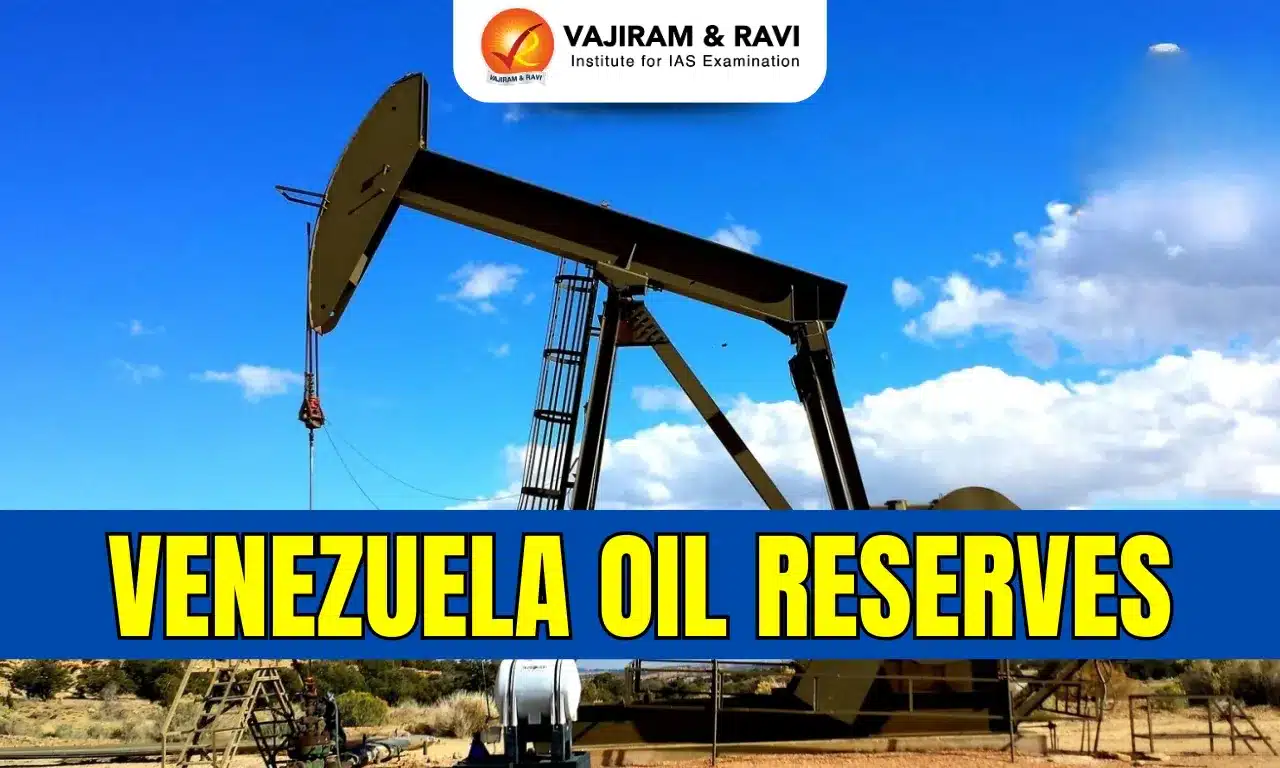
  • Venezuela holds the world’s largest proven oil reserves, estimated at over 300 billion barrels, roughly one-fifth of global reserves. 
    • Saudi Arabia, the world’s largest oil exporter, ranks second in reserves. 
  • Yet Venezuela produces only around 1 million barrels per day (bpd), compared to over 100 million bpd globally.
  • Venezuela is a member of Organization of the Petroleum Exporting Countries (OPEC) but currently contributes only about 3.5% of OPEC’s exports and around 1% of global oil supplies.

Why Production Lags Despite Massive Potential

  • Venezuela’s low output stems from:
    • US sanctions constraining oil and gas exports
    • A prolonged economic crisis
    • Severe underinvestment and deteriorated oil infrastructure
  • Together, these factors have sharply limited realisation of its resource potential.

US Intervention and Trump’s Plan

  • US President Donald Trump has said Washington aims to bring American oil majors into Venezuela to invest billions of dollars to repair broken infrastructure and ramp up production—benefiting both Venezuela and US companies, and supplying oil to global markets, including the US.
  • If implemented, the plan could:
    • Make Venezuela a significantly larger oil supplier
    • Reopen the sector to foreign investment beyond US firms
    • Add supply to global markets, creating downward pressure on oil prices over the long term
  • However, experts caution that tangible effects would take several years, given the scale of investment required to revive ageing infrastructure.

India Watches Venezuela Closely Amid Shifting US Policy

  • How US–Venezuela relations evolve in the coming months is critical for India. 
  • Any easing or suspension of US sanctions could allow Venezuelan oil to re-enter global markets—including India—and reopen stalled investment and dividend flows.

Potential Gains for India’s Oil Companies

  • A sanctions thaw could enable ONGC Videsh, the overseas arm of Oil and Natural Gas Corporation, to recover over $500 million in pending dividends from two Venezuelan projects:
    • San Cristobal (40% stake)
    • Carabobo 1 (11% stake)
  • ONGC Videsh has sought US approvals since 2024, but permissions are still pending.

India’s Crude Import History with Venezuela

  • An analysis of recent trade data indicates that the US attack on Venezuela is unlikely to directly affect India’s energy security. 
  • India imported $255.3 million worth of oil from Venezuela up to November 2025, accounting for just 0.3% of total oil imports in the current financial year.
  • Before US sanctions in 2019, Reliance Industries Ltd (RIL) was a regular buyer of Venezuelan crude.
    • 2019: Venezuela was India’s 5th-largest oil supplier, exporting ~16 million tonnes to Indian refiners.
    • Post-2019 sanctions: Imports stopped within months.
  • In October 2023, the US briefly eased sanctions, allowing exports for six months—prompting RIL and others to restart imports. 
  • These stopped again when the waiver lapsed amid disputes over Venezuela’s elections. 
  • RIL later resumed imports under a specific US waiver, but halted them again in summer 2025 after the Trump administration threatened higher tariffs on buyers of Venezuelan crude.

The ‘Chevron Model’ and US Licensing

  • ONGC Videsh aims to operate under the “Chevron model”, which allows sanctioned-country operations via specific US licenses.
  • Such licenses are issued by the Office of Foreign Assets Control under the US Department of the Treasury and typically:
    • Permit use of US banking channels and the US dollar;
    • Grant foreign companies significant control over finances, operations, production, and marketing, even when the host country’s NOC is the majority shareholder
  • In Venezuela’s case, that NOC is Petróleos de Venezuela, SA (PDVSA).

Source: IE | TH

Venezuela Oil Reserves FAQs

Q1: How large are the Venezuela Oil Reserves?

Ans: Venezuela Oil Reserves are the largest in the world. These Venezuela Oil Reserves exceed 300 billion barrels. Venezuela Oil Reserves represent one-fifth of the total global supply.

Q2: Why has production from Venezuela Oil Reserves been low?

Ans: Infrastructure decay harmed Venezuela Oil Reserves output. Sanctions limited the development of Venezuela Oil Reserves. Economic collapse stifled the potential of Venezuela Oil Reserves.

Q3: What is the plan for Venezuela Oil Reserves?

Ans: The US will use majors to revive Venezuela Oil Reserves. Profits from Venezuela Oil Reserves will recoup intervention costs. Venezuela Oil Reserves will eventually supply international markets.

Q4: How do Venezuela Oil Reserves affect India?

Ans: India has a limited current stake in Venezuela Oil Reserves. Past imports from Venezuela Oil Reserves were significant. Future access to Venezuela Oil Reserves depends on US licensing.

Q5: Will Venezuela Oil Reserves lower global prices?

Ans: Over time, Venezuela Oil Reserves could exert downward price pressure. However, reviving Venezuela Oil Reserves takes years. Venezuela Oil Reserves won't cause immediate global market shocks.

Enquire Now