

How the Supreme Court Broadened the Meaning of Terrorist Act Under UAPA

Meaning of Terrorist Act

Meaning of Terrorist Act Latest News

  • The Supreme Court of India granted bail to five of the seven accused in the 2020 Northeast Delhi riots case but denied relief to Umar Khalid and Sharjeel Imam. 
  • The Court held that the accused did not stand on equal footing, creating a hierarchy of culpability by distinguishing alleged principal planners from those with subsidiary or facilitative roles, even though all faced similar charges.
  • All accused are booked under the Unlawful Activities (Prevention) Act, along with the Arms Act and other penal provisions. 
  • Central to the ruling are two issues: what constitutes a “terrorist act” and who determines it, and whether prolonged pre-trial incarceration is justified under anti-terror law. 
  • Beyond immediate bail outcomes, the order endorses an expansive interpretation of “terrorist act”, with implications for future UAPA cases.

Hierarchy of Roles’ in the Alleged Conspiracy

  • The Supreme Court of India centred its bail decision on an individualised assessment of culpability, holding that the accused did not occupy the same position within the alleged conspiracy. 
  • The Court noted a clear hierarchy of roles, rather than treating all accused as equally culpable.

Principal Accused: Alleged Masterminds

  • For Umar Khalid and Sharjeel Imam, the Court found that prosecution material placed them at the level of conceptualisation, direction, orchestration, and mobilisation. 
  • They were described as “ideological drivers” and “masterminds”, allegedly responsible for strategising the transformation of protests against the Citizenship (Amendment) Act into disruptive chakka jams aimed at paralysing Delhi. 
  • The allegations suggested a central and directive role.

Co-Accused Granted Bail: Peripheral Roles

  • In contrast, the five accused granted bail were characterised as “local-level facilitators” or “site-level executors”. 
  • Their roles were termed derivative, indicating that they acted on instructions from higher levels of the alleged conspiracy rather than shaping it.
  • The Court held that continued incarceration of these minor participants would be disproportionate, especially since the investigation was complete and the trial had seen significant delays.

How the Law Defines a ‘Terrorist Act’

  • Section 15 of the Unlawful Activities (Prevention) Act (UAPA) defines a terrorist act as one carried out with intent to threaten India’s unity, integrity, security, economic security, or sovereignty, or to strike terror among people.
  • The provision lists methods such as bombs, explosives, firearms, or inflammable substances, and also adds a broader clause—“or any other means”.
  • The prosecution argued that an alleged “chakka jam” (road blockade) planned by the accused could fall under “any other means”, even if it did not involve conventional weapons, because of its intended impact and consequences.

Defence’s Stand: Protest Is Not Terror

  • Defence Counsel contended that road blockades are a legitimate democratic protest. 
  • Since Section 15 primarily refers to violent methods, he argued that “any other means” should be read narrowly to include only other violent means.

Supreme Court’s View

  • Rejecting the defence claim that the acts were mere political dissent, the Court accepted the prosecution’s view that sustained choking of arterial roads and systemic disruption of civic life can amount to calibrated acts threatening India’s unity and integrity. 
  • When such blockades are planned, synchronised, and timed with international events—such as the Donald Trump visit in 2020—they may prima facie fall within the definition of a terrorist act.
  • The Court emphasised that the focus is not just on the weapon used, but on the design, intent, and effect of the act.

Impact on Bail Under Section 43D(5)

  • Under Section 43D(5) of the UAPA, bail is barred if accusations appear prima facie true. 
  • Applying this, the Court found that witness statements, chats, and meeting records established a prima facie conspiracy against Khalid and Sharjeel Imam. 
  • As a result, the statutory bar on bail operated fully against them.

Prolonged Incarceration and the Bail Question

  • All appellants highlighted their long custody since 2020, with the trial still at the charge-framing stage. 
  • They relied on the Union of India v. K A Najeeb ruling, where the Supreme Court of India held that constitutional courts may grant bail under UAPA if there is no likelihood of a speedy trial, to protect Article 21 rights to life and liberty.

SC’s Clarification on K.A. Najeeb

  • The Court clarified that K.A. Najeeb is not a mechanical rule. 
  • Delay does not automatically override statutory bail bars; it acts as a trigger for heightened judicial scrutiny, not a “trump card.”
  • The Court noted the voluminous record—over 1,000 documents and 835 witnesses—and procedural objections by the defence, holding that the delay cannot be attributed solely to the prosecution.
  • The Court held that delay must be weighed against the gravity of the offence and the role of the accused. 
  • For alleged “masterminds” Umar Khalid and Sharjeel Imam, their conspiratorial centrality meant the statutory bar on bail prevailed despite delay.
  • For co-accused characterised as facilitators with limited logistical or local roles, continued custody was deemed punitive. 
    • As they lacked the autonomous capacity to affect the trial, the balance tilted in favour of liberty.

Source: IE | IE | LL

Meaning of Terrorist Act FAQs

Q1: How did the Supreme Court broaden the meaning of terrorist act?

Ans: The Supreme Court broadened the meaning of terrorist act by holding that non-violent acts like coordinated road blockades may qualify under UAPA based on intent and impact.

Q2: Why is the meaning of terrorist act important in bail decisions?

Ans: The meaning of terrorist act is crucial because under UAPA, bail is barred if accusations appear prima facie true, directly affecting liberty and prolonged incarceration.

Q3: How did the Court link protests to the meaning of terrorist act?

Ans: The Court ruled that protests causing sustained civic disruption, threatening economic security, can fall within the meaning of terrorist act if strategically planned.

Q4: What role did Section 15 play in expanding the meaning of terrorist act?

Ans: Section 15’s phrase “any other means” allowed the Court to expand the meaning of terrorist act beyond weapons to include coordinated non-violent actions.

Q5: How does this ruling affect future UAPA cases?

Ans: By widening the meaning of terrorist act, the ruling lowers the bail threshold under UAPA and strengthens prosecutorial discretion in protest-related cases.
Trump’s Arctic Ambition: Why the US Wants Greenland After Venezuela

Trump’s Arctic Ambition

Trump’s Arctic Ambition Latest News

  • Leaders of Denmark and Greenland have sharply rejected US President Donald Trump’s assertion that the United States needs Greenland “for defence”. 
  • The response comes amid a year-long US campaign signalling interest in taking control of Greenland. Trump has repeatedly floated the idea of “purchasing” the Arctic island, and has not ruled out the use of force, escalating tensions.
  • The crisis intensified after Trump doubled down on Greenland’s strategic necessity, while aides shared provocative maps showing the island draped in the US flag. 
  • Denmark has accused Washington of encouraging secessionist sentiments within Greenland, turning the issue into a major diplomatic flashpoint with implications for Arctic security, sovereignty, and international law.

Why the US Wants Greenland: Strategic and Resource Interests

  • US interest in Greenland is primarily driven by geostrategy. During the Cold War, Greenland served as a crucial forward base, a role that continues today. 
  • The US operates the Pituffik Space Base (formerly Thule Air Base), which enables early warning and missile defence, allowing monitoring of potential threats from Russia, China, and North Korea. 
  • Its location also offers strategic reach across Europe and Asia.

Arctic Power Competition

  • As Russia and China expand their Arctic military presence, Greenland’s importance has grown. 
  • Control or influence over the island strengthens US positioning in the emerging Arctic security theatre, where melting ice is opening new routes and strategic spaces.

Critical Minerals and Supply Chains

  • Greenland holds significant rare earth mineral reserves, vital for electronics, electric vehicles, and defence systems. 
  • With China dominating global supply, access to alternative sources is strategically attractive. 
  • However, Greenland passed a law banning uranium mining in 2021, complicating large-scale extraction plans.

A Longstanding US Interest in Greenland

  • The United States has expressed interest in Greenland for over a century. As early as 1867, the US State Department noted Greenland’s strategic location and natural resources, though no formal action followed.
  • During World War II, the US moved into Greenland after Nazi Germany occupied Denmark. In 1946, President Harry S Truman offered $100 million to Denmark to purchase Greenland, and even explored exchanging parts of Alaska for Greenlandic territory.
  • In 1951, the US and Denmark signed a defence agreement allowing the US to build and operate military bases in Greenland, cementing a long-term American military presence.
  • Interest resurfaced during Donald Trump’s first term (2017–21), when he publicly proposed buying Greenland as a “large real estate deal.” 
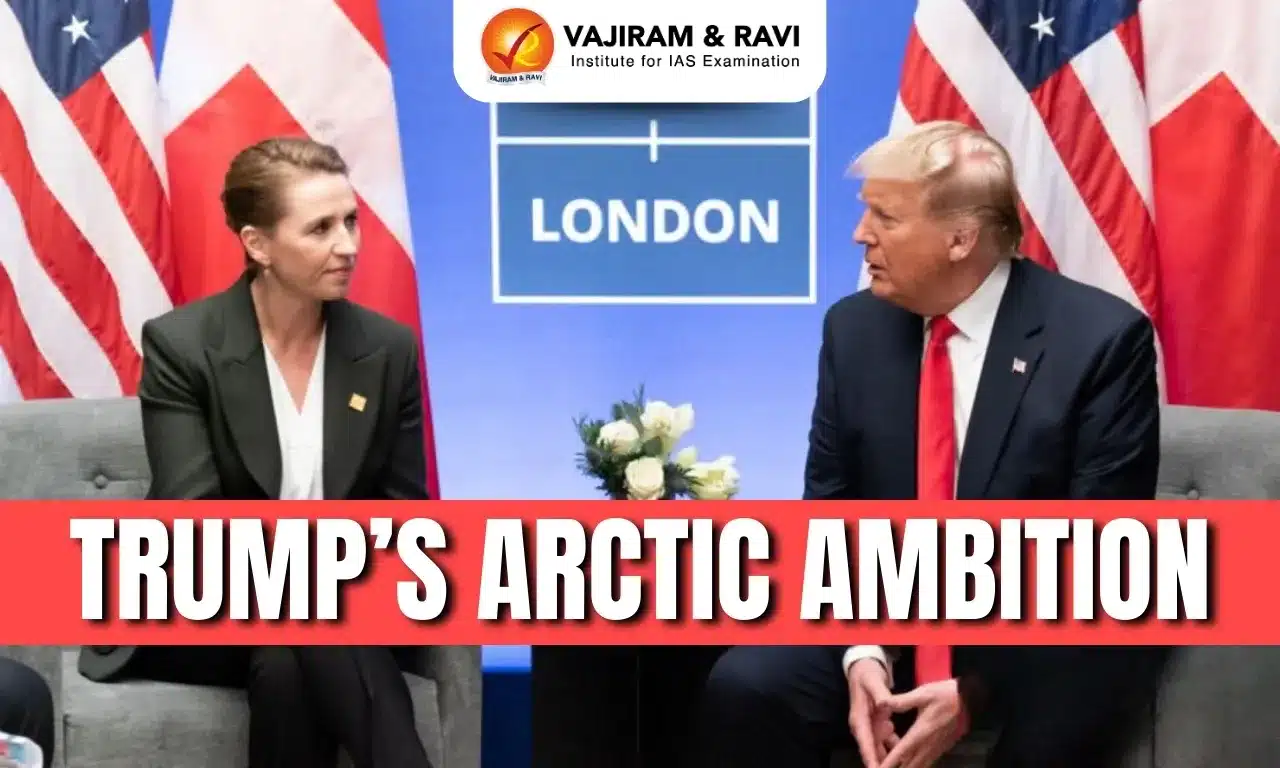
  • After Danish Prime Minister Mette Frederiksen dismissed the idea as absurd, Trump cancelled an official visit to Denmark, highlighting the diplomatic sensitivity around the issue.

Why Denmark and Greenland Are Wary of Trump

  • Concerns in Denmark and Greenland have intensified following US President Donald Trump’s actions in Venezuela, including the capture of President Nicolás Maduro. 
  • The episode heightened anxieties about sovereignty and intervention, making Trump’s remarks on Greenland more alarming.

Alleged ‘Three-Phase’ Strategy

  • A report by Danish Broadcasting Corporation (DR) claimed the Trump administration pursued a three-phase plan to take over Greenland:
    • Charm offensive—including outreach such as a visit by Donald Trump Jr
    • Direct pressure on Denmark—with JD Vance travelling to Greenland and publicly criticising Denmark
    • Influence operations—alleged efforts to identify and cultivate local supporters to fuel a secessionist movement

Has the US Bought Territories in the Past

  • Alaska Purchase (1867) - The United States purchased Alaska from Russia in 1867 for $7.2 million, adding about 1.5 million sq km to US territory. Alaska became a US state in 1959.
  • Louisiana Purchase (1803) - In 1803, under President Thomas Jefferson, the US bought over 2 million sq km of land from France for $15 million, dramatically expanding the nation westward.
  • Danish West Indies (1917) - In 1917, the US purchased the Danish West Indies from Denmark. The islands were renamed the US Virgin Islands, becoming a permanent US territory.

Source: IE | ToI

Trump’s Arctic Ambition FAQs

Q1: What is Trump’s Arctic ambition regarding Greenland?

Ans: Trump’s Arctic ambition refers to renewed US efforts to assert control or influence over Greenland due to its strategic location, military value, and critical mineral resources.

Q2: Why is Greenland important to Trump’s Arctic ambition?

Ans: Greenland’s position enables missile defence, Arctic dominance, and access to rare earth minerals, making it central to Trump’s Arctic ambition and US geostrategic planning.

Q3: How have Denmark and Greenland reacted to Trump’s Arctic ambition?

Ans: Denmark and Greenland have strongly rejected Trump’s Arctic ambition, calling it a violation of sovereignty and warning against interference and influence operations.

Q4: Has the US pursued Trump’s Arctic ambition before?

Ans: Trump’s Arctic ambition builds on long-standing US interest, including past purchase attempts, Cold War military presence, and defence agreements with Denmark.

Q5: What could Trump’s Arctic ambition mean for global geopolitics?

Ans: Trump’s Arctic ambition could heighten Arctic militarisation, strain NATO unity, challenge international law, and intensify US rivalry with China and Russia.

Police Social Media Monitoring in India – Explained

Social Media Monitoring

Social Media Monitoring Latest News

  • Indian States have significantly expanded dedicated police social media monitoring cells over the last five years to address emerging digital-era crime trends.

Background: Social Media and Policing in India

  • The rapid expansion of social media platforms such as Facebook, X (formerly Twitter), WhatsApp, Instagram and Snapchat has transformed the nature of crime, public mobilisation and information dissemination in India. 
  • While these platforms have strengthened democratic participation and communication, they have also become channels for cybercrime, misinformation, hate speech, radicalisation and coordination of unlawful activities.
  • In response, policing in India has increasingly incorporated digital surveillance and online intelligence gathering as part of internal security management. 
  • Social media monitoring has thus emerged as a critical component of modern policing, aimed at both crime prevention and public order maintenance.

Growth of Social Media Monitoring Cells

  • According to an analysis of police infrastructure data, the number of dedicated social media monitoring cells across States and Union Territories rose from 262 in January 2020 to 365 in January 2024
  • These cells are distinct units tasked with tracking online activity, unlike earlier arrangements where such functions were embedded within cybercrime police stations.
  • The expansion reflects an institutional recognition that digital platforms require specialised monitoring capabilities, trained personnel, and real-time response mechanisms.

State-wise Trends and Expansion

  • The growth of monitoring cells has been uneven across States, reflecting differences in population size, internal security challenges and digital penetration. 
  • States with the highest number of such cells include Bihar (52), Maharashtra (50), Punjab (48), West Bengal (38) and Assam (37).
  • Several States have witnessed rapid scaling up since 2021. 
  • For instance, Assam expanded from 1 cell in 2022 to 37 in 2024, while West Bengal increased from 2 to 38 cells in the same period. Punjab doubled its capacity between 2022 and 2024.
  • In Manipur, the number of monitoring cells rose from 3 in 2020 to 16 in 2024, despite prolonged internet shutdowns during ethnic violence in 2023. 
  • This highlights the perceived importance of digital monitoring even in disrupted connectivity environments.

Institutional Framework and Data Source

  • The data on social media monitoring cells is compiled under the Data on Police Organisations (DoPO) reports, prepared annually by the Bureau of Police Research and Development
  • These reports provide a comprehensive snapshot of police infrastructure, manpower, technology adoption and capacity gaps across India.
  • Significantly, social media monitoring cells began to be recorded as separate units only from 2021, indicating a formal administrative shift towards recognising digital surveillance as a standalone policing function.

Rationale Behind Increased Monitoring

  • Police officials cite evolving crime patterns as the primary reason for expanding monitoring infrastructure. Social media platforms are increasingly used for:
    • Coordinating organised crime and cyber fraud
    • Spreading misinformation and disinformation
    • Mobilising crowds during protests or riots
    • Radicalisation and extremist recruitment
    • Online harassment, stalking and financial scams
  • The objective of monitoring is largely preventive, enabling early identification of threats, tracking viral misinformation, and intervening before online activity translates into offline violence or crime.

Related Trends in Police Modernisation

  • The expansion of social media monitoring cells has coincided with broader trends in police modernisation. 
  • The number of cybercrime police stations increased from 376 in 2020 to 624 in 2024, reflecting the growing burden of digital crime.
  • Additionally, police forces across States and Union Territories collectively possess over 1,100 drones, used for surveillance, crowd monitoring and disaster response.
  • However, these technological advances coexist with structural challenges, including over 5.9 lakh vacancies in police forces nationwide, underscoring gaps in manpower even as technological capacity expands.

Governance and Civil Liberties Concerns

  • The rise of social media monitoring raises important constitutional and legal questions, particularly related to privacy, freedom of speech, and procedural safeguards. 
  • Following the Supreme Court’s recognition of the right to privacy as a fundamental right (Puttaswamy judgment), any form of surveillance must meet tests of legality, necessity and proportionality.

Source: TH

Social Media Monitoring FAQs

Q1: What are police social media monitoring cells?

Ans: They are dedicated police units that track online platforms to prevent and detect crime and public order threats.

Q2: How much have these monitoring cells increased in India?

Ans: Their number rose from 262 in 2020 to 365 in 2024.

Q3: Which States have the highest number of such cells?

Ans: Bihar, Maharashtra, Punjab, West Bengal and Assam.

Q4: Which agency compiles data on police monitoring infrastructure?

Ans: The Bureau of Police Research and Development through DoPO reports.

Q5: Why is social media monitoring important for policing today?

Ans: Because many crimes, misinformation campaigns and security threats now originate or spread through digital platforms.

Enquire Now

