
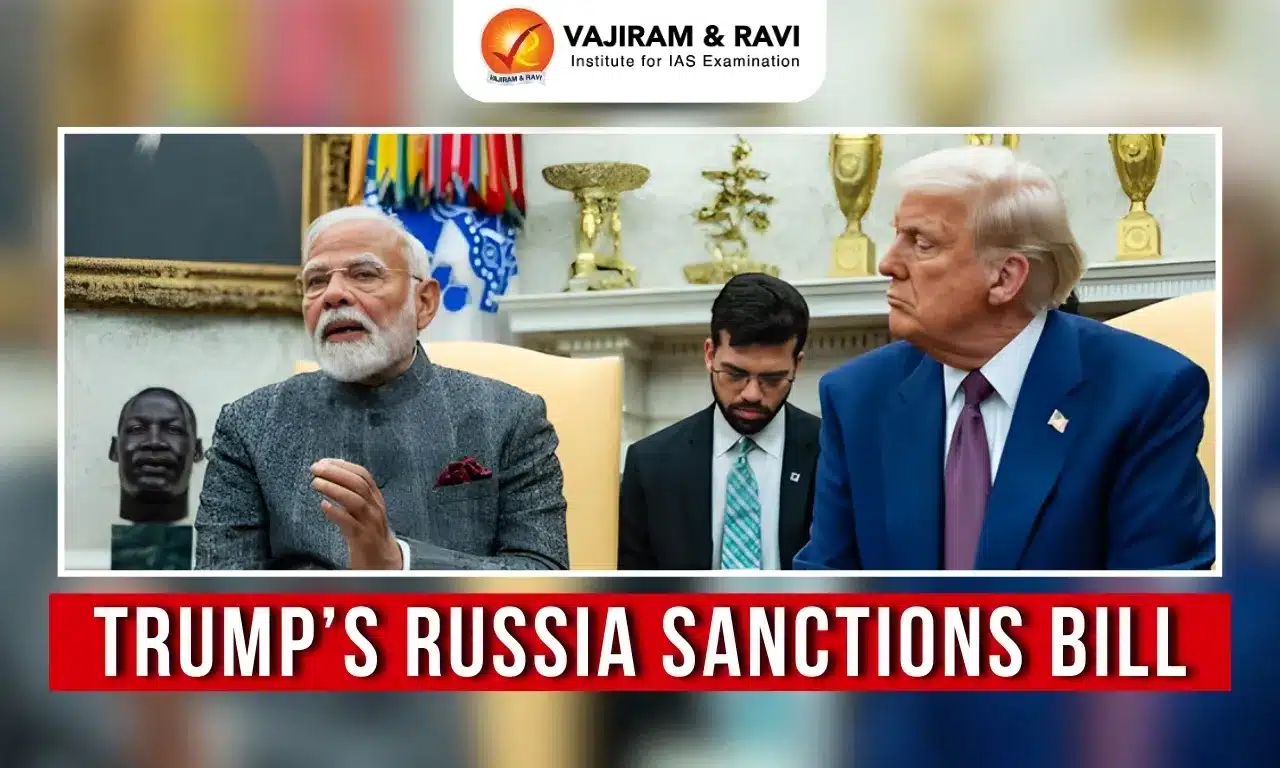
Trump’s Russia Sanctions Bill Could Cripple India–US Trade

Trump’s Russia Sanctions Bill

Trump’s Russia Sanctions Bill Latest News

  • President Donald Trump has approved a sweeping Russia sanctions Bill that proposes 500% tariffs on all goods and services imported from countries that knowingly trade in Russian-origin uranium and petroleum products. 
  • The Bill also includes fresh restrictions on Vladimir Putin and certain Russian military commanders, along with 500% tariffs on direct Russian imports into the US.
  • For India, the impact could be severe. New Delhi has not yet concluded a trade deal with the US, leaving it exposed to escalating tariff actions. 
  • India already faces steep duties that threaten exports from labour-intensive sectors such as textiles, footwear, and marine products. 
  • If the Russia sanctions Bill passes, India’s continued purchases of discounted Russian energy could trigger punitive tariffs that effectively choke Indian exports to the US, compounding existing trade disruptions.

Sanctions Bill Sidesteps Courts, Strengthens Trump’s Tariff Powers

  • This announcement comes as the Donald Trump administration faces legal setbacks over its use of the International Emergency Economic Powers Act (IEEPA). 
  • Three lower courts — the US District Court for the Northern District of Illinois, the US Court of International Trade, and the US Court of Appeals for the Federal Circuit — have ruled against the administration’s reliance on IEEPA for imposing tariffs.
  • The proposed Russia Sanctions Bill would bypass these legal vulnerabilities, giving Trump a firmer statutory basis to penalise trade linked to Russian oil and uranium, while sustaining tariff pressure as part of efforts to end the Russia–Ukraine war. 
  • In parallel, the US has already initiated multiple Section 232 of the Trade Expansion Act investigations, enabling the imposition of 50% tariffs on steel, aluminium, and copper, further strengthening the administration’s trade arsenal.

500% Tariff Threat Could Halt India–US Trade

  • A key provision of the Russia Sanctions Bill mandates that the US President raise duties to at least 500% on all goods and services imported from countries that knowingly trade in Russian-origin uranium and petroleum products. 
  • Trade experts warn that such a levy would effectively shut down India’s exports to the United States, currently valued at over $85 billion annually.
  • The bill’s scope remains unclear and potentially expansive, raising concerns that it could extend beyond existing reciprocal tariffs. 
  • Products so far excluded—such as electronics, pharmaceuticals, coffee, and tea—could also be covered. 
  • This is critical for India, which has continued exporting fast-growing items like mobile phones despite earlier tariff actions.

China’s Export Diversification Blunts Tariff Shock, India More Exposed

  • While proposed US tariffs on countries buying Russian oil could disrupt global trade, India is likely to be hit harder than China due to weaker export diversification. 
  • Despite US tariffs, China recorded a $1 trillion trade surplus in 2025, driven by dominance in sunrise sectors and control over critical minerals.
  • India, though pushing manufacturing reforms and investment, remains vulnerable as many exports are less technology-intensive, making them easier to replace. 
  • By contrast, China—the largest buyer of Russian oil—has multiple levers to counter tariff pressure, as it has done before.

Russia Sanctions Bill Could Undercut India’s Trade Bargaining Power

  • If passed, the Russia sanctions Bill would weaken India’s negotiating leverage by pushing New Delhi to diversify exports away from the United States under pressure. 
  • This comes as India is in active trade talks with the European Union, ASEAN, and partners including Chile, Peru, Australia, Bahrain, the Gulf Cooperation Council, Eurasian Economic Union, Canada, and the Southern African Customs Union.
  • A weaker bargaining position typically invites steeper demands from partners. 
  • India has consistently held firm red lines on agriculture and dairy, even when counterparts insist on access. 
  • Notably, Australia and New Zealand did not receive deep access in these sectors during negotiations—an approach that could become harder to sustain if external pressures intensify.

US Tariff Threat Deepens Investment Uncertainty for India

  • Beyond goods trade, escalating US tariff risks are hurting investment sentiment in India. 
  • Investors are holding back amid the unresolved United States–India trade rift, and a potential 500% tariff linked to Russian oil purchases could further deter capital inflows.
  • A 2025 note by Bank of America highlights stalled capital flows across FDI, FPI, and debt. 
  • The Reserve Bank of India has sold $65 billion in the spot market and holds a large $63.6 billion short forward position, reflecting pressure on the rupee.
  • The rupee has weakened nearly 7% over the past year, underperforming peers and leading to a real effective exchange rate depreciation of over 9%. 
  • Persisting uncertainty around the US–India trade deal could amplify macroeconomic risks if capital pressures continue.

Source: IE

Trump’s Russia Sanctions Bill FAQs

Q1: What is Trump’s Russia sanctions bill and why is it significant for India?

Ans: Trump’s Russia sanctions bill proposes 500% tariffs on countries trading Russian oil or uranium, which could effectively end India’s exports to the United States.

Q2: How would Trump’s Russia sanctions bill impact Indian exports to the US?

Ans: Trump’s Russia sanctions bill could impose 500% duties on Indian goods, making exports commercially unviable and threatening over $85 billion in annual India–US trade.

Q3: Why does Trump’s Russia sanctions bill bypass legal challenges in the US?

Ans: Trump’s Russia sanctions bill avoids reliance on IEEPA, giving the administration a stronger legal basis after US courts questioned emergency tariff powers.

Q4: Why is India more vulnerable to Trump’s Russia sanctions bill than China?

Ans: India’s exports are less diversified and less technology-intensive, while China’s diversified exports and control over critical minerals reduce its exposure to Trump’s Russia sanctions bill.

Q5: How does Trump’s Russia sanctions bill affect India’s investment climate?

Ans: Trump’s Russia sanctions bill raises trade uncertainty, weakens capital flows, pressures the rupee, and discourages foreign investors amid unresolved India–US trade tensions.
US Climate Body Exit Brings Mixed Relief and Risks for India

US Climate Body Exit

US Climate Body Exit Latest News

  • The United States has announced its withdrawal from the UN Framework Convention on Climate Change (UNFCCC) and over 60 international treaties and organisations it says no longer serve American interests. 
  • The exit includes key climate bodies such as the Intergovernmental Panel on Climate Change (IPCC), the International Solar Alliance (ISA), and the International Renewable Energy Agency (IRENA).
  • This follows the earlier decision by President Donald Trump to withdraw from the Paris Agreement, a move that will take effect on January 20 after the mandatory one-year notice period. 
  • Over the past year, the Trump administration has also cut funding and staffing for US climate research agencies.
  • Together, these steps mark a near-total US disengagement from the global climate governance system, casting serious doubt on the effectiveness and future of multilateral efforts to address climate change.

The United States’ Emissions Profile

  • The United States ranks among the top countries for annual and per-capita carbon emissions. 
  • Data from the Global Carbon Project show that US territorial CO₂ emissions in 2024 were about 4.9 billion tonnes, accounting for roughly 12.7% of global emissions.
  • In 2024, US per-capita CO₂ emissions stood at around 14.6 tonnes per person, far exceeding the global average, underlining the country’s carbon-intensive consumption patterns.
  • The US is also the largest cumulative emitter of CO₂ from fossil fuels and industry. Its share of historical global emissions is about 24%.
  • According to the US Environmental Protection Agency, total US greenhouse gas emissions were 6.3 billion metric tonnes of CO₂-equivalent in 2022. 
  • Land use and forests offset roughly 13% of these emissions as a net carbon sink.

US and Climate Action: A Longstanding Love–Hate Relationship

  • The United States played a key role in shaping the UN Framework Convention on Climate Change (UNFCCC), recognising climate change and setting global principles. 
  • However, it never joined the Kyoto Protocol, which imposed binding emission targets.

Architect of Paris, Weak on Delivery

  • The US actively pushed for an alternative to Kyoto, culminating in the Paris Agreement. 
  • Yet, its performance under Paris has been poor, with limited emissions cuts and inadequate delivery on finance and technology commitments.

Engagement Without Denial (Pre-Trump Era)

  • Despite shortcomings, the US did not deny climate change. 
  • It remained engaged in global climate talks, invested heavily in climate science and clean technologies, and promoted green investments domestically and internationally.

Trump Era: From Ambivalence to Undermining

  • Under President Donald Trump, the US shifted sharply. 
  • A declared climate sceptic, Trump openly mocked climate action, withdrew from agreements, and slashed funding for climate research—moves that risk long-term global setbacks given the US’s scientific leadership.

Fallout of the US Exit from Global Climate Institutions

  • The US withdrawal from the UN Framework Convention on Climate Change and related bodies was not entirely unexpected, given its earlier exit from the Paris Agreement and cuts to climate research funding. 
  • Since the world was already off track to meet 2030 targets—and the US itself was not contributing meaningfully—the short-term global impact may be marginal.
  • The deeper fallout will hinge on whether future administrations reverse course. A prolonged US absence could weaken multilateral climate cooperation and delay collective action over the long run.
  • By disengaging, the United States risks surrendering leadership to China, which is aggressively expanding renewable energy manufacturing, deployment, and supply chains.

Renewables’ Irreversible Momentum

  • Most countries are already committed to renewables for energy security and affordability. 
  • Solar and wind are now economically and strategically attractive, making a full reversal of the energy transition unlikely.
  • Efforts to boost fossil fuel output—such as expanding oil supply—may slow the transition but won’t stop it. 
  • By vacating the clean energy space, the US risks undermining its own long-term economic interests and geopolitical leverage.

Impact on India’s Climate and Energy Transition

  • The United States exit from global climate bodies may ease short-term pressure on India to decarbonise rapidly. 
  • However, it also introduces uncertainty for India’s plans to attract investments in clean technologies.

Setback to India–US Climate Cooperation

  • Before President Donald Trump’s second term, India and the US shared a strong strategic partnership on climate and clean energy, with US support across multiple energy sectors. 
  • This collaboration is now expected to stall, potentially forcing India to recalibrate its energy transition pathways.

International Solar Alliance and Funding Gaps

  • The US has withdrawn from the International Solar Alliance (ISA), which India co-founded with France on the sidelines of COP21 Paris. 
  • Although the US joined the ISA in 2021 as its 101st member, it provided no financial support. 
  • A 2025 decision to levy annual membership fees is yet to be implemented, leaving questions over future funding and momentum.

Source: IE | TH

US Climate Body Exit FAQs

Q1: What does the US climate body exit include?

Ans: The US climate body exit covers withdrawal from UNFCCC, IPCC, ISA, IRENA, and the Paris Agreement, marking near-total disengagement from global climate governance.

Q2: Why has the US climate body exit raised global concern?

Ans: The US climate body exit weakens multilateral climate action, reduces funding, and undermines collective efforts to meet global emission reduction targets.

Q3: How does the US climate body exit affect India’s climate strategy?

Ans: The US climate body exit lowers pressure on India to decarbonise rapidly but creates uncertainty for clean energy investments and technology partnerships.

Q4: What is the impact of the US climate body exit on the International Solar Alliance?

Ans: The US climate body exit removes a major member from the ISA, though the US never provided funding, raising concerns about momentum and leadership.

Q5: Why could the US climate body exit benefit China strategically?

Ans: The US climate body exit cedes leadership in renewables to China, which dominates clean energy manufacturing and supply chains critical for global energy transition.

Samagra Shiksha 3.0 – Reimagining School Education Framework

Samagra Shiksha

Samagra Shiksha Latest News

  • The Union government has initiated nationwide consultations with States and stakeholders to chart a roadmap for Samagra Shiksha 3.0 for the 2026-27 academic cycle.

Samagra Shiksha 3.0

  • Background and Evolution
    • Samagra Shiksha is an integrated, centrally sponsored scheme for school education covering the entire continuum from pre-primary to senior secondary level. 
    • Launched in 2018 by subsuming Sarva Shiksha Abhiyan, Rashtriya Madhyamik Shiksha Abhiyan, and Teacher Education schemes, it marked a shift toward a holistic and unified approach to school education.
    • Samagra Shiksha 3.0 represents the next phase of this reform journey, aligned with five years of National Education Policy (NEP) 2020 implementation and India’s long-term vision of Viksit Bharat by 2047.
  • Core Objectives
    • Universal enrolment up to Class XII
    • Reduction in dropout rates
    • Improvement in foundational and grade-level learning outcomes
    • Strengthening teacher capacity and school leadership
    • Ensuring equity for socio-economically disadvantaged groups
  • Key Focus Areas
    • Access and Infrastructure: Bridging regional and social gaps in schooling facilities
    • Quality of Learning: Age-appropriate learning benchmarks, curriculum equivalence across boards, and competency-based assessments
    • Teacher Capacity Building: Continuous professional development, pedagogical reforms, and leadership training
    • Digital Education: Integration of technology, digital platforms, and Artificial Intelligence in classrooms
    • Equity and Inclusion: Support for girls, children with disabilities, SC/ST students, and aspirational districts
  • Governance and Planning Approach
    • A major shift under Samagra Shiksha 3.0 is the emphasis on consultative, bottom-up planning. 
    • States and Union Territories are encouraged to prepare robust annual plans grounded in local school realities while aligning with national priorities. 
    • The scheme promotes convergence among Ministries, States, and civil society to improve implementation efficiency.

News Summary

  • A high-level consultation was held in New Delhi to deliberate on the future direction of Samagra Shiksha 3.0, bringing together State Education Secretaries, State Project Directors, central ministries, and education experts. 
  • The meeting aimed to develop a clear, implementable national roadmap for the next phase of school education reforms.
  • Key Themes of Deliberation
    • Bridging learning gaps exacerbated by pandemic disruptions
    • Improving nutrition and learning outcomes simultaneously
    • Integrating vocational education and skilling pathways within schools
    • Leveraging digital tools and Artificial Intelligence for personalised learning
    • Making schools active agents of social and economic transformation
  • Alignment with National Development Goals
    • The consultations highlighted that human capital development is central to achieving India’s long-term growth ambitions. 
    • Strengthening school education was identified as the foundation for a skilled workforce, social mobility, and inclusive development.
  • Outcome-Oriented Vision
    • Globally competitive, while remaining rooted in Indian values
    • Responsive to diverse student needs across regions
    • Outcome-driven, with measurable improvements in learning indicators
    • Society-centric, encouraging community participation in school governance

Road Ahead

  • States have been urged to treat the 2026-27 planning cycle as a national movement rather than a routine administrative exercise. 
  • The convergence of best practices, technological innovation, and cooperative federalism is expected to strengthen India’s school education ecosystem in the coming decade.

Source: TH | PIB

Samagra Shiksha FAQs

Q1: What is Samagra Shiksha 3.0?

Ans: It is the next phase of India’s integrated school education scheme focused on outcome-based reforms aligned with NEP 2020.

Q2: Which levels of education does Samagra Shiksha cover?

Ans: It covers the entire continuum from pre-primary to senior secondary education.

Q3: What is the key shift under Samagra Shiksha 3.0?

Ans: The focus has shifted from infrastructure expansion to improving learning outcomes and governance quality.

Q4: How does Samagra Shiksha 3.0 support equity?

Ans: It provides targeted interventions for disadvantaged groups, including girls, SC/ST students, and children with disabilities.

Q5: Why is Samagra Shiksha 3.0 significant for India’s future?

Ans: It strengthens human capital development, which is essential for achieving the vision of Viksit Bharat by 2047.

Enquire Now

